
石油

Search documents
哥伦比亚政府再次下调石油价格
Shang Wu Bu Wang Zhan· 2026-02-28 02:34
Group 1 - The Colombian government announced a reduction in gasoline prices by approximately 500 pesos (about $0.13) effective March 1 [1] - The average price in 13 major cities is expected to decrease to 15,057 pesos (approximately $3.99) per gallon [1] - This price cut follows a similar reduction implemented earlier in the month, indicating a trend of price adjustments [1] Group 2 - The government's decision is related to addressing the price gap formed by the fuel price stabilization fund [1]
国际油价2月27日上涨
Xin Hua Wang· 2026-02-28 02:14
Core Viewpoint - International oil prices increased on the 27th, with significant gains in both light crude and Brent crude futures [1] Group 1: Price Movements - As of the close on the 27th, light crude oil futures for April delivery rose by $1.81, settling at $67.02 per barrel, representing a 2.78% increase [1] - April delivery Brent crude oil futures increased by $1.73, closing at $72.48 per barrel, which is a 2.45% rise [1]
初步核算,全年能源消费总量61.7亿吨标准煤
Guo Jia Tong Ji Ju· 2026-02-28 02:02
Group 1 - The total supply of state-owned construction land in 2025 is projected to be 471,000 hectares, a decrease of 22.2% compared to the previous year [1] - Among the land supply, industrial and storage land is 138,000 hectares, down 10.8%; real estate land is 62,000 hectares, down 14.4%; and infrastructure land is 272,000 hectares, down 28.4% [1] - The area completed for afforestation in the year is 3.56 million hectares, with artificial afforestation accounting for 830,000 hectares, or 23.2% of the total afforestation area [1] Group 2 - The total energy consumption for the year is 6.17 billion tons of standard coal, an increase of 3.5% from the previous year [1] - Coal consumption increased by 0.1%, oil consumption increased by 3.6%, natural gas consumption increased by 2.0%, and electricity consumption increased by 5.0% [1] - The proportion of coal consumption in total energy consumption is 51.4%, a decrease of 1.8 percentage points from the previous year; the share of clean energy consumption is 30.4%, an increase of 1.8 percentage points [1] Group 3 - The energy consumption per unit of GDP, excluding raw material energy and non-fossil energy consumption, decreased by 5.1% compared to the previous year [2] - The carbon emissions trading market saw a transaction volume of 235 million tons of carbon emission allowances, with a transaction value of 14.63 billion yuan [2]
专家:中东地缘政治风险上升推动油价走高
Sou Hu Cai Jing· 2026-02-28 01:59
Group 1 - The core viewpoint of the articles highlights the rising geopolitical risks in the Middle East, particularly due to the U.S. military presence and threats against Iran, which are driving oil prices higher [1][2][6] - The deployment of two U.S. aircraft carriers in the region has heightened market concerns about potential military conflict, leading to increased risk premiums in oil pricing [1][2] - The Brent crude oil price has been rising rapidly since mid-February, primarily driven by expectations of geopolitical conflict, with the market pricing in a high risk premium despite a fundamentally oversupplied global oil market [2][6] Group 2 - The relationship between oil prices and geopolitical conflicts is deeply intertwined, with wars impacting global supply balance and causing price spikes due to disruptions in key regions like the Middle East [5][6] - The financial attributes of oil, including heightened risk aversion and speculative pricing, contribute to a feedback loop that drives prices up even without actual conflict [5][6] - Historical patterns indicate that oil price increases are often a reflection of conflict expectations rather than precursors to war, with current price movements being a preemptive response to potential supply disruptions [8]


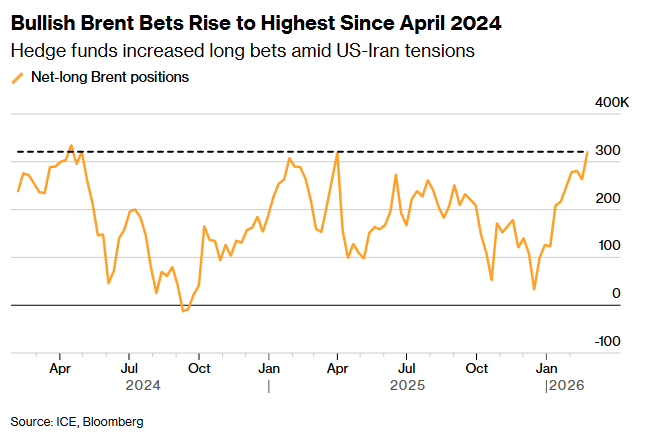
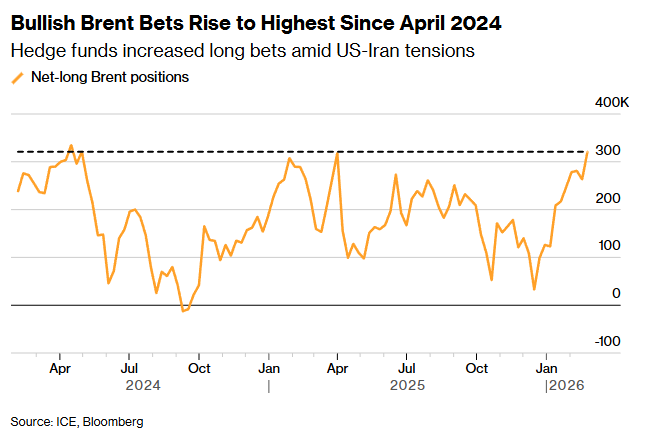
中东地缘局势趋紧推动风险溢价回归,对冲基金原油看涨押注升至22个月高点
Zhi Tong Cai Jing· 2026-02-28 01:01
Group 1 - The core viewpoint of the articles indicates that investor sentiment towards oil, particularly Brent crude, has shifted to a bullish stance due to rising concerns over potential U.S. military actions in the Middle East, which could disrupt oil supplies [1][4] - Hedge funds have increased their net long positions in Brent crude oil to 320,952 contracts, marking the highest level since April 2024, with a notable increase of 57,766 contracts in the week ending February 24 [1][4] - The WTI crude oil futures for April closed at $67.02 per barrel, up 2.78%, while Brent crude futures for April closed at $72.48 per barrel, up 2.45%, reflecting a cumulative increase of 3.52% and 5.64% respectively for February [4] Group 2 - The U.S. military has significantly increased its presence in the Middle East, with the deployment of two aircraft carriers, the USS Ford and USS Lincoln, marking the largest military buildup in the region since the 2003 invasion of Iraq [4] - There are rising tensions as Iran has threatened a "devastating" response to any U.S. aggression, indicating a potential escalation in conflict [4] - Analysts warn that if negotiations between the U.S. and Iran fail and Iran were to cut off the Strait of Hormuz, the oil supply in the Middle East could face severe disruptions, potentially driving oil prices above $100 per barrel [5]
一触即发!双航母就位,美国呼吁所有在伊公民立即离境,特朗普:有时候不得不打!
Xin Lang Cai Jing· 2026-02-28 00:34
Group 1 - The core message indicates that President Trump is seeking an agreement with Iran while also emphasizing the potential for military action if necessary [1][3][15] - The U.S. military has deployed two aircraft carriers, the USS Ford and USS Lincoln, in the Middle East, signaling increased military pressure on Iran [3][16][18] - The U.S. State Department has called for all American citizens in Iran to leave immediately, citing safety concerns [18][20][22] Group 2 - The third round of indirect negotiations between the U.S. and Iran took place recently, with a new round of technical discussions scheduled for March 2 [9][23] - Despite some optimism from the negotiations, significant differences remain, particularly regarding Iran's nuclear facilities and uranium enrichment [9][25] - The international community, including multiple countries, has issued travel warnings and advisories due to the escalating tensions in the region [20][22] Group 3 - Gold and oil prices have surged, with gold rising by 1.85% to $5,279.95 per ounce and oil prices increasing by over 3% [12][26] - U.S. stock markets experienced volatility, with all three major indices declining and nearly 3,800 stocks falling [12][26]

中东地缘局势趋紧推动风险溢价回归 对冲基金原油看涨押注升至22个月高点
智通财经网· 2026-02-28 00:25
Group 1 - Investor sentiment towards Brent crude oil has reached its highest level since April 2024, driven by concerns over potential U.S. military actions in the Middle East disrupting oil supplies [1] - Hedge funds increased their net long positions in Brent crude oil by 57,766 contracts to 320,952 contracts, marking the highest level in nearly two years [1] - Bullish bets on U.S. WTI crude oil have also risen to a seven-month high, indicating a broader market shift towards optimism regarding oil prices [1] Group 2 - Following a decline in optimism regarding U.S.-Iran negotiations, investors have shifted back to a bullish stance on oil, leading to a risk premium being reintroduced to benchmark futures prices [2] - WTI April crude futures rose by 2.78% to $67.02 per barrel, with a cumulative increase of 3.52% in February; Brent April crude futures increased by 2.45% to $72.48 per barrel, with a cumulative rise of 5.64% in February [2] - The U.S. military has significantly increased its presence in the Middle East, marking the largest deployment since the 2003 invasion of Iraq, which raises the risk of conflict in the region [2] Group 3 - U.S. President Trump expressed dissatisfaction with the current state of Iran nuclear negotiations but has not made a final decision on military action against Iran [3] - Analysts suggest that if U.S.-Iran negotiations fail and Iran cuts off the Strait of Hormuz, there could be a substantial impact on oil supply, potentially driving prices above $100 per barrel [3]
道指深夜跳水超500点,美股半导体下挫,英伟达跌超4%,国际油价飙升3%,特朗普不满意伊核谈判进展
2 1 Shi Ji Jing Ji Bao Dao· 2026-02-27 23:19
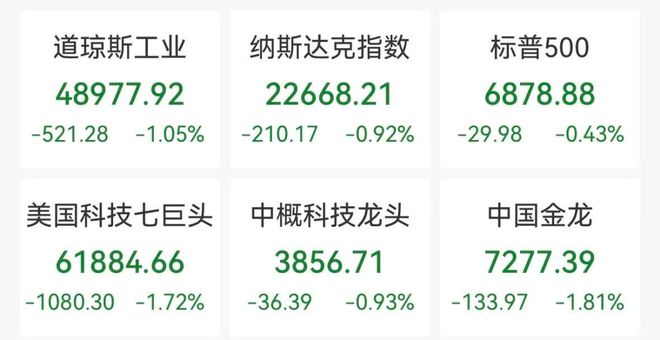
Market Overview - The three major U.S. stock indices closed lower on February 27, with the Dow Jones down 1.05%, the S&P 500 down 0.43%, and the Nasdaq down 0.92% [1] - The Dow Jones Industrial Average closed at 48,977.92, down 521.28 points [2] Technology Sector - Major technology stocks mostly declined, with Nvidia falling over 4% after a previous drop of 5%, raising concerns about its reliance on a few large cloud service providers and AI startups [2] - Other notable declines included Apple down over 3%, Microsoft down over 2%, and Tesla and Facebook down over 1% [2] Semiconductor Sector - The Philadelphia Semiconductor Index fell by 1.21%, with significant drops in stocks such as NXP Semiconductors down over 2%, Qualcomm down over 2%, and AMD down over 1% [3] Banking Sector - Bank stocks showed weak performance, with JPMorgan down over 2%, Goldman Sachs down over 7%, Citigroup down over 5%, Morgan Stanley down over 6%, Bank of America down over 4%, and Wells Fargo down over 5% [3] Energy Sector - Energy stocks mostly rose, with ExxonMobil up over 2%, Chevron up over 1%, ConocoPhillips up over 2%, and Occidental Petroleum up over 3% [4] - Oil prices increased by over 3% due to escalating geopolitical tensions between the U.S. and Iran, alongside OPEC+'s decision to maintain production levels [4] Commodity Market - Precious metals saw gains, with spot gold rising nearly 2% to $5,278.3 per ounce and spot silver up over 6% to $93.7 per ounce [4] - February saw spot gold accumulate a rise of 7.84%, while COMEX gold futures rose by 11.27% [4] Cryptocurrency Market - Major cryptocurrencies experienced declines, with Bitcoin dropping to $65,554.7, a decrease of 2.82% [6]

美国掌握委内瑞拉,万亿桶油田轻松获取!2月23日上午,加拉加斯传来新动态
Sou Hu Cai Jing· 2026-02-27 23:00
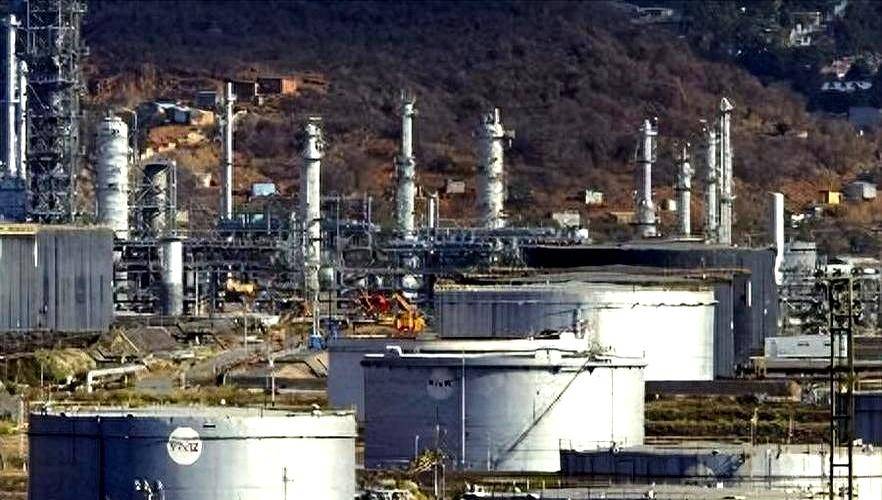
Core Viewpoint - The article discusses the geopolitical implications of the recent political changes in Venezuela, particularly focusing on the U.S. actions and their impact on oil resources, while highlighting China's strategic position in the region. Group 1: U.S. Actions and Intentions - The U.S. has taken aggressive actions against Venezuela, including the arrest of Maduro and his wife, under the guise of anti-drug efforts, which the article suggests is a cover for resource acquisition [1][3] - U.S. oil companies, such as Chevron, are eager to exploit Venezuela's oil resources, viewing the situation as an opportunity for profit following the easing of sanctions [3] - The article criticizes the U.S. approach as one of "strong-arm tactics," disregarding international law in favor of resource control [1][3] Group 2: Venezuela's Oil Industry Challenges - Venezuela's oil production has drastically declined from 3 million barrels per day to 500,000 barrels due to years of U.S. sanctions, leading to severe economic instability [3] - The article emphasizes that reviving Venezuela's oil industry will require more than just U.S. investment; it needs comprehensive cooperation and expertise, which may not be readily available from American companies alone [4][3] Group 3: China's Role and Strategy - China has invested significantly in Venezuela, with hundreds of billions in loans and long-term oil contracts, positioning itself as a key player in the region [8][6] - The article argues that China will not be sidelined by U.S. actions and can adapt its strategy to maintain its interests, including renegotiating contracts and exploring new investment opportunities [8][6] - China's approach is characterized by a focus on long-term cooperation and mutual benefit, contrasting with the U.S. strategy of immediate resource extraction [8][10] Group 4: Broader Implications for the Energy Market - The political turmoil in Venezuela is likely to affect global oil prices, with potential increases in costs for consumers due to rising inflation linked to oil price fluctuations [12][10] - The article notes that China's ability to negotiate and collaborate in the energy sector positions it favorably compared to the U.S., which is seen as more aggressive and unilateral [12][10] - The strategic importance of Venezuela's oil reserves, estimated at over 300 billion barrels, underscores the competitive dynamics between the U.S. and China in the region [10][12]
据美国能源信息署(EIA),12月美国石油产量下滑至大约1370万桶/日,创半年最低
Mei Ri Jing Ji Xin Wen· 2026-02-27 22:34
每经AI快讯,2月28日,据美国能源信息署(EIA),12月美国石油产量下滑至大约1370万桶/日,创半年 最低。 ...