原油风险溢价

Search documents
金信期货日刊-20260401
Jin Xin Qi Huo· 2026-04-01 01:35
1. Report Industry Investment Rating - No relevant content provided 2. Core Viewpoints of the Report - After the Iran - US conflict, crude oil prices are likely to fall. Geopolitical conflicts mainly cause short - term emotional premiums on oil prices, and the risk premium usually fades within a few weeks to 2 - 3 months. If the current conflict subsides quickly, Brent crude oil is likely to fall from the current high to the range of $62 - 73 per barrel [3][4]. - When crude oil prices fall, the crude oil chemical sector and futures will show a downward trend, with structural differentiation. Direct oil - chemical varieties will decline in sync with crude oil, while coal - chemical/light - hydrocarbon route varieties have stronger resistance to decline, and downstream processing links will see improved profitability [5][6]. - For stock index futures, it is expected that there will be further adjustments in the early trading session tomorrow, and it is recommended to adopt a strategy of shorting at high and buying at low for the time being. Gold is expected to continue with a slightly bullish and volatile trend. Iron ore is in a high - level wide - range oscillation, and the right - side signal is yet to come. Glass should be treated as wide - range oscillation before the upper pressure is broken. Methanol is in a high - level oscillation. Pulp futures are in an interval oscillation [7][11][12][16][18][20]. 3. Summary According to the Catalog I. After the Iran - US conflict, crude oil prices are likely to fall - Geopolitical conflicts on oil prices are mostly short - term emotional premiums rather than long - term trends. After most Middle - East geopolitical events, the crude oil risk premium will quickly be reversed within a few weeks to 2 - 3 months and return to the pricing based on supply - demand fundamentals [4]. - If the current conflict subsides quickly and the Strait of Hormuz resumes navigation, Brent crude oil is likely to fall from the current high to the range of $62 - 73 per barrel, and the geopolitical premium will fade. Only when there is a substantial long - term blockade or continuous interruption of supply in core oil - producing areas can oil prices remain high for a long time, but the probability of this scenario is currently low [4]. II. The trends of the crude oil chemical sector and futures when crude oil prices fall - The crude oil chemical futures as a whole will follow the decline of crude oil but show structural differentiation. Direct oil - chemical varieties such as naphtha cracking, pure benzene, ethylene glycol, PTA, PP/PE will see weakened cost support and their prices will fall in sync with crude oil. The larger the previous increase, the more obvious the decline [5]. - Coal - chemical/light - hydrocarbon route varieties such as coal - based olefins and methanol have relatively independent costs, stronger resistance to decline, and a smaller decline compared with pure oil - chemical varieties. Downstream processing links such as plastic and rubber products will see relieved cost pressure, improved marginal profitability, and smoother price transmission [6]. III. Key influencing factors and rhythm - The speed of premium fading: The faster the conflict subsides, the steeper the decline of crude oil and chemical futures, and the main decline is usually completed within 1 - 4 weeks [6]. - Inventory and positions: The concentrated closing of previous profit - taking positions will amplify short - term fluctuations, and the market will gradually return to the supply - demand logic after the decline [6]. - Macroeconomics and supply - demand: If the global crude oil inventory rises, OPEC+ increases production, or strategic reserves are released, it will accelerate the decline of oil prices. If the demand side remains stable, the decline will be more moderate [6]. Technical Analysis - Stock index futures: It is expected that there will be further adjustments in the early trading session tomorrow, and it is recommended to adopt a strategy of shorting at high and buying at low for the time being. The Shanghai Composite Index is still within the 15 - minute oscillation range [7][8]. - Gold: Gold has stabilized in the daily - level oscillation. After a higher opening, it showed an oscillating trend throughout the day. It should be treated with a slightly bullish and volatile mindset in the future [11]. - Iron ore: Australia and Brazil's shipments maintain a normal rhythm. In the medium - to - long - term, it is in the period of mine production capacity release, and the expectation of loose supply still exists. The resumption of production of steel mills after the festival may have a certain driving effect, but the start of terminal demand still takes time. Attention should be paid to the influence of policy and sentiment. Technically, it is in a high - level wide - range oscillation, and the right - side signal is yet to come [12][13]. - Glass: The daily melting volume has declined slightly, and the inventory has been slightly reduced. Attention should be paid to the resumption progress of deep - processing enterprises after the festival. In the short term, it is more affected by the overall sentiment of commodities. Technically, it should be treated as wide - range oscillation before the upper pressure is broken [16][17]. - Methanol: Iran is China's largest source of methanol imports, accounting for over 70%. The obstruction of shipping in the Strait of Hormuz and the expected maintenance of Iranian facilities have led to a sharp increase in the expectation of import supply contraction, which is the core driver of this round of price increase. However, if the price remains high for a long time, terminal demand will be suppressed, forming a negative feedback. It should be treated as high - level oscillation [18]. - Pulp: The trading sentiment in the spot market is average. Domestic pulp enterprises' production is within the normal range, and the pulp output will not change much. The inventory in domestic ports has started to accumulate, and the pressure remains. The previously shut - down facilities of downstream paper mills are gradually resuming production, and the overall pulp consumption continues to rise. The futures market has shown an interval oscillation recently [20].
金信期货日刊-20260331
Jin Xin Qi Huo· 2026-03-31 01:19
Report Summary 1. Report Industry Investment Rating No relevant information provided. 2. Core Viewpoints - After the Iran - US conflict ends, crude oil prices are likely to fall. Geopolitical conflicts mainly cause short - term emotional premiums on oil prices, and after most Middle - East geopolitical events, the risk premium of crude oil will be quickly reversed within weeks to 2 - 3 months, returning to fundamental supply - demand pricing [3][4]. - If the current conflict subsides quickly and the Strait of Hormuz resumes navigation, Brent crude oil is likely to fall from the current high to the range of $62 - 73 per barrel [4]. - Only when there is a substantial long - term blockade or continuous interruption of supply in core oil - producing areas can oil prices remain high for a long time, but the probability of this scenario is currently low [4]. 3. Summary by Directory I. Impact of the End of the Iran - US Conflict on Crude Oil Prices - Geopolitical conflicts mainly bring short - term emotional premiums to oil prices, not long - term trends. After most Middle - East geopolitical events, the risk premium of crude oil will be quickly reversed within weeks to 2 - 3 months, returning to fundamental supply - demand pricing [4]. - If the conflict subsides quickly and the Strait of Hormuz resumes navigation, Brent crude oil is likely to fall from the current high to the range of $62 - 73 per barrel, and the geopolitical premium will fade [4]. - Only when there is a substantial long - term blockade or continuous interruption of supply in core oil - producing areas can oil prices remain high for a long time, but the probability of this scenario is currently low [4]. II. Trends of Crude Oil Chemical Sector and Futures when Crude Oil Prices Fall - Crude oil chemical futures generally follow the decline of crude oil but show structural differentiation [5]. - Direct oil - chemical products (such as naphtha cracking, pure benzene, ethylene glycol, PTA, PP/PE): The cost support weakens, and prices fall synchronously with crude oil. The greater the previous increase, the more obvious the decline [5]. - Coal - chemical/light - hydrocarbon route products (such as coal - to - olefins, methanol): The cost is relatively independent, with stronger resistance to decline, and the decline range is smaller than that of pure oil - chemical products [6]. - Downstream processing sectors (such as plastic and rubber products): The cost pressure eases, the profit margin improves, and price transmission becomes smoother [6]. III. Key Influencing Factors and Rhythms - The speed of premium fading: The faster the conflict subsides, the steeper the decline of crude oil and chemical futures, and the main decline is usually completed within 1 - 4 weeks [6]. - Inventory and positions: The concentrated closing of previous profit - taking positions will amplify short - term fluctuations, and the market will gradually return to the supply - demand logic after the decline [6]. - Macroeconomics and supply - demand: If the global crude oil inventory rises, OPEC+ increases production or releases strategic reserves, it will accelerate the decline of oil prices; if the demand side remains stable, the decline range will be more moderate [6]. IV. Technical Analysis of Different Futures - **Stock Index Futures**: After sufficient adjustment, it is expected to continue to fill the gap upwards tomorrow. It is recommended to go long on dips [8][9]. - **Gold**: The daily - level decline of gold is gradually stopping. After opening lower, it fluctuated higher throughout the day. It should be treated with a bullish and oscillating mindset in the future [12]. - **Iron Ore**: The shipments from Australia and Brazil maintain a normal rhythm. In the medium - to - long - term, it is in the mine production capacity release cycle, and the expectation of loose supply still exists. The resumption of production of steel mills after the festival may have a certain driving effect, but the start of terminal demand still takes time. It is necessary to pay attention to the impact of policy and sentiment. Technically, it is in a high - level wide - range oscillation, and the right - side signal still needs to wait [13][14]. - **Glass**: The daily melting volume has declined slightly, and the inventory has decreased slightly. It is necessary to pay attention to the resumption progress of deep - processing enterprises after the festival. In the short term, it is more affected by the overall sentiment of commodities. Technically, it should be regarded as a wide - range oscillation before the upper pressure is broken [17][18]. - **Methanol**: Iran is China's largest source of methanol imports, accounting for more than 70%. The obstruction of shipping in the Strait of Hormuz, combined with the expected maintenance of Iranian facilities, has sharply increased the expectation of import supply contraction, which has become the core driving force for this round of price increase. However, if the price remains high for a long time, terminal demand will be suppressed, forming a negative feedback. It should be treated as a high - level oscillation [19]. - **Pulp**: The trading sentiment in the spot market is average. Domestic pulp mills' production is within the normal range, and the pulp output will change little. The inventory in domestic ports has started to accumulate, and the pressure continues. The previously shut - down facilities of downstream paper mills are gradually resuming production, and the overall pulp consumption continues to rise. The futures market has shown a range - bound trend recently [22].
金信期货日刊-20260330
Jin Xin Qi Huo· 2026-03-30 01:15
Report Summary 1. Report Industry Investment Rating No relevant information provided. 2. Core Viewpoints - After the Iran-US conflict subsides, crude oil prices are likely to fall. Geopolitical conflicts usually cause short - term emotional premiums in oil prices, and the risk premium will quickly be reversed within weeks to 2 - 3 months, and the price will return to be determined by supply - demand fundamentals. If the current conflict is quickly resolved and the Strait of Hormuz resumes navigation, Brent crude oil is likely to fall from its current high to the range of $62 - 73 per barrel [3][4]. - When crude oil prices fall, the crude oil chemical futures market will generally follow the decline, but there will be structural differentiation. Direct oil - chemical varieties will decline in sync with crude oil, while coal - chemical/light - hydrocarbon route varieties have stronger resistance to price drops, and the downstream processing sector will see improved profitability [5][6]. 3. Summary by Directory I. After the Iran - US conflict, crude oil prices are likely to fall - Geopolitical conflicts in the Middle East usually lead to short - term emotional premiums in oil prices. After most Middle - East geopolitical events, the risk premium of crude oil will be quickly reversed within weeks to 2 - 3 months, and the price will return to be determined by supply - demand fundamentals. - If the current conflict is quickly resolved and the Strait of Hormuz resumes navigation, Brent crude oil is likely to fall from its current high to the range of $62 - 73 per barrel, and the geopolitical premium will disappear. - Only when there is a substantial long - term blockade or continuous interruption of supply in core oil - producing areas can oil prices remain high for a long time, but the probability of this scenario is currently low [3][4]. II. Trends of the crude oil chemical sector and futures when crude oil prices fall - Crude oil chemical futures will generally follow the decline of crude oil, but there will be structural differentiation. - Direct oil - chemical varieties (such as naphtha cracking, pure benzene, ethylene glycol, PTA, PP/PE) will see a weakening of cost support, and their prices will fall in sync with crude oil. The greater the previous increase, the more obvious the decline [5]. III. Key influencing factors and rhythms - Coal - chemical/light - hydrocarbon route varieties (such as coal - based olefins, methanol) have relatively independent costs, stronger resistance to price drops, and a smaller decline compared to pure oil - chemical varieties. - The downstream processing sector (such as plastic and rubber products) will see a relief in cost pressure, an improvement in profitability, and smoother price transmission. - The speed of premium disappearance: The faster the conflict is resolved, the steeper the decline of crude oil and chemical futures, and the main decline is usually completed within 1 - 4 weeks. - Inventory and positions: The concentrated closing of previous profit - taking positions will amplify short - term fluctuations, and the market will gradually return to the supply - demand logic after the decline. - Macroeconomic and supply - demand factors: If the global crude oil inventory rises, OPEC+ increases production, or strategic reserves are released, it will accelerate the decline of oil prices. If the demand side remains stable, the decline will be more moderate [6]. IV. Technical analysis of various futures - **Stock index futures**: The market opened lower and closed higher today, with heavy trading volume at noon and finally closed with a mid -阳线. Technically, the 5 - minute adjustment is sufficient, and it is expected that there will be an upward trend in the early trading on Monday. It is recommended to go long on dips [8][9]. - **Gold**: The daily - level decline of gold has gradually stopped. Gold maintained a volatile trend throughout the day, and a bullish and volatile outlook is recommended for the future [12]. - **Iron ore**: The shipping from Australia and Brazil maintains a normal rhythm. In the medium - to - long term, it is in the period of mine production capacity release, and the supply is expected to be loose. On the demand side, steel mills will resume production after the holiday, which may have a certain driving effect, but the start of terminal demand still takes time. Technically, it is in a wide - range high - level shock, and the right - side signal still needs to wait [14][15]. - **Glass**: The daily melting has declined, and the inventory has slightly decreased. The resumption of work of deep - processing enterprises after the holiday needs to be monitored. In the short term, it is more affected by the overall sentiment of commodities. Technically, it should be regarded as a wide - range shock before the upper - level pressure is broken [17][18]. - **Methanol**: From the perspective of the industrial chain transmission mechanism, the current methanol price increase is "cost - driven". In the short term, downstream enterprises can digest cost pressure by raising prices, but if the price remains high for a long time, terminal demand will be suppressed, forming a negative feedback. It should be treated as a high - level shock [19]. - **Pulp**: The trading sentiment in the spot market is average. Domestic pulp mills are operating within the normal range, and the pulp output will not change much. The inventory in domestic ports has started to accumulate, and the pressure remains. Downstream paper mills' previously shut - down equipment has gradually resumed production, and the overall pulp consumption continues to rise. The futures market has shown a range - bound trend recently [21].
金信期货日刊-20260326
Jin Xin Qi Huo· 2026-03-26 01:23
Group 1: Investment Rating - No investment rating information provided Group 2: Core View - After the Iran-US conflict subsides, crude oil prices are likely to fall. If the conflict ends quickly and the Strait of Hormuz resumes navigation, Brent crude oil is likely to drop from its current high to the range of $62 - 73 per barrel [3][4] - Crude oil chemical futures will generally follow the decline of crude oil, but show structural differentiation. Direct oil chemical varieties will see their prices fall in sync with crude oil, while coal chemical/light hydrocarbon route varieties are more resistant to decline, and downstream processing sectors will see improved profitability [5][6] - The stock index continues to show a strong upward trend, and it is recommended to buy on dips. Gold is expected to continue to be volatile and bullish. Iron ore is in a high - level wide - range shock, and the right - side signal is yet to come. Glass should be treated as a wide - range shock before the upper pressure is broken. Methanol inventories have decreased. Pulp has some bottom support [8][14][16] Group 3: Summary by Directory 1. Impact of Iran - US Conflict on Crude Oil Prices - Geopolitical conflicts usually cause short - term emotional premiums on oil prices. After most Middle East geopolitical events, the risk premium of crude oil will be quickly reversed within a few weeks to 2 - 3 months and return to fundamental pricing [4] - If the current conflict ends quickly, Brent crude oil is likely to fall to the range of $62 - 73 per barrel, and the geopolitical premium will fade. Only in the case of long - term blockade or continuous supply interruption in core oil - producing areas can oil prices remain high for a long time, but the probability of this scenario is low [4] 2. Trends of Crude Oil Chemical Sector and Futures when Crude Oil Falls - Crude oil chemical futures will generally follow the decline of crude oil, with direct oil chemical varieties such as naphtha cracking, pure benzene, ethylene glycol, PTA, PP/PE seeing their prices fall in sync with crude oil, and the greater the previous increase, the more obvious the decline [5] - Coal chemical/light hydrocarbon route varieties such as coal - to - olefins and methanol are more resistant to decline, and downstream processing sectors such as plastic and rubber products will see improved profitability [6] 3. Key Influencing Factors and Rhythms - The faster the conflict subsides, the steeper the decline of crude oil and chemical futures, usually completing the main decline within 1 - 4 weeks [6] - The concentrated liquidation of previous profit - taking positions will amplify short - term fluctuations, and the market will gradually return to the supply - demand logic after the decline [6] - If global crude oil inventories rise, OPEC+ increases production or releases strategic reserves, it will accelerate the decline of oil prices. If demand remains stable, the decline will be more moderate [6] 4. Technical Analysis of Different Futures - **Stock Index Futures**: Continues to show a strong upward trend. It is recommended to buy on dips. On Wednesday, the stock index continued to rebound and strengthen, and it is expected to form a three - wave rise in the 15 - minute chart in the early trading tomorrow [8][9] - **Gold**: The daily - level decline of gold has gradually stopped. It is expected to continue to be volatile and bullish [14] - **Iron Ore**: Australia and Brazil's shipments maintain a normal rhythm. There is still an expectation of loose supply in the medium - and long - term. The terminal demand needs time to start. It is in a high - level wide - range shock, and the right - side signal is yet to come [16][17] - **Glass**: The daily melting volume has declined, and inventories have slightly decreased. It is more affected by the overall sentiment of commodities in the short term. It should be treated as a wide - range shock before the upper pressure is broken [20][19] - **Methanol**: In March, due to intensified geopolitical conflicts and the tense situation in the Middle East, as of March 25, 2026, the total inventory of Chinese methanol ports was 1.1555 million tons, a decrease of 106,200 tons from the previous period, with a decrease of 84,700 tons in East China [22] - **Pulp**: The current futures price has broken through the low of nearly a year ago. Although there is still some downward space, it is relatively limited. It has attracted some corporate customers to take over, and there is some bottom support. Attention should be paid to position control [24]
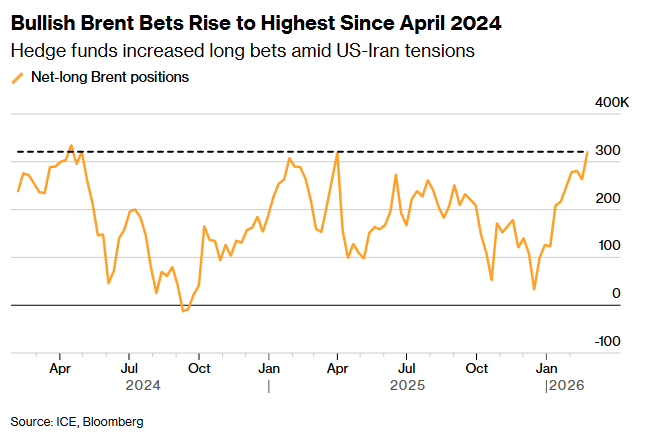
中东地缘局势趋紧推动风险溢价回归,对冲基金原油看涨押注升至22个月高点
Zhi Tong Cai Jing· 2026-02-28 01:01
Group 1 - The core viewpoint of the articles indicates that investor sentiment towards oil, particularly Brent crude, has shifted to a bullish stance due to rising concerns over potential U.S. military actions in the Middle East, which could disrupt oil supplies [1][4] - Hedge funds have increased their net long positions in Brent crude oil to 320,952 contracts, marking the highest level since April 2024, with a notable increase of 57,766 contracts in the week ending February 24 [1][4] - The WTI crude oil futures for April closed at $67.02 per barrel, up 2.78%, while Brent crude futures for April closed at $72.48 per barrel, up 2.45%, reflecting a cumulative increase of 3.52% and 5.64% respectively for February [4] Group 2 - The U.S. military has significantly increased its presence in the Middle East, with the deployment of two aircraft carriers, the USS Ford and USS Lincoln, marking the largest military buildup in the region since the 2003 invasion of Iraq [4] - There are rising tensions as Iran has threatened a "devastating" response to any U.S. aggression, indicating a potential escalation in conflict [4] - Analysts warn that if negotiations between the U.S. and Iran fail and Iran were to cut off the Strait of Hormuz, the oil supply in the Middle East could face severe disruptions, potentially driving oil prices above $100 per barrel [5]

油价隐含每桶5至6美元的伊朗风险溢价,高盛重申布伦特年底将回落至60美元
Sou Hu Cai Jing· 2026-02-26 07:35
Group 1 - The core viewpoint of the articles highlights the significant impact of geopolitical factors on global oil pricing, particularly due to the ongoing tensions between the US and Iran, which has led to a risk premium of $5 to $6 per barrel in oil prices [1] - Goldman Sachs reports that the current Brent crude oil price is supported by a combination of the aforementioned risk premium and a notable decline in global inventories, with a daily average reduction of 500,000 barrels last week and a 300,000 barrels daily average decline since February [1] - The report also notes that Iran's oil loading has reached its highest level since 2018, with record-high offshore Iranian oil inventories, indicating potential significant disruptions to global supply if geopolitical conflicts escalate [1] Group 2 - On the supply side, Goldman Sachs indicates that Russian oil production is under pressure from ongoing attacks in Ukraine, adding to short-term supply uncertainties, while new production capacities are expected to come online in the medium term [2] - New projects in Saudi Arabia, Brazil, Nigeria, Uganda, and the US are set to launch this year, with Saudi Arabia's Jafurah gas field already in production since December and the Zuluf oil field expected to come online within the year [2] - Considering the evolving geopolitical risks and supply-demand dynamics, Goldman Sachs reaffirms its previous forecast that Brent crude oil prices will decline to $60 per barrel by the fourth quarter of this year [2]

陡然升温,原油大涨2.9%,下周汽柴油涨幅“或大增”,2月3日调价
Sou Hu Cai Jing· 2026-01-24 06:52
Group 1 - The core viewpoint of the articles indicates that the domestic oil prices are expected to rise significantly due to strong support from the international crude oil market and geopolitical tensions [1][3][5] - In January, there have been two adjustments in refined oil prices, resulting in a market situation of "1 increase and 1 stable," reversing the downward trend expected for gasoline and diesel prices by the end of 2025 [1][5] - The WTI crude oil price has shown volatility, initially dropping to $55.99 per barrel but later rising to $62.02 per barrel, indicating a strong upward trend in the oil market [3][5] Group 2 - As of January 24, 2026, the domestic gasoline and diesel prices are projected to increase by approximately 95 yuan per ton, with gasoline prices expected to rise by about 0.08 yuan per liter [5][6] - The overnight WTI crude oil price was reported at $61.07 per barrel (+2.9%), and Brent crude at $65.88 per barrel (+2.8%), suggesting that the domestic price increase could be substantial in the upcoming adjustment [5][6] - The International Energy Agency has raised its forecast for global oil demand growth in 2026 from 860,000 barrels per day to 930,000 barrels per day, which has improved market demand expectations [3]
光大期货能化商品日报(2026年1月13日)-20260113
Guang Da Qi Huo· 2026-01-13 02:40
Report Industry Investment Rating - Not provided in the report Core Viewpoints of the Report - The oil price is expected to fluctuate and move upward as the market continues to price in geopolitical risks [1] - The absolute prices of high - sulfur and low - sulfur fuel oils are likely to follow the oil price fluctuations, with high - sulfur fuel oil facing greater subsequent supply - demand pressure [2] - The asphalt market is expected to be in a game between "weak demand reality" and "strong cost expectation", with prices expected to stabilize and strengthen [2] - Polyester prices are expected to be strongly volatile in the short - term due to the game between downstream negative feedback and rising oil prices [3] - Rubber prices may rebound due to a warming macro - expectation but could be pressured by inventory accumulation [3] - Methanol is expected to maintain a bottom - level oscillation, with the current tense situation in Iran potentially increasing its volatility [5] - Polyolefins are likely to oscillate at the bottom, with inventory expected to rise gradually from late January [5] - PVC prices are expected to maintain a bottom - level oscillation, with the 05 contract showing a structure of weak reality and strong expectation [7] Summary by Relevant Catalogs Research Views - **Crude Oil**: On Monday, WTI February contract rose $0.38 to $59.50 per barrel (0.64% increase), Brent March contract rose $0.53 to $63.87 per barrel (0.84% increase), and SC2602 fell 0.3 yuan to 435.4 yuan per barrel (0.07% decrease). Market concerns about reduced Iranian exports offset the expected increase in Venezuelan supply. The price center of oil is expected to oscillate upward [1] - **Fuel Oil**: On Monday, the main fuel oil contract FU2603 fell 1.32% to 2461 yuan per ton, and the low - sulfur fuel oil contract LU2603 rose 0.93% to 3026 yuan per ton. The low - sulfur market will have sufficient supply in the short - term, while the high - sulfur market has some support. With Venezuelan heavy crude entering the market, it may be negative for relevant spreads. Short - term prices are expected to follow oil prices, and high - sulfur fuel oil is recommended to be shorted on rallies [2] - **Asphalt**: On Monday, the main asphalt contract BU2602 fell 0.25% to 3157 yuan per ton. Due to the Venezuelan situation, the expectation of tight processing raw materials strengthens cost - side support, and refinery supply decreases. The market is expected to be in a game between weak demand and strong cost expectation, with prices expected to stabilize and strengthen [2] - **Polyester**: TA605 rose 0.67% to 5142 yuan per ton, EG2605 rose 0.36% to 3880 yuan per ton, and the PX futures contract 603 rose 0.97% to 7308 yuan per ton. The production and sales of polyester yarn in Jiangsu and Zhejiang were moderately good. Some devices had changes. The market is in a game between downstream negative feedback and rising oil prices, with prices expected to be strongly volatile in the short - term. The supply of ethylene glycol is still abundant, and prices are expected to oscillate widely [2][3] - **Rubber**: On Monday, the main rubber contract RU2605 rose 100 yuan to 16130 yuan per ton, and the NR contract rose 60 yuan to 13010 yuan per ton. In 2025, Cote d'Ivoire's natural rubber exports increased by 13.4% year - on - year. In the United States, tire imports from different countries had different changes. In December 2025, the retail sales of passenger cars decreased year - on - year. The rubber inventory in Qingdao increased. Rubber prices may rebound due to a warming macro - expectation but could be pressured by inventory accumulation [3][5] - **Methanol**: On Monday, the spot price in Taicang was 2260 yuan per ton. In January, the arrival volume will decline significantly, and the MTO device load will also decrease. The port will face de - stocking pressure. Methanol is expected to maintain a bottom - level oscillation, with the Iranian situation potentially increasing volatility [5] - **Polyolefins**: On Monday, the mainstream price of East China拉丝 was 6350 - 6500 yuan per ton. In January, the supply may decrease slightly, and demand is expected to recover in the first half of the month but weaken in the second half due to the Spring Festival. Polyolefins are likely to oscillate at the bottom [5][7] - **Polyvinyl Chloride (PVC)**: On Monday, the PVC market prices in East, North, and South China had different adjustments. The supply is at a high - level oscillation, domestic demand is slowing, and the 05 contract has a large premium. The export policy change will put pressure on the far - month contract and support the near - month contract. PVC prices are expected to maintain a bottom - level oscillation [7] Daily Data Monitoring - **Crude Oil**: The spot price of Oman crude was 426.82 yuan per barrel on January 12, the futures price of SC was 435.70 yuan per barrel, the basis was - 8.88 yuan per barrel, and the basis rate was - 2.04% [8] - **Other Varieties**: Similar data on spot prices, futures prices, basis, and basis rates are provided for various energy - chemical products such as liquefied petroleum gas, asphalt, fuel oil, etc. [8] Market News - Market concerns about reduced Iranian exports during the anti - government protests offset the expected increase in Venezuelan supply. Iran is in communication with the US, and Trump is considering how to respond to the protests in Iran [10] - After the Venezuelan president was taken away by the US, Venezuela is expected to resume oil exports soon. Trump said Venezuela will transfer up to 50 million barrels of oil to the US, and oil companies are preparing for transportation [10] Chart Analysis - **4.1 Main Contract Prices**: Charts show the closing prices of main contracts for various energy - chemical products such as crude oil, fuel oil, low - sulfur fuel oil, etc. from 2022 to 2026 [12][14][16] - **4.2 Main Contract Basis**: Charts present the basis data for main contracts of different products, including crude oil, fuel oil, etc. over different time periods [29][34][35] - **4.3 Inter - period Contract Spreads**: Charts display the spreads between different contracts (e.g., 01 - 05, 05 - 09) for products like fuel oil, asphalt, etc. [42][44][47] - **4.4 Inter - variety Spreads**: Charts show the spreads between different varieties, such as crude oil internal and external markets, fuel oil high - low sulfur spreads, etc. [58][60][62] - **4.5 Production Profits**: Charts illustrate the production profits of products like LLDPE, PP, PTA, etc. [66][68] Team Members Introduction - **Zhong Meiyan**: Deputy Director of Everbright Futures Research Institute. She has over a decade of experience in futures derivatives market research, has won multiple awards, and has served many listed companies and well - known domestic enterprises [71] - **Du Bingqin**: Research Director of Energy and Chemicals. She has a background in finance, has won many industry awards, and has in - depth research on the energy industry chain [72] - **Di Yilin**: Analyst for natural rubber and polyester. She has won several awards in the industry and is good at data analysis [73] - **Peng Haibo**: Analyst for methanol, propylene, etc. He has a background in energy - chemical spot - futures trading and has passed the CFA Level III exam [74]
特朗普称美国将暂时“管理”委内瑞拉
Dong Zheng Qi Huo· 2026-01-05 01:13
Report Industry Investment Ratings No relevant content provided. Core Views of the Report - The domestic economic outlook is expected to improve in Q1 2026, but short - term geopolitical risks may suppress risk assets [1][18]. - The short - term strengthening of the US dollar index is due to rising geopolitical risks after the US's actions in Venezuela [3][12][13]. - The stock index long - position strategy should be continued, while the bond market may still face downward pressure after a rapid rise [19][22]. - Different commodities have different trends. For example, palm oil may face supply pressure, and copper prices are mainly affected by macro factors [24][52]. Summary by Directory 1. Financial News and Comments 1.1 Macro Strategy (Gold) - The arrest of the Venezuelan president by the US has increased geopolitical tensions, but the impact on the financial market is expected to be limited. Short - term precious metals may face correction risks [10]. 1.2 Macro Strategy (Foreign Exchange Futures - US Dollar Index) - The US's actions in Venezuela have raised geopolitical risks, causing the US dollar index to strengthen in the short term. The US dollar is expected to rise in the short term [3][12][13]. 1.3 Macro Strategy (US Stock Index Futures) - The US air strike on Venezuela may cause short - term market risk aversion, but the market risk appetite is expected to improve. US stocks are expected to operate in a volatile and slightly stronger manner [15][16]. 1.4 Macro Strategy (Stock Index Futures) - The domestic economic outlook is expected to improve, but short - term geopolitical risks may suppress risk assets. The long - position strategy for stock indices should be continued [18][19]. 1.5 Macro Strategy (Treasury Bond Futures) - The new fee rate regulations are short - term positive for the bond market, but cannot reverse the bearish sentiment. It is recommended to consider short - selling at high prices [2][22]. 2. Commodity News and Comments 2.1 Agricultural Products (Soybean Oil/Rapeseed Oil/Palm Oil) - In December 2025, Malaysian palm oil production and exports decreased, and the inventory may exceed 3 million tons. It is advisable to wait for India's increased purchases and consider going long at low levels [23][24][25]. 2.2 Agricultural Products (Soybean Meal) - CBOT soybeans declined due to poor export prospects. Domestic soybean crushing is expected to decrease in January. Soybean meal is expected to decline with CBOT soybean futures prices [28][29]. 2.3 Agricultural Products (Sugar) - The global sugar market is expected to have a small surplus in 2025/26. The sugar price may be sensitive to weather and production changes. Pay attention to the actual stocking and sales progress [30][32][33]. 2.4 Agricultural Products (Cotton) - The US cotton export demand is weak, and the Indian import tariff exemption has expired. The external market is expected to remain in a low - level shock. Be wary of the risk of a decline in Zhengzhou cotton [38][39]. 2.5 Black Metals (Rebar/Hot - Rolled Coil) - Before the New Year's Day holiday, the inventory of five major steel products continued to decline, but the speed slowed down. The steel price is expected to fluctuate in the short term, waiting for the accumulation of market contradictions [44][45]. 2.6 Black Metals (Steam Coal) - The price of steam coal in the northern port market was stable on December 31, 2025. The demand is weak, and attention should be paid to the coal mine's production in January [45][46]. 2.7 Black Metals (Iron Ore) - The Samarco mine expansion project was suspended. The iron ore price is expected to continue to fluctuate. Pay attention to the steel mills' raw material replenishment after January [47][48]. 2.8 Non - ferrous Metals (Copper) - Macro factors have a great impact on copper prices. Fundamentally, short - term price increases are restricted. It is recommended to buy at low prices [52]. 2.9 Non - ferrous Metals (Nickel) - Indonesia's supply contraction expectation is being realized. Unilaterally, it is advisable to consider going long at low levels. For arbitrage, pay attention to the 03 - 05 reverse spread opportunity [55][56]. 2.10 Non - ferrous Metals (Lithium Carbonate) - There may be short - term callback pressure, and it is recommended to consider going long at low levels in the medium term [58][59][60]. 2.11 Non - ferrous Metals (Polysilicon) - Polysilicon enterprises have raised spot quotes. It is advisable to consider going long at low levels, but investors should hold positions carefully [60][61]. 2.12 Non - ferrous Metals (Industrial Silicon) - The current production reduction scale of industrial silicon is insufficient to reverse the inventory accumulation pattern in 2026. It is recommended to short at high prices after a rebound [63][64]. 2.13 Non - ferrous Metals (Tin) - The supply and demand contradictions of tin are alleviated, and attention should be paid to the risk of price decline caused by the withdrawal of funds [68]. 2.14 Non - ferrous Metals (Lead) - The fundamental contradictions of lead are marginally alleviated. It is recommended to take a wait - and - see approach both unilaterally and in terms of arbitrage [69][70]. 2.15 Non - ferrous Metals (Zinc) - The short - term fundamentals of zinc have no obvious contradictions. Unilaterally, wait for the opportunity to take profits at high prices; for arbitrage, take a wait - and - see approach [71][72][73]. 2.16 Energy Chemicals (Carbon Emissions) - The EU carbon price is expected to be volatile and slightly stronger in the short term [74]. 2.17 Energy Chemicals (Crude Oil) - The short - term risk premium of crude oil prices may rise moderately, and the long - term supply growth depends on US investment [75][76].
以伊冲突一夜反转!国际油价暴跌8%回吐地缘溢价,国内油气股遭重挫
Hua Xia Shi Bao· 2025-06-24 23:29
Core Viewpoint - International oil prices experienced a significant decline due to the de-escalation of geopolitical tensions, with prices dropping over 8% in a single day, effectively reversing gains made since June 13 [1][2][3] Oil Price Movement - On June 23, international oil prices fell sharply after initial increases due to heightened geopolitical risks, with WTI crude oil futures dropping by $6.61 to $67.23 per barrel (down 8.95%) and Brent crude oil futures falling by $6.36 to $70.65 per barrel (down 8.26%) [2] - Following the announcement of a ceasefire between Iran and Israel, oil prices continued to decline, nearly erasing all gains from the previous weeks [1][3] Impact on Oil and Shipping Stocks - The oil and shipping sectors in the A-share market faced significant losses on June 24, with companies like Shandong Molong and Tongyuan Petroleum hitting their daily limit down [1][4] - Prior to the decline, oil-related stocks had surged, with Shandong Molong experiencing a nearly 95.44% increase from June 13 to June 23 [4] Market Sentiment and Future Outlook - Analysts predict that the easing of geopolitical tensions will shift market focus back to fundamental and macroeconomic drivers, with expectations of oil prices stabilizing in the $60-$65 per barrel range for Q3, but facing potential downward pressure in Q4 [6] - The market is also influenced by OPEC's continued production increases and macroeconomic factors such as U.S. tariff policies and inflation risks [6]