美国WTI原油

Search documents
收盘后11分钟发帖!美股遭遇伊朗战争以来“最惨一天”,特朗普“立刻”延长10天“谈判时间”
华尔街见闻· 2026-03-27 00:40
Core Viewpoint - The article discusses the significant market reactions to the escalating Middle East conflict and President Trump's decision to extend the deadline for striking Iranian energy facilities, highlighting the volatility in the stock and bond markets as well as the implications for inflation and energy prices [2][4][10]. Market Reactions - The U.S. stock market experienced its most severe sell-off in months, with the S&P 500 index dropping 1.7%, marking its largest single-day decline since January 20, and reaching a six-month low [5]. - The Nasdaq Composite index fell 2.4%, entering a "technical correction" as it dropped over 10% from its late October peak [6]. - The bond market was also heavily impacted, with the 10-year Treasury yield rising by 7.95 basis points to 4.4117%, and the two-year yield increasing by 10.05 basis points to 3.9858%, reflecting investor fatigue amid rising inflation concerns [5]. Energy Prices and Inflation - Brent crude oil prices surged by 5.7% to $108.01 per barrel, the largest single-day increase since March 11, while WTI crude rose by 4.6% to $94.48 [5]. - The OECD warned that the Middle East crisis could push U.S. inflation rates to 4.2%, the highest among G7 countries [5]. Political and Economic Dynamics - Trump's administration is seen to oscillate between diplomatic efforts and military threats, with a recent extension of the deadline for military action against Iran, indicating a complex interplay of negotiation and military readiness [10]. - Observers note that Trump's rhetoric tends to soften when energy prices or borrowing costs reach certain thresholds, suggesting a strategic response to market conditions [9]. Investor Sentiment - Market reactions are characterized as rational responses to extreme uncertainty, with many investors opting to remain cautious and avoid sudden moves in light of potential policy shifts from the White House [11].


高盛最新判断“油价短期或破2008年147高点” (复盘五轮原油冲击)
华尔街见闻· 2026-03-20 10:19
Core Viewpoint - Goldman Sachs predicts that Brent crude oil prices may exceed the historical high of 2008, with a rising risk of oil prices maintaining at $100 in the long term [4][6][25]. Group 1: Oil Price Trends - Goldman Sachs' commodity research team indicates that the upward trend in oil prices is likely to continue due to ongoing disruptions in the Strait of Hormuz [5]. - Brent crude oil reached a historical high of $147.50 per barrel in July 2008 [7]. - If the current low supply situation persists, concerns about prolonged supply disruptions could lead Brent crude prices to surpass the 2008 peak [6]. Group 2: Supply Chain and Production Risks - Goldman Sachs emphasizes that even after the Strait is reopened, production may take a long time to recover due to infrastructure damage [9]. - Historical analysis shows that major supply shocks often last for years, with affected countries typically experiencing an average of 42% production loss four years post-shock [12]. - If Iran and surrounding regions suffer significant production capacity damage, oil prices could remain above $100 for longer than current market expectations [13]. Group 3: Strategic Oil Reserves and Global Demand - The ongoing uncertainty from the Strait of Hormuz crisis may trigger accelerated construction of global strategic oil reserves starting in 2027 [16]. - Goldman Sachs identifies three reasons for this potential increase in reserves: low levels of existing reserves in OECD countries, heightened government reserve targets, and the need to replenish the U.S. strategic oil reserve [17]. - An accelerated pace of global strategic reserve construction could add approximately $12 per barrel to oil prices by the end of 2027 [17]. Group 4: Historical Context and Future Predictions - Historical experiences indicate that high oil prices can lead to increased energy efficiency and fuel substitution, ultimately reducing economic dependence on oil [22]. - The report suggests that the balance of risks for oil prices remains tilted towards the upside, with potential for sustained prices above $100 per barrel in scenarios of prolonged supply disruptions [24][25]. - Goldman Sachs' baseline forecast for Brent crude oil prices in Q4 2027 is $69 per barrel, with various risk scenarios indicating potential price deviations [26].


沪指4000点失而复得,关注四大因素
21世纪经济报道· 2026-03-19 09:58
Market Overview - The A-share market continued its adjustment trend on March 19, with the Shanghai Composite Index dipping below the 4000-point mark, reaching a low of 3994.17 points, down over 200 points from the year's high of 4197.23 points [1] - Market trading volume has shrunk significantly, decreasing from over 3 trillion yuan at the beginning of March to 2.13 trillion yuan on March 19, indicating a strong wait-and-see sentiment among investors [1] External Macro Environment - The U.S. Producer Price Index (PPI) for February 2026 rose by 0.7% month-on-month and 3.4% year-on-year, marking the highest level since February 2025 and significantly exceeding market expectations [4] - The unexpected rise in inflation data has disrupted market expectations for U.S. Federal Reserve monetary easing, with traders reducing the likelihood of interest rate cuts to just one occurrence later in the year [5] Geopolitical and Economic Impact - Ongoing geopolitical tensions, particularly in the Middle East, have led to increased economic costs, with significant missile strikes reported by Iran against U.S.-related oil and energy facilities, causing a spike in international oil prices [6] - Brent crude oil prices surged over 8.44%, surpassing $110 per barrel, while WTI crude oil exceeded $96 per barrel, indicating a volatile market driven by geopolitical conflicts and supply chain disruptions [6] Market Dynamics and Investment Trends - The market is experiencing a shift in investment style, with a potential move from technology growth sectors to traditional value sectors as the gold-oil ratio has significantly declined [7] - Short-term market movements are expected to revolve around the 4000-point level, with structural opportunities emerging, while medium-term prospects suggest a consolidation around this level, with a slow bull market anticipated [7]

布油猛涨8%冲破110美元,花旗称油价或涨至130美元
21世纪经济报道· 2026-03-19 09:58
Group 1 - International crude oil prices surged significantly, with Brent crude futures rising by 8.44% to over $110 per barrel, and WTI crude surpassing $96 per barrel as of March 19 [1] - Israeli airstrikes targeted Iran's major natural gas facilities in Bushehr, with threats of further attacks on Iranian infrastructure, leading to heightened tensions in the region [3] - Analysts from Citigroup predict that Brent crude futures could reach $120 per barrel in the coming days, and if energy infrastructure faces widespread attacks, prices could average $130 per barrel in Q2 and Q3 of this year [3] Group 2 - The article discusses the implications of geopolitical tensions on energy prices, particularly focusing on the potential for increased oil prices due to military actions in the Middle East [3]

中东地缘局势趋紧推动风险溢价回归,对冲基金原油看涨押注升至22个月高点
Zhi Tong Cai Jing· 2026-02-28 01:01
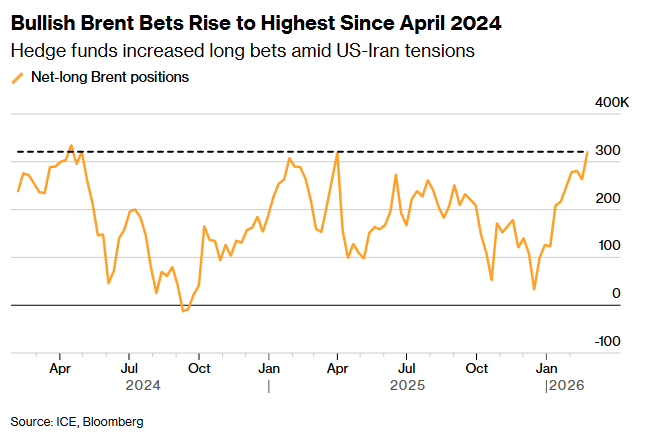
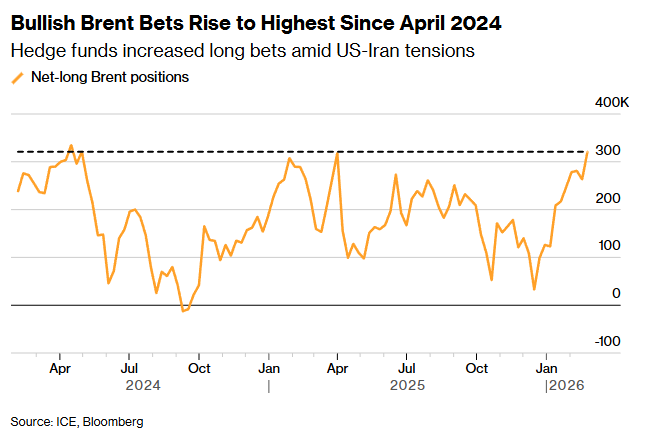
Group 1 - The core viewpoint of the articles indicates that investor sentiment towards oil, particularly Brent crude, has shifted to a bullish stance due to rising concerns over potential U.S. military actions in the Middle East, which could disrupt oil supplies [1][4] - Hedge funds have increased their net long positions in Brent crude oil to 320,952 contracts, marking the highest level since April 2024, with a notable increase of 57,766 contracts in the week ending February 24 [1][4] - The WTI crude oil futures for April closed at $67.02 per barrel, up 2.78%, while Brent crude futures for April closed at $72.48 per barrel, up 2.45%, reflecting a cumulative increase of 3.52% and 5.64% respectively for February [4] Group 2 - The U.S. military has significantly increased its presence in the Middle East, with the deployment of two aircraft carriers, the USS Ford and USS Lincoln, marking the largest military buildup in the region since the 2003 invasion of Iraq [4] - There are rising tensions as Iran has threatened a "devastating" response to any U.S. aggression, indicating a potential escalation in conflict [4] - Analysts warn that if negotiations between the U.S. and Iran fail and Iran were to cut off the Strait of Hormuz, the oil supply in the Middle East could face severe disruptions, potentially driving oil prices above $100 per barrel [5]
中东地缘局势趋紧推动风险溢价回归 对冲基金原油看涨押注升至22个月高点
智通财经网· 2026-02-28 00:25
Group 1 - Investor sentiment towards Brent crude oil has reached its highest level since April 2024, driven by concerns over potential U.S. military actions in the Middle East disrupting oil supplies [1] - Hedge funds increased their net long positions in Brent crude oil by 57,766 contracts to 320,952 contracts, marking the highest level in nearly two years [1] - Bullish bets on U.S. WTI crude oil have also risen to a seven-month high, indicating a broader market shift towards optimism regarding oil prices [1] Group 2 - Following a decline in optimism regarding U.S.-Iran negotiations, investors have shifted back to a bullish stance on oil, leading to a risk premium being reintroduced to benchmark futures prices [2] - WTI April crude futures rose by 2.78% to $67.02 per barrel, with a cumulative increase of 3.52% in February; Brent April crude futures increased by 2.45% to $72.48 per barrel, with a cumulative rise of 5.64% in February [2] - The U.S. military has significantly increased its presence in the Middle East, marking the largest deployment since the 2003 invasion of Iraq, which raises the risk of conflict in the region [2] Group 3 - U.S. President Trump expressed dissatisfaction with the current state of Iran nuclear negotiations but has not made a final decision on military action against Iran [3] - Analysts suggest that if U.S.-Iran negotiations fail and Iran cuts off the Strait of Hormuz, there could be a substantial impact on oil supply, potentially driving prices above $100 per barrel [3]
春节期间地缘驱动油价持续走高,国企红利ETF(159515)涨1.54%
Sou Hu Cai Jing· 2026-02-24 06:01
Group 1 - The core viewpoint of the news highlights the significant rise in major stock indices, particularly the state-owned enterprise dividend sector, with the National Enterprise Dividend ETF (159515) increasing by 1.54% as of 13:30 on February 24 [1] - Notable component stocks within this sector include Shanxi Coal International rising by 5.15%, Lu'an Environmental Energy by 3.97%, and Shaanxi Coal and Chemical Industry by 3.69%, indicating strong performance across the board [1] - The international oil market experienced significant volatility during the Spring Festival period (February 13-23), with WTI crude oil prices climbing from $62.89 per barrel to $66.31 per barrel, a rise of 5.5%, and Brent crude oil increasing from $67.75 per barrel to $71.11 per barrel, a rise of 5.0%, both reaching their highest levels in nearly six months [1] Group 2 - The ongoing tension between the United States and Iran has led to increased military activity in the Middle East oil-producing regions, raising market concerns about potential supply disruptions due to failed negotiations [2] - The deployment of a U.S. aircraft carrier strike group in the Middle East has further exacerbated market volatility, with analysts predicting that the oil market will continue to focus on developments in the geopolitical landscape of the region [2] - Despite crude oil prices being at a relatively high level, uncertainties in geopolitics and declining oil inventories are expected to provide support for oil prices moving forward [2]
伊朗外长称就伊美谈判“指导原则”达成一致,布油一度跌近3%
Sou Hu Cai Jing· 2026-02-18 02:08
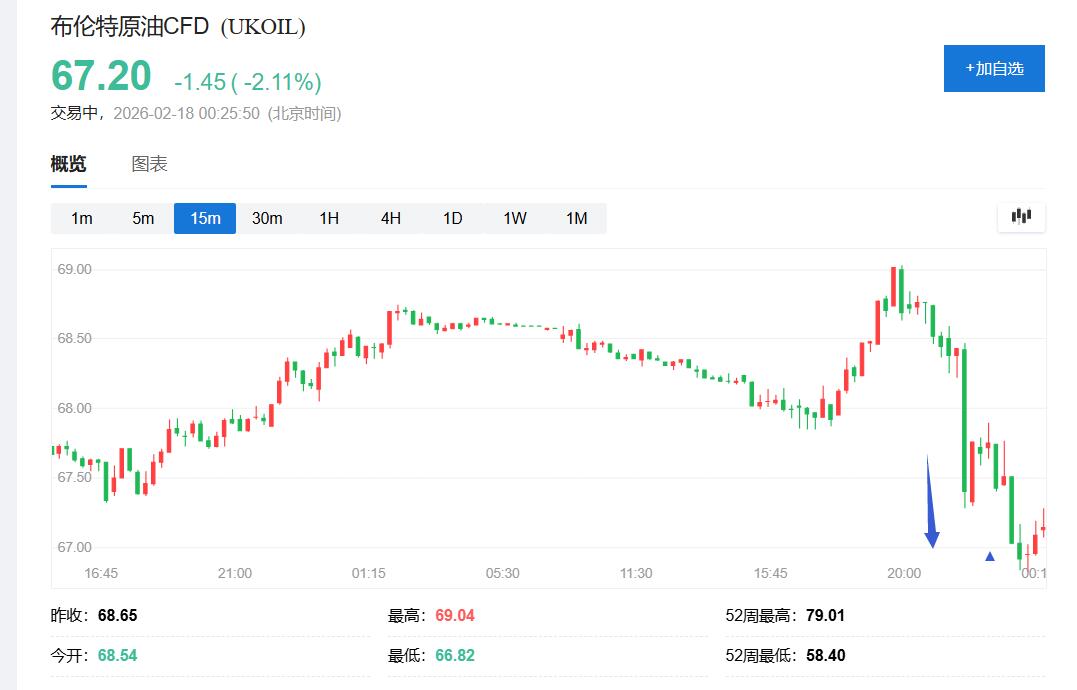
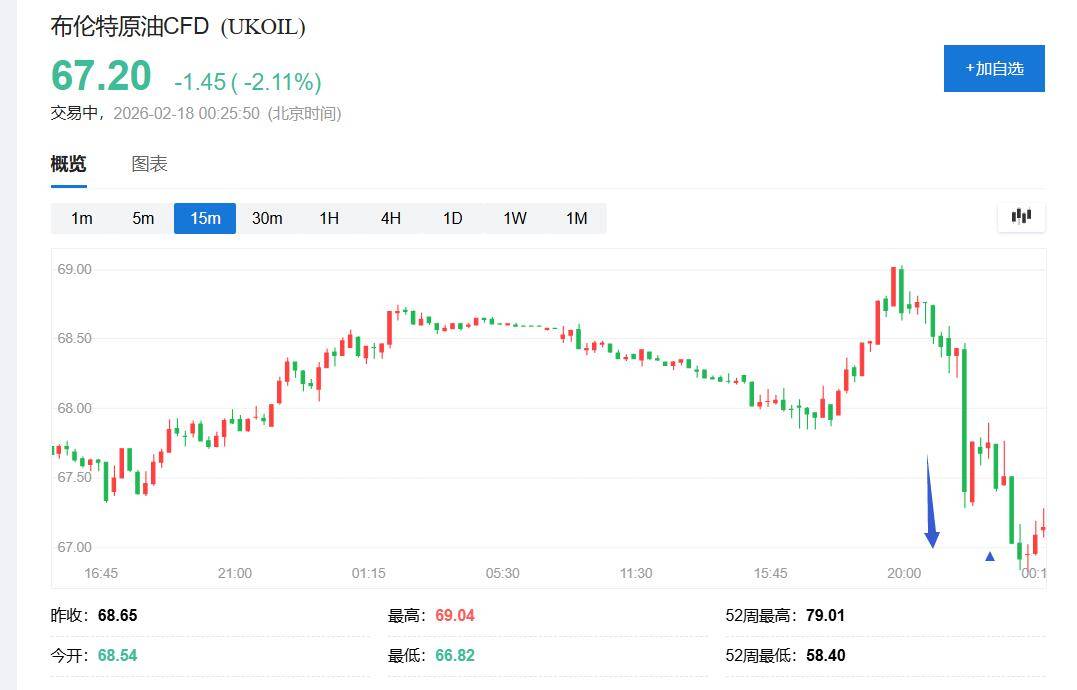
Core Insights - Iran and the United States have made significant progress in nuclear negotiations, reportedly reaching a consensus on "guiding principles," which may pave the way for a landmark agreement [1][3][4] - The news has caused volatility in the oil market, with international oil prices experiencing a notable decline [1] Negotiation Progress - Iranian Foreign Minister Zarif stated that the recent talks in Geneva were more serious and constructive, leading to a general consensus on guiding principles for a potential agreement [1][3] - Oman confirmed that the negotiations have made "tangible progress," establishing a foundation for future discussions [2][4] - Despite the positive developments, Zarif warned that entering the drafting phase of the agreement will be more challenging, with several issues still requiring further negotiation [2][3] Market Impact - Following the announcement of progress in negotiations, Brent crude oil prices fell nearly 2.7% to around $66.80, while WTI crude dropped over 1.6% to below $61.90 [1] Future Negotiation Dynamics - The next round of talks has not been scheduled, but both parties have agreed to draft and exchange text proposals before determining the timing for further discussions [3] - Iranian President Raisi emphasized that the negotiations aim for genuine solutions rather than mere discussions [3] Regional Tensions - Concurrently, military deployments in the Persian Gulf are increasing, with Iran temporarily closing parts of the Strait of Hormuz due to military exercises, while the U.S. has sent a second aircraft carrier to the region [2][5] Diverging Perspectives - There are significant differences between the U.S. and Iran regarding the scope of negotiations, with Iran focusing on its nuclear program while the U.S. seeks to broaden the discussion [8] - The U.S. insists on limiting Iran's ballistic missile range, which Iran views as a red line, complicating the negotiation process [8]
谈判结束,伊美双方发声!油价跳水,金银齐跌
Qi Huo Ri Bao· 2026-02-17 23:45
Group 1: Market Movements - International oil prices experienced a significant drop, with WTI crude oil down 0.93% to $62.17 per barrel and Brent crude oil down 1.79% to $67.42 per barrel [1] - Gold prices fell by 2.29% to $4878.57 per ounce, while silver prices decreased by 4.04% to $73.36 per ounce [1] - Major market institutions are taking profits, leading to consecutive reductions in holdings of gold and silver ETFs [3] Group 2: Iran-U.S. Negotiations - Recent indirect negotiations between the U.S. and Iran in Geneva showed signs of progress, reducing the risk premium on commodities [4] - Iranian Foreign Minister stated that both parties reached a general consensus on guiding principles for negotiations, although a final agreement is not imminent [6][8] - The U.S. Vice President noted that negotiations are progressing in certain aspects, but Iran has not yet agreed to some of the "red lines" set by the previous administration [10] Group 3: Gold Market Outlook - Analysts predict that gold prices may continue to rise due to ongoing demand for hedging and safe-haven assets amid a slowing U.S. economy and geopolitical tensions [20] - The global central banks' continued gold purchases and rising investment demand are expected to support gold prices [21] - Market experts anticipate a period of consolidation for gold prices, with potential for new upward momentum in the coming months [22]
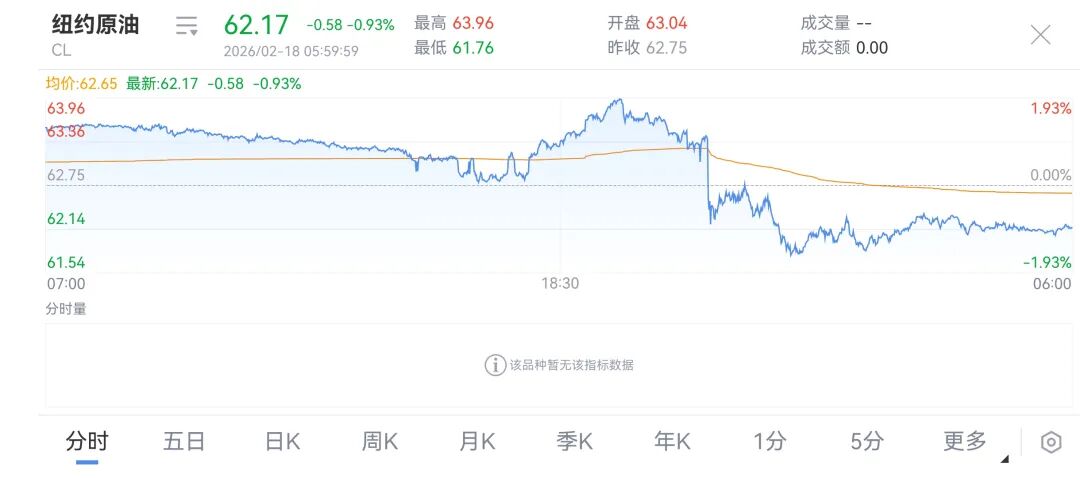
伊朗外长称就伊美就谈判“指导原则”达成一致,布油一度跌近3%
Hua Er Jie Jian Wen· 2026-02-17 17:52
Core Insights - Iran and the U.S. have made significant progress in nuclear negotiations, reaching a consensus on "guiding principles," which may pave the way for a landmark agreement [1][4] - The news has caused volatility in the oil market, with Brent crude oil prices dropping nearly 2.7% to around $66.80 and WTI crude falling over 1.6% to below $61.90 [1] Group 1: Negotiation Progress - Iranian Foreign Minister Amir-Abdollahian stated that the recent talks in Geneva were serious and constructive, leading to a general consensus on guiding principles for a potential agreement [1][4] - Oman confirmed that the negotiations have made "tangible progress," establishing a foundation for future discussions [3][5] - The Iranian leadership, including President Raisi, emphasized the importance of achieving real outcomes from the negotiations rather than merely engaging in talks [4] Group 2: Challenges Ahead - Despite the progress, Amir-Abdollahian warned that entering the drafting phase of the agreement will be more challenging, with several issues still requiring further negotiation [4][6] - The Iranian Supreme Leader Khamenei cautioned against U.S. military threats and emphasized that negotiations should not involve imposed terms from the U.S. [6][7] Group 3: Market Impact - The potential for a successful agreement could lead to the lifting of severe sanctions on Iran's oil industry, which has seen Brent crude prices rise nearly 13% this year due to tensions in the region [8] - Analysts express concern over the ongoing escalation of rhetoric between the U.S. and Iran, which may affect market perceptions and pricing of risk premiums [8]