创新药

Search documents
交银国际每日晨报-20251205
BOCOM International· 2025-12-05 02:02
Group 1: Technology Industry - The outlook for 2026 suggests that the artificial intelligence (AI) supercycle may continue, with strong growth in AI infrastructure expected at least until 2026, driven by significant capital expenditure increases from major cloud providers, projected to grow over 30% in 2026 following over 60% growth in 2024 and 2025 [1][2] - The report highlights a persistent supply-demand imbalance in computing acceleration and network communication chips, with overall demand remaining high despite potential increases in supply [1] - The "15th Five-Year Plan" is expected to accelerate domestic substitution opportunities in key industrial chains, supported by favorable policies during this period [1] Group 2: Semiconductor and AI Infrastructure - The recovery in terminal demand is noted to be moderate, with strong demand for servers closely related to AI, while global consumer electronics demand for 2026 is viewed with caution due to the prolonged price increases in memory chips [2] - Investment recommendations include overseas chip design and foundry companies such as NVIDIA (NVDA US), Broadcom (AVGO US), and TSMC (TSM US), which are expected to benefit from AI infrastructure development [2] - Domestic AI and substitution opportunities are also highlighted, with companies like Northern Huachuang (002371 CH), OmniVision (603501 CH), Zhongwei Company (688012 CH), and Huahong Semiconductor (1347 HK) recommended for investment [2] Group 3: Pharmaceutical Industry - The report indicates that the transition to an inquiry-based procurement model for the 1-8 batch of national procurement may limit overall price reductions, suggesting a smaller-than-expected impact on Hong Kong prescription drug companies [3] - The healthcare sector's performance is noted, with the Hang Seng Healthcare Index rising by 0.5%, although it underperformed the broader market [3] - Investment insights suggest a focus on innovative drugs and stable traditional companies, with a positive outlook on the innovation theme in the long term [3][6] Group 4: Economic Data and Market Performance - The report includes key economic data releases from the US and China, with manufacturing and non-manufacturing PMI figures indicating varying market expectations [7] - The performance of major global indices is summarized, with the Hang Seng Index closing at 25,936, reflecting a year-to-date increase of 29.05% [4] - Commodity prices and foreign exchange rates are also provided, showing significant fluctuations in various markets, which may impact investment strategies [5]
止于至善投资何理:构建“理性共识” 追求“合理价格”
Zhong Guo Zheng Quan Bao· 2025-12-05 00:27
Group 1 - The core idea presented is the integration of subjective insights, quantitative tools, and artificial intelligence to create a scientific investment system that seeks "rational consensus" [1] - The definition of "reasonable price" is based on discounted future free cash flows and identifying a "consensus value range" through in-depth research, with investments made when market prices show significant discounts [2] - The company aims to construct a "anti-fragile" investment portfolio using options and other tools to benefit from market volatility rather than suffer from it [2] Group 2 - The AI system, referred to as "AI Cybertron," is deeply integrated into the company's operations, enhancing efficiency and enabling rapid iteration of research and decision-making processes [3] - The investment in a specific AI hardware company exemplifies the successful application of the investment philosophy, with initial investments made during a downturn and increased as understanding of the company's long-term value grew [4] - The investment portfolio is globally diversified, covering A-shares, Hong Kong stocks, and U.S. stocks, with a focus on sectors like AI and innovative pharmaceuticals [5][6] Group 3 - In the AI sector, the company sees no overall bubble but warns of overheating at the individual stock level, particularly emphasizing the importance of storage in the computing segment [5] - The company believes that leading domestic pharmaceutical firms have advantages in developing best-in-class (BIC) drugs, while smaller overseas firms may be more flexible in first-in-class (FIC) drug development [6] - The new core assets identified for 2026 include AI technology innovation companies, new consumer companies providing "emotional value," and resource and energy companies with scarcity in the changing global supply landscape [6]
国际医学拟定增10.08亿元;众生药业RAY1225注射液新增适应证获批临床|医药早参
Mei Ri Jing Ji Xin Wen· 2025-12-04 23:20
Group 1: International Medicine - International Medicine plans to raise up to approximately 1.008 billion yuan through a private placement of A-shares to no more than 35 specific investors [1] - The raised funds will be allocated to three main projects: Smart Health and Elderly Care project (total investment of about 751 million yuan, with approximately 638 million yuan from the raised funds), Phase II of the Proton Therapy Center (total investment of 99.93 million yuan, with 99.93 million yuan from the raised funds), and working capital (total investment of 270 million yuan, with 270 million yuan from the raised funds) [1] Group 2: Zhongtai Securities - Zhongtai Securities reports that the innovative drug sector remains the most important theme in the pharmaceutical industry, with recent adjustments leading to a more reasonable valuation and increased safety margins [2] - The report suggests that the innovative drug sector has entered a favorable allocation window following a correction, and highlights structural rotation opportunities within the sector [2] Group 3: Zhongsheng Pharmaceutical - Zhongsheng Pharmaceutical's subsidiary has received approval for clinical trials of the innovative peptide drug RAY1225 for the treatment of Metabolic Associated Steatotic Hepatitis (MASH) [3] - The approval is significant as there are currently no approved drugs for this condition in the domestic market, indicating a clear market demand and considerable potential [3] Group 4: Tiantan Biological - Tiantan Biological's "Human Prothrombin Complex" has completed Phase III clinical trials, showing significant improvement in coagulation factor levels and bleeding symptoms in patients with Hemophilia B [4] - The positive results from the clinical trials provide a critical foundation for the product's market application, marking an important advancement in the field of blood products [4]


构建“理性共识” 追求“合理价格”
Zhong Guo Zheng Quan Bao· 2025-12-04 20:22
Core Insights - The founder and general manager of Zhiyu Zhishan Investment, He Li, emphasizes the integration of subjective insights, quantitative tools, and AI technology to create a scientific investment system that evolves continuously and seeks "rational consensus" [1][2] Group 1: Investment Philosophy - Value investment is defined as a combination of good assets and good prices, with a focus on buying when market prices significantly discount the consensus value range determined by future free cash flow [1] - The company aims to construct a "anti-fragile" investment portfolio using options and other tools to benefit from market volatility rather than suffer from it [1] - Examples include increasing stock positions and buying call options before the "9.24 market" in 2024, and purchasing put options on the Nasdaq index in April 2025 as insurance against high valuations in the tech sector [1] Group 2: AI Integration - The company has developed an AI system called "AI Cybertron," which integrates research, trading, risk control, and backtesting, making AI an essential part of every operational aspect [2] - AI enhances efficiency and fosters the development of better solutions through continuous discussions and iterations with the team [2] - A systematic approach to covering cutting-edge fields and maintaining a stable network of industry experts ensures that every viewpoint and transaction is traceable and analyzable [2] Group 3: Investment Examples - A successful investment in a US AI hardware company exemplifies the integration of investment philosophy and system, with initial investments made in 2022 based on its quality during a cyclical downturn [3] - As understanding of AI deepened, the company increased its valuation assessment and adjusted positions based on "quality-price ratio" [3] Group 4: Asset Outlook - The company is optimistic about the AI sector, believing there is no overall bubble, but warns of potential overheating at the individual stock level [4] - Focus areas include the computing power segment, particularly storage, which is expected to yield excess profits due to ongoing demand [4] - In the innovative drug sector, the company notes a trend where overseas firms lead in first-in-class (FIC) drugs while Chinese firms excel in best-in-class (BIC) drugs, with a caution on high stock price increases reflecting optimistic expectations [4] Group 5: Future Core Assets - The company identifies three categories of "new core assets" for 2026: AI technology innovation companies driving industrial upgrades, new consumer companies providing "emotional value" and high quality-price ratios, and resource and energy companies with scarcity in the changing global supply landscape [4]
医药团队联合展望 - 2026年度策略报告汇报会议
2025-12-04 15:36
Summary of Key Points from the Conference Call Industry Overview - The pharmaceutical industry is significantly influenced by medical insurance payment policies, which have evolved through four stages: moderate growth, rapid expansion, initial cost control, and comprehensive management [1][4][5] - The medical device sector is expected to have a positive outlook in the coming years, with a focus on overseas patent protection, market access, and commercialization capabilities [1][6] - The innovation drug sector is seeing a normalization of overseas expansion, with strong demand for cross-border collaboration and manageable pharmaceutical tariff risks [1][10] Core Insights and Arguments - The investment outlook for the pharmaceutical industry in 2026 is divided into four parts: overall industry investment views, consumer healthcare and bioproducts, pharmaceutical and biotechnology, and medical devices and services [2] - The first three quarters of 2025 showed a mixed performance among pharmaceutical companies, with the innovative drug sector performing relatively well, while medical devices and retail showed improved growth rates [1][8] - The consensus on high-quality development indicates a slowdown across different terminals, with online channels performing better [1][9] Investment Opportunities and Risks - The integration and mergers within the industry are expected to create new cyclical opportunities, particularly for CXO companies with high overseas business ratios [1][12] - The traditional Chinese medicine sector is undergoing positive changes, with companies focusing on inventory reduction and improving terminal sales speed [1][15][16] - The blood products industry is facing challenges due to changes in supply-demand dynamics, but there are opportunities in expanding application scenarios due to aging populations and clinical awareness [1][17] Additional Important Insights - The vaccine industry is under pressure but presents investment opportunities in overseas expansion, new product development, and mergers [3][18] - The retail pharmaceutical sector is currently focused on inventory adjustments and diversification, with a potential for valuation improvement through multi-channel strategies [20] - The medical circulation industry is lagging due to regulatory pressures but shows resilience among leading companies [21] Future Trends and Developments - The internationalization of Chinese innovative drugs is characterized by a significant increase in licensing deals and global competitiveness [26][28] - The medical device sector is rebounding after a period of decline, with growth driven by innovation, overseas expansion, and mergers [35] - High-value consumables and IVD sectors are expected to see improvements as procurement policies optimize and domestic manufacturers grow [38][47] Conclusion - Overall, the medical device and service sectors are projected to have substantial growth potential, despite current challenges, with optimism for future investment opportunities [50]
看好医药“四重共振”投资机会
2025-12-04 15:36
Summary of Key Points from the Conference Call Industry Overview - The pharmaceutical sector is expected to experience a recovery in 2025, although it has not yet become a market leader, with the Shenwan Pharmaceutical and Biological Index ranking 17th among 31 industries. The sector has shown signs of rebound after four years of adjustment, with further upside anticipated in 2026 due to favorable fundamentals rather than a deterioration in the market. This presents a good opportunity for investment [1][4]. Core Insights and Arguments - The pharmaceutical industry has undergone several market movements in 2025, including valuation recovery post-Chinese New Year, positive data from major conferences in March, and resilience in innovative drugs following geopolitical tensions in April. Despite a pullback in the second quarter, the overall adjustments are attributed to funding rather than fundamental issues, indicating a favorable time to invest in pharmaceutical stocks [1][5]. - The three main investment lines identified are innovative drugs, medical devices, and CRO/CDMO services. Innovative drugs are seen as the leading sector with high certainty and stable valuations; medical devices benefit from technological advancements and growing demand; CRO/CDMO services are poised to gain from the increasing global outsourcing needs in pharmaceuticals [1][6][7]. - Traditional pharmaceutical companies transitioning into innovative drug development are performing well, leveraging stable income and performance as valuation references. Their R&D capabilities are gaining market recognition, and they show potential for international expansion [1][7]. Market Dynamics - The commercial environment for innovative drugs is improving both domestically and internationally. Domestic medical insurance negotiations have seen moderate reductions, and reimbursement speeds have increased, while international markets are actively pursuing new pipelines due to patent cliffs [3][11]. - The investment landscape for innovative drugs is characterized by increased certainty in clinical trial timelines and data accuracy, with improved regulatory approval times and reduced data volatility for core pipelines [9][10]. Future Outlook - The pharmaceutical industry is expected to see absolute and even excess returns over the next few years, driven by both innovative and traditional companies that are adapting to new growth trajectories. Companies with stable long-term growth potential are likely to receive more attention and achieve reasonable valuations [12]. - The overseas commercialization of domestic innovative drugs is promising, with potential pricing significantly higher than domestic markets, driven by stronger commercial insurance capabilities and a focus on clinical data [13][14]. Investment Opportunities - Notable investment opportunities include interferons, chain traditional Chinese medicine, domestic replacement R&D equipment and consumables, service robots, and chain pharmacies. These companies are typically in the early stages of development, with significant growth potential and currently undervalued [22]. - The transition of traditional pharmaceutical companies presents four key opportunities: growth in generic drug revenues, unrecognized R&D capabilities, potential for international expansion, and opportunities for mergers and acquisitions [21]. Conclusion - The pharmaceutical sector is positioned for a rebound, with innovative drugs leading the way. The combination of improved market conditions, favorable regulatory environments, and the potential for significant returns makes this an opportune time for investment in the industry [1][4][12].
ETF日报 港股科技资产回稳?首只聚焦“港股芯片”的159131放量涨超2%,港股互联网、港股通创新药携手反弹超1%
Jin Rong Jie· 2025-12-04 15:14
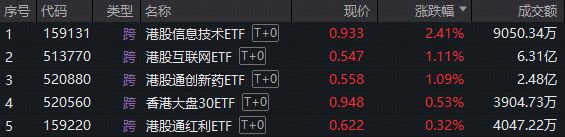
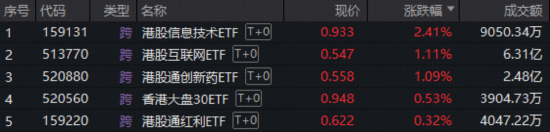
Core Viewpoint - The Chinese technology sector, particularly in Hong Kong and A-shares, is experiencing a significant rebound, driven by positive sentiment from foreign investment institutions and strong performance in the semiconductor and AI sectors. Group 1: Market Performance - Hong Kong stocks, especially in the technology sector, have shown strong performance, with the first Hong Kong ETF focused on the semiconductor industry (159131) rising by 2.41% and significant trading volume of over 90.5 million [1][4] - A-shares also saw robust performance in the dual innovation sector, with the dual innovation leader ETF (588330) increasing by 1.58% and the AI-focused ETF (159363) rising over 1% [2][3] Group 2: Foreign Investment Sentiment - Major foreign investment banks, including UBS, Goldman Sachs, and Morgan Stanley, have recently shifted their outlook to a bullish stance on Chinese technology stocks, indicating a notable change in sentiment [3][4] - A wave of foreign limited partners is returning to the Chinese primary market, particularly focusing on technology sectors, suggesting a growing trend of capital allocation towards Chinese tech innovation [3][4] Group 3: Semiconductor Sector Growth - The domestic semiconductor industry is witnessing significant growth, with companies like SMIC and Hua Hong Semiconductor reporting nearly 4% increases in stock prices [4][6] - According to Bernstein's report, domestic AI chip sales surged from $6 billion last year to $16 billion, with market share increasing from 29% to 42%, reflecting a growth rate of 112% [6] Group 4: Valuation and Investment Opportunities - The valuation of the Hong Kong technology ETF (159131) is currently at a price-to-earnings ratio of 33.75, indicating significant upside potential compared to historical highs [7][9] - The Hong Kong internet ETF (513770) is trading at a low valuation of 25.13, well below the levels of the ChiNext index and Nasdaq 100, highlighting its attractiveness for investment [14][15] Group 5: AI and Innovation Trends - Companies like Xiaomi are ramping up AI investments, with significant advancements in AI applications expected to drive growth in the sector [13][14] - Alibaba's recent launch of AI products, such as the Quark AI glasses, indicates a strong push into AI hardware and applications, further enhancing the growth narrative for the sector [13][14] Group 6: Pharmaceutical Sector Recovery - The Hong Kong innovation drug ETF (520880) has rebounded by 1.09%, signaling a recovery in the pharmaceutical sector after a period of decline [17][19] - Recent regulatory changes, including the launch of a drug pricing registration system, are expected to provide a favorable environment for innovation drug companies [19][21]

众生药业儿童用抗甲流药物昂拉地韦颗粒III期试验开始入组;凌科药业拟赴港IPO,核心在研产品面临同类激烈竞争|掘金创新药
Mei Ri Jing Ji Xin Wen· 2025-12-04 12:53
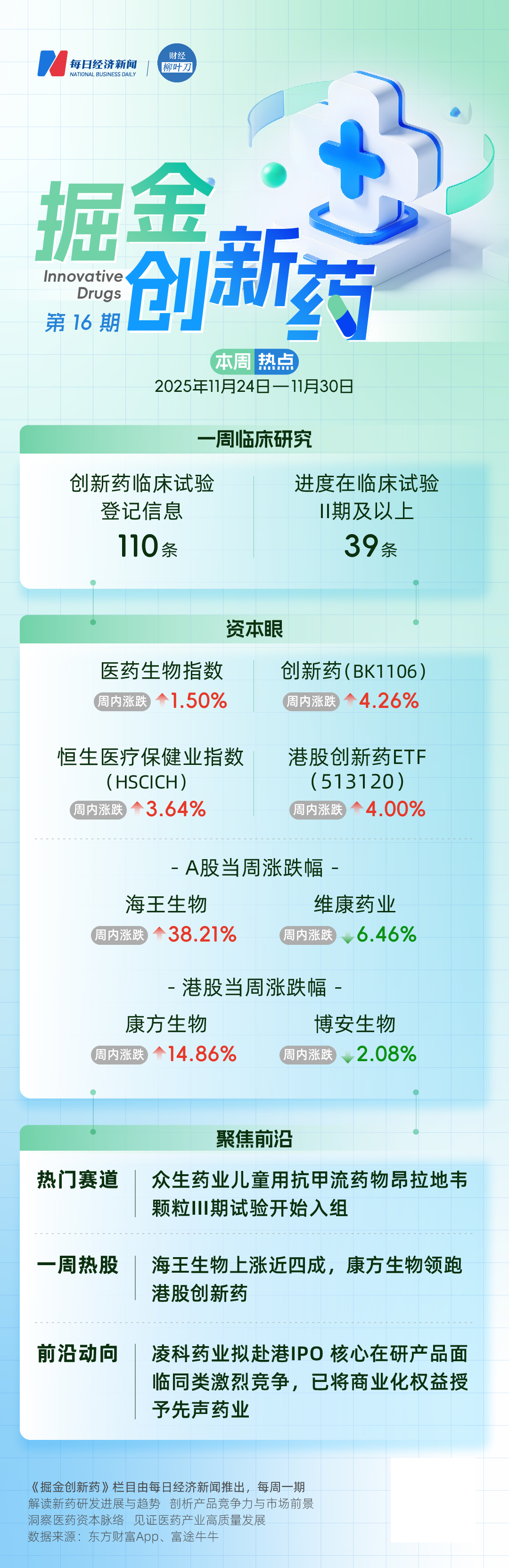
Core Insights - The Hong Kong and A-share innovative drug sectors have shown significant weekly performance, with notable increases in specific stocks such as Haiwang Bio and Kangfang Biotech, indicating a positive trend in the market [2][4][5]. Market Performance - The pharmaceutical and biotechnology index rose by 1.50%, outperforming the Shanghai Composite Index by 0.10 percentage points, marking two consecutive weeks of gains [4]. - The innovative drug sector (BK1106) saw a weekly increase of 4.26%, while the Hang Seng Healthcare Index (HSCICH) rose by 3.64% and the Hong Kong innovative drug ETF (513120) increased by 4.00% [4]. Stock Highlights - Haiwang Bio experienced a remarkable weekly increase of 38.21%, while Kangfang Biotech led with a 14.86% rise [2]. - The focus on children's antiviral drugs is highlighted by the initiation of Phase III trials for the drug Anladiwei by Zhongsheng Pharmaceutical, targeting a critical market need [12][13]. IPO Developments - Lingke Pharmaceutical has filed for an IPO in Hong Kong, focusing on innovative drugs for autoimmune and inflammatory diseases, with its lead candidate LNK01001 facing intense competition from existing JAK inhibitors [6][7]. - The company reported R&D expenditures of approximately 186 million yuan, 223 million yuan, and 121 million yuan for the years 2023, 2024, and the first nine months of 2025, respectively [7]. Clinical Trials - A total of 110 clinical trial registrations were disclosed by the National Medical Products Administration, with 39 trials in Phase II or higher, indicating robust activity in drug development [8]. - The ongoing clinical trials for various drugs, including SKB500 for small cell lung cancer and Anladiwei for pediatric influenza, reflect the industry's focus on addressing unmet medical needs [14][12]. Regulatory Approvals - Four innovative drugs received approval during the week, including Yimazhi for pediatric Tourette syndrome and a radiopharmaceutical for prostate cancer detection [11]. - The approval of Anladiwei for adult treatment earlier this year and its subsequent pediatric trial initiation underscores the strategic expansion of product lines to meet market demands [13].
港股科技资产回稳?首只聚焦“港股芯片”的159131放量涨超2%,港股互联网、港股通创新药携手反弹超1%
Xin Lang Cai Jing· 2025-12-04 11:59
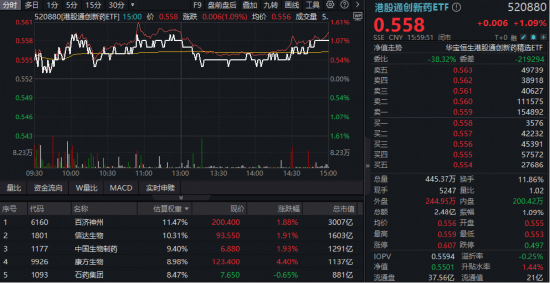
Group 1 - The core viewpoint of the article highlights a significant rebound in Chinese technology assets in both Hong Kong and A-shares, with foreign institutions increasingly optimistic about the sector [1][26][30] - The Hong Kong market saw a strong performance in the chip industry chain, with the first ETF focused on "Hong Kong chips" (159131) surging by 2.41% and significant trading volume [1][27][30] - A-shares also showed strength, particularly in the dual innovation sector, with notable gains in semiconductor chips and related ETFs [2][29] Group 2 - Major foreign investment banks, including UBS, Goldman Sachs, and Morgan Stanley, have recently published reports expressing bullish views on Chinese technology stocks, indicating a marked shift in sentiment [3][30] - The AI narrative is driving the market, with companies like Xiaomi making significant advancements in AI applications, further boosting investor confidence [13][14] - The valuation of Hong Kong technology stocks appears attractive, with the Hong Kong Information Technology ETF (159131) trading at a price-to-earnings ratio of 33.75, suggesting substantial upside potential compared to other major indices [7][30] Group 3 - The domestic chip sector is experiencing rapid growth, with sales of domestic AI chips expected to increase from $6 billion last year to $16 billion, reflecting a market share rise from 29% to 42% [6][30] - The Hong Kong Internet ETF (513770) and the Hong Kong Innovation Drug ETF (520880) also saw gains of over 1%, indicating a broader recovery in technology-related assets [1][27][30] - The Hong Kong Innovation Drug ETF (520880) has shown signs of recovery after a significant pullback, with a trading volume of 2.48 billion and a 1.09% increase [18][20][30]
港股创新药回暖,520880放量反弹1%!标的指数本轮回撤16%,调整到位了吗?
Xin Lang Cai Jing· 2025-12-04 11:47
Core Viewpoint - The Hong Kong innovative drug sector has shown signs of recovery after a period of decline, with the Hong Kong Stock Connect Innovative Drug ETF (520880) rising by 1.09% on December 4, ending a four-day losing streak and indicating a significant rebound in market sentiment [1][8]. Market Performance - The Hong Kong innovative drug sector has been in a phase of adjustment since early September, with the Hong Kong Stock Connect Innovative Drug ETF (520880) index experiencing a decline of nearly 16% from its previous high, suggesting that prior high-risk levels have been adequately released [3][11]. - The ETF's trading volume reached 248 million yuan, reflecting increased market activity and interest in the sector [1][8]. Positive News Factors - Two major positive developments have been reported: the launch of the Chinese drug price registration system on December 2, which provides market price references for drug imports and exports, and the anticipated release of the new basic medical insurance drug list and the first commercial insurance innovative drug list by the end of the week, which could optimize the payment structure for innovative drug companies [3][11]. Investment Outlook - Short-term forecasts from CITIC Securities suggest that innovative drugs are expected to be a primary upward trend in the market heading into 2026, supported by a robust domestic demand base and comprehensive manufacturing capabilities within the pharmaceutical industry [5][13]. - The current market conditions may present a favorable opportunity for medium to long-term investments in core innovative drug assets, as the sector is entering a critical phase of "innovation realization and global layout" [5][11]. ETF Characteristics - The Hong Kong Stock Connect Innovative Drug ETF (520880) is noted for its significant concentration in leading stocks, with the top ten holdings accounting for 72.57% of the index, indicating a strong representation of core innovative drug companies [6][14]. - The ETF is characterized by its focus on pure innovative drug companies, excluding CXO firms, and aims to provide comprehensive coverage of the innovative drug development sector [5][13].