
能源

Search documents
巴菲特,突发!
券商中国· 2025-11-01 14:54
Core Viewpoint - The transition of leadership at Berkshire Hathaway is accelerating, with Warren Buffett passing responsibilities to his successor, Greg Abel, amid a cautious investment strategy in the current market environment [2][4][5]. Financial Performance - In Q3 2025, Berkshire Hathaway reported revenue of $94.972 billion, up from $92.995 billion year-on-year, exceeding market expectations of $91.55 billion [3]. - The operating profit surged by 34% to $13.485 billion, while net profit increased by 17% to $30.796 billion, also surpassing market forecasts [3]. - Cash reserves reached a record high of $381.67 billion, with the company not engaging in stock buybacks for nine consecutive months [2][3]. Investment Strategy - Berkshire Hathaway's cautious approach is highlighted by its decision to net sell stocks, recording $10.4 billion in taxable gains, continuing a trend of reducing stock holdings [3][4]. - The significant increase in operating profit is primarily attributed to a more than 200% rise in insurance underwriting profits, reaching $2.37 billion, indicating a recovery in core business segments [4]. Leadership Transition - Warren Buffett will no longer write the highly anticipated annual letter to shareholders, a responsibility now assigned to Greg Abel [2][5]. - Buffett plans to step down as CEO by the end of 2025, while retaining the position of chairman [5][7]. Market Sentiment - Berkshire Hathaway recently received a rare "sell" rating from Keefe, Bruyette & Woods, downgrading its status from "market perform" to "underperform" [6][7]. - Analysts express concerns about macroeconomic uncertainties and the unique succession risks associated with the company, predicting that stock performance may lag behind the market [7][8]. - As of October 31, 2025, Berkshire B shares have only risen 5.35% year-to-date, compared to a 16.3% increase in the S&P 500 index, reflecting a potential decline in the "Buffett premium" [7][8].


伯克希尔,重大发布!最后一次!“巴菲特溢价”面临考验
Zheng Quan Shi Bao· 2025-11-01 14:42
Core Insights - Berkshire Hathaway, led by Warren Buffett, released its latest financial report before his resignation as CEO, showing stable performance but underperforming compared to the market [1] Financial Performance - In Q3, Berkshire Hathaway reported revenue of $94.972 billion, a year-over-year increase of 2.13% [2] - Net profit attributable to shareholders was $30.796 billion, up 17% year-over-year [2] - Operating profit reached $13.49 billion, a significant increase of 34% compared to $10.09 billion in the same period last year [2] - As of September 30, the fair value of the company's equity securities investments was $283.241 billion, with the top five holdings (American Express, Apple, Bank of America, Coca-Cola, Chevron) accounting for 66% of the total fair value [2] - The company announced a major acquisition plan to purchase Occidental Petroleum's chemical business for $9.7 billion in cash, expected to be completed by Q4 2025 [2] Stock Performance - Despite stable financial results, Berkshire Hathaway's stock has underperformed since Buffett announced his resignation as CEO in May, with a decline of 11% from a historical high of $812,855 [3] - In contrast, the S&P 500 index has increased by 21% during the same period [3] - Analyst Meyer Shields downgraded Berkshire Hathaway's A-class stock rating from "in line with the market" to "underperform," citing several factors moving in the wrong direction [3][4] Analyst Insights - Shields also lowered the target price for Berkshire Hathaway's A-class stock from $740,000 to $700,000, highlighting unique challenges related to the successor of Buffett and weak performance in key business areas [4] - Concerns about the uncertainty surrounding Buffett's successor are seen as a major factor affecting investor sentiment, with the so-called "Buffett premium" appearing to diminish [4] - The company faces operational pressures across its diversified portfolio, including insurance, railroads, and energy sectors [4]
【环球财经】俄扩大对欧盟成员国及其机构代表的入境禁令名单
Xin Hua She· 2025-11-01 05:38
Core Points - Russia has expanded its entry ban list against EU member states and representatives of EU institutions in response to the EU's 19th round of sanctions against Russia [1] - The Russian Foreign Ministry stated that the EU's unilateral restrictive measures are not in accordance with international law, prompting Russia to significantly broaden the list of individuals banned from entering the country [1] Summary by Categories Sanctions and Responses - The expanded entry ban includes representatives of EU institutions, EU member states, and individuals from several European countries that pursue anti-Russian policies [1] - The list targets individuals involved in providing military assistance to Ukraine, organizing supplies of dual-use products to Ukrainian forces, and activities aimed at undermining Russia's territorial integrity [1] - The ban also includes those who support the establishment of a "special court" against Russian leadership, advocate for the confiscation of Russian state assets, and those involved in formulating and implementing sanctions against Russia [1] Political Stance - The Russian Foreign Ministry emphasized that the EU's hostile actions will not affect Russia's policy stance, asserting that Russia will continue to defend its national interests and protect the rights and freedoms of its citizens [1] - Russia aims to maintain its position in the emerging multipolar world order [1] EU Sanctions - The EU Council announced on October 23 that it officially adopted the 19th round of sanctions against Russia, which includes 69 new individual sanctions and various economic restrictions primarily targeting the Russian energy, financial, and military-industrial sectors [1]
四川“十四五”时期基础设施建设主要成就发布 “四张网”撑起高质量发展新格局
Si Chuan Ri Bao· 2025-11-01 01:24
Group 1: Infrastructure Achievements - Sichuan has made significant progress in infrastructure construction during the "14th Five-Year Plan" period, focusing on both traditional and new infrastructure, resulting in a comprehensive transportation network, modern water conservancy network, green energy network, and smart digital network [1] - The total length of the comprehensive transportation network in Sichuan has reached 443,000 kilometers, ranking first in the country, equivalent to the distance from Earth to the Moon [2] - The province's highway network has reached 425,000 kilometers, also ranking first nationally, with the high-speed railway mileage expected to reach 11,000 kilometers by the end of this year, ranking third in the country [2] Group 2: Investment in Transportation - Transportation has become a key driver of investment growth in Sichuan, with road and waterway construction investments exceeding 200 billion yuan in the first year of the "14th Five-Year Plan" and maintaining a high level of over 10% of the province's fixed asset investment [3] - Cumulatively, Sichuan has completed 1.2 trillion yuan in transportation investment during the "14th Five-Year Plan," ranking first in the country [3] Group 3: Water Resources Development - Sichuan's water resources development has seen significant advancements, with total water conservancy investment expected to exceed 70 billion yuan this year and a total investment of 280 billion yuan during the "14th Five-Year Plan," double that of the previous five-year period [4][5] - The province has diversified its investment sources, attracting social capital through various means, including government special bonds and financial credit funds [5] Group 4: Energy and Digital Infrastructure - Sichuan's total installed power capacity has reached 149 million kilowatts, with hydropower capacity expected to exceed 100 million kilowatts this year [5] - The province has established a comprehensive computing power system, with 128 data centers built and 49 under construction, achieving a significant increase in intelligent computing power from less than 10% to nearly 60% [6]
隔夜美股 | 三大指数收涨 纳指连续第7个月录得涨幅
智通财经网· 2025-10-31 23:57
Market Performance - The three major U.S. indices closed higher, with the S&P 500 index achieving a six-month consecutive increase, rising 2.27% this month, marking the longest monthly winning streak since August 2021 [1] - The Dow Jones index also saw a six-month consecutive increase, up 2.51% this month, while the Nasdaq index recorded a seven-month consecutive increase, rising 4.7%, the longest streak since January 2018 [1] - As of the close, the Dow rose by 40.75 points (0.09%) to 47,562.87 points, the Nasdaq increased by 143.81 points (0.61%) to 23,724.96 points, and the S&P 500 gained 17.86 points (0.26%) to 6,840.20 points [1] Commodity Prices - WTI crude oil futures for December delivery rose by 0.7%, settling at $60.98 per barrel, while January Brent crude oil futures increased by 0.6% to $64.77 per barrel [3] - OPEC+ is expected to agree on a slight increase in oil production targets for December, with a potential increase of 137,000 barrels per day, amid concerns of oversupply in the market [3] Cryptocurrency - Bitcoin rose over 1% to $10.9, while Ethereum surpassed $3,900 per coin, increasing by 2.54% [4] Precious Metals - Spot gold fell by 0.55% to $4,002.62, with Morgan Stanley projecting gold prices could rise to $4,500 per ounce by mid-2026 due to strong physical demand from ETFs and central banks [5] Federal Reserve Insights - Federal Reserve Governor Waller indicated that data suggests a rate cut in December, despite concerns about the labor market and inflation [6] - Several Federal Reserve officials expressed caution regarding excessive rate cuts, emphasizing the need to maintain a restrictive policy to control inflation [7] Corporate Developments - Tesla CEO Elon Musk announced plans to potentially unveil a flying car by the end of this year, claiming it will surpass all James Bond vehicles [8] - Coinbase is in advanced talks to acquire stablecoin infrastructure company BVNK for approximately $2 billion, aiming to enhance its stablecoin business [8] Analyst Ratings - HSBC raised its target price for Apple (AAPL.US) from $220 to $250 [9] - UBS increased its target price for Amazon (AMZN.US) from $279 to $310, maintaining a buy rating [9]


麦肯锡称巴西正在吸引战略领域投资
Shang Wu Bu Wang Zhan· 2025-10-31 16:40
Group 1 - The core viewpoint of the article highlights a significant increase in foreign investment in Brazil's strategic sectors, particularly in natural resources and infrastructure [1] - Foreign investments are primarily concentrated in energy, mining, agriculture, and pulp industries [1] - Brazil faces challenges in advanced industrial competition, particularly in semiconductors and electric vehicles [1] Group 2 - The main driver of Brazil's economic growth in recent years has been population growth rather than productivity improvement [1] - Brazil has been undergoing a "de-industrialization" process, lagging behind larger and more competitive countries like the United States and China [1] - McKinsey suggests that Brazil should increase investments in technology and artificial intelligence to drive productivity leaps [1] Group 3 - Tax reform and regulatory improvements could help Brazil attract more foreign investment [1] - Brazil needs to address issues related to public debt sustainability and security to further enhance its business environment [1]
A subsidiary of Aktsiaselts Infortar signed a share purchase agreement for acquiring a shareholding in OÜ Oisu Biogaas
Globenewswire· 2025-10-31 14:00
Core Points - Aktsiaselts Infortar's subsidiary OÜ Infortar Agro has entered into a share purchase agreement to acquire a 60% stake in OÜ Oisu Biogaas [1][2] - This acquisition follows Infortar's earlier purchase of Estonia Farmid, a major agricultural company in Estonia, which supplies raw materials for the biomethane plant in Oisu [2] - The transaction requires approval from the Competition Authority and completion of additional operations before it can be finalized [2] Company Overview - Infortar operates in seven countries, focusing on maritime transport, energy, and real estate, with a diverse portfolio including a 68.47% stake in Tallink Grupp and a 100% stake in Elenger Grupp [4] - The company has a real estate portfolio of approximately 141,000 square meters and employs 6,866 people across 110 companies, including 101 subsidiaries [4] - Infortar is also involved in construction, mineral resources, agriculture, and printing, showcasing its diversified business model [4]

2025年11月海外金股推荐:资源品和科技百花齐放
GOLDEN SUN SECURITIES· 2025-10-31 09:05
Recent Key Events - The recent US-China trade negotiations in Kuala Lumpur focused on key economic issues, including maritime logistics, tariffs, and agricultural trade, leading to a basic consensus on resolving mutual concerns [1][9] - The Chinese government released the 15th Five-Year Plan, emphasizing the development of strategic emerging industries such as new energy, aerospace, and quantum technology [2][10] - Nvidia announced collaborations to develop new supercomputers and autonomous vehicle fleets, projecting GPU sales to reach $500 billion by the end of 2026 [4][12] Market Situation - The Hong Kong stock market experienced a pullback in October, with the Hang Seng Index declining from 26,856 points at the end of September to 26,346 points by October 28, a drop of 1.9% [13] - The Hang Seng Technology Index fell by 5.8% during the same period, while both indices have seen significant gains year-to-date, with increases of 31.3% and 36.4% respectively [13] - Net inflows from southbound trading in Hong Kong stocks reached HKD 701 billion in October, indicating stable investment interest [14] Current Investment Recommendations - Focus on growth-oriented energy and non-ferrous metal companies such as Luoyang Molybdenum, China Qinfa, and China Hongqiao [23] - Pay attention to internet companies benefiting from AI model iterations, including Alibaba and Kuaishou [23] - Consider undervalued and high-growth electronic component firms like QiuTai Technology and AAC Technologies [23] - Monitor new energy vehicle companies and those recently listed in Hong Kong, such as Leap Motor, Xiaopeng Motors, and Pony.ai [23] Company-Specific Insights Luoyang Molybdenum (3993.HK) - The company reported a revenue of CNY 145.5 billion for the first three quarters of 2025, with a net profit increase of 72.6% year-on-year [24][30] - Production of copper and cobalt exceeded expectations, with copper output reaching 543,400 tons, a 14.14% increase [25][30] China Qinfa (0866.HK) - The company achieved a revenue of CNY 1.089 billion in the first half of 2025, with a focus on optimizing its operations in Indonesia [32][33] - The divestment of underperforming assets is expected to enhance financial metrics and allow for greater focus on profitable ventures [33] China Hongqiao (1378.HK) - The company reported a revenue of CNY 81.04 billion in the first half of 2025, a 10.1% increase, driven by higher aluminum prices and lower electricity costs [39][40] - The increase in production capacity is expected to further enhance profitability [41] Alibaba (9988.HK) - Alibaba's revenue for the first quarter of FY2026 was CNY 247.65 billion, with a 2% year-on-year growth, driven by its e-commerce and cloud services [45][48] - The company is focusing on enhancing its instant retail capabilities and AI-driven cloud services [46][48] Kuaishou (1024.HK) - Kuaishou reported a revenue of CNY 35 billion in Q2 2025, reflecting a 13.1% year-on-year growth, with significant contributions from e-commerce [50] - The company is optimizing its marketing strategies and enhancing its AI capabilities to drive future growth [51][52] QiuTai Technology (1478.HK) - The company achieved a revenue of CNY 8.83 billion in the first half of 2025, with a notable increase in profit margins [53] - QiuTai is expanding its product offerings in the IoT sector and enhancing its competitive edge through vertical integration [54]

发电业务估值超过了英伟达和GE Vernova!大摩:卡特彼勒被严重高估
Hua Er Jie Jian Wen· 2025-10-31 06:42
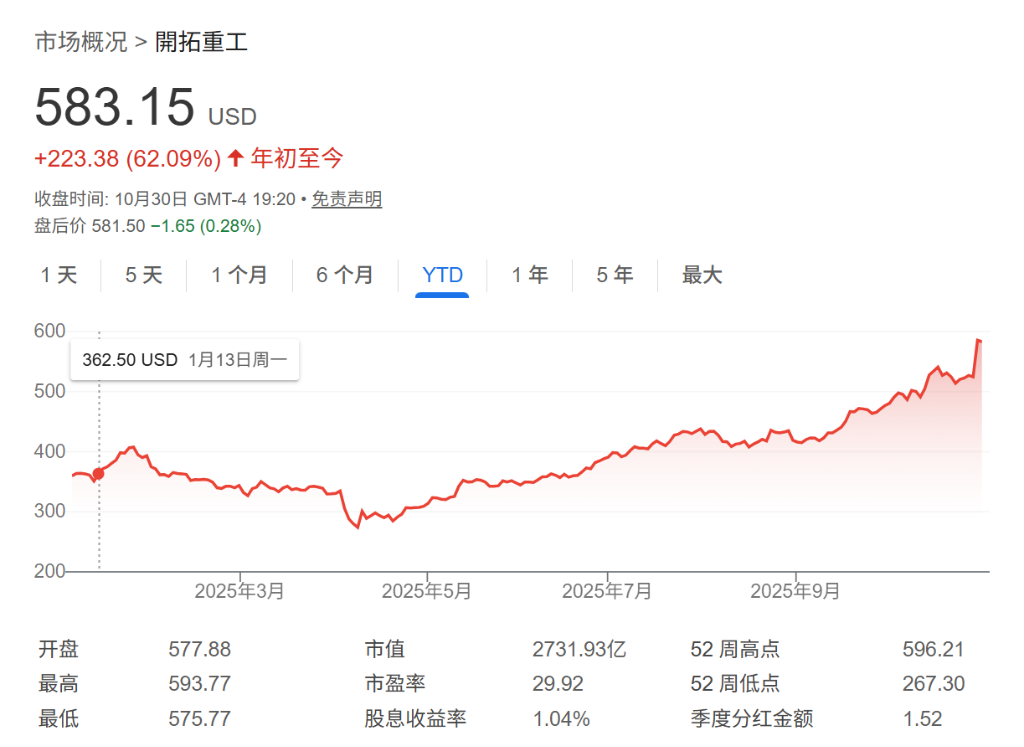
Core Viewpoint - Morgan Stanley warns that the market valuation multiples for Caterpillar's power generation business have significantly exceeded those of industry leaders like Nvidia and GE Vernova, indicating a potential overvaluation that could lead to a sharp correction if market conditions change [1][4]. Valuation Comparison - Caterpillar's power generation business is currently valued at an EV/EBITDA multiple between 58x and 103x, while GE Vernova and Nvidia are valued at approximately 28x and 25x, respectively [1][4]. - This suggests that the market perceives Caterpillar's power generation business as more valuable than the related businesses of top technology and energy companies [4]. Business Segment Analysis - The projected EBITDA for Caterpillar's segments in 2026 is as follows: - Construction Industries: $3,664 million at a 13.0x multiple, resulting in an EV of $47,628 million - Resource Industries: $2,118 million at a 13.0x multiple, resulting in an EV of $27,538 million - Power Generation: $1,508 million at a 103.0x multiple, resulting in an EV of $155,369 million - Other Energy & Transportation: $7,132 million at a 13.0x multiple, resulting in an EV of $92,713 million [5]. Market Expectations - To justify Caterpillar's current stock price of $585, the market must accept one of two extreme scenarios: 1. The valuation of Caterpillar's traditional cyclical businesses (like construction and resource extraction) is pushed to "absurd levels" far beyond historical norms. 2. Even with optimistic assumptions for the power generation business, the implied valuation for cyclical businesses remains high at 28x, despite declining operating margins [6][7]. - Morgan Stanley estimates that even with aggressive growth projections for the power generation business, it is unlikely to meet bullish expectations of $20 billion in sales by 2027 [7]. Price Target and EPS Forecast - Morgan Stanley maintains a 2026 EPS forecast for Caterpillar at $19.24, with a target price of $380 based on a 20x P/E ratio, indicating a potential downside of 35% from the current stock price [7].


能源化工期权策略早报:能源化工期权-20251031
Wu Kuang Qi Huo· 2025-10-31 03:54
Group 1: Report Overview - Report Title: Energy and Chemical Options Strategy Morning Report [2] - Date: October 31, 2025 [2] - Covered Option Types: Energy (crude oil, LPG), polyolefins (PP, PVC, L, EB), polyester (PX, PTA, PF, PR), alkali chemicals (SH, SA, UR), and others (rubber) [3] - General Strategy: Construct option portfolio strategies mainly as sellers, and enhance returns through spot hedging or covered strategies [3] Group 2: Underlying Futures Market Overview - Multiple underlying futures are presented, including crude oil, LPG, methanol, etc., with details on the latest price, change, change rate, trading volume, volume change, open interest, and open interest change [4] Group 3: Option Factor - Volume and Open Interest PCR - PCR indicators (volume PCR and open interest PCR) are provided for various options, which are used to describe the strength of the option underlying market and the turning point of the underlying market [5] Group 4: Option Factor - Pressure and Support Levels - Pressure and support levels for each option are determined based on the strike prices with the largest open interest of call and put options [6] Group 5: Option Factor - Implied Volatility - Implied volatility data, including at - the - money implied volatility, weighted implied volatility, and its change, are presented for different options [7] Group 6: Strategy and Recommendations for Each Option Type Crude Oil Options - Fundamental Analysis: US refinery demand is stabilizing and rising, shale oil production cut is small, OPEC exports are increasing but mostly absorbed by China, and European refined product inventory is decreasing while crude oil inventory is rising [8] - Market Analysis: The crude oil market has shown a pattern of weakening, consolidation, and then a rebound since July [8] - Option Factor Analysis: Implied volatility has declined to near the average, open interest PCR indicates a weak market, and the pressure and support levels are 500 and 450 respectively [8] - Strategy Recommendations: For volatility, construct a neutral short call + put option combination; for spot hedging, use a long collar strategy [8] LPG Options - Fundamental Analysis: High production and inventory in the US, potential extreme weather in winter and Sino - US trade trends may affect prices, and OPEC + policies will impact future exports [10] - Market Analysis: The LPG market has experienced a decline, followed by a rebound and then a resistance to further increase [10] - Option Factor Analysis: Implied volatility has significantly declined to below the average, open interest PCR indicates a weak market, and the pressure and support levels are 4500 and 4000 respectively [10] - Strategy Recommendations: Similar to crude oil, construct a neutral short call + put option combination for volatility and a long collar strategy for spot hedging [10] Methanol Options - Fundamental Analysis: Port inventory is increasing at a slower rate, and enterprise inventory is at a relatively low level year - on - year [10] - Market Analysis: The methanol market has shown a weak trend with some rebounds [10] - Option Factor Analysis: Implied volatility fluctuates around the historical average, open interest PCR indicates a weak and volatile market, and the pressure and support levels are 2300 and 2200 respectively [10] - Strategy Recommendations: Construct a short - biased call + put option combination for volatility and a long collar strategy for spot hedging [10] Ethylene Glycol Options - Fundamental Analysis: EG load has decreased, port inventory is increasing, and it has entered a inventory accumulation cycle [11] - Market Analysis: The ethylene glycol market has been in a weak trend [11] - Option Factor Analysis: Implied volatility fluctuates below the average, open interest PCR indicates strong short - side power, and the pressure and support levels are 4500 and 4050 respectively [11] - Strategy Recommendations: Construct a bear spread strategy for direction, a short - volatility strategy for volatility, and a long collar strategy for spot hedging [11] Polypropylene Options - Fundamental Analysis: PP inventory pressure is higher than PE [11] - Market Analysis: The polypropylene market has shown a weak trend [11] - Option Factor Analysis: Implied volatility has declined to near the average, open interest PCR indicates a weak market, and the pressure and support levels are 7000 and 6300 respectively [11] - Strategy Recommendations: Use a long collar strategy for spot hedging [11] Rubber Options - Fundamental Analysis: Imported rubber prices are rising, but downstream procurement is weak [12] - Market Analysis: The rubber market has been in a weak consolidation pattern [12] - Option Factor Analysis: Implied volatility has decreased to below the average, open interest PCR is below 0.6, and the pressure and support levels are 17000 and 14000 respectively [12] - Strategy Recommendations: Construct a short - biased call + put option combination for volatility [12] PTA Options - Fundamental Analysis: PTA load is increasing slightly, and maintenance volume in October has decreased [12] - Market Analysis: The PTA market has shown a weak trend [12] - Option Factor Analysis: Implied volatility fluctuates at a relatively high level, open interest PCR indicates a volatile market, and the pressure and support levels are 4600 and 4300 respectively [12] - Strategy Recommendations: Construct a short - biased call + put option combination for volatility [12] Caustic Soda Options - Fundamental Analysis: Non - aluminum demand for caustic soda has not shown significant restocking, and cost support has weakened [13] - Market Analysis: The caustic soda market has been in a weak downward trend [13] - Option Factor Analysis: Implied volatility is at a high level, open interest PCR indicates a weak and volatile market, and the pressure and support levels are 2600 and 2240 respectively [13] - Strategy Recommendations: Construct a bear spread strategy for direction and a long collar strategy for spot hedging [13] Soda Ash Options - Fundamental Analysis: Soda ash inventory has increased slightly [13] - Market Analysis: The soda ash market has been in a weak consolidation pattern [13] - Option Factor Analysis: Implied volatility is at a relatively high historical level, open interest PCR indicates strong short - side pressure, and the pressure and support levels are 1300 and 1100 respectively [13] - Strategy Recommendations: Construct a short - volatility combination strategy for volatility and a long collar strategy for spot hedging [13] Urea Options - Fundamental Analysis: Enterprise inventory is at a high level year - on - year, and port inventory is decreasing [14] - Market Analysis: The urea market has been in a weak and volatile pattern [14] - Option Factor Analysis: Implied volatility fluctuates around the historical average, open interest PCR indicates strong short - side pressure, and the pressure and support levels are 1800 and 1600 respectively [14] - Strategy Recommendations: Construct a neutral short call + put option combination for volatility and a long collar strategy for spot hedging [14] Group 7: Charts - Charts for each option type are provided, including price trends, volume and open interest, PCR indicators, implied volatility, historical volatility cones, and pressure and support levels [15][36][54]