证券

Search documents
午评:沪指涨0.22% 化工板块反复走强
Xin Lang Cai Jing· 2026-02-11 04:18
Market Overview - The three major indices showed mixed performance, with the Shanghai Composite Index rising by 0.22% to 4137.55 points, while the Shenzhen Component Index fell by 0.07% to 14200.38 points, and the ChiNext Index decreased by 0.91% to 3290.41 points [1] Sector Performance - The chemical sector has shown strong performance recently, with companies like Jihua Group achieving a 5-day streak of gains, and stocks such as Sanfangxiang, Baichuan Co., Vinegar Chemical, and Hualitai hitting the daily limit [2] - The fiberglass concept saw rapid gains, with Shandong Fiberglass, International Composites, and China Jushi all reaching the daily limit [2] - The computing power leasing concept also surged, with Naxing Co. and Dawi Technology hitting the daily limit [2] - Conversely, the film and cinema sector faced significant declines, with Hengdian Film falling to the daily limit [2] Individual Stock Performance - Over 2700 stocks in the market experienced an increase [3] Institutional Insights - CITIC Securities highlighted that the surge in silver prices could accelerate the replacement of precious metal pastes by leading photovoltaic cell manufacturers, leading to increased cost differentiation in the industry. They expect a rapid acceleration in the "anti-involution" trend within the photovoltaic industry, recommending leading manufacturers in battery components, pastes, and equipment [4] - Huatai Securities projected that by 2025, new investments from insurance funds in secondary equity (including stocks and funds) could reach 1 trillion yuan, with secondary equity positions potentially reaching around 16%. They anticipate that by 2026, total new investable funds from insurance could reach 3.1 trillion yuan, with new investments in secondary equity expected to hit 900 billion yuan. They also noted that dividend stocks will remain a key focus for insurance fund allocations [4]
Q4货政报告显示政策稳增长诉求提升但宽松落地时点仍需观察
Huafu Securities· 2026-02-11 04:11
Group 1: Report Industry Investment Rating - The report doesn't explicitly mention the investment rating for the fixed - income industry [1][2][3] Group 2: Report's Core View - The Q4 monetary policy report shows an increased demand for stable growth, but the timing of policy easing needs further observation. The central bank may still be in the observation period of the fundamentals and has not provided clues for the timing of subsequent reserve requirement ratio cuts and interest rate cuts. The short - term bond market may continue to fluctuate strongly, and the follow - up situation depends on the clarification of the fundamentals and policy environment after the Two Sessions and post - holiday resumption of work [2][5][7] Group 3: Summary of Related Catalogs Concerns about risk prevention have weakened, and the demand for stable growth has increased - The Q4 report maintains confidence in the domestic economy but mentions the problem of strong supply and weak demand. In the next - stage policy tone, the central bank removed the relationship of "balancing stable growth and risk prevention" and adjusted the consideration from "promoting a reasonable recovery of prices" to "promoting stable economic growth and a reasonable recovery of prices". After the release of the Q4 GDP growth rate dropping to 4.5%, the central government's demand for stable growth has increased, and the central bank's concern about the risks brought by easing has decreased, which may be the reason for the overall loose monetary policy recently [2][3] The central bank has not revealed signals for the implementation of aggregate policies, and reserve requirement ratio cuts and interest rate cuts may depend on the overall central government deployment - The report continues the spirit of the Central Economic Work Conference at the overall policy level, but many statements in the text are the same as those in the Q3 monetary policy report. This may reflect that although the central government's tone has changed, the central bank may not have fully conceived the specific time for policy implementation and is still in the observation period of the fundamentals. Subsequent reserve requirement ratio cuts and interest rate cuts may depend on the overall policy deployment [4] The central bank pays attention to changes in long - term yields and flexibly controls the scale of treasury bond trading operations - The central bank mentioned the coordination between monetary policy and fiscal policy in Column 1. It will normalize the trading of treasury bonds, pay attention to changes in long - term yields, and flexibly control the operation scale. After the interest rate central point rose from 1.75% - 1.85% to 1.8% - 1.9%, the central bank increased its bond purchase scale. However, after the interest rate breaks through 1.8%, further decline may rely more on its own strength [4] Deposit transfer, overnight interest rate, and exchange rate appreciation - The phenomenon of financial disintermediation and deposit transfer may affect the bank liability structure but will not impact the overall liquidity. The central bank emphasizes guiding short - term money market interest rates to run smoothly around the policy rate, and 1.3% of DR001 may be considered within the policy rate range. The report shows that the central bank may tolerate a certain degree of RMB exchange rate appreciation [5]
刚刚,直线拉升!香港,突发大消息!
Xin Lang Cai Jing· 2026-02-11 04:08
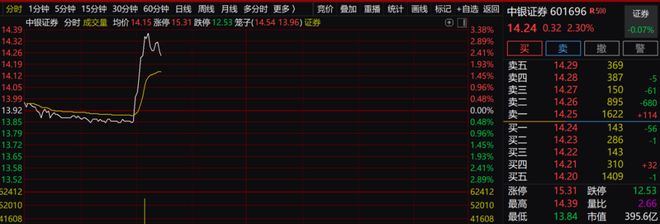
Market Movement - Zhongyin Securities experienced a sudden surge in stock price, rising from a -0.5% decline to over a 3% increase [1] - Other stocks related to stablecoins, such as Lingyi Technology, also saw significant gains [1] Regulatory Developments - Hong Kong's Chief Executive, Li Jiachao, announced at the Consensus Hong Kong conference that the Hong Kong Monetary Authority (HKMA) is actively processing license applications for stablecoin issuers, with the first licenses expected to be issued next month [3] - The HKMA is evaluating applications for stablecoin issuance and has requested additional information from some applicants regarding their risk management frameworks and asset reserves [3] - The HKMA emphasized that any licensed operators involved in cross-border activities must comply with the regulations of the jurisdictions where they operate [3] Industry Landscape - Major technology and financial firms are making significant moves in the stablecoin sector, with Ant Group's Ant International becoming the first client of HSBC's tokenized deposit blockchain settlement service [4] - JD.com's blockchain technology arm is one of the first participants in the HKMA's stablecoin sandbox, alongside Standard Chartered Bank and Yuanbi Technology [4] - Xiaomi's Tianxing Bank has partnered with JD.com's blockchain technology to develop stablecoin solutions, indicating a growing interest from internet giants in the Web3 space [5] Regulatory Concerns - A joint notice from several Chinese regulatory bodies highlighted the risks associated with stablecoins, particularly those pegged to the renminbi, stating that no entity is allowed to issue such stablecoins abroad without approval [5] - The Bank for International Settlements reported three major flaws of stablecoins: lack of central bank backing, insufficient measures against illegal use, and absence of funding flexibility for generating loans [5]


刚刚,直线拉升!香港,突发大消息!
券商中国· 2026-02-11 03:52
Market Movement - China Securities (中银证券) experienced a sudden surge, with its stock price increasing from a decline of -0.5% to over 3% rise, indicating strong market interest [1] - Other stocks related to stablecoins, such as Lianyi Technology and Lianlian Digital, also saw significant increases [1] Stablecoin Developments - Hong Kong's Chief Executive, John Lee, announced that the Hong Kong Monetary Authority (HKMA) is actively processing license applications for stablecoin issuers, with the first licenses expected to be issued next month [3] - The implementation of the Stablecoin Regulation last August established a licensing system for issuers of fiat-backed stablecoins in Hong Kong [3] - HKMA's President, Eddie Yue, emphasized that the number of initial licenses will be limited to ensure a cautious approach [3] Regulatory Landscape - Major technology and financial firms are making significant investments in the stablecoin sector, with Ant Group and JD.com being notable players [4] - Standard Chartered Bank is recognized for its strong financial infrastructure and experience in sandbox testing, positioning it favorably in the market [5] - A joint notice from several Chinese regulatory bodies highlighted that any issuance of stablecoins pegged to the Renminbi outside of China requires approval [5] Challenges of Stablecoins - The Bank for International Settlements (BIS) identified three main shortcomings of stablecoins: lack of central bank backing, insufficient measures against illegal use, and limited flexibility in generating loan funds [6]

固态电池概念拉升,电池ETF(561910)涨1.21%
Sou Hu Cai Jing· 2026-02-11 03:51
Group 1 - The Shanghai Composite Index rose by 0.27%, while the Shenzhen Component Index increased by 0.08%, and the ChiNext Index fell by 0.60% as of February 11 [2] - Small metals, energy metals, and cobalt sectors showed significant gains, with the battery ETF (561910) increasing by 1.21% [2] - Key stocks such as Greeenmei (002340.SZ) hit the daily limit, while New Zhoubang (300037.SZ), Zhongwei New Materials (300919.SZ), and Duofuduo (002407.SZ) rose over 5% [2] Group 2 - Aijian Securities forecasts that the domestic battery and lithium iron phosphate cathode material production will exceed that of the same period in 2024, with lithium carbonate prices recently declining and energy storage cell prices rising [3] - The implementation of a new pricing mechanism for independent energy storage capacity on the grid side is expected to further drive energy storage demand, promoting growth in the lithium battery industry [3] - Xinyi Securities notes that since the second half of 2024, solid-state battery sector has seen frequent catalytic events, boosting the overall prosperity of the lithium battery sector [3]





2025年四季度货币政策执行报告解读:从“先手棋”到“组合拳”
Huafu Securities· 2026-02-11 03:22
Monetary Policy Insights - By the end of 2025, the loan interest rate decreased by 10 basis points to 3.15%, with general loan rates falling by 12 basis points to 3.55%[2][10] - The central bank's excess reserve ratio rose to 1.5% by the end of 2025, up 0.1 percentage points from September and 0.4 percentage points year-on-year[2][10] Fiscal and Monetary Coordination - The report emphasizes the coordination between monetary and fiscal policies, highlighting three main modes of collaboration: supporting government bond issuance, using "re-lending + fiscal subsidies," and risk-sharing mechanisms[3][12] - The government is expected to be the main driver of leverage in 2026, with limited room for significant rate cuts due to the need to maintain low financing costs[3][12] Liquidity and Financial Structure - The central bank aims to merge asset management products with bank deposits to better observe liquidity, indicating that changes in deposit structure do not significantly affect total liquidity[4][13] - The growth rate of combined household and corporate deposits aligns closely with M2 growth, showing no significant volatility in overall liquidity[4][13] Economic Outlook and Policy Focus - The central bank expresses concerns over economic conditions, including trade barriers and inflation risks, while emphasizing the need for macro policy consistency and flexibility in counter-cyclical adjustments for 2026[5][15] - Future monetary policy will focus on expanding domestic demand and optimizing supply, with an emphasis on service consumption and new productive capacities[5][15] Risk Considerations - Potential risks include unexpected policy changes, slower-than-expected economic recovery, and the possibility of historical economic patterns not holding true in the current context[6][19][20]
A股市场快照:宽基指数每日投资动态-20260211
Jianghai Securities· 2026-02-11 03:21
- The report primarily focuses on tracking and analyzing the performance of broad-based indices in the A-share market, including metrics such as daily returns, moving averages, turnover rates, risk premiums, PE-TTM, dividend yields, and net asset ratios[1][3][4] - The turnover rate of the indices is calculated as the weighted average of the turnover rates of constituent stocks, weighted by their free-float market capitalization[19] - The risk premium is measured relative to the 10-year government bond yield, serving as a reference for risk-free rates, to evaluate the relative investment value and deviation of indices[28][30] - The PE-TTM (Price-to-Earnings Trailing Twelve Months) is used as a valuation reference to assess the investment value of indices at the current point in time, with historical percentile ranks provided for comparison[40][43] - Dividend yield is analyzed as a measure of cash return, particularly relevant during market downturns or periods of declining interest rates, with historical trends and percentile ranks provided for each index[49][54] - The net asset ratio (or "破净率") is tracked to reflect the proportion of stocks trading below their book value, indicating market valuation attitudes and potential undervaluation[55][58]
央行四季度货币政策报告6大信号:存款“流失”的变与不变
GOLDEN SUN SECURITIES· 2026-02-11 03:16
Group 1: Monetary Policy Outlook - The central bank maintains an optimistic view on the domestic economy, expecting stable growth conditions for 2026, supported by solid foundations, new growth drivers, and strong policy support[2] - The monetary policy continues to emphasize "appropriate easing" and the importance of promoting stable economic growth as a key consideration[7] - The social financing cost outlook has shifted from "promoting cost reduction" to "promoting low-cost operation," indicating a more cautious approach to interest rate cuts[8] Group 2: Global Economic Concerns - The central bank has alleviated concerns about the global economy, citing short-term resilience in growth, but notes a divergence in performance among major economies[3] - Risks highlighted include persistent inflation, cooling labor markets, and increasing global trade uncertainties[3] - The central bank emphasizes the need for enhanced counter-cyclical and cross-cyclical adjustments to improve macroeconomic governance[4] Group 3: Inflation and Price Trends - Global inflation remains sticky, with ongoing monitoring of the de-inflation process, particularly in the U.S., U.K., and Japan[6] - Domestic inflation shows positive changes, with the CPI rising to its highest level since March 2023 by the end of 2025, supported by improved supply-demand matching[6] - The central bank prioritizes promoting reasonable price recovery as a key aspect of monetary policy[6] Group 4: Banking Sector Dynamics - The report discusses the "loss" of bank deposits, indicating that while asset reallocation affects bank liabilities, it does not significantly alter overall liquidity in the financial system[9] - The weighted average interest rate for new loans in December 2025 was 3.15%, down 0.09 percentage points from September, with corporate loans at 3.1% and personal housing loans stable at 3.06%[8]
来自华尔街的测算:“存款迁移”只有1万亿,而非10万亿,但对保险和A股仍然“意义重大”
Hua Er Jie Jian Wen· 2026-02-11 03:08
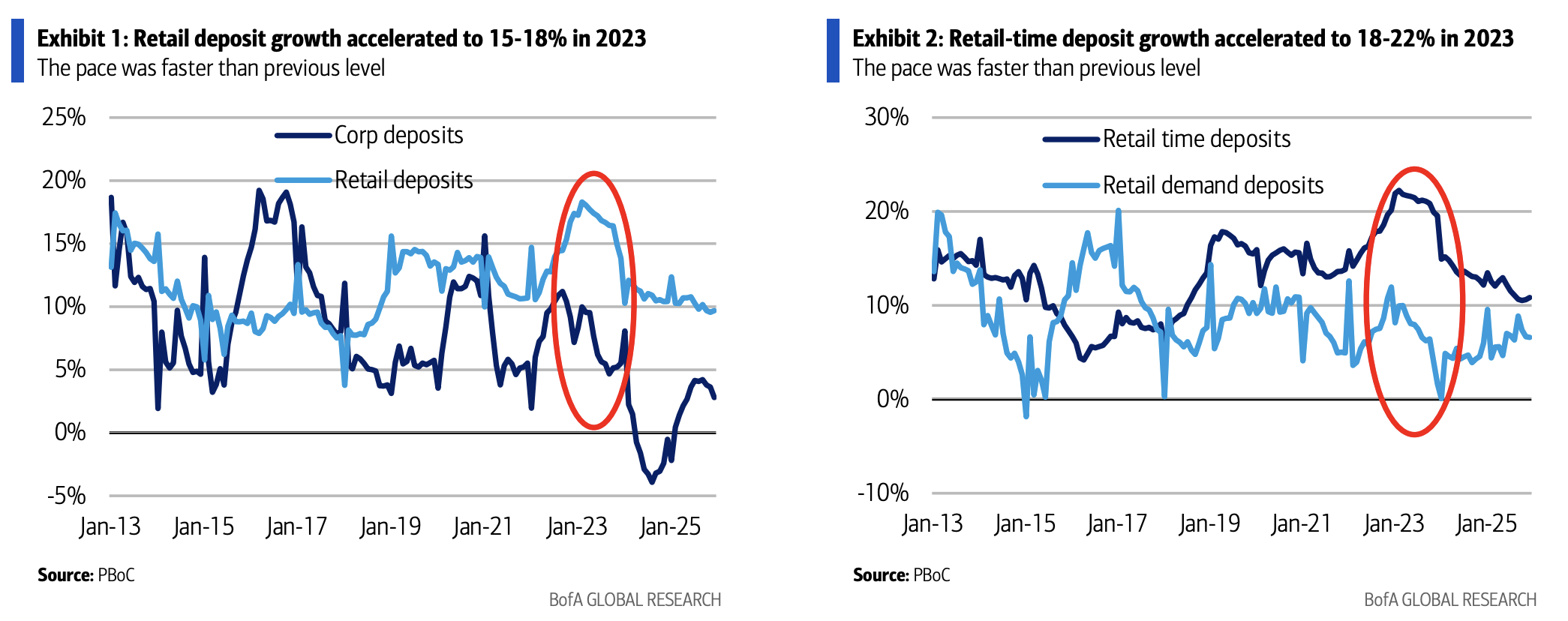
存款"搬家"从2025年中开始成了市场绕不开的话题:大额定存到期,会不会突然从银行体系流向股市、保险、甚至地产和消费?关于到期规模的传言从10万 亿一路飙到70万亿,背后期待的其实是"更快的资金再配置",足以改写不同资产的供需和定价。 据追风交易台,美国银行全球研究部分析师Michael Li在最新报告里把这个预期往回拉了一截,估计存款搬家规模约1万亿元,而不是10万亿元或更高。存款 外流确实在发生,但节奏和体量更像"渐进式",短期很难看到想象中的洪水。 美银表示,居民定存增速从过去常态的14%-16%抬升到18%-22%,累积出约4-5万亿元的"超额"定存,并将在未来逐步到期。问题在于,到期不等于迁徙。 70%-80%仍会留在银行体系(再定存、转活期、偿还按揭等),用于消费的比例不超过10%,真正流向"非存款资产"的规模大约1万亿元。 报告给了两个最直接的落点:一是保险,如果其中5000亿元流向保险,足以让寿险销售端出现"看得见的"弹性;二是A股,哪怕相对>100万亿元市值、日均 2.5-3.0万亿元成交看起来不大,但它是额外增量,还可能通过两融等杠杆放大对成交和情绪的影响。要检验这条链条是否真的在走,报告 ...
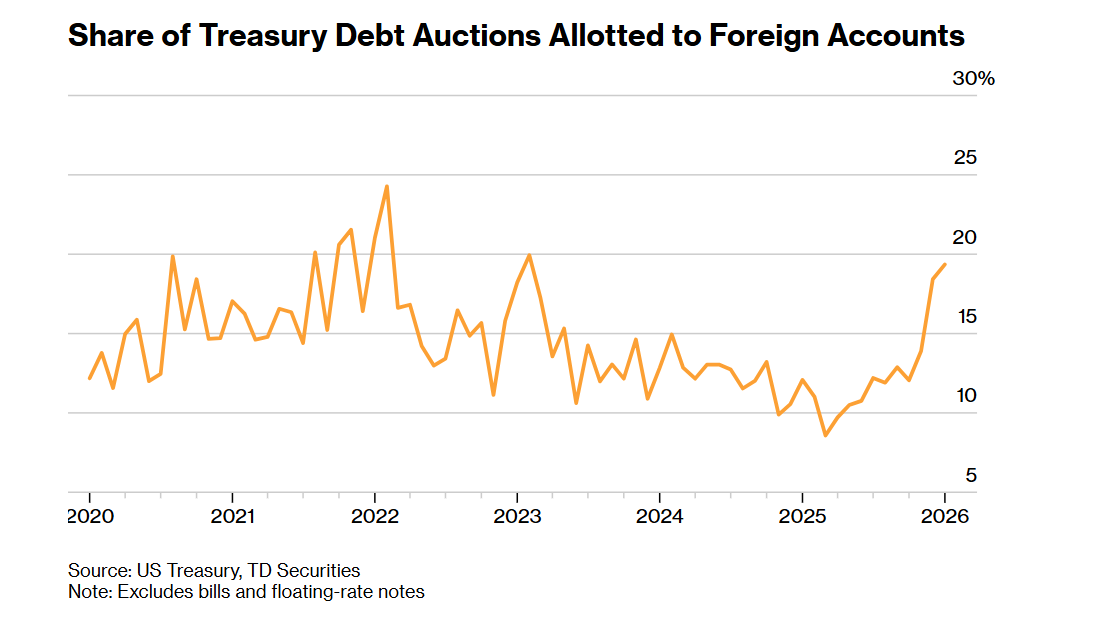
“抛售美国”谎言破灭?外国资金回流美债,获配比例飙升至近三年新高!
Jin Shi Shu Ju· 2026-02-11 03:07
Group 1 - The core viewpoint of the article highlights that the allocation ratio of foreign buyers in U.S. Treasury auctions has been increasing, alleviating concerns about the loss of the safe-haven status of U.S. Treasuries and the impact of large fiscal deficits on foreign investments [1][4] - According to TD Securities' analysis, in January, the allocation ratio for foreign and international accounts in Treasury auctions reached approximately 19%, marking a three-year high. This ratio had previously peaked at nearly 25% in early 2022 but declined to below 10% by November 2024 [1][4] - The report indicates that the increase in foreign account allocations is broad-based, suggesting that the narrative of a "sell America" trend may be more of a market story than reality [4] Group 2 - Despite a significant sell-off of $53 billion in U.S. Treasuries by foreign investors following tariff announcements in April 2025, they subsequently increased their holdings by $354 billion by November of the same year [4] - The participation of foreign investors in Treasury auctions notably increased in November and December, driven by the expansion of the term premium, which is the additional yield of 10-year Treasuries over shorter-term bonds [4][6] - The upcoming auction of $58 billion in three-year Treasuries and the issuance of 10-year and 30-year bonds may further influence foreign investment behavior, as a lack of alternative assets could compel investors to continue holding U.S. dollar assets [7]