数据中心

Search documents
长假期间港股表现平稳,A股节后有望“开门红”
Sou Hu Cai Jing· 2025-10-08 23:25
Group 1 - The Hong Kong stock market experienced a volatile performance during the long holiday, with the Hang Seng Index rising by 1.61% on October 2, followed by three consecutive days of decline, resulting in a cumulative drop of 0.1% for October so far [2] - The Hang Seng Technology Index performed slightly better, with a cumulative increase of 0.75% for October [2] - The AH share premium reached 117.14, marking the lowest level since January 2019 [2] Group 2 - Certain sectors in the Hong Kong market, such as e-commerce, semiconductors, and non-ferrous metals, showed strong performance during the holiday, with notable gains from companies like Youzan (over 38% increase) and SMIC (over 10% increase) [2] - The gold sector benefited from rising international gold prices, with companies like Chifeng Jilong Gold seeing a significant increase of over 23% in October, creating a premium of 16.3% compared to A-shares [2] Group 3 - Analysts from Guotai Junan Securities predict that the Hong Kong stock market may outperform the first quarter of this year, driven by continued inflow of incremental funds and structural advantages of Hong Kong assets [3] - The expectation of a 25 basis point rate cut by the Federal Reserve in October could lead to a favorable liquidity environment, potentially attracting foreign capital back to the Hong Kong market [3] Group 4 - The A-share market is expected to have a high probability of a "opening red" after the holiday, with historical data showing an average increase of 0.48% on the first trading day of October since 2000 [4] - Analysts suggest that the A-share market typically exhibits a "post-holiday opening red" characteristic, especially during bull markets [4] Group 5 - A survey indicated that 70.19% of private equity firms are optimistic about the post-holiday market, with 59.62% favoring investment in technology growth sectors such as AI, semiconductors, and smart driving [5] Group 6 - Investment firms believe that the weakened trading sentiment in the A-share market before the holiday is likely to recover, supported by a stable domestic macroeconomic environment and positive performance in the Hong Kong market [6] - Developments in AI and technology during the holiday, such as collaborations between OpenAI and AMD, may act as catalysts for related sectors in the A-share market [6]
美股异动 | IREN Ltd(IREN.US)跌超6.4% 今年至今累积涨幅仍超490%
智通财经网· 2025-10-08 15:42
智通财经APP获悉,周三,IREN Ltd(IREN.US)股价走低,截至发稿,该股跌超6.4%,报57.7美元。消 息面上,该公司宣布其有意根据市场及其他条件,向认为符合资格的机构买家进行私人配售,计划发行 总额为8.75亿美元的2031年到期可转换高级票据。IREN Ltd主要从事与数据中心及加密货币挖矿相关的 业务。公司运营可再生能源驱动的数据中心基础设施,拥有电力、冷却设施、硬件部署等一体化架构。 该股股价在今年飞涨,今年至今累积涨幅超490%。 ...

美最新研究:如果排除AI数据中心,美国上半年GDP增长仅为0.1%
Guan Cha Zhe Wang· 2025-10-08 14:41
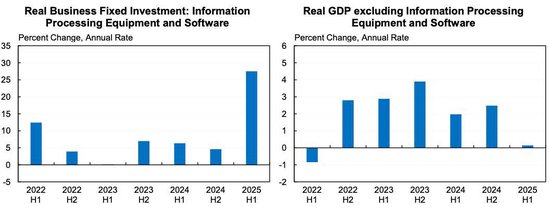
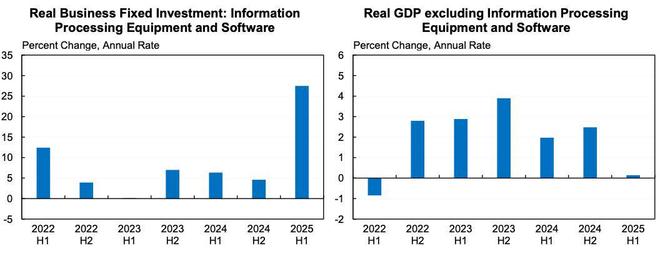
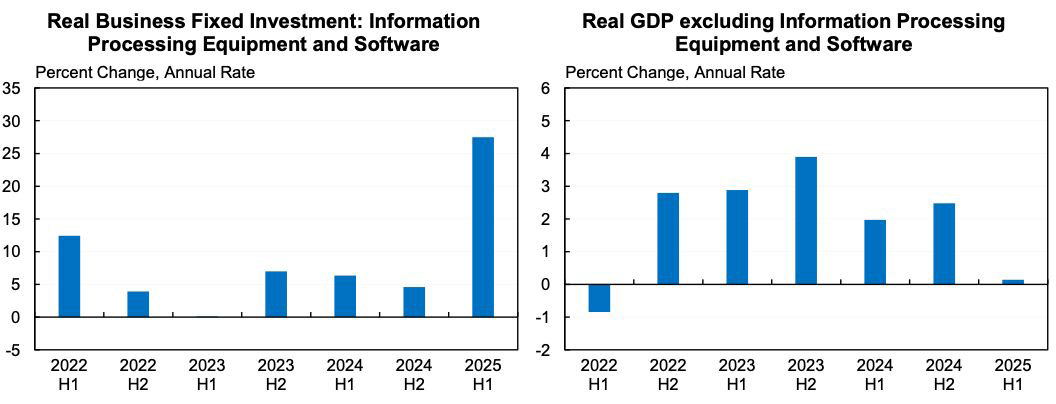
Core Insights - A study by Harvard economist Jason Furman indicates that nearly all GDP growth in the U.S. for the first half of 2025 will be driven by data centers and information processing technologies, with other sectors showing a growth rate of only 0.1% [1][4] - Concerns are rising about a "data center bubble," as many fear that without technological investments, the U.S. economy could face a recession [1][5] - Investment in information processing equipment and software accounted for only 4% of GDP but contributed 92% to GDP growth in the first half of the year [1][4] Investment Trends - Major tech companies have significantly increased their capital expenditures in data centers, with spending quadrupling in recent years to nearly $400 billion [4] - The top 10 companies account for nearly one-third of total spending in this area, contributing approximately 100 basis points to actual GDP growth [4] - Companies like Microsoft, Google, Amazon, Meta, and Nvidia have invested hundreds of billions in building and upgrading data centers due to explosive demand for computing power driven by AI [4][8] Economic Implications - The construction of AI data centers is projected to surpass consumer spending's contribution to GDP growth for the first time, which is notable given that consumer spending typically accounts for two-thirds of U.S. GDP [4] - Other sectors such as manufacturing, real estate, retail, and services are experiencing stagnation or negative growth, raising alarms about the overall economic health [5] - The labor market is also showing signs of distress, with only 22,000 jobs added in August and a rising long-term unemployment rate [5] Funding and Financial Models - As of the end of 2024, there are 1,240 data centers either completed or approved in the U.S., a fourfold increase since 2010 [8] - Major tech firms are raising funds through various channels for data center expansion, with Oracle issuing $18 billion in bonds and Meta securing $29 billion in financing [8] - There are concerns regarding the sustainability of the business model, as it remains unclear whether AI product revenues can support the rising expenditures [9]




AIl in AI?“没了数据中心,美国经济增长几乎归零”
Guan Cha Zhe Wang· 2025-10-08 13:21
Core Insights - A study by Harvard economist Jason Furman indicates that nearly all GDP growth in the U.S. for the first half of 2025 will be driven by data centers and information processing technology, with other sectors showing a growth rate of only 0.1% [1][4] - Concerns are rising about a potential "data center bubble," as the sustainability of the business model for tech giants investing heavily in data centers remains uncertain [1][8] Investment Trends - Investment in information processing equipment and software accounted for only 4% of U.S. GDP but contributed 92% to GDP growth in the first half of the year [1][3] - Major tech companies have significantly increased capital expenditures in data centers, with spending nearly quadrupling in recent years to approximately $400 billion annually [3][7] Economic Impact - The contribution of data center-related spending to U.S. GDP growth is estimated to be around 100 basis points, highlighting its macroeconomic significance [3] - AI technology is driving an explosive demand for computing power, leading to substantial investments from companies like Microsoft, Google, Amazon, Meta, and Nvidia [3][7] Sector Performance - Other sectors such as manufacturing, real estate, retail, and services are experiencing stagnation or negative growth, raising alarms about the overall health of the U.S. economy [4][5] - The labor market is showing signs of weakness, with only 22,000 jobs added in August and a rising long-term unemployment rate [5][4] Future Outlook - The current investment in AI infrastructure is closely tied to the training of large language models, which require vast amounts of data and computing power [7] - There is skepticism regarding whether AI product revenues can sustain the rising expenditures on data centers, which could reshape the U.S. economic landscape if not supported [8][1]
美最新研究:如果没有AI数据中心,美国上半年GDP增长仅为0.1%
Guan Cha Zhe Wang· 2025-10-08 13:06
Core Insights - A study by Harvard economist Jason Furman indicates that nearly all GDP growth in the U.S. during the first half of 2025 will be driven by data centers and information processing technologies, with other sectors showing a mere 0.1% growth [1][4] - Concerns are rising over a potential "data center bubble," as the sustainability of the business model for tech giants expanding data centers remains unproven [1][7] - Investment in information processing equipment and software accounted for only 4% of GDP but contributed 92% to GDP growth in the first half of the year [1][4] Investment Trends - Major tech companies have significantly increased capital expenditures in data centers, with spending quadrupling in recent years to nearly $400 billion annually [4] - The top 10 companies account for about one-third of total spending related to data centers, contributing approximately 100 basis points to actual GDP growth [4] - Microsoft, Google, Amazon, Meta, and Nvidia have invested hundreds of billions in building and upgrading data centers due to explosive demand for computing power driven by AI technologies [4][7] Economic Implications - While tech-driven growth is evident, other sectors such as manufacturing, real estate, retail, and services are experiencing stagnation or negative growth, raising fears of an economic downturn without tech investment [5] - The U.S. labor market is showing signs of stagnation, with only 22,000 jobs added in August and a rising long-term unemployment rate [5] - Some analysts suggest that the strong spending data may not correlate directly with the growth in GDP attributed to data center construction, indicating a complex economic landscape [5] Infrastructure Development - By the end of 2024, the U.S. is expected to have 1,240 data centers, a fourfold increase since 2010, with major companies projected to spend $320 billion on AI infrastructure this year [7] - The demand for data centers is closely linked to the training of large language models, which require vast amounts of data and computing power [7] - Companies are raising funds through various channels to support data center expansions, with Oracle issuing $18 billion in bonds and Meta securing $29 billion in financing for new projects [7]
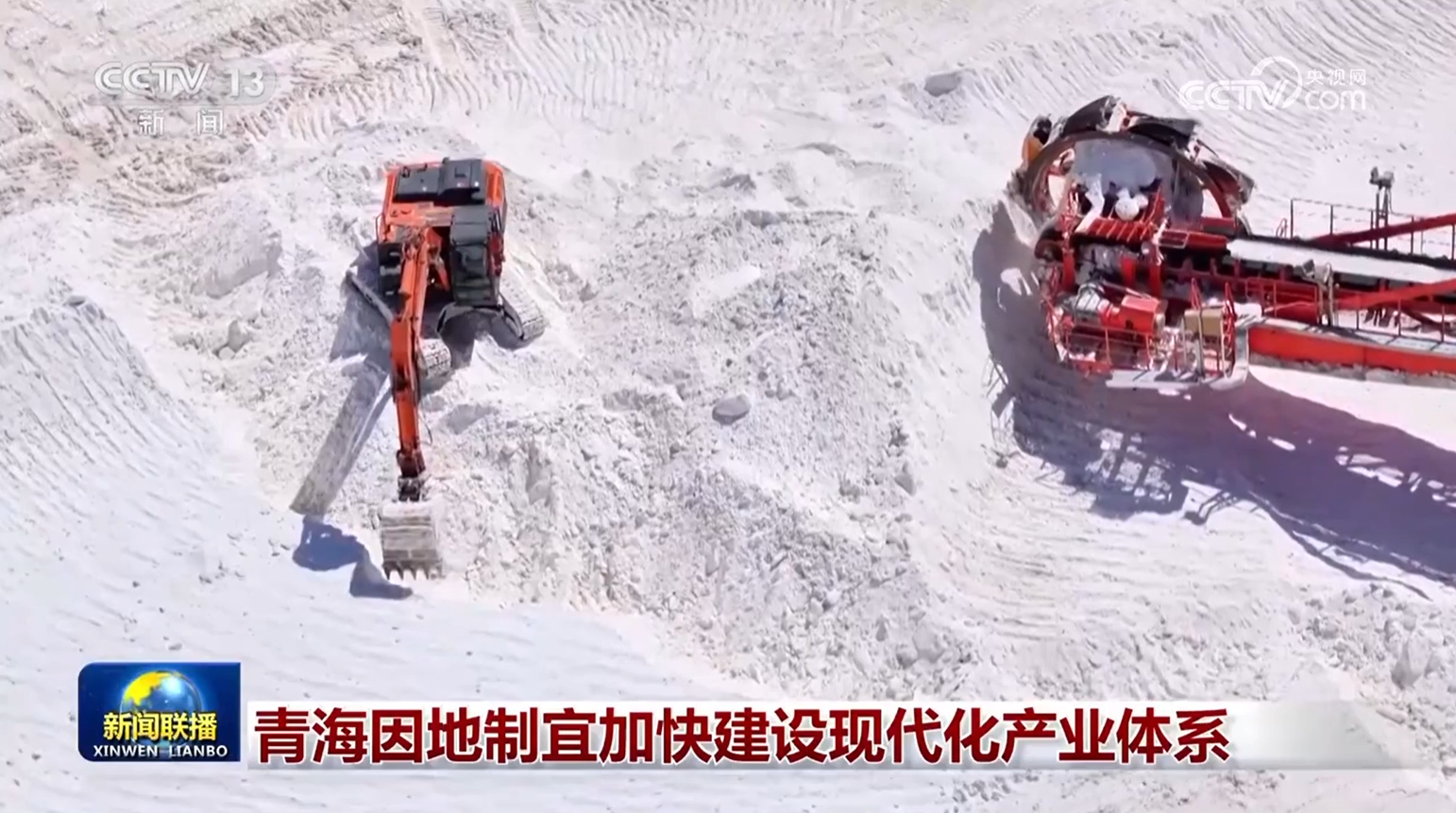
青海因地制宜加快建设现代化产业体系
Yang Shi Wang· 2025-10-08 12:50
Group 1 - The core viewpoint is that during the "14th Five-Year Plan" period, Qinghai is focusing on developing a modern industrial system with local characteristics, achieving high-quality development [1] Group 2 - In the Qaidam Basin, the Chaka Salt Lake is the largest potash fertilizer production base in China, with Qinghai accelerating the construction of a world-class salt lake industry base, forming five major industrial clusters: potassium, sodium, magnesium, lithium, and chlorine, with potash fertilizer production accounting for 77% of the national total [3] Group 3 - During the "14th Five-Year Plan" period, Qinghai's clean energy and new energy installed capacity reached 94% and 72% respectively, actively integrating into the national "East Data West Computing" strategy and the construction of an "integrated computing power network," with 19,000 standard racks and a computing power scale of 17,000 P established by August this year [5] Group 4 - As one of the five major pastoral areas in China, Qinghai has significant advantages in green and organic agriculture, with a strong focus on developing cool-season vegetables and cold-water fish industries, establishing major platforms such as the national-level plateau cool-season vegetable industrial park and the Longyangxia salmon industry technology park, leading to an increase in the export of Qinghai's specialty agricultural and livestock products [7]
黄金周看点 |长假期间港股表现平稳 A股节后有望“开门红”
Sou Hu Cai Jing· 2025-10-08 10:09
Group 1 - The Hong Kong stock market experienced a fluctuation during the long holiday, with the Hang Seng Index rising by 1.61% on October 2, followed by three consecutive days of decline, resulting in a cumulative drop of 0.1% for October so far [2] - The Hang Seng Technology Index performed slightly better, with a cumulative increase of 0.75% for October [2] - The AH share premium reached 117.14, marking the lowest level since January 2019 [2] Group 2 - Certain sectors in the Hong Kong market, such as e-commerce, semiconductors, and non-ferrous metals, showed strong performance during the holiday, with notable gains from companies like Youzan (over 38% increase) and SMIC (over 10% increase) [2] - The gold sector benefited from rising international gold prices, with companies like Chifeng Jilong Gold seeing a significant increase of over 23%, reaching a historical high [2] - Conversely, sectors like consumer goods and digital economy faced declines, with companies such as Xiaobu Xiaobu and GDS Holdings dropping over 9% and 8% respectively [2] Group 3 - Analysts from Guotai Junan Securities predict that the Hong Kong stock market may outperform the first quarter of this year, driven by structural advantages and inflows of new capital [3] - The expectation of a 25 basis point rate cut by the Federal Reserve in October could lead to a favorable liquidity environment, potentially attracting foreign capital back to the Hong Kong market [3] - Southbound capital is expected to continue flowing into Hong Kong stocks, particularly in technology and consumer sectors, which are seen as scarce compared to A-shares [3] Group 4 - Historical data indicates a high probability of a positive opening for A-shares after the holiday, with an average increase of 0.48% on the first trading day of October from 2000 to 2024 [4] - Analysts suggest that A-shares typically exhibit a "post-holiday opening red" characteristic, especially during bull markets [4] - The fourth quarter is expected to show strong earning potential for A-shares, influenced by policy dynamics and year-end valuation adjustments [4] Group 5 - A survey indicated that 70.19% of private equity firms are optimistic about the post-holiday market, anticipating a gradual recovery [5] - The favored investment directions include AI, semiconductors, humanoid robots, and smart driving technologies, with 59.62% of private equity firms expressing interest in these sectors [5] Group 6 - The overall sentiment in the A-share market is expected to improve due to a stable domestic macroeconomic environment and high consumer activity during the holiday [6] - Developments in AI and significant collaborations, such as those between OpenAI and AMD, may catalyze related sectors in the A-share market [6]
科华数据:部分董事、高级管理人员合计减持约50万股,减持计划实施完毕
Mei Ri Jing Ji Xin Wen· 2025-10-08 07:55
Company Overview - KWH Data (SZ 002335) announced on October 8 that the share reduction plan by key executives has been completed, with a total of approximately 500,000 shares reduced, accounting for 0.0969% of the company's total shares [1] Financial Performance - For the first half of 2025, KWH Data's revenue composition is as follows: 49.62% from the renewable energy sector, 37.44% from the data center sector, 11.77% from the smart electric power sector, and 1.17% from other businesses [1] Market Capitalization - As of the report date, KWH Data's market capitalization stands at 36.9 billion yuan [1]

她,河北女首富
投资界· 2025-10-08 07:36
Core Viewpoint - The article highlights the success story of Runze Technology, which has capitalized on the AI boom by providing computing power services, transforming from a struggling company to a market leader with a valuation of 870 billion yuan, significantly increasing its market value by over 500% since 2022 [2][3]. Company Overview - Founded in 2009 by Zhou Chaonan, Runze Technology initially focused on computing infrastructure but faced losses for the first ten years until the AI wave began in 2018, leading to a turnaround [3][5]. - The company has established seven AIDC intelligent computing centers across six major economic regions in China, emphasizing the importance of computing power in the global AI competition [5][6]. Financial Performance - Runze Technology reported a revenue increase of 60.27% in 2023, reaching 4.351 billion yuan, with a net profit of 1.762 billion yuan [7]. - The stock price surged over 90% during the ChatGPT boom, with a cumulative increase of over 100% in 2024, briefly exceeding a market capitalization of 1 trillion yuan [7][8]. Client Relationships - ByteDance has become Runze Technology's largest client, with its business accounting for a significant portion of the company's revenue from 2018 to 2021, highlighting the dependency on major clients [5][6]. - The company has also collaborated with other clients, including Huawei and Kuaishou, contributing to its profitability [6]. Market Position and Challenges - Runze Technology's rapid growth has positioned Zhou Chaonan as a prominent figure in the AI industry, with her family ranking 600th on the 2025 Global Rich List [3][10]. - Despite the success, the company faces challenges due to its reliance on a few major clients, which account for over 90% of sales, posing potential risks to its revenue stability [11].

“AI闭环”假期刷屏!一文读懂北美数据中心供应链
Hua Er Jie Jian Wen· 2025-10-08 05:50
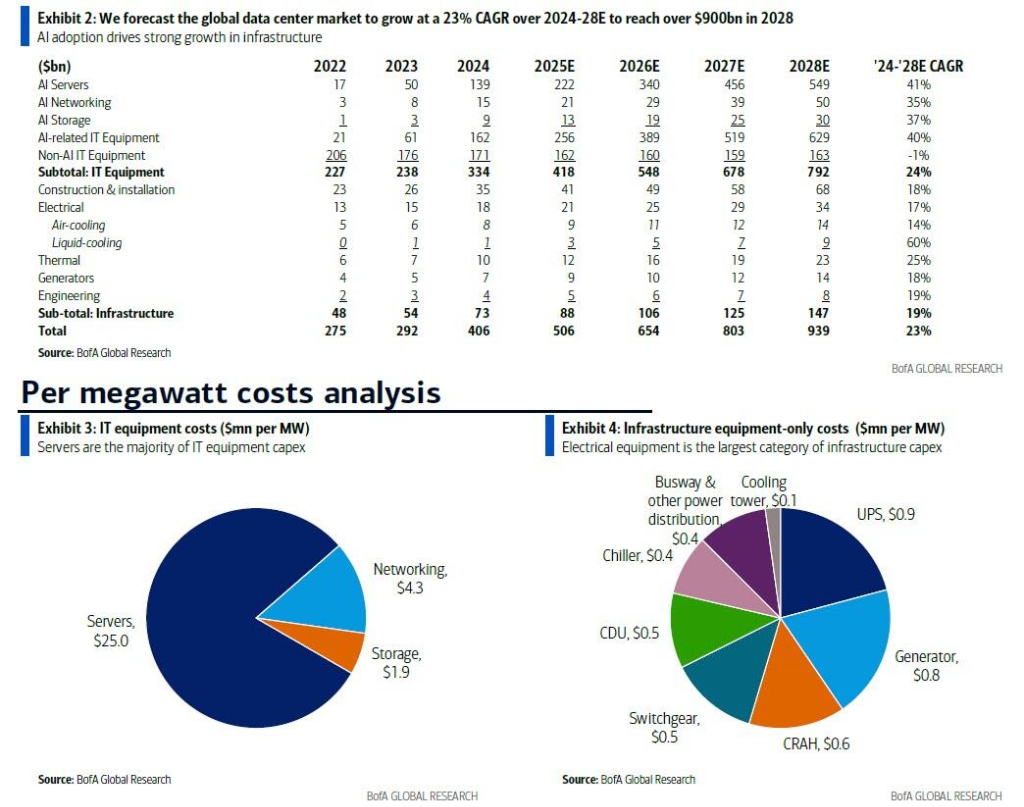
Core Insights - The essence of the AI competition is fundamentally a race for physical infrastructure, particularly data centers, which are expanding at an unprecedented pace, projected to exceed $400 billion in capital expenditure by 2024 and reach $506 billion by 2025, driven by AI demand [1][2] - The data center market is expected to grow at a remarkable compound annual growth rate (CAGR) of 23% from 2024 to 2028, ultimately forming a market exceeding $900 billion by 2028 [1][2] Market Overview - The data center market's growth is no longer driven by traditional enterprises; since 2017, cloud service providers and colocation companies have contributed nearly all new capacity, with major players like Amazon AWS and Microsoft Azure leading the way [5][7] - North Virginia, USA, accounts for nearly 15% of the global hyperscale data center capacity, making it the largest single concentration globally, followed by Beijing, China, at approximately 7% [9] Investment Dynamics - Data centers are viewed as high-value infrastructure assets with clear and attractive return models, exemplified by a typical wholesale colocation project that can yield an internal rate of return (IRR) of 11% over a 20-year holding period [12][13] - The average annual rent per megawatt (MW) is projected to increase from $2.50 in 2022 to $4.38 by 2028, with occupancy rates remaining stable at around 90% [14] Technological Evolution - The "density revolution" in data centers is driven by the exponential increase in power consumption of AI chips, leading to a significant rise in rack power density, with current standards reaching up to 120 kW per rack [15][17] - The global infrastructure for data centers is lagging, with only 5% of existing centers capable of supporting the latest high-power AI chips, necessitating massive upgrades and new constructions [18][19] Infrastructure Transformation - The shift from air cooling to liquid cooling systems is becoming essential due to the limitations of traditional cooling methods, with the market for cooling solutions expected to grow significantly [21][23] - The transition to high-voltage direct current (DC) power systems is underway, promising to reduce copper usage and improve efficiency in power delivery to data centers [25][28] Supply Chain Analysis - The rise of AI is increasing the unit construction costs of data centers, with next-generation AI architectures projected to cost approximately $5.2 million per MW, a 33% increase from traditional setups [30] - Key players in the thermal systems market include Vertiv, Johnson Controls, and Carrier, while Schneider Electric leads in the electrical systems market [32][36] - The IT equipment segment is the largest component of data center investments, with the global server market expected to reach $280 billion in 2024, driven significantly by AI servers [39] Conclusion - The ongoing AI-driven construction boom in data centers is set to surpass the total construction spending of all general office buildings in the coming months, highlighting the critical role of infrastructure in the AI landscape [43][46]