教育科技

Search documents
点赞|惠阳教育局:聚力AI教师培训 助推高质量发展
Nan Fang Du Shi Bao· 2025-11-09 00:07
Core Insights - The Huizhou Huiyang District Education Bureau is focusing on the core needs of artificial intelligence (AI) education development by organizing specialized training for teachers from 18 AI education demonstration schools [2][3] - The training aims to enhance teacher capabilities, promote the popularization of AI education, and establish practical scenarios for high-quality development in basic education [2][3] - The project has achieved significant milestones since its initiation in February 2025, with 100% coverage of teaching equipment in the demonstration schools and the establishment of dedicated AI laboratories [3][4] Training Details - The training consists of four core modules: overall event planning and introduction to the World Robot Contest (WRC) rules, training for WRC events on the Ministry of Education's whitelist, training for the "Future of Innovation" on the Ministry of Education's red list, and practical experience in competitions [2] - The curriculum is designed to align with the requirements of recognized competition courses, ensuring both practicality and forward-thinking [2] Implementation and Impact - The project has provided over 50 course planning consultations, organized one general training for AI teachers, and conducted more than 40 internal teaching support services and over 10 competition coaching services within eight months [3] - More than 1,500 students have participated in AI course learning, and over 190 teachers have been involved, creating a positive environment where every school has equipment, every teacher can teach, and every student can experience AI [3] School Achievements - Several schools, including Huizhou No. 7 Middle School and Sanhe Middle School, have successfully integrated AI courses into their daily teaching since September, achieving notable results in competitions [4] - These schools have actively participated in related events organized by the Guangdong Provincial Education Technology Center and the WRC city selection and championship competitions, setting benchmarks for AI education development in the district [4]


伴鱼PalFish入选福布斯出海TOP30 海外业务高增长凸显全球化战略价值
Zheng Quan Ri Bao Wang· 2025-11-07 10:15
Core Insights - PalFish, an international brand under Beijing Read Me Technology Co., Ltd. (伴鱼), has been recognized as the only education company in the 2025 Forbes China Globalization TOP 30 list, awarded as a "Leading Brand" [1] - PalFish's overseas business has shown a remarkable annual growth rate of over 150%, becoming a significant growth driver for the company [1] - The selection of PalFish reflects a strategic upgrade in China's new economy from "scale going global" to "value going global" [1] Business Strategy - PalFish has adopted a "high quality, high price" positioning, moving away from a money-burning strategy to establish a healthy business loop and brand barrier [1] - The company has strategically opened 14 learning centers overseas since 2023 to address rising online traffic costs, creating new growth pathways [1] Technological Innovation - The core engine driving PalFish's global business is technological innovation, particularly through the self-developed AI teacher "Coco," which enhances teaching efficiency and forms a key technological barrier [2] - The company plans to focus on four core components: "content + hardware + offline centers + AI" to enhance international competitiveness [2] - With a clear strategic plan, robust business model, and leading technology investment, PalFish's globalization journey opens new avenues for long-term value growth [2]
美股三大指数集体低开,多邻国跌超26%
Feng Huang Wang Cai Jing· 2025-11-06 14:41
Group 1 - U.S. stock indices opened lower, with Dow Jones down 0.06%, S&P 500 down 0.14%, and Nasdaq down 0.26% [1] - Snap's stock rose over 17% after reporting Q3 revenue of $1.51 billion and global daily active users reaching 477 million, both exceeding expectations [1] - Duolingo's stock fell over 26% as the company lowered its Q4 booking guidance by 3.6% [1] - Moderna's stock increased over 7% after reporting Q3 revenue and EPS that surpassed expectations [1] - Nasdaq Golden Dragon Index rose 1% to 8223.78 points [1] Group 2 - Samsung Electronics completed the acquisition of European ventilation company FläktGroup, aiming to develop integrated air conditioning solutions and maximize synergies [2] Group 3 - Nissan Motor Company announced the sale of its global headquarters building in Yokohama for 97 billion yen (approximately 4.5 billion RMB), planning to continue using the building under a lease [3] - The sale is part of Nissan's operational restructuring efforts [3] Group 4 - Intel's Vice President highlighted that personal computers are undergoing a disruptive upgrade with the introduction of AI PCs, marking a significant evolution in computing [4] - Deutsche Bank reported Q3 net profit of €591 million with revenue of €2.94 billion, maintaining a forecast of approximately €2.5 billion net profit for the year [4]




恒生指数早盘跌0.28% AI概念股悉数走低
Zhi Tong Cai Jing· 2025-11-05 04:06
Group 1 - The Hang Seng Index fell by 0.28%, down 73 points, closing at 25,878 points, while the Hang Seng Tech Index decreased by 0.80%. The early trading volume in Hong Kong stocks was HKD 138.2 billion [1] - AI concept stocks experienced a decline, with concerns over high valuations. Institutions suggest that the long-term outlook for Hong Kong tech stocks remains attractive [1] - Hui Liang Technology (01860) dropped over 6%, and Kingsoft (03888) fell by 2.81% [1] Group 2 - Longpan Technology (603906) saw an increase of over 9% as lithium battery midstream prices continue to rise, with institutions expecting further price momentum [2] - Yimai Sunshine (02522) rose by 3.27% following several directors' share purchases, and the "AI + healthcare" sector is expected to benefit from new policies [3] - China Duty Free Group (601888) (01880) increased by over 4%, marking its first interim dividend, with recent policies likely to boost the duty-free industry [3] Group 3 - Yihua Tong (02402) surged by 7.7%, with significant cash flow improvement in the first three quarters, and fuel cell vehicle production is expected to accelerate [4] - Tianli International Holdings (01773) rose by 4.9%, with its AI learning companion already implemented in over 100 schools nationwide [5] - Mixue Group (02097) increased by 2.89%, planning to collaborate with Anjun Express for cold chain operations in Brazil [6] Group 4 - Huishang Bank (03698) rose by 4%, reporting a net profit of CNY 14.149 billion in the first three quarters, with institutions indicating potential for future growth [7] - Sanhua Intelligent Control (002050) (02050) fell by 1.94%, as Goldman Sachs pointed out overly optimistic robot expectations, while the market is focused on Tesla's trillion-dollar compensation plan [7] - Home Control (01747) dropped by 13%, facing scrutiny from the Hong Kong Securities and Futures Commission due to high stock ownership concentration [7] - Long Fiber Optic (601869) (06869) declined by 2.81%, with Q3 net profit down nearly 11%, and UBS stated that the impact of hollow-core fiber on profitability is limited in the short term [7]


美国科技巨头闪电撤离中国,400名在华员工全被解雇;印度富豪逾8亿美元资产遭查封;诺基亚将退市;零跑回应一汽收购其股权丨邦早报
创业邦· 2025-11-05 00:08
Group 1 - SAS Institute has completely withdrawn from the Chinese market after 25 years, laying off all 400 employees and will continue operations through third-party partners [1] - Leap Motor responded to rumors of FAW Group acquiring its shares, stating that the news is untrue [1] - The Chinese government announced a 9-day holiday for the 2026 Spring Festival, leading to a 63% increase in flight bookings compared to the same period in 2025 [2] Group 2 - The AI model competition "Alpha Arena" concluded with Alibaba's Qwen winning, achieving a 22.32% return, while other models, including GPT-5, suffered significant losses [8][9] - Nokia plans to delist from the Paris Stock Exchange, citing trading volume and administrative costs as reasons [9] - The global AI glasses market is rapidly growing, with shipments expected to reach 4 million units by 2029, driven by major tech companies like Google and Apple [22] Group 3 - The Indian online brokerage Groww's parent company is set to launch an IPO, potentially valuing the company at $7 billion [10] - Beta Technologies, an electric aircraft manufacturer, raised over $1 billion in its IPO, pricing shares at $34 [10] - The robotics industry saw a revenue increase of 29.5% year-on-year in the first three quarters, with significant production growth in both industrial and service robots [22][23]

思考乐教育(01769)与深圳华夏隽永成立合资公司,以研发及开拓教育类人工智能机器人
智通财经网· 2025-11-04 13:46
Core Viewpoint - The company has entered into a joint venture agreement with Shenzhen Huaxia Junyong to establish a company focused on the research and development of educational artificial intelligence robots, with a registered capital of RMB 385 million [1] Group 1 - The joint venture will have a registered capital of RMB 385 million, with the company contributing RMB 115.5 million and Shenzhen Huaxia Junyong contributing RMB 269.5 million, resulting in ownership stakes of 30% and 70% respectively [1] - The joint venture will be accounted for as an associate company in the company's consolidated financial statements, using the equity method [1] - The company believes that the development of educational AI robots complements its existing business and will create synergies for overall business growth [1] Group 2 - Establishing the joint venture will accelerate the company's entry into the educational AI robot industry and promote overall business development [2] - The joint venture will provide access to diverse and advanced equipment and technology, enhancing the company's technological capabilities and accumulating valuable experience and knowledge [2] - Educational AI robots can assist teaching by recognizing handwritten characters and complex formulas, providing step-by-step solutions and learning analysis, offering instant feedback, and enabling personalized teaching through student behavior analysis [2]

效率优先一切! 新一轮万人裁员潮席卷美国 但不全赖AI
智通财经网· 2025-11-03 01:29
Core Viewpoint - The recent wave of layoffs in major companies like Amazon, UPS, and Meta is not solely driven by AI advancements but rather by a need for efficiency amid slowing economic momentum [1][3][5]. Group 1: Layoff Trends - Amazon announced a reduction of approximately 14,000 positions, raising questions about whether workers are being replaced by emerging technologies [1][3]. - UPS and Target are also implementing significant layoffs, with UPS reducing around 34,000 operational positions in the first nine months of the year [5]. - Meta, despite being a major player in AI, has also announced layoffs, indicating that the trend is not limited to companies heavily invested in AI [5]. Group 2: Economic Context - The U.S. labor market, which was robust a few years ago, has seen a significant decline in job openings, particularly in tech-related positions, which fell to 36% below pre-pandemic levels by July [3]. - The economic environment is characterized by uncertainty, AI enthusiasm, and geopolitical tensions, contributing to the current wave of layoffs [1][3]. Group 3: AI's Role - Amazon's CEO Andy Jassy stated that the layoffs are not primarily driven by financial factors or AI at this moment, but rather by cultural issues within the company [1]. - Despite significant investments in AI, there is little evidence that these technologies are being deployed in ways that would replace large numbers of workers [4][5]. - A Goldman Sachs survey indicated that only 11% of U.S. companies are actively reducing their workforce due to AI, suggesting that the impact of AI on employment is still limited [4][5]. Group 4: Future Outlook - Analysts predict that AWS's revenue growth will accelerate due to increased demand for AI computing power, with expected growth rates of 23% and 25% over the next two years [2]. - Companies like Chegg and Salesforce are also adjusting their workforce in response to AI's efficiency gains, indicating a potential shift in labor needs [6][7].

教育应用程序白名单公布 445项上榜 不得向学生和家长收取任何费用
Bei Jing Wan Bao· 2025-11-02 02:02
Core Points - The Beijing Municipal Education Commission has published a whitelist of 445 educational mobile applications (referred to as "education APPs") that are allowed in schools [1][2] - The principle of "strict selection and necessary review" is emphasized for the use of education APPs in schools, which must not charge fees to students and parents or be linked to academic credits and grades [1] - Schools are required to conduct strict reviews and file records with the Municipal Education Commission, adhering to the "non-essential, non-selection" principle to control the number of education APPs used [1] Summary by Categories Regulations and Compliance - Education APPs must comply with the "double reduction" policy and reflect a quality education orientation, avoiding negative or harmful content, game links, and advertisements [1] - Schools are prohibited from organizing parents to purchase APPs under the guise of parent committees, directly connecting parents with companies, or inducing purchases through free trials [1][2] - Any education APP that requires unified use and extensive personal information collection must undergo thorough review and seek user opinions [1] Monitoring and Accountability - The Municipal Education Commission will conduct inspections of the education APP registration situation and publish black and white lists of education APPs every six months on its official website [2] - Education APP providers that violate regulations will be required to rectify their actions within a specified timeframe, and those who fail to comply will be blacklisted and subject to joint enforcement actions by relevant departments [2]
教育科技行业“十五五”市场战略研究及投资建议可行性评估预测报告(2025版)
Sou Hu Cai Jing· 2025-10-29 02:15
Core Insights - The education technology (EdTech) industry is rapidly evolving, leveraging modern technologies to enhance educational quality and efficiency, with a significant focus on online learning platforms, learning hardware, and support software [3][5][6] Group 1: Industry Overview - The EdTech industry integrates education and technology, utilizing AI, big data, cloud computing, and virtual reality to innovate various educational processes [3][4] - Online learning platforms dominate the market due to their accessibility and extensive course offerings, creating a diverse educational ecosystem [3][4] Group 2: Market Dynamics - The online education market is the largest segment within EdTech, with a projected global market size of approximately $166.55 billion in 2023, reflecting a year-on-year growth of 13.4% [6][8] - The global EdTech market is expected to reach $404 billion by 2025, indicating substantial growth potential [6] Group 3: Industry Trends - Recent policies in China have aimed to promote the steady development of the EdTech industry, encouraging a shift towards non-exam-oriented learning solutions [5][6] - The integration of emerging technologies like 5G and AI is anticipated to further enhance the online education experience, making it more personalized and efficient [8][10] Group 4: Industry Structure - The EdTech industry comprises a comprehensive value chain, including upstream technology development, midstream product and service integration, and downstream educational application [9] - Cloud computing serves as a critical infrastructure for the EdTech sector, with China's cloud computing market reaching approximately 458.05 billion yuan in 2023, growing by 13.25% [10] Group 5: Future Outlook - The ongoing digital transformation in education emphasizes the need for continuous optimization of educational technologies and tools to improve usability and applicability [11] - Collaboration between educators and EdTech companies is essential for developing high-quality educational products that support the modernization of education [11]

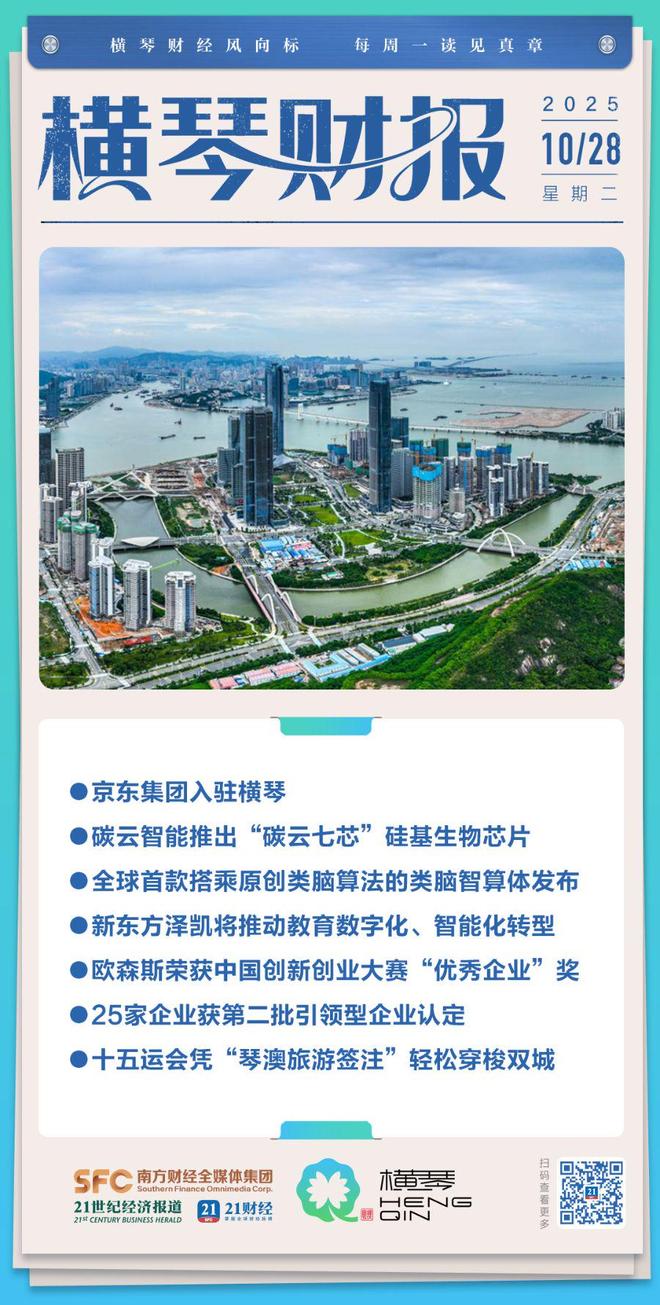
京东集团入驻横琴;新东方泽凯布局科技教育丨横琴财报⑯
2 1 Shi Ji Jing Ji Bao Dao· 2025-10-28 15:19
Group 1: JD Group's Entry into Hengqin - JD Group has officially entered Hengqin, leveraging the region's strategic location and policy advantages to enhance its retail, logistics, and investment operations [4] - The company aims to integrate deeply into the development of the Hengqin Guangdong-Macao Deep Cooperation Zone, contributing to industrial upgrades and high-quality economic development [4] - Hengqin leaders view JD Group's entry as a significant opportunity for industrial development, anticipating collaboration in retail ecosystem construction and modern supply chain systems [4] Group 2: Carbon Cloud Intelligence's New Chip Launch - Carbon Cloud Intelligence launched the "Carbon Cloud Seven Core" silicon-based biological chip, which utilizes advanced in-situ synthesis technology on 8-inch silicon wafers [5] - This technology allows for the in-situ synthesis of up to 168 million different probes within 15 hours, reducing detection costs by over 90% and significantly increasing detection throughput and coverage [5] - The company focuses on digital life research and applications, establishing a technology platform capable of unbiased protein binding analysis [5] Group 3: Brain Computing Agent Release - The world's first Brain Computing Agent (BCA), named "Wise One" (BIE-1), has been launched, featuring an original brain-like algorithm [6][7] - This ultra-compact mobile intelligent supercomputing platform is designed to efficiently run various AI models, including large models [7] - The BCA aims to advance intelligent computing towards general, generative, and specialized brain-like intelligence, enabling broader participation in the BI ecosystem [7] Group 4: New Oriental Zekai's Digital Transformation - New Oriental Zekai Software Technology Co., Ltd. is enhancing its investment in AI and IoT technologies to promote digital and intelligent transformation in the education sector [8] - The company aims to deepen the application of technology in educational scenarios following its relocation to a new site [8] Group 5: Osons' Award Recognition - Osons Technology Co., Ltd. won the "Excellent Enterprise" award at the 14th China Innovation and Entrepreneurship Competition for its online industrial CT project [9] - The technology represents a breakthrough in real-time comprehensive detection, moving away from traditional sampling methods in high-end manufacturing [9] - Osons specializes in high-end testing equipment development and solutions across various sectors, including consumer electronics and renewable energy [9] Group 6: Recognition of Leading Enterprises - The Hengqin Guangdong-Macao Deep Cooperation Zone announced the second batch of leading enterprises for 2024, with 25 companies recognized [10] - The classification includes comprehensive leading enterprises and growth leading enterprises based on revenue and economic contributions [10] - The recognition aims to support substantial operational development for these enterprises within the cooperation zone [10]