通信

Search documents
扩内需促消费政策显效 2025年物价呈温和回升态势
Shang Hai Zheng Quan Bao· 2026-01-09 18:39
Group 1 - The core viewpoint of the articles indicates that the Consumer Price Index (CPI) has shown a moderate recovery, with a year-on-year increase of 0.8% in December 2025, marking the highest level since March 2023 [2][6][7] - The increase in CPI is significantly driven by food prices, particularly fresh vegetables and fruits, which saw year-on-year price increases of 18.2% and 4.4%, respectively [2][3] - The Producer Price Index (PPI) has shown a narrowing year-on-year decline of 1.9% in December, indicating positive changes in certain industries due to improved market competition [4][5] Group 2 - The core CPI, excluding food and energy, rose by 1.2%, maintaining a growth rate above 1% for four consecutive months, reflecting a stable recovery in demand [3][6] - The overall price stability in 2025, with CPI remaining flat year-on-year and PPI declining by 2.6%, suggests that market supply and demand relationships are improving [6][7] - Experts predict that in 2026, with more proactive macroeconomic policies, CPI is expected to rise steadily, supported by recovering consumer demand and structural adjustments in the economy [7][8]
南向资金今日净买入68.15亿港元,腾讯控股净买入14.12亿港元
Zheng Quan Shi Bao Wang· 2026-01-09 14:41
Core Viewpoint - The Hang Seng Index rose by 0.32% on January 9, with southbound capital totaling HKD 111.39 billion, resulting in a net inflow of HKD 6.81 billion [1] Group 1: Southbound Capital Activity - Total southbound trading amounted to HKD 111.39 billion, with buy transactions at HKD 59.10 billion and sell transactions at HKD 52.29 billion, leading to a net buy of HKD 6.81 billion [1] - The Shenzhen Stock Connect saw a total trading volume of HKD 44.30 billion, with net buying of HKD 5.15 billion, while the Shanghai Stock Connect had a total trading volume of HKD 67.08 billion, resulting in a net buy of HKD 1.66 billion [1] Group 2: Active Stocks - Alibaba-W had the highest trading volume among southbound stocks at HKD 99.89 billion, with a net sell of HKD 26.22 billion, despite a closing price increase of 2.73% [1] - Tencent Holdings recorded a net buy of HKD 14.12 billion, closing down by 0.81%, while Xiaomi Group-W had a net buy of HKD 8.70 billion, closing down by 0.53% [1][2] - Kuaishou-W also saw significant activity with a net buy of HKD 7.76 billion, closing up by 3.89% [2] Group 3: Continuous Net Buying - Xiaomi Group-W and Tencent Holdings were noted for continuous net buying, with Xiaomi seeing 7 consecutive days of net buying totaling HKD 55.53 billion, and Tencent with 3 consecutive days totaling HKD 42.31 billion [2]





康希通信:2025前三季度公司实现营业收入5.26亿元
Zheng Quan Ri Bao Wang· 2026-01-09 12:46
Core Viewpoint - The company, 康希通信, has reported that its revenue for the first three quarters of 2025 reached 526 million yuan, surpassing the 523 million yuan revenue for the entire year of 2024, indicating a strong foundation for its annual performance [1] Group 1 - The company is currently finalizing its financial data for the full year of 2025 [1] - There is a continuous growth in orders related to Wi-Fi 7, and products in the IoT sector, particularly drones, are driving innovation and revenue growth [1] - The company anticipates steady revenue growth, with specific annual performance growth rates to be disclosed in future announcements and regular reports [1]
放量普涨
第一财经· 2026-01-09 11:13
Core Viewpoint - The A-share market is experiencing a trend of upward fluctuations with increased trading volume, driven by the surge in AI applications and emerging sectors like commercial aerospace, while traditional industries face adjustments [4][5]. Market Performance - The three major indices of the A-share market are showing a trend of upward movement, with the Shanghai Composite Index breaking through the 4100-point mark, although gains were narrowed by the financial sector [4]. - A total of 3918 stocks rose, indicating a broad-based market rally, with significant gains in sectors such as AI applications, commercial aerospace, humanoid robots, and small metals [4]. Trading Volume - The total trading volume of the two markets reached 3.7 trillion yuan, marking an increase of 11.51%, and is the fifth instance in A-share history to surpass the 3 trillion yuan threshold [5]. - The surge in trading volume is attributed to the explosive growth of new themes like AI applications and commercial aerospace, which attracted substantial short-term capital inflows [5]. Fund Flow and Investor Sentiment - Institutional investors are adjusting their portfolios, with capital flowing into media, internet services, and small metals, while reducing positions in semiconductors, consumer electronics, and insurance [7]. - Retail investors are favoring short-term operations, focusing on popular themes such as media and internet services, showing a high acceptance of new concepts like AI and commercial aerospace [7]. Market Sentiment - The sentiment among retail investors is positive, with 75.85% of participants expressing bullish views on the market [8]. - A significant portion of investors, 67.55%, anticipate a market rise in the next trading day, reflecting growing confidence [12][13].

【9日资金路线图】计算机板块净流入逾207亿元居首 龙虎榜机构抢筹多股
Zheng Quan Shi Bao· 2026-01-09 10:46
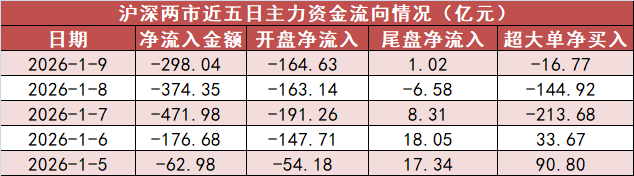
Market Overview - The A-share market experienced an overall increase on January 9, with the Shanghai Composite Index closing at 4120.43 points, up 0.92%, the Shenzhen Component Index at 14120.15 points, up 1.15%, and the ChiNext Index at 3327.81 points, up 0.77% [1]. Capital Flow - The A-share market saw a net outflow of 29.804 billion yuan in main funds throughout the day, with a net outflow of 16.463 billion yuan at the opening and a net inflow of 1.02 million yuan at the close [2][3]. - The CSI 300 index recorded a net outflow of 4.635 billion yuan, while the ChiNext saw a net outflow of 8.618 billion yuan and the STAR Market a net outflow of 5.118 billion yuan [4][5]. Sector Performance - Among the 13 sectors tracked, the computer industry led with a net inflow of 20.706 billion yuan, followed by media with 14.4 billion yuan and non-ferrous metals with 12.166 billion yuan [6][7]. - The sectors with the highest net outflows included electric power equipment at -9.133 billion yuan, banking at -5.673 billion yuan, and basic chemicals at -4.191 billion yuan [7]. Notable Stocks - Liou Co. saw the highest net inflow of main funds at 1.790 billion yuan [8]. - The top stocks with institutional net purchases included Zhenlei Technology, Qianzhao Optoelectronics, and Leike Defense, while Jin Feng Technology experienced significant net selling [10][11]. Institutional Focus - Recent institutional interest has been noted in several stocks, with ratings and target prices provided for companies such as Honglu Steel Structure, Sinopec, and Keda Li, indicating potential upside [13].
【9日资金路线图】计算机板块净流入逾207亿元居首 龙虎榜机构抢筹多股
证券时报· 2026-01-09 10:45
Market Overview - The A-share market experienced an overall increase on January 9, with the Shanghai Composite Index closing at 4120.43 points, up 0.92%, the Shenzhen Component Index at 14120.15 points, up 1.15%, and the ChiNext Index at 3327.81 points, up 0.77% [1]. Capital Flow - The A-share market saw a net outflow of 298.04 billion yuan in main funds throughout the day, with a net outflow of 164.63 billion yuan at the opening and a net inflow of 1.02 billion yuan at the close [2][3]. - The CSI 300 index had a net outflow of 46.35 billion yuan, while the ChiNext and STAR Market experienced net outflows of 86.18 billion yuan and 51.18 billion yuan, respectively [4][5]. Sector Performance - Among the 13 sectors tracked, the computer industry led with a net inflow of 207.06 billion yuan, followed by media with 144.00 billion yuan and non-ferrous metals with 121.66 billion yuan [6][7]. - The sectors with the highest net outflows included electric power equipment at -91.33 billion yuan, banks at -56.73 billion yuan, and basic chemicals at -41.91 billion yuan [7]. Notable Stocks - Liou Co. saw the highest net inflow of main funds at 17.90 billion yuan [8]. - The top stocks with institutional net purchases included Zhenlei Technology, Qianzhao Optoelectronics, and Leike Defense, with respective net purchases of 42.24 million yuan, 21.83 million yuan, and 20.46 million yuan [10][11]. Institutional Focus - Recent institutional attention has been directed towards several stocks, including Honglu Steel Structure, China Petroleum, and Gaon Environment, with target price increases ranging from 9.25% to 60.85% [13].

腾势前高管转发余承东智界V9预热微博
Xin Lang Cai Jing· 2026-01-09 10:26
1月9日,华为常务董事、终端BG董事长余承东在微博发文称,鸿蒙智行首款旗舰MPV—智界V9将于春 天正式亮相。 随后赵长江转发该微博并为智界V9预热,称"行业里总需要一些产品来拔高想象力的天花 板",并在评论区回复网友留言评价这台车"保守估计三年内没有对手"。 炒股就看金麒麟分析师研报,权威,专业,及时,全面,助您挖掘潜力主题机会! (来源:智通财经) ...

深沪北百元股数量达213只,电子行业占比最高
Zheng Quan Shi Bao Wang· 2026-01-09 10:22
追溯发现,最新百元股近一个月平均上涨18.78%,其间沪指上涨5.00%,涨幅居前的有超捷股份、臻镭 科技、西测测试等,涨幅分别为145.21%、143.31%、129.46%。 今日有1只股收盘价首次突破百元大关,麦格米特最新收盘价100.81元,上涨3.39%,全天换手率 4.68%,成交额21.53亿元,全天主力资金净流入3551.78万元。 以最新收盘价计算,A股平均股价为14.61元,其中股价超过100元的有213只,相比上一个交易日增加6 只。 百元股作为判定市场热度的信号之一,历来受到投资者关注。证券时报·数据宝统计显示,截至1月9日 收盘,沪指报收4120.43点,上涨0.92%,A股平均股价为14.61元,个股股价分布看,股价超过100元的 有213只,股价在50元至100元的有526只,股价在30元至50元的有798只。 股价超百元个股中,收盘价最高的是寒武纪,今日报收1491.00元,上涨3.25%,其次是贵州茅台、源杰 科技等,最新收盘价分别为1419.10元、752.00元。 市场表现方面,收盘股价超百元股中,今日平均上涨1.89%,跑赢沪指0.97个百分点。今日上涨的有137 只, ...


12月物价数据解读:工业品涨价支撑通胀回升
Yin He Zheng Quan· 2026-01-09 08:48
CPI Insights - In December, the CPI increased by 0.2% month-on-month (previous value: -0.1%) and rose by 0.8% year-on-year (previous value: 0.7%) [1] - Core CPI also rose by 0.2% month-on-month (previous value: -0.1%) and maintained a year-on-year growth of 1.2% for four consecutive months [1] - The main driver for the food CPI was the seasonal increase in fresh fruit prices, while fresh vegetable prices saw a significant decrease in growth [5] PPI Insights - The PPI increased by 0.2% month-on-month (previous value: 0.1%) but showed a year-on-year decline of -1.9% (previous value: -2.2%) [13] - The structural characteristics of PPI indicate an improvement in overall economic conditions, with the PMI at 50.1% [13] - Rising prices in industrial goods are influenced by geopolitical risks and increased demand in sectors like new energy and AI [2] Market Outlook - The outlook for CPI in 2025 is cautiously optimistic, driven by the upward trend in consumer goods prices due to rising raw material costs [2] - The long-term forecast suggests that pig prices may gradually enter an upward trend in the second half of the year, impacting food CPI [5] - The overall improvement in industrial product prices reflects a recovery in market conditions, supported by various economic policies [13]
2025年,基金赢家的三大特点
Hua Er Jie Jian Wen· 2026-01-09 08:10
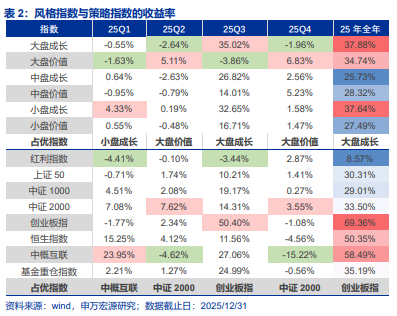
Core Insights - The year 2025 marked a significant "ability repricing" in China's active equity fund market, with over 90% of products achieving positive returns and a median return close to 30%, while top products exceeded 200% [1] - The differentiation in performance was more critical than the returns themselves, emphasizing the importance of timing and method in capturing structural gains [1][2] Fund Performance and Market Dynamics - The report from Shenwan Hongyuan highlighted three core changes in fund evaluation for 2025: track selection dominated annual rankings, adjustment rhythm was more crucial than long-term style, and high turnover, actively managed funds regained superiority [1][3] - The A-share market exhibited a typical "N-shaped structural market," with significant sector performance variations, particularly in metals, communications, and electronics, which saw annual gains of 94.73%, 84.75%, and 47.88% respectively [1][5] - The disparity in industry returns reached a record high, with the food and beverage sector declining by 9.69%, resulting in a 104.43% difference between the best and worst-performing sectors [1][5] Fund Manager Insights - The value of active management was validated in 2025, highlighting the importance of track timing, as 31% of top-performing products in the first half fell to the bottom 20% in the second half [2] - Fund managers who effectively adjusted their portfolios demonstrated superior performance, indicating that flexibility in trading is essential for success [2][10] Company Performance - Among companies with active equity assets exceeding 10 billion, Yongying Fund, AVIC Fund, and Caitong Fund stood out, with average performances exceeding 50%, and Yongying Fund achieving an average return of 56.76% [4] - The top-performing funds were predominantly technology-themed, leveraging industry allocation to generate substantial excess returns [8][19] Market Structure and New Fund Launches - The market's recovery was reflected in the new fund launches, with 334 new active equity funds totaling 161.9 billion yuan, marking a significant rebound from previous years [16][18] - The top new products included those with substantial initial offerings, such as the 4.955 billion yuan launch of the Zhaoshang Balanced Selection Fund [16] Key Themes and Strategies - Five major thematic opportunities emerged in 2025, with precious metals providing consistent returns, and the precious metals index rising over 111% [11] - The performance of innovative pharmaceuticals and new consumption sectors was notable, with significant gains in the first half of the year, although they faced declines later [11][14] - The ability to switch between multiple tracks and manage drawdowns effectively became a critical factor for fund success in 2025 [15][19]