云计算

Search documents
道指涨超600点,甲骨文市值蒸发超4800亿,加密货币近14万人爆仓
21世纪经济报道· 2025-12-11 23:30
Market Overview - On December 11, US stock indices closed mixed, with the Dow Jones rising by 1.34% (over 600 points), the S&P 500 up by 0.21%, and the Nasdaq down by 0.25% [1] - Major tech stocks mostly declined, with the Wande American Technology Seven Giants Index falling by 0.71%, and Oracle's stock dropping over 10%, resulting in a market cap loss of approximately $68.9 billion (about 48.63 billion RMB) [3][4] Oracle's Performance - Oracle's stock price fell sharply, initially dropping by 16% and later closing down by over 10% due to disappointing cloud business revenue and a significant increase in capital expenditure guidance for 2026, raised by $15 billion to $50 billion [3][4] Commodity Market - Gold and silver prices strengthened, with spot gold rising by 1.27% to $4,282.49 per ounce and spot silver up by 2.82% to $63.543 per ounce, reaching historical highs [5] - Crude oil prices declined, with WTI crude oil down by 0.92% to $57.92 per barrel and Brent crude down by 1% to $61.59 per barrel [6][7] Cryptocurrency Market - Bitcoin increased by over 1% to $93,005.06, while Ethereum fell by 1.94% to $3,259.6, with significant liquidation events occurring in the crypto market [7] Economic Indicators - The US Department of Labor reported an increase in initial jobless claims to 236,000, up by 44,000 from the previous week [7] - Recent trade data showed September imports at $342.1 billion and exports at $289.3 billion, leading to a narrower trade deficit, the lowest since 2020 [8] Federal Reserve Actions - The Federal Reserve cut the federal funds rate by 25 basis points and announced the resumption of Treasury purchases to ease market liquidity [8] - Future economic indicators will be crucial in determining the Fed's monetary policy direction, with upcoming employment and CPI reports being particularly significant [10] AI Investment Trends - The performance of major tech stocks, particularly in AI, is critical as they contribute over 50% to the S&P 500 index's gains [11] - The ongoing debate about potential AI market bubbles continues, with Oracle's recent performance expected to have lasting effects on the stock market [11]


盘前必读丨明年经济工作重点任务来了;摩尔线程提示股票交易风险
Sou Hu Cai Jing· 2025-12-11 23:28
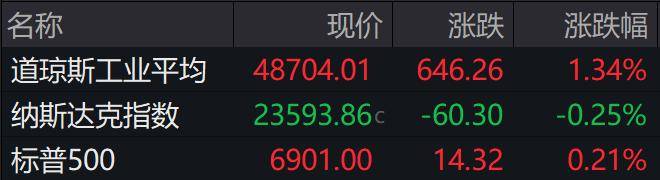
【财经日历】 沪深300、中证500等指数定期调整于收市后生效 上证50、上证180、上证380、科创50等指数定期调整于收市后生效 新股申购:天溯计量、锡华科技 | 名称 | 现价 | 涨跌 | 涨跌幅 | | --- | --- | --- | --- | | 道琼斯工业平均 | 48704.01 | 646.26 | 1.34% | | 纳斯达克指数 | 23593.86c | -60.30 | -0.25% | | 标普500 | 6901.00 | 14.32 | 0.21% | 当地时间周四,美股走势分化,道指与标普500指数在周期股带动下续创新高。截至收盘,道指涨 1.34%,纳指跌0.25%,标普500指数涨0.21%。 降息驱动下,小盘股表现尤为亮眼,罗素2000指数收涨1.21%,报2590.61点,盘中亦创历史新高。 甲骨文暴跌10.83%,科技股情绪受明显冲击。公司财报披露云业务收入不及预期,同时宣布未来将额 外投入150亿美元扩建数据中心。 大型科技股多数下跌,谷歌A收跌2.43%,英伟达跌1.55%,特斯拉跌1.01%,亚马逊跌0.65%,苹果跌 0.27%,Meta涨0.4%,微 ...
华尔街见闻早餐FM-Radio | 2025年12月12日
Hua Er Jie Jian Wen· 2025-12-11 23:26
Market Overview - Oracle's earnings report revealed weak cloud revenue and significant capital expenditure plans, causing a 16% drop in its stock and nearly 11% decline at close, impacting the Nasdaq [2] - OpenAI launched GPT-5.2, leading to a 2.43% drop in Google's stock, which was the worst performer among major tech companies [2] - Broadcom's earnings report showed a 74% increase in AI chip revenue, but the stock initially rose 4% before falling over 5% [8] Economic Indicators - The U.S. initial jobless claims rose by 44,000, marking the largest increase since 2020, while continuing claims fell to an eight-month low [26] - The U.S. trade deficit in September dropped to a five-year low, attributed to a reduction in gold imports [26] Company News - Broadcom's fourth-quarter revenue and profit reached record highs, with a nearly 30% and 40% year-over-year increase, respectively [26] - OpenAI's GPT-5.2 is claimed to surpass human experts in coding tasks, with the model expected to be a significant advancement in AI capabilities [27] - Disney invested $1 billion in OpenAI and authorized the use of its iconic characters for content generation [28] Industry Developments - The Central Economic Work Conference in China emphasized the continuation of a moderately loose monetary policy and measures to stabilize the real estate market [6][25] - Rivian announced new AI chip and L4 autonomous driving plans, but its stock fell by 10% following the announcement [28] - Ciena reported a 20% year-over-year revenue increase, reaching $1.35 billion, driven by strong demand in the optical networking sector [29] Technology Trends - The semiconductor industry is experiencing a significant increase in demand, with TSMC planning to ramp up production capacity for advanced packaging [28] - The AI sector is seeing intense competition, with Microsoft set to unveil a new AI model, indicating a strategic move in the evolving landscape [27] Commodity Market - Gold prices rose nearly 1.3%, surpassing $4,300, while silver prices also reached new highs, driven by supply-demand imbalances [4][19] - The price of NAND flash memory is expected to rise significantly due to supply constraints, with some prices increasing by over 100% [48]

股价又崩了,市值蒸发6690亿元!甲骨文成“煤矿中的金丝雀”
Mei Ri Jing Ji Xin Wen· 2025-12-11 22:29
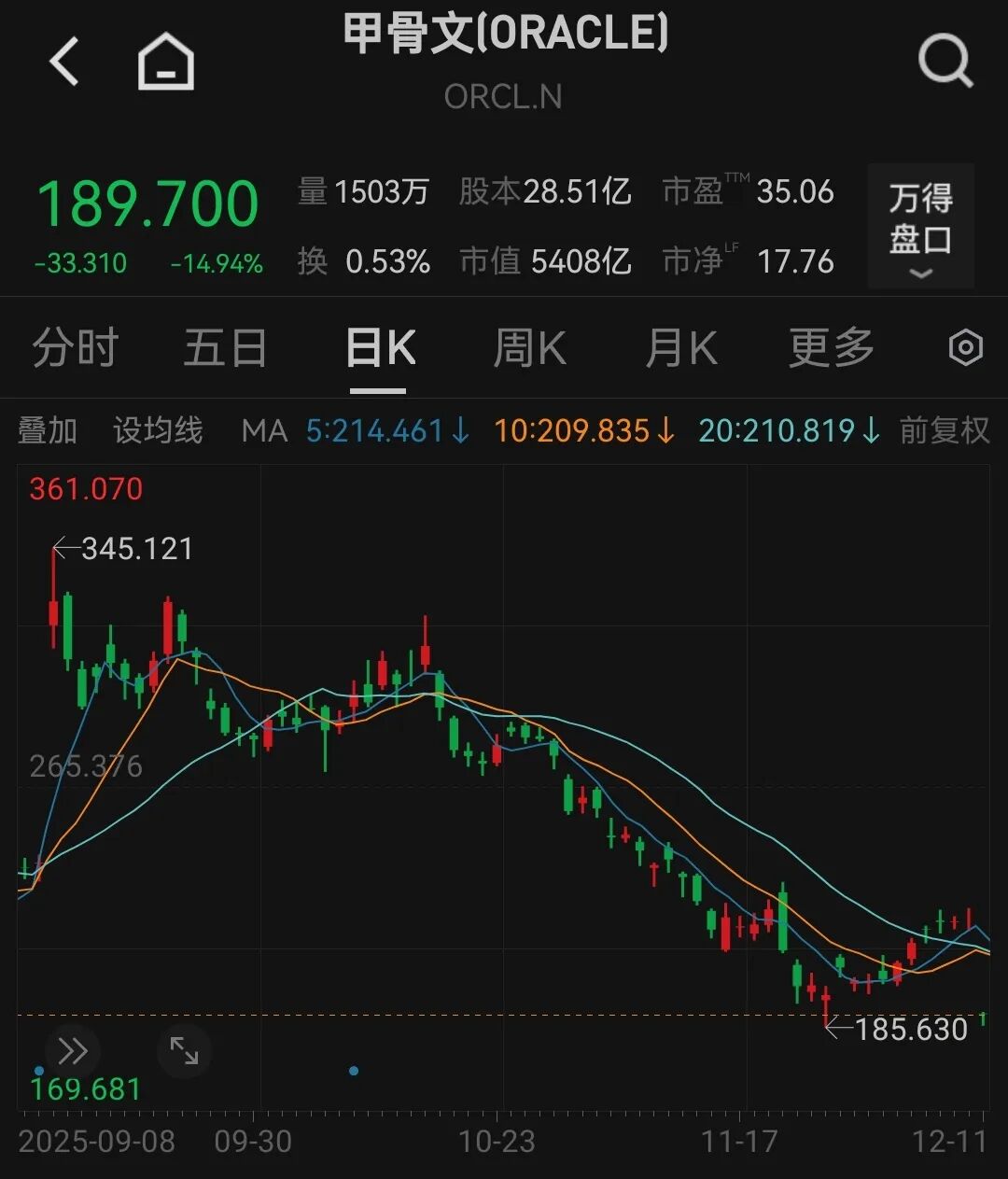
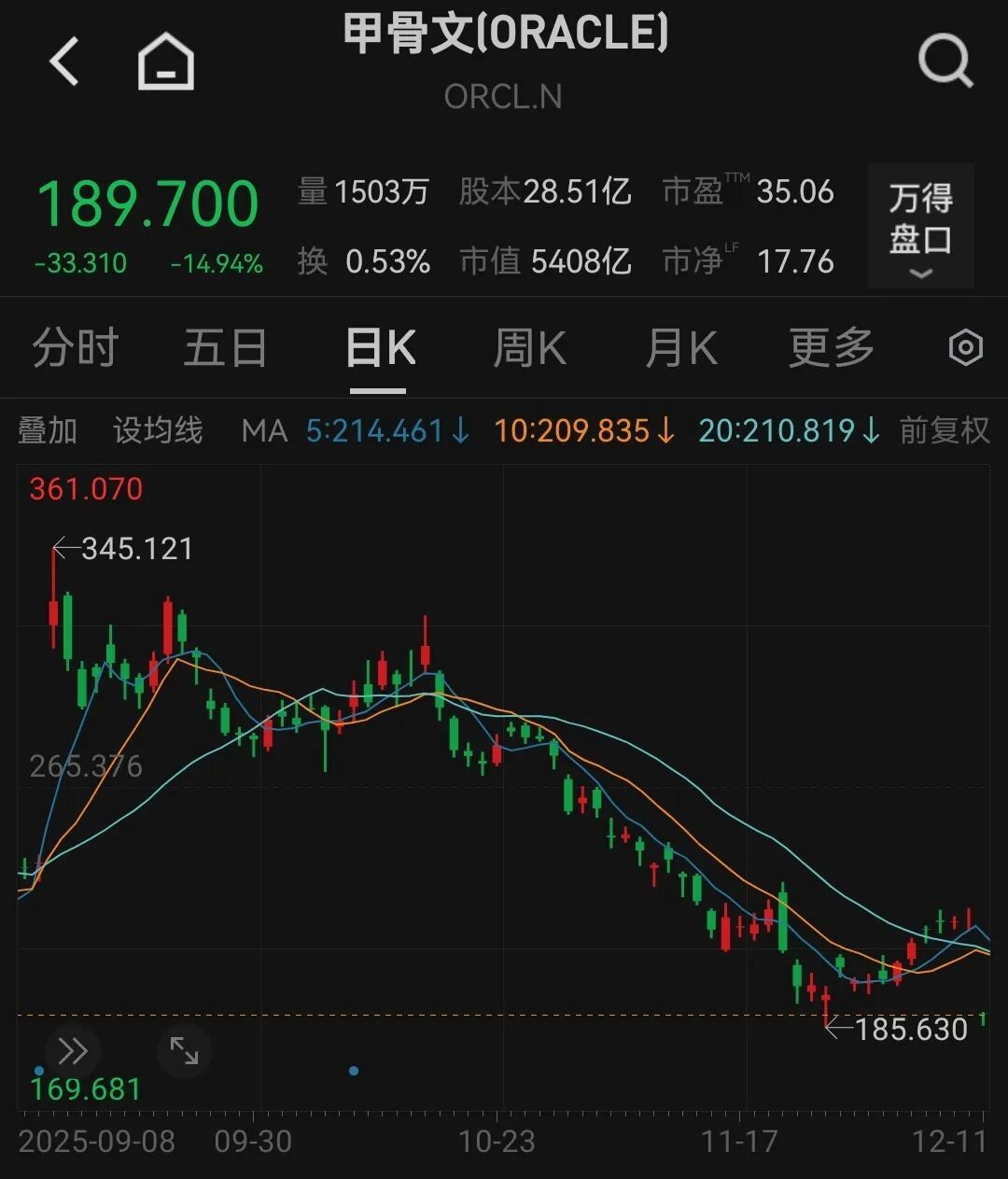
Core Insights - Oracle's remaining performance obligations (RPO) surged 438% year-over-year to $523 billion, driven by orders from major players like OpenAI and Nvidia [1][6] - The company reported a free cash flow deficit of $13.2 billion, raising concerns about its financial health [1][6] - Morgan Stanley analysts predict Oracle's adjusted debt could exceed $300 billion by 2028 [1][7] Financial Performance - For Q2 of fiscal year 2026, Oracle's total revenue was $16.06 billion, falling short of expectations [6] - Cloud business revenue reached $8 billion, a 34% year-over-year increase, but also below analyst forecasts [6] - AI-driven cloud infrastructure revenue grew 68% year-over-year to $4.1 billion [6] Debt and Credit Risk - Oracle's total outstanding debt has surpassed $100 billion, making it the largest debt holder among investment-grade tech companies [7] - The five-year credit default swap (CDS) for Oracle has risen to its highest level since 2009, indicating increased credit risk [4][13] - CDS trading volume surged to approximately $9.2 billion over ten weeks, compared to $410 million in the same period last year [4][13] Market Reaction - Oracle's stock price fell nearly 15% to $189.7, resulting in a market capitalization loss of about $95 billion [1][3] - The Philadelphia Semiconductor Index dropped 1.93%, with major companies like Nvidia and AMD experiencing declines of over 3% [1][3] Strategic Partnerships and Risks - Oracle's partnership with OpenAI involves a five-year agreement for $300 billion in computing resources, raising concerns about OpenAI's ability to meet its financial commitments [8][12] - The capital expenditure for Oracle is projected to reach $50 billion for fiscal year 2026, increasing by $15 billion from previous estimates [6][8] - Analysts warn that Oracle's heavy reliance on debt for data center expansion poses significant risks, especially if customer commitments falter [8][12]
尾盘:道指大涨650点 再创盘中新高
Xin Lang Cai Jing· 2025-12-11 19:55
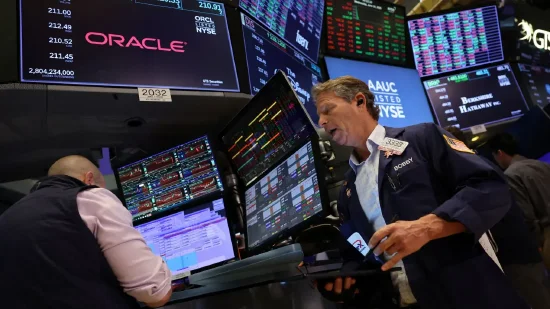
Market Overview - The Dow Jones Industrial Average (DJIA) rose by 654.60 points, an increase of 1.36%, closing at 48,712.35 points, while the Nasdaq Composite Index fell by 55.46 points, a decrease of 0.23%, closing at 23,598.70 points, and the S&P 500 Index dropped by 14.60 points, a decline of 0.21%, closing at 6,901.28 points [3][9] - The DJIA reached an intraday all-time high of 48,728.24 points [4][9] Company-Specific Developments - Oracle Corporation's stock plummeted by 14% after reporting quarterly revenue that fell short of expectations and raising its spending forecast, which heightened concerns about its debt situation [4][9] - The disappointing earnings report from Oracle intensified discussions regarding how quickly technology companies can expect returns on their investments in artificial intelligence (AI) [4][9] Sector Performance - The decline in Oracle's stock negatively impacted the technology sector, which suppressed the upward momentum gained in the previous trading day [4][9] - Other AI-related stocks, including Nvidia, AMD, and CoreWeave, also experienced declines following Oracle's report [4][9] Economic Indicators - The U.S. trade deficit unexpectedly narrowed to its smallest level since mid-2020, with a reduction of nearly 11% to $52.8 billion in September, driven by an increase in exports [6][11]
午盘:道指创盘中新高 甲骨文拖累纳指下跌
Xin Lang Cai Jing· 2025-12-11 17:05
北京时间12月12日凌晨,美股周四午盘走势分化,道指创盘中历史新高,纳指下跌220点。甲骨文拖累 科技股走低。尽管昨日美联储降息一度提振市场,但甲骨文的财报重新引发了市场对科技股估值过高的 担忧。 道指涨535.00点,涨幅为1.11%,报48592.75点;纳指跌227.06点,跌幅为0.96%,报23427.09点;标普 500指数跌20.70点,跌幅为0.30%,报6865.98点。 周四早间,道指最高上涨至48661.94点,创盘中历史新高。 甲骨文股价重挫14%。这家云计算公司公布季度营收不及预期,并上调了支出预期,引发对其债务状况 的更大担忧,导致其股价暴跌13%。 甲骨文公司的财报与上调开支预期,进一步加剧了关于科技公司能在多快时间内从人工智能(AI)投 资中获得回报的争论。包括包括英伟达和AMD、CoreWeave等在内,其他人工智能概念股也普遍走低。 科技股板块的下跌,抑制了前一交易日积累的上涨动能。此前,周三美联储在内部意见分歧的情况下宣 布今年第三次降息,并排除了加息的可能性,推动美股收高,标普500指数收盘仅差毫厘便创下新高。 北京时间12月12日凌晨,美股周四午盘走势分化,道指创盘中 ...

英伟达IR会和甲骨文不及预期的财报
傅里叶的猫· 2025-12-11 16:02
Core Viewpoint - Oracle's Q2 FY2026 financial results were disappointing, leading to a significant drop in stock price and market capitalization, primarily due to lower-than-expected revenue and profit margins [1][2]. Financial Performance - Oracle reported Q2 revenue of $16.058 billion, a 14% year-over-year increase, but below market expectations [2]. - Cloud business revenue reached $8 billion, growing 33% year-over-year, with Infrastructure as a Service (IaaS) growing 66%, although it was below guidance [2]. - The backlog surged to $523 billion, with new Remaining Performance Obligations (RPO) of $67.7 billion [2]. Market Reaction - The market's reaction to Oracle's results was notably negative, contrasting with previous earnings reports where the backlog was positively received [2]. - Concerns were raised regarding Oracle's capital expenditures, which increased by 203% to $12 billion, resulting in negative free cash flow of $10 billion [6]. Analyst Ratings - Morgan Stanley maintained an "Equal Weight" rating with a target price of $320, citing pressure on revenue and profit margins [1]. - Citigroup rated Oracle as "Buy" with a target price of $370, indicating a long-term positive outlook despite short-term challenges [1]. - Goldman Sachs rated Oracle as "Neutral" with a target price of $220, reflecting concerns about risk and return balance [1]. AI Demand and Infrastructure - Despite the disappointing financial results, Oracle remains a leader in AI infrastructure, with GPU-related revenue surging 177% and GPU capacity deliveries increasing by 50% [6]. - The company has over 700 AI customers, including significant contracts with Meta and Nvidia, indicating robust demand for AI services [6].

A股晚间热点 | 加大支持力度!商务部将出台加快零售业创新发展意见
智通财经网· 2025-12-11 15:21
Group 1: Central Economic Work Conference Insights - The Central Economic Work Conference emphasized the continuation of a moderately loose monetary policy, focusing on stabilizing economic growth and reasonable price recovery, while maintaining ample liquidity [1] - The conference called for a more proactive fiscal policy, optimizing fiscal expenditure structure, and managing necessary fiscal deficits [1] - It highlighted the need to stabilize the real estate market with targeted measures, including controlling increments, reducing inventory, and improving supply [1] Group 2: Retail Industry Support - The Ministry of Commerce plans to introduce policies to accelerate innovation and high-quality development in the retail sector, enhancing product and service quality [3] - The focus will be on promoting fair competition between online and offline channels, aiming for a positive interaction between new supply and demand [3] Group 3: Oracle's Financial Performance - Oracle's stock dropped over 12% due to cloud business revenue falling short of expectations, raising concerns over increased AI spending [4] - The company reported a free cash flow of -$10 billion for the quarter and projected a $15 billion increase in annual capital expenditures [4] - Despite a record backlog of $523 billion in orders, analysts noted that profits were heavily reliant on non-recurring income [4] Group 4: DRAM Shortage Forecast - UBS reported an unprecedented supply-demand imbalance in the storage industry, predicting DRAM shortages to last until Q1 2027 [5] - Demand for DDR memory is expected to grow by 20.7%, significantly outpacing supply growth, leading to a 35% price increase in Q4 [5] Group 5: Waymo's Expansion - Waymo announced a threefold increase in ride-hailing trips since 2025, with plans to expand operations to over 20 cities, including Tokyo and London [6] - The company aims to increase its fleet from 1,500 to 3,500 vehicles by 2026, with a target of 4 million fully autonomous rides in 2024 [6] Group 6: Upgraded Economic Growth Forecasts - Multiple international institutions have raised their 2025 economic growth forecasts for China, citing improved resilience despite challenges [7] - The World Bank, IMF, and ADB adjusted their forecasts upward by 0.4, 0.2, and 0.1 percentage points, respectively, attributing this to proactive fiscal and monetary policies [7] Group 7: Ice and Snow Economy Opportunities - The ice and snow economy is projected to exceed 1 trillion yuan, driven by government policies and increased consumer interest [8] - Key investment opportunities include companies in the ice sports sector, such as Anta Sports and Bosideng, which are expected to benefit from this trend [8]

百度智能云与伙伴共探政务AI规模化落地新路径
Sou Hu Cai Jing· 2025-12-11 15:14
Core Insights - The digitalization of government affairs is crucial for public welfare and socio-economic development, entering a deepening phase centered on system intelligence with the empowerment of AI [1][4] - Baidu Smart Cloud hosted a government ecosystem forum, engaging over fifty core partners from various sectors to discuss government large models, intelligent applications, and industry-level solutions [1][3] Group 1 - Baidu Smart Cloud showcased its Government Large Model Solution 3.0, which offers integrated and platform-based model service capabilities to enhance efficiency in intelligent practices [3] - The collaboration with partners has led to the development of replicable scenario applications, such as the "Urban Governance Industry Large Model Joint Solution" by Digital Governance, which enhances smart upgrades in urban management and legal governance [3] - The partnership with AsiaInfo Technology has facilitated the implementation of government large model projects across multiple regions, providing essential support for complex system collaboration and scalable delivery [3] Group 2 - Baidu Smart Cloud has established a clear technical integration path and project collaboration mechanism with its partners, emphasizing that the health of the ecosystem relies on the depth of collaboration and replicability of results [3] - The company has become the choice for 65% of central enterprises, 100% of systemically important banks, and over 800 financial institutions, showcasing its technical accumulation and service capabilities in the government sector [4] - Baidu Smart Cloud aims to continue opening its full-stack AI technology and optimizing ecosystem collaboration mechanisms to promote validated cooperation models across more government scenarios [4]


刚刚股价又崩了,市值蒸发6690亿元!硅谷巨头深度捆绑英伟达和OpenAI,代价可能是3000亿美元巨债
Mei Ri Jing Ji Xin Wen· 2025-12-11 15:14
Core Insights - Oracle's remaining performance obligations (RPO) surged 438% year-over-year to $523 billion, driven by orders from major players like OpenAI and Nvidia [1][7] - The company reported a free cash flow deficit of $13.2 billion, raising concerns about its financial health [1][7] - Oracle's stock price fell nearly 15% following the earnings report, resulting in a market capitalization loss of approximately $95 billion [1][6] Financial Performance - For Q2 of FY2026, Oracle's total revenue was $16.06 billion, which fell short of expectations [6] - Cloud revenue reached $8 billion, a 34% year-over-year increase, but also did not meet analyst forecasts [6] - AI-driven cloud infrastructure revenue grew 68% year-over-year to $4.1 billion [6] Debt and Credit Risk - Morgan Stanley predicts Oracle's adjusted debt could exceed $300 billion by 2028 [1][7] - The company's five-year credit default swap (CDS) has risen to its highest level since 2009, indicating increased credit risk [4][13] - CDS trading volume surged to approximately $9.2 billion over ten weeks, compared to $410 million in the same period last year [4][13] Market Impact - Oracle's stock decline has negatively affected the Philadelphia Semiconductor Index, which dropped 1.93%, with major semiconductor companies like Nvidia and AMD seeing declines of over 3% [1][3] - Despite a 16% year-to-date increase, Oracle's stock has fallen about 41% from its September peak [3][6] Strategic Partnerships and Risks - Oracle's partnership with OpenAI involves a five-year agreement for $300 billion in computing resources, raising concerns about OpenAI's ability to fulfill its financial commitments [8][11] - The company faces significant capital expenditure requirements, estimated at $50 billion for FY2026, which could lead to substantial asset impairment risks if client commitments falter [8][12]