
家电

Search documents
抢跑“国家线”10年!海信“双碳”提速
Da Zhong Ri Bao· 2026-01-14 04:49
基于产品全生命周期碳足迹理念,海信构建了覆盖研供产销回的全链条绿色发展体系。制造端已打造3 家全球领先"灯塔工厂"、4座零碳工厂、17座国家级绿色工厂,国内制造园区实现能碳数字化平台全覆 盖,可精准核算组织碳与产品碳足迹。产业链端将50%核心供应商纳入碳排放管控,推动40%供应商制 定减碳目标,下游构建"线上+线下"一体化回收网络,实现电子废弃物100%规范再利用;产品端家电类 一、二级能耗产品占比超90%,目前已实现显示、商空在产机型碳足迹在线核算,29个重点产品碳足迹 经第三方认证,6个产品获碳标签认证,主导参与130余项绿色低碳国家/行业/团体标准制修订。 (大众新闻记者 杨成) 据了解,海信是海外营收占比接近50%的外向型企业。上月17日,欧盟发布碳边境调节机制(CBAM) 提案,将碳关税覆盖范围从6种原材料拓展至180种下游产品(含冰箱、洗衣机等家电),2028年起逐步 实施。本次发布的《行动方案》通过健全碳足迹管理体系,为家电企业应对绿色贸易壁垒筑牢政策支 撑。 1月14日,省政府新闻办举行省政府政策例行吹风会,解读近期出台的《关于推进绿色转型健全碳足迹 管理体系的行动方案》(以下简称《行动方案》 ...

广州南沙八大领域惠企政策包持续落地见效
Zheng Quan Shi Bao Wang· 2026-01-14 03:31
Core Viewpoint - Guangzhou's Nansha District has introduced a series of measures to stimulate economic growth and investment at the beginning of 2026, focusing on enhancing investment vitality, supporting small and micro enterprises, and optimizing financial services for businesses [1] Tax Incentives - Nansha has implemented three regional tax incentive policies since January 1, 2022, including a reduced corporate income tax rate of 15% for eligible industries, extended loss carryforward for high-tech enterprises up to 13 years, and tax exemptions for Hong Kong and Macau residents exceeding local tax burdens [1][2] Business Growth and Market Dynamics - By November 2025, 60 enterprises benefited from the 15% corporate income tax incentive, resulting in a total tax reduction of over 2.1 billion yuan, with new enterprises contributing over 1.9 billion yuan in taxes and generating over 50 billion yuan in revenue [2] - Nansha's market entities exceeded 380,000 by the end of 2025, with nearly 5,000 new Hong Kong and Macau enterprises established in three years, indicating a growing talent aggregation effect [2] Land Supply and Cost Reduction - Nansha has reformed its land supply system to match land resources with enterprise needs, implementing a model that provides various types of industrial space and reducing land costs by over 1.9 billion yuan through flexible land transfer periods [2][3] Financial Support - The Nansha Technology Innovation Fund has approved 49 sub-funds, leveraging over 18 billion yuan in total scale and investing approximately 1.468 billion yuan in 74 projects, recognized as one of the top county-level government guidance funds in China [3] Market Access and Regulatory Reforms - In 2023, Nansha began exploring regulatory reforms in biomedicine and intelligent unmanned systems, allowing clinical applications of restricted cell transplantation technologies [4] - Nansha has established itself as a pioneer in cell and gene therapy, successfully conducting the first clinical application of thalassemia treatment in June 2025 [4] Research and Development Support - Nansha allocates up to 100 million yuan annually for R&D subsidies, rewarding enterprises that increase R&D spending with up to 3 million yuan based on their expenditures [4] Customs and Logistics Improvements - The implementation of a "seven-day exemption" for customs procedures significantly reduced the number of required steps from 42 to 1, enhancing shipping efficiency and supporting the Greater Bay Area's logistics [5] Approval and Service Efficiency - Nansha has streamlined its approval processes, achieving significant reductions in project initiation times, with some projects starting construction within 128 days of negotiation [6] - The introduction of a comprehensive inspection system has reduced the frequency of enterprise inspections by 70%, minimizing disruptions to business operations [6]
出口增长48.7%!我国成为工业机器人净出口国
Zhong Guo Jing Ji Wang· 2026-01-14 03:26
Core Insights - China's industrial robot exports grew by 48.7%, making the country a net exporter of industrial robots, with exports surpassing imports [1] - Overall exports reached 26.99 trillion yuan, a year-on-year increase of 6.1%, driven by quality improvements and innovation [1] Group 1: Innovation and Market Adaptation - High-tech product exports are projected to grow by 13.2% by 2025, contributing 2.4 percentage points to overall export growth [1] - Exports of specialized equipment, high-end machine tools, and industrial robots increased by 20.6%, 21.5%, and 48.7% respectively [1] - Traditional industries are undergoing transformation, with examples such as innovative ceramic designs and advanced air conditioning systems for extreme climates [1] Group 2: Green Development - Exports in the green energy sector, including lithium batteries and wind turbine sets, are expected to grow by 26.2% and 48.7% respectively by 2025 [2] - Electric motorcycles and bicycles are projected to see an 18.1% increase in exports, while electric locomotives are expected to grow by 27.1% [2] - Industrial gas purification equipment exports are anticipated to rise by 17.3%, and electric forklift exports by 5.2% [2] Group 3: Cooperation and Global Trade - Trade in intermediate goods is growing rapidly, becoming a major driver of exports and supporting global industrial cooperation [2] - Exports to countries involved in the Belt and Road Initiative increased by 11.2%, contributing 5.4 percentage points to overall export growth [2] - ASEAN has remained China's largest export market for three consecutive years, with emerging markets in Latin America, the Middle East, Central Asia, and Africa showing faster growth than the overall export rate [2]

格力加快布局AI家电矩阵,全力构建全屋智能健康生态
Quan Jing Wang· 2026-01-14 03:22
Core Insights - The Chinese home appliance market is undergoing a significant transformation towards AI-driven products, moving from mere functionality to understanding and serving user needs [1][2] - The smart home market is projected to exceed 952.3 billion yuan, with AI penetration surpassing 50%, indicating a shift from "connected appliances" to "intelligent entities that understand users" [1][3] Industry Trends - The transition from "pseudo-intelligence" to "true AI" is reshaping the home appliance industry, with traditional products often failing to deliver genuine smart capabilities [2][3] - AI technology breakthroughs, particularly in large language models and multi-modal perception, are creating new opportunities for innovation in the home appliance sector [2][4] Market Dynamics - A report indicates that 83% of consumers are willing to pay a premium for effective health technologies, with health-related appliance searches increasing by 4.9 times from 2022 to 2025 [3][4] - Government policies are increasingly supporting the AI sector, promoting initiatives that encourage the development of smart appliances and enhancing supply in the market [3][4] Competitive Landscape - Gree Electric Appliances is positioning itself as a leader in the AI home appliance market with a focus on "AI + energy-saving + health" as its competitive edge [5][6] - The company aims to leverage its strong manufacturing capabilities and core technologies to create differentiated products that meet consumer demands for health and energy efficiency [5][6] Product Innovations - Gree's AI product lineup includes key categories such as air conditioners, washing machines, and water purifiers, designed to address clear user pain points related to health and comfort [8][9] - The AI Cool King air conditioner features dynamic energy-saving technology, achieving a 13.6% reduction in annual energy consumption compared to standard models, showcasing Gree's commitment to energy efficiency [10][11] Consumer Engagement - Gree's "Dong Mingzhu Health Home" stores provide immersive experiences for consumers, allowing them to interact with AI appliances and understand their benefits firsthand [18][19] - The company is capitalizing on the trend of upgrading existing appliances through policies that encourage consumers to replace older models with AI-enabled products [7][8] Future Outlook - The AI home appliance sector is expected to mature and scale significantly by 2026, driven by ongoing technological advancements and evolving consumer preferences [18][19] - Gree's strategy emphasizes a balance between self-developed technologies and ecosystem partnerships, positioning the company to capitalize on the growing demand for intelligent home solutions [19]



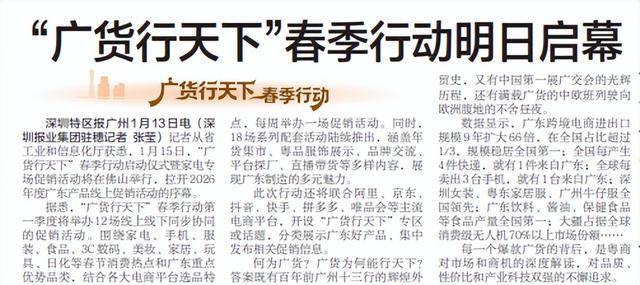
【深圳特区报】“广货行天下”春季行动明日启幕
Sou Hu Cai Jing· 2026-01-14 03:18
Group 1 - The "Guangdong Goods Going Global" spring campaign will kick off on January 15, 2026, in Foshan, marking the beginning of online promotional activities for Guangdong products [1] - The first quarter of the campaign will feature 12 promotional events, both online and offline, focusing on consumer hotspots such as home appliances, mobile phones, clothing, food, 3C digital products, beauty, home goods, toys, and daily chemicals [3] - The campaign will collaborate with major e-commerce platforms like Alibaba, JD.com, Douyin, Kuaishou, Pinduoduo, and Vipshop to create dedicated sections or topics for showcasing Guangdong products and promoting related information [3] Group 2 - Guangdong's cross-border e-commerce import and export scale has expanded 66 times over the past nine years, accounting for over one-third of the national total, maintaining the largest scale in the country [3] - Guangdong produces one out of every four express deliveries in China, and one out of every three smartphones sold globally comes from Guangdong [3] - The region leads the nation in the production of beverages, soy sauce, and health foods, with DJI holding over 70% of the global market share for consumer drones [3]
不等过年!招工“先人一步”,开局就“快人一拍”
Chang Jiang Ri Bao· 2026-01-14 02:57
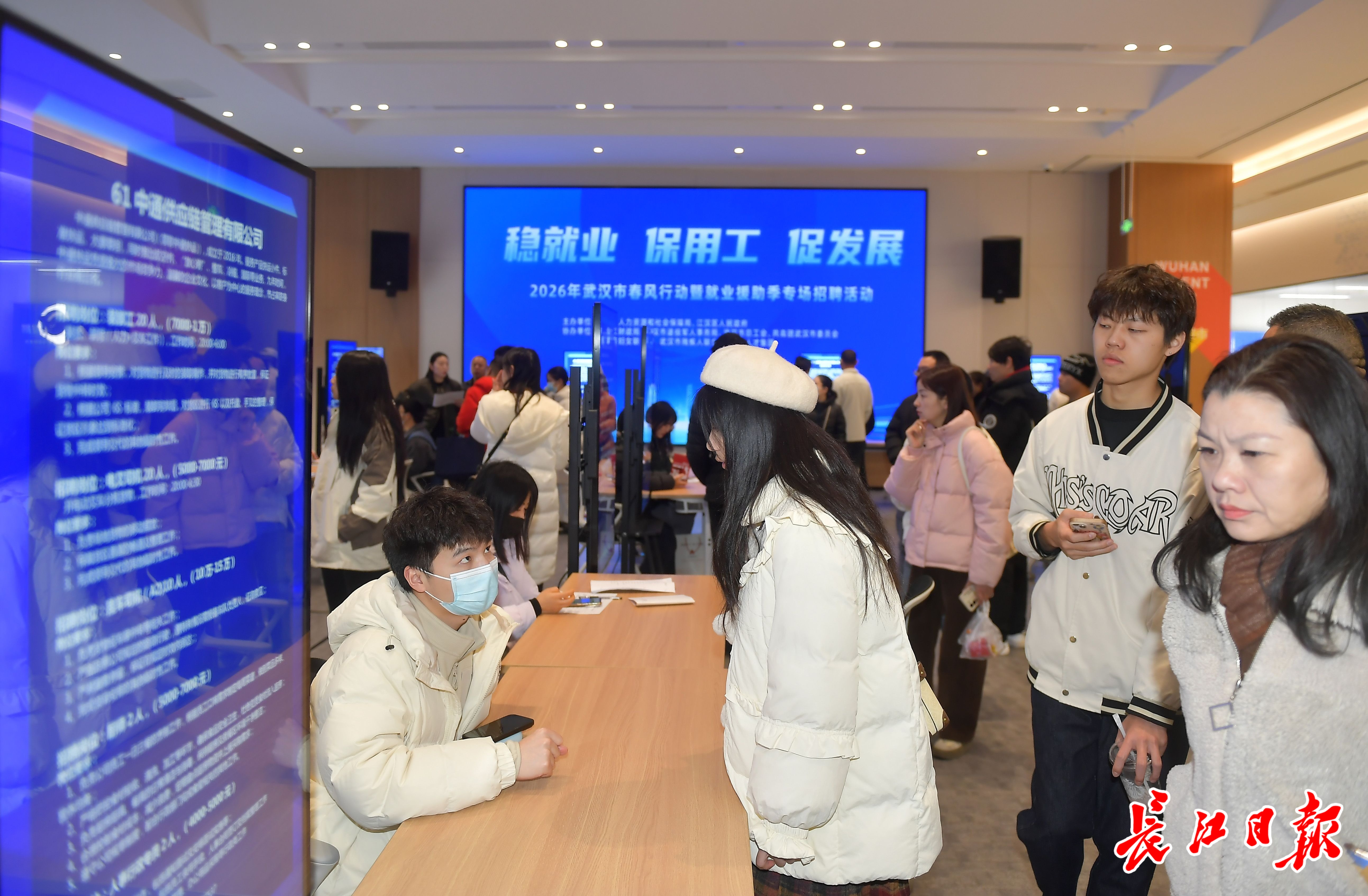
Group 1 - The "Spring Breeze" recruitment event in Wuhan, part of the city's employment guarantee initiative for 2026, aims to provide over 4,000 job positions across various sectors, including software, automotive, and high-end equipment manufacturing, with some positions offering monthly salaries exceeding 30,000 yuan [4][11][30] - The event features participation from 80 quality companies, including Kingsoft, Dongfeng Cummins, and JD Logistics, showcasing a strong demand for technical and management roles [4][30] - The recruitment strategy emphasizes early hiring to ensure companies can meet production demands post-holiday, with firms like Gree Electric and TCL actively seeking to fill positions before the Spring Festival [11][16][30] Group 2 - The Wuhan government is proactively organizing recruitment activities, with plans for over 800 events this year, focusing on key industries such as optoelectronic information, automotive manufacturing, and logistics [4][30] - The initiative aims to secure over 15,000 job positions and ensure that key enterprises have sufficient workforce to maintain operations without interruption during the holiday season [30][31] - Companies are adopting a "talent reserve" approach, recognizing the importance of early recruitment for future growth and innovation, as seen in firms like Danlai Technology, which plans to increase its R&D staff significantly [21][25][30]
出口增长48.7%,我国成为工业机器人净出口国
Xin Jing Bao· 2026-01-14 02:53
Core Insights - In 2025, China's industrial robot exports are projected to grow by 48.7%, surpassing imports, making China a net exporter of industrial robots [1] - Overall foreign trade in China is expected to reach 45.47 trillion yuan, with a growth rate of 3.8% [1] - High-tech product exports are anticipated to increase by 13.2%, contributing 2.4 percentage points to the overall export growth [1] Export Performance - Exports of specialized equipment, high-end machine tools, and industrial robots are expected to grow by 20.6%, 21.5%, and 48.7% respectively [1] - The export of lithium batteries and wind turbine generators is projected to rise by 26.2% and 48.7%, while electric motorcycles and bicycles are expected to grow by 18.1% [1] - Exports of railway electric locomotives are anticipated to increase by 27.1% [1] Market Diversification - Exports to countries involved in the Belt and Road Initiative are expected to grow by 11.2%, contributing 5.4 percentage points to overall export growth [1] - ASEAN has remained China's largest export market for three consecutive years [1] - Export growth rates to emerging markets in Latin America, the Middle East, Central Asia, and Africa are expected to exceed the overall growth rate [1]
中国品牌浪潮:从世界工厂到全球心智占领
Sou Hu Cai Jing· 2026-01-14 02:49
Core Insights - The article discusses the transformation of Chinese brands from being known as "Made in China" to becoming global brand leaders through emotional connections and cultural exports, highlighting four key characteristics of this shift [1][10][14]. Group 1: Brand Globalization - The speed of brand globalization has significantly increased, with the time required to establish brand recognition in overseas markets reduced from ten years to just 3-5 years [14]. - Enhanced infrastructure, including cross-border e-commerce platforms and social media marketing, has facilitated this rapid expansion, shifting the approach from a "prolonged battle" to a "lightning war" [14][15]. Group 2: Evolution of Export Categories - The scope of exports has evolved from physical products to include cultural IP and services, with IP product exports growing at a rate of 8%, surpassing the average growth of consumer goods exports [15][19]. - This evolution signifies a transition for Chinese brands from being mere suppliers to becoming co-creators of value through deeper interactions with consumers [15][19]. Group 3: Deepening Export Models - The export model has shifted from simple trade to a comprehensive global supply chain layout, indicating that Chinese brands are moving from being participants in the global market to becoming network builders [16]. - Companies are now integrating R&D and production globally, enhancing their competitiveness and embedding themselves within local economic ecosystems [16]. Group 4: Consumer Connection Channels - Brands are moving away from reliance on third-party platforms like Amazon, adopting a multi-channel operation system that includes DTC (Direct-to-Consumer) models [17]. - This transition allows brands to directly reach consumers, gain insights into their needs, and accumulate user assets more effectively [17]. Group 5: Regional Market Opportunities - The Asia-Pacific market is experiencing rapid demand growth, particularly in beauty and fashion sectors, due to localized innovation and cost advantages [22]. - In contrast, the North American and European markets prioritize technology, design, and sustainability, making consumer electronics and high-end appliances more likely to gain acceptance [23]. - Latin America presents opportunities for high-cost performance products like smartphones and white goods, while the Middle East and Africa focus on basic needs, with daily necessities and communication devices achieving scale through cost optimization [24]. Group 6: Strategic Paths for Exporting Companies - Companies are forming three strategic paths based on their strengths: - A-class "Scale Guardians" like Haier focus on global supply chain integration and localized operations to enhance value in existing markets [21]. - B-class "Value Heights" brands like Miniso leverage IP collaborations and localized co-creation to build emotional connections with consumers [21]. - C-class "New Star Disruptors" like Huaxizi utilize "super products + cultural symbols" strategies to rapidly capture market attention and occupy niche segments [21]. Group 7: Case Studies - Haier has successfully established a localized operational system, achieving overseas revenue of 143.81 billion yuan in 2024, marking a 5.43% increase [33]. - Miniso's overseas revenue grew by 41.9% to 6.68 billion yuan in 2024, with a focus on flagship stores in prime locations to enhance brand experience [38]. - Huaxizi has entered over 110 countries, with significant sales in Japan, leveraging unique product designs and cultural narratives to build brand recognition [42][43].




解码2026“国补”新政
Jing Ji Wang· 2026-01-14 02:24
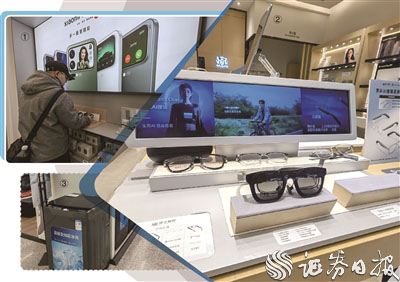
Group 1: National Subsidy Policy - The new "National Subsidy" policy, with an initial funding of 62.5 billion yuan, aims to boost consumption upgrades and improve livelihoods by focusing on large-scale equipment updates and trade-in programs for consumer goods [2][4] - The 2026 subsidy rules have been optimized compared to 2025, with specific adjustments for automobiles and home appliances, including a 15% subsidy for energy-efficient products and a cap of 1,500 yuan per item [2][7] - The inclusion of smart glasses in the subsidy program reflects the government's support for the smart wearable industry and aligns with the trend of consumption upgrades [3][4] Group 2: Smart Glasses Market - Smart glasses are transitioning from niche products to practical tools for various scenarios, including education, workplace efficiency, and fitness monitoring, which is attracting attention from major tech companies [5][6] - The domestic retail market for smart glasses is expected to recover significantly this year, with companies like VITURE expanding their presence in key urban areas [3][6] - The smart glasses segment is projected to experience substantial growth, with the global AI glasses market expected to reach 6.653 billion yuan in 2025 and 18.209 billion yuan in 2026 [5] Group 3: Home Appliances and Environmental Focus - The 2026 subsidy policy emphasizes energy-efficient home appliances, with a focus on products meeting level 1 energy or water efficiency standards, which is expected to enhance the market share of green products [7][8] - The policy changes are anticipated to accelerate the elimination of outdated production capacities and drive companies to invest more in R&D for high-end, eco-friendly products [7][8] - The shift towards level 1 energy-efficient products is expected to significantly reduce carbon emissions, reinforcing the social value of green consumption [8] Group 4: Market Dynamics and Consumer Behavior - The adjustment in subsidy policies is likely to lead to a decline in sales for lower-efficiency products while promoting higher-efficiency alternatives, thus influencing consumer purchasing behavior [9][10] - The smart consumer electronics sector is experiencing high growth, with online retail sales of smart wearables increasing by 23.1% from January to October 2025, indicating a strong demand for intelligent and experiential products [10]
2026年首批625亿元资金已下达 新一轮“国补”落地多地积极部署
Zhong Guo Chan Ye Jing Ji Xin Xi Wang· 2026-01-14 01:08
Core Viewpoint - The 2026 national subsidy program aims to stimulate domestic consumption through a series of financial incentives for consumers purchasing new products, particularly in the electronics and automotive sectors, with a total of 62.5 billion yuan allocated for the first batch of subsidies [1][8]. Subsidy Details - Consumers purchasing eligible digital products such as smartphones, tablets, smartwatches, and smart glasses priced under 6,000 yuan will receive a subsidy of 15% of the product price, capped at 500 yuan per item [2]. - For major home appliances like refrigerators, washing machines, and air conditioners, a similar subsidy of 15% applies, with a maximum of 1,500 yuan per item [2]. - In the automotive sector, scrapping eligible old vehicles for new energy cars will yield a subsidy of 12% of the new car price, up to 20,000 yuan, while scrapping fuel vehicles for smaller fuel cars will provide a 10% subsidy, capped at 15,000 yuan [2]. Regional Implementation - All 21 cities in Guangdong Province launched the 2026 subsidy program on January 1, with the first transactions occurring in Guangzhou, indicating strong local engagement [3]. - Other provinces, such as Yunnan and Zhejiang, have also initiated their own automotive subsidy programs, leading to increased consumer interest and foot traffic in dealerships [3][4]. Process Optimization - Various regions have streamlined the subsidy application process, allowing consumers to apply for automotive subsidies through national systems or mobile apps, while home appliance subsidies are facilitated through major e-commerce platforms [4]. - Cities like Beijing and Shanghai have adopted innovative methods for subsidy distribution, enhancing consumer participation and interest [4]. Market Impact - The expanded subsidy program is expected to create new opportunities in the digital and smart product markets, with significant sales increases observed in smart glasses and AI-enabled home appliances during the New Year holiday [5][7]. - The policy is designed to support small and medium enterprises by lowering investment thresholds for equipment upgrades, thereby enhancing public service and commercial facilities [5]. Economic Outlook - The 2026 subsidy program is viewed as a critical measure for boosting domestic demand and stabilizing economic growth, with long-term benefits anticipated in industrial structure optimization and consumer ecosystem enhancement [8].