
外卖

Search documents
以平台自治提升售后纠纷处置效率
Jing Ji Guan Cha Wang· 2025-08-15 17:03
Core Viewpoint - The rise of platform economy has led to increased efficiency in resource allocation and consumption upgrades, but it has also resulted in frequent disputes, difficulties in rights protection, and delayed after-sales responses, necessitating platforms to enhance internal governance mechanisms through self-regulation [2][3][4]. Group 1: Platform Challenges - In 2024, the e-commerce return rate in China reached 35%, with certain women's clothing categories experiencing return rates as high as 80% [2]. - Traditional government regulation is insufficient to cover the complex and rapidly changing online transaction scenarios, highlighting the need for platforms to improve their internal governance [2][3]. - The "involution" competition in the food delivery sector has led to price pressures on products, resulting in decreased merchant profits and increased consumer dissatisfaction, prompting regulatory intervention [3][4]. Group 2: Regulatory Measures - The implementation of the Consumer Rights Protection Law in July 2024 specifically addresses issues related to automatic renewals, such as default selections and lack of reminders, which infringe on consumer rights [4][10]. - The government aims to clarify the boundaries of right and wrong, establish bottom lines, and promote a fair competitive market environment through legal frameworks [4][10]. Group 3: Importance of Platform Autonomy - Given the complexity and immediacy of disputes, government regulation lacks the capacity to intervene in every micro-transaction, necessitating a "white space" for platform innovation and self-regulation [5][6]. - Platforms have an inherent motivation to maintain their reputation and ecosystem, as a platform filled with fraud and disputes will ultimately lose user trust [5][6]. - Self-regulation can enhance governance efficiency, reduce costs, and alleviate regulatory pressure, supporting high-quality macroeconomic development [6]. Group 4: Innovations in Dispute Resolution - Traditional after-sales dispute resolution mechanisms are inadequate for the complexities introduced by new models like live-streaming and second-hand e-commerce [7][11]. - Platforms like Xianyu have introduced innovative mechanisms such as the "Xianyu Small Court," allowing users to participate in dispute resolution, thereby enhancing community engagement and trust in platform rules [11][12]. - The "Small Court" mechanism improves dispute resolution efficiency and addresses issues of user perception and trust, as peer reviewers can provide more relatable judgments than automated systems [12][13]. Group 5: Future Directions - The trend towards user participation and community governance in platform autonomy is expected to become a significant direction for platform governance [13][14]. - Platforms are transitioning from being mere arbiters to facilitators of community-driven governance, while government roles evolve from regulators to enablers [13][14]. - Establishing a collaborative governance community can enhance dispute resolution efficiency and foster a healthier online transaction ecosystem [14].


行业告别双寡头割据时代 京东外卖在战略预期下的破局
Jing Ji Guan Cha Wang· 2025-08-15 16:17
Core Insights - The article highlights the emergence of JD.com as a significant player in China's food delivery market, challenging the existing duopoly of Meituan and Ele.me by addressing key industry pain points such as high commissions and rider welfare [2][3][5] - JD.com's second-quarter earnings report shows a total revenue of 356.7 billion RMB, a year-on-year increase of 22.4%, with its new business segment driven by food delivery experiencing a staggering 199% revenue growth [2][3][8] - The management emphasizes a long-term strategy for the food delivery business, focusing on sustainable growth rather than short-term gains, aiming to create a win-win situation for merchants, riders, and consumers [5][14][18] Business Performance - JD.com’s food delivery service has expanded to cover 350 cities and over 1.5 million quality dining establishments, establishing a reliable service network for consumers [3][5] - The number of orders has surpassed 25 million, reflecting a strong internal operational strategy that enhances consumer experience and merchant services [5][15] - The company has reported a significant increase in active users and shopping frequency, with over 40% year-on-year growth in both metrics [7][8] Strategic Positioning - JD.com aims to innovate within the food delivery sector by leveraging its supply chain capabilities, moving away from the "two landlord" model to a self-operated brand approach [15][16] - The introduction of the "Seven Fresh Kitchen" model has shown promising results, with daily orders exceeding 1,000 and a repurchase rate significantly higher than the industry average [16] - The management's focus on long-term value creation is evident in their commitment to addressing the longstanding issues in the food delivery industry, aiming for a sustainable business model [14][18] Market Dynamics - The competitive landscape is intensifying, with JD.com opting not to engage in aggressive subsidy wars, instead focusing on building a robust operational framework [5][14] - The company’s strategic collaboration with quality restaurants aims to enhance the overall dining experience and drive growth for restaurant partners [16][18] - JD.com’s food delivery service is positioned as a critical component of its broader retail strategy, contributing to the overall growth of its core e-commerce business [10][18]

滴滴旗下99Food在巴西圣保罗正式上线
Shang Wu Bu Wang Zhan· 2025-08-15 16:01
Core Insights - Didi's food delivery app 99Food officially launched operations in São Paulo on August 12, with an investment of 500 million Brazilian Reais, which accounts for half of 99Food's investment plan in the Brazilian market [1] Company Strategy - The strategy for 99Food in Brazil includes not only food delivery services but also plans for future integration of transportation, delivery, and payment services [1]

行业告别双寡头割据时代 京东外卖在战略预期下的破局
经济观察报· 2025-08-15 15:48
Core Viewpoint - The article emphasizes that JD's new business model in the food delivery sector has successfully withstood market tests, showcasing its strategic depth and value creation beyond just competing in a duopoly market [1][19]. Group 1: Market Context and Challenges - China is the world's largest food delivery market, yet it has faced issues such as declining prices, high commissions, and difficulties for riders, leading to a stagnant competitive landscape dominated by two major players [2]. - The entry of JD into the food delivery market is seen as a disruptive force, addressing industry pain points with a focus on zero commissions for merchants, quality delivery, and rider protections [2][9]. Group 2: Financial Performance and Growth - JD's Q2 2025 earnings report revealed total revenue of 356.7 billion RMB, a year-on-year increase of 22.4%, with the new business segment driven by food delivery seeing a staggering 199% revenue growth [2][11]. - The number of active users and purchase frequency on JD's platform increased by over 40% year-on-year, indicating strong user engagement and cross-purchase potential between food delivery and other retail categories [11]. Group 3: Strategic Development and Long-term Vision - JD's management emphasizes a long-term approach to its food delivery strategy, aiming to establish a sustainable business model over the next five to twenty years [4][6]. - The company has expanded its food delivery service to cover 350 cities and over 1.5 million quality dining establishments, creating a reliable service network for consumers [6][8]. Group 4: Competitive Positioning and Innovation - JD has positioned itself as a "third pole" in the food delivery market, effectively breaking the duopoly of Meituan and Ele.me, and is focused on enhancing user experience and merchant confidence [6][18]. - The company has chosen to avoid engaging in destructive subsidy wars, instead opting for a strategy that emphasizes quality and sustainability [9][18]. Group 5: Supply Chain and Operational Efficiency - JD's food delivery service leverages its supply chain capabilities to enhance operational efficiency and reduce costs, aiming to solve long-standing issues in the food delivery industry [18][21]. - The launch of the "Seven Fresh Kitchen" brand has shown promising results, with daily orders exceeding 1,000 and a repurchase rate significantly higher than the industry average [19]. Group 6: Future Outlook - JD's management believes that the food delivery business will play a crucial role in the company's overall strategy, particularly in enhancing its instant retail capabilities [21]. - The company is committed to exploring sustainable growth models that benefit all stakeholders in the food delivery ecosystem, including merchants, riders, and consumers [16][19].

京东正在帆满舵稳地驶入顺风区
Cai Jing Wang· 2025-08-15 12:55
Core Viewpoint - JD.com has successfully navigated the competitive landscape of China's e-commerce industry by adhering to a long-term strategy that emphasizes substantial investments in logistics, employee welfare, and technology integration, leading to significant growth and a strong market position [1][2][12]. Group 1: Financial Performance - In Q2 2025, JD.com reported revenues of 356.7 billion RMB (approximately 49.8 billion USD), marking a year-on-year growth of 22.4%, surpassing market expectations and setting a record for growth in nearly three years [1]. - The majority of JD.com's product categories experienced accelerated growth, with daily necessities revenue increasing by 16.4% year-on-year, and service revenue growing by 29.1% [1][4]. Group 2: Employee Welfare and Compliance - JD.com has been a pioneer in the industry by signing labor contracts with all delivery personnel and providing social insurance, having paid over 100 billion RMB in social insurance over 18 years [2][3]. - The company plans to extend social insurance benefits to full-time delivery riders in the food delivery sector, positioning itself as the only platform in the industry to do so [3]. Group 3: Supply Chain and Technology - JD.com has invested over 150 billion RMB in research and development since its technological transformation began in 2017, focusing on creating a comprehensive supply chain ecosystem that integrates consumption and industrial internet [6]. - The company has built a supply chain infrastructure valued at nearly 170 billion RMB, enhancing its ability to apply advanced technologies like AI to improve operational efficiency [6]. Group 4: New Business Ventures - JD.com has expanded into new business areas such as food delivery and hospitality, aiming to optimize supply chains and reduce costs through centralized procurement and efficient logistics [7][8]. - The launch of the "Seven Fresh Food Mall" and "Seven Fresh Kitchen" represents significant innovations in the food delivery sector, leveraging JD.com's supply chain advantages to enhance operational efficiency for restaurant partners [7][8]. Group 5: Global Expansion - JD.com is actively building a global supply chain network, having established overseas warehouses in 23 countries and regions, including the U.S., U.K., and Saudi Arabia [10][11]. - The company is shifting its focus from short-term gains to long-term value creation in its international operations, adapting to new regulatory environments and local market conditions [11][12].
送外卖半年,京东净利润成绩单
Cai Jing Wang· 2025-08-15 12:51
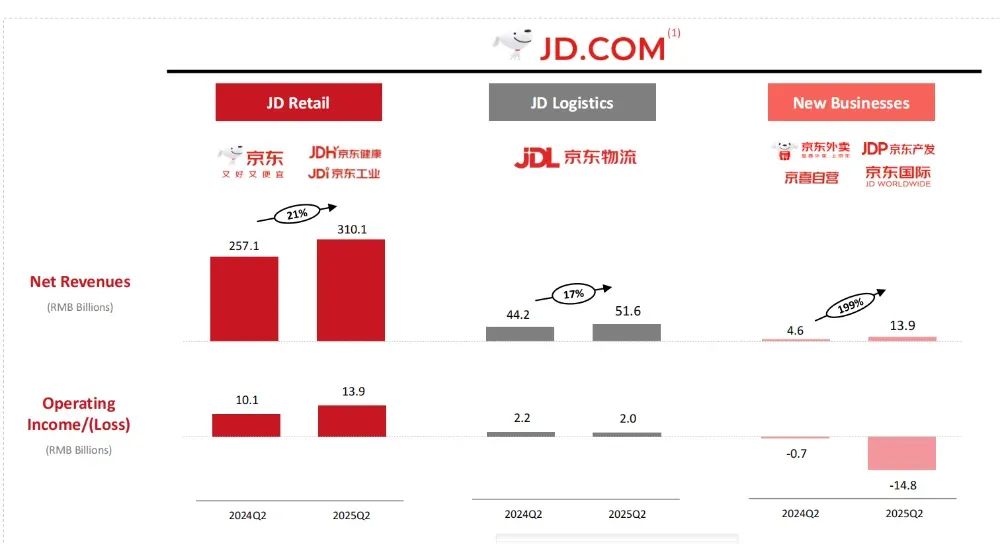
Core Insights - JD Group reported a significant loss in its food delivery segment, amounting to 14.8 billion yuan in Q2 2025, but this segment contributed to a more than 40% year-on-year increase in active user numbers and shopping frequency for its main e-commerce platform [1][9]. Financial Performance - In Q2 2025, JD Group's revenue reached 356.7 billion yuan, marking a 22.4% year-on-year growth, the highest growth rate in nearly three years [1]. - The net profit attributable to ordinary shareholders for Q2 was 6.2 billion yuan, a substantial decline of 51% year-on-year; under Non-GAAP standards, the net profit was 7.4 billion yuan, down 49% year-on-year and 42% from the previous quarter [1][2]. Business Segment Analysis - The food delivery business, categorized under "new business," saw a revenue increase of 199% year-on-year, rising from 4.6 billion yuan to 13.9 billion yuan, but the operating loss expanded from 700 million yuan to 14.8 billion yuan [6]. - JD's core retail segment generated 310.1 billion yuan in revenue during Q2, contributing 87% to the overall revenue, with an operating profit of 13.9 billion yuan, offsetting the losses from new business ventures [7]. Strategic Initiatives - JD's CEO emphasized the long-term strategic importance of food delivery and instant retail, indicating ongoing investments to enhance operational capabilities in these areas [8]. - The company has launched a new food delivery model called "Seven Fresh Kitchen," aiming to innovate the supply chain and reduce food prices while maintaining quality [14]. Market Competition - The food delivery market is highly competitive, with JD's rivals, including Taobao and Meituan, also engaging in aggressive subsidy strategies, leading to a significant increase in order volumes across the industry [3][4]. - Despite the competitive landscape, JD's management has expressed a clear stance against participating in destructive price wars, citing concerns over market sustainability [13].
3200亿快手,“杀向”外卖、自营网贷
凤凰网财经· 2025-08-15 12:46
Core Viewpoint - The article discusses the challenges faced by leading short video platforms like Kuaishou and Douyin in the context of user growth limitations and competition, particularly in the food delivery and e-commerce sectors. It highlights Kuaishou's attempts to diversify its business through food delivery, financial services, and AI initiatives as a means to overcome these challenges [4][16][24]. Group 1: Industry Challenges - The food delivery sector has become a critical battleground for major e-commerce and short video platforms, with intense competition following JD's entry into the market [5][6]. - The competition in the food delivery market has intensified, leading to a resurgence of subsidy wars among Meituan, Ele.me, and Kuaishou [6][8]. - Both Kuaishou and Douyin are facing a user growth ceiling, making commercialization a top priority for both platforms [16][18]. Group 2: Kuaishou's Business Performance - Kuaishou's Q1 revenue growth slowed to 10.9% year-on-year, down from previous years, with a net profit of 39.78 billion yuan, a decrease from 41.19 billion yuan year-on-year [17][18]. - Kuaishou's e-commerce GMV growth has been declining, with figures from 2021 to 2024 showing a drop from 78% to 17% [22]. - In contrast, Douyin's 2024 GMV reached approximately 3.43 trillion yuan, growing by 35% year-on-year, indicating a stronger market position [23]. Group 3: Kuaishou's Strategic Moves - Kuaishou has entered the food delivery market, viewing it as a means to acquire new users and enhance GMV growth, rather than directly competing in the delivery sector [20][21]. - The company is also venturing into the financial services sector with its self-operated lending platform "Shengxin Jie," which is currently in the testing phase [24][25]. - Kuaishou has established an AI division focused on developing large model businesses, indicating a strategic pivot towards AI as a potential growth driver [30][31]. Group 4: Market Response and Future Outlook - Kuaishou's stock has risen over 81% this year, with its market capitalization surpassing 320 billion HKD, reflecting positive market sentiment towards its strategic initiatives [35][36]. - UBS has highlighted the potential of Kuaishou's AI model, estimating a global market size of 11 to 23 billion USD, suggesting a promising second growth curve for the company [36][37]. - The article concludes that while food delivery and lending may serve as supplementary avenues, the core future growth for Kuaishou lies in AI development [37].


京东Q2增收653亿却少赚50%:外卖狂飙成"利润刺客",这笔账到底怎么算?
3 6 Ke· 2025-08-15 12:45
Core Viewpoint - The takeaway from the news is that JD.com is experiencing significant revenue growth in its core retail business, but this is accompanied by a sharp decline in net profit due to high investments in new business areas like food delivery, indicating a strategy focused on long-term growth despite short-term losses [2][7][10]. Group 1: Financial Performance - In Q2 2025, JD.com reported revenue of 356.66 billion yuan, a year-on-year increase of 22.4%, marking a record growth rate for nearly three years [2]. - The net profit attributable to shareholders was 6.178 billion yuan, down 50.8% year-on-year, with a 13.7% decline in net profit for the first half of the year [2]. - JD Retail's revenue reached 310.08 billion yuan in Q2, up 20.6% year-on-year, with operating profit of 13.9 billion yuan, a 37.9% increase, and an operating profit margin of 4.5%, the highest for any major promotional quarter in JD's history [3]. Group 2: User Growth and Engagement - User engagement metrics showed significant improvement, with both PLUS members and regular users growing over 50% year-on-year, and quarterly active user numbers and shopping frequency increasing over 40% [4]. - During the "618" shopping festival, JD's app daily active users reached 212 million, a 52.1% increase year-on-year, with order numbers more than doubling [4]. Group 3: Investment in New Business - JD's new business, including food delivery, saw revenue surge by 199% year-on-year to 13.9 billion yuan, but incurred an operating loss of 14.8 billion yuan, resulting in an operating profit margin of -107% [7]. - The company has been heavily investing in marketing and operational costs, with Q2 expenses rising to 57.5 billion yuan, a 62% increase from the previous year [8]. Group 4: Strategic Initiatives - JD is focusing on creating synergies between its retail and new business sectors, with plans to enhance user experience and operational efficiency through technology [5][11]. - The company is also expanding its offline presence and international operations, including a proposed acquisition of European retailer Ceconomy for 2.2 billion euros, aiming to leverage local supply chains for faster delivery services [12].
“史上最贵”外卖大战,会以“多输”收场吗?
3 6 Ke· 2025-08-15 12:21
Core Viewpoint - The article discusses the ongoing "takeout war" in China's food delivery industry, highlighting the intense competition among major players like Meituan, Ele.me, and JD.com, and the impact on consumers and small businesses [5][7][11]. Industry Overview - The food delivery market has seen a significant influx of investment, with companies burning hundreds of billions in a saturated market to capture high-frequency consumer demand [5][7]. - JD.com has entered the market with a strategy focused on quality takeout, targeting chain restaurants to quickly scale operations [7][9]. Market Dynamics - The daily order volume in the food delivery sector has surged, with peak orders reaching 2.5 billion, indicating a rapid expansion of the market [7][8]. - The competition has led to a "zero-sum game," where the gains of one player often come at the expense of another, affecting the sustainability of consumer habits [11][12]. Consumer Behavior - The article notes a shift in consumer habits, with increased frequency of orders for low-cost items like coffee and milk tea, driven by promotional campaigns [8][9]. - However, the sustainability of these habits is questioned, as the initial surge in orders may not be maintained once subsidies decrease [7][11]. Business Challenges - Small business owners are struggling to maintain profitability amid rising order volumes, leading some to withdraw from delivery platforms altogether [12]. - The intense competition has resulted in operational challenges, with delivery personnel and restaurant staff facing increased pressure to meet demand [11][12].


美团青山计划的8年:让绿色生活“人人可参与”
Xin Jing Bao· 2025-08-15 11:37
Core Viewpoint - The article highlights the increasing involvement of young people in environmental actions, particularly through initiatives led by Meituan, aimed at reducing plastic waste from the food delivery industry and promoting sustainable practices [1][2]. Group 1: Environmental Initiatives - Meituan's "Good Cup Rebirth" initiative, launched in April 2025, aims to create a green and low-carbon demonstration system covering the entire lifecycle of disposable beverage cups [1][7]. - The "Green Mountain Plan" initiated by Meituan in 2017 has led to significant achievements, including over 10 billion orders using the "no utensils" feature and the recovery of approximately 37,000 tons of plastic takeout boxes [2][3]. - The plan also includes a 5 billion yuan public welfare fund to support young researchers in environmental science, focusing on breakthroughs in recycling and reuse [2][9]. Group 2: Plastic Waste Statistics - In 2023, China's consumption of polypropylene (PP) takeout boxes reached approximately 1.35 million tons, a 26% increase from 2020, with a recycling rate of about 40% [3]. - The recycling of PP takeout boxes has increased from 250,000 tons in 2020 to 400,000 tons in 2023, marking a 60% growth [3]. Group 3: Challenges and Solutions - Challenges in the green packaging sector include poor performance, high costs, and insufficient market recognition, which Meituan's Green Mountain Plan aims to address through innovation and supply chain support [4]. - The "Box Fusion" initiative launched in 2023 focuses on large-scale recycling of plastic takeout boxes, with projects established in 24 cities across 20 provinces, resulting in a carbon reduction of 57,000 tons [6][8]. Group 4: Technological Innovations - Meituan has collaborated with various brands to create over ten products from recycled takeout boxes, demonstrating the potential of turning waste into valuable resources [8]. - The Green Mountain Plan emphasizes the importance of technology in promoting sustainable practices and has funded numerous projects aimed at green innovation and recycling [9].
