智能手机

Search documents
雷军斥资超1亿港元增持小米集团260万股
Sou Hu Cai Jing· 2025-11-24 13:13
Group 1 - The core point of the news is that Lei Jun, the founder, chairman, and CEO of Xiaomi Group, has invested over 100 million HKD to purchase 2.6 million shares, increasing his personal shareholding to 23.26% [1][2] - The board of directors of Xiaomi Group believes that this share purchase reflects Lei Jun's confidence in the company's development prospects and growth potential [2] - Xiaomi Group has conducted significant stock buybacks, totaling over 800 million HKD in the past month, with a cumulative buyback amount exceeding 2.3 billion HKD this year [4] Group 2 - On November 18, Xiaomi Group reported its earnings for the third quarter of 2025, achieving revenue of approximately 113.12 billion CNY, a year-on-year increase of 22.3%, marking the fourth consecutive quarter of revenue exceeding 100 billion CNY; adjusted net profit reached 11.3 billion CNY, a historical high with a year-on-year growth of 80.9% [5] - On November 20, Xiaomi Group celebrated the rollout of its 500,000th electric vehicle, setting a record for the fastest production of 500,000 units among global new energy vehicle companies [5]



雷军增持小米股票超1亿港元
Zheng Quan Shi Bao Wang· 2025-11-24 12:04
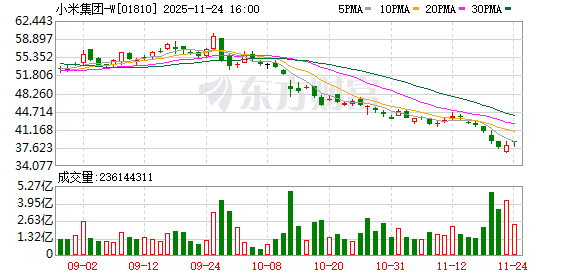
Core Viewpoint - Xiaomi Group's founder and CEO Lei Jun has invested over HKD 100 million to increase his stake in the company, signaling confidence in its future despite recent market challenges [2][4]. Group 1: Stock Buyback and Shareholding - Lei Jun has purchased 2.6 million shares, raising his ownership to 23.26% [2]. - Xiaomi has conducted significant stock buybacks, repurchasing 21.5 million shares on November 20 and 21, totaling over HKD 800 million [2]. - The total buyback amount for the year has exceeded HKD 2.3 billion, positioning Xiaomi among the top tech stocks in Hong Kong for buyback activity [3]. Group 2: Market Performance and Valuation - Xiaomi's market capitalization has declined significantly, losing over HKD 530 billion from September 25 to November 19, which surpasses the combined market cap loss of competitors NIO, Li Auto, Xpeng, and Leap Motor (approximately HKD 500 billion) [3]. - The company's stock performance reflects broader market challenges faced by tech stocks in Hong Kong [3]. Group 3: Financial Performance and Growth - In Q3, Xiaomi reported total revenue of CNY 113.1 billion, a year-on-year increase of 22.3%, and adjusted net profit of CNY 11.3 billion, up 80.9% [4]. - The core business of smartphones and AIoT is showing steady growth, while innovative sectors like electric vehicles and AI are accelerating towards profitability [4]. - Xiaomi's automotive division achieved a milestone with the production of its 500,000th electric vehicle, marking the fastest record for a global new energy vehicle company [4].
雷军斥资约1亿港元增持小米股份
Guan Cha Zhe Wang· 2025-11-24 11:57
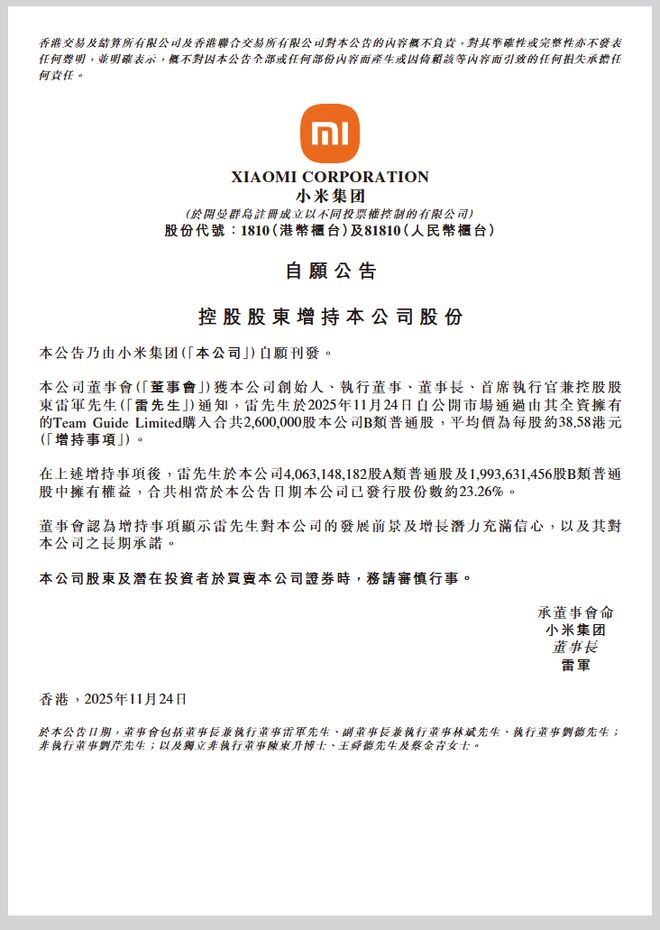
Core Viewpoint - Xiaomi Group's founder and CEO Lei Jun has purchased 2.6 million Class B shares at an average price of approximately HKD 38.58 per share, demonstrating confidence in the company's growth potential and long-term commitment [1][4]. Shareholding Increase - Lei Jun's acquisition involved an investment exceeding HKD 100 million through his wholly-owned Team Guide Limited [1][4]. - Following this purchase, Lei Jun holds a total of 4,063,148,182 Class A shares and 1,993,631,456 Class B shares, representing approximately 23.26% of the company's total issued shares [1][4]. Financial Performance - For Q3 2025, Xiaomi reported total revenue of CNY 113.1 billion, marking a year-on-year increase of 22.3% [8]. - Adjusted net profit for the same quarter reached CNY 11.3 billion, reflecting a significant year-on-year growth of 80.9% [8]. - The company achieved over 100,000 electric vehicle deliveries in the quarter, marking its first profitable quarter in this segment [8]. - Revenue from innovative businesses, including smart electric vehicles and AI, surged to CNY 29 billion, a year-on-year increase of over 199% [8]. - Xiaomi's smartphone revenue was CNY 46 billion, with a shipment of 43.3 million units, continuing a nine-quarter streak of year-on-year growth [8].
雷军出手,花费超1亿港元!
Mei Ri Jing Ji Xin Wen· 2025-11-24 11:25
Core Viewpoint - Xiaomi Group's founder Lei Jun has increased his stake in the company by purchasing 2.6 million Class B shares at an average price of approximately HKD 38.58 per share, totaling over HKD 100 million, reflecting his confidence in the company's growth potential and long-term commitment [1]. Financial Performance - For Q3 2025, Xiaomi reported revenue of RMB 113.1 billion, a year-on-year increase of 22.3%, and an adjusted net profit of RMB 11.3 billion, up 80.9%, marking the highest quarterly profit in the company's history [5]. - The innovative business segment, including smart electric vehicles and AI, generated revenue of RMB 29 billion, with smart electric vehicle sales contributing RMB 28.3 billion, showing a growth of over 199% year-on-year [5][8]. - Xiaomi delivered a record 108,796 new vehicles in Q3, with the innovative business segment achieving a gross margin of 25.5% [7][8]. Stock Performance - As of the latest market close, Xiaomi's stock rose by 1.52% to HKD 38.66, but has seen a cumulative decline of over 35% since reaching a year-to-date high of HKD 61.45 on June 27 [3]. Share Buyback - In November, Xiaomi repurchased 21.5 million shares over two days, with total expenditures exceeding HKD 800 million, indicating a strategy to support its stock price amid market fluctuations [3]. Market Challenges - The company anticipates challenges in 2026 for its electric vehicle segment due to reduced purchase tax subsidies and increased competition in the automotive industry, which may lead to a decline in gross margins compared to 2025 [8].

小米集团-W获创始人雷军增持260万股公司B类普通股
Zhi Tong Cai Jing· 2025-11-24 11:10
Core Viewpoint - Xiaomi Group-W (01810) announced that its founder and CEO Lei Jun purchased a total of 2.6 million Class B ordinary shares at an average price of approximately HKD 38.58 per share, reflecting his confidence in the company's growth potential and long-term commitment [1] Group 1 - Lei Jun's acquisition of shares was made through his wholly-owned Team Guide Limited [1] - Following this purchase, Lei Jun holds interests in 4.063 billion Class A ordinary shares and 1.994 billion Class B ordinary shares, amounting to approximately 23.26% of the company's total issued shares as of the announcement date [1] - The board of directors views this share purchase as a strong indication of Lei Jun's confidence in the company's future development and growth potential [1]
雷军,1亿港元增持小米
证券时报· 2025-11-24 11:06
Core Viewpoint - Xiaomi Group's recent stock buybacks and significant investments by its founder indicate confidence in the company's future despite a decline in stock price [1][3][4]. Group 1: Stock Buybacks and Investments - Xiaomi Group's founder, Lei Jun, invested over 100 million HKD to purchase 2.6 million shares at an average price of approximately 38.58 HKD per share, increasing his ownership to 23.26% [1]. - The company repurchased 21.5 million shares over two days, with a total expenditure exceeding 800 million HKD [3]. Group 2: Financial Performance - For Q3 2025, Xiaomi reported total revenue of 113.1 billion RMB, reflecting a year-on-year growth of 22.3% [5]. - The mobile and AIoT segment generated revenue of 84.1 billion RMB, a growth of 1.6% year-on-year, while the smart electric vehicle and AI innovation segment reached a record high of 29 billion RMB, growing by 199.2% [5][6]. - Xiaomi's adjusted net profit for Q3 was 11.3 billion RMB, marking an 80.9% increase year-on-year [6]. Group 3: Electric Vehicle Business - Xiaomi's smart electric vehicle segment achieved a quarterly operating profit for the first time, with earnings of 700 million RMB [6]. - The company announced the production of its 500,000th vehicle, emphasizing a commitment to safety, delivery, and technological innovation [6].

英伟达的好业绩,是小米的坏消息
芯世相· 2025-11-24 06:07
Core Viewpoint - Nvidia reported strong financial results for Q3 FY26, with revenue reaching $57 billion, a 62% year-over-year increase, and a record quarterly growth of $10 billion, exceeding market expectations [8][9]. Group 1: Financial Performance - Nvidia's data center revenue reached $51.2 billion, growing 66% year-over-year and 25% quarter-over-quarter [8]. - The gross margin for the quarter was 73.4%, with a net profit of $31.91 billion, reflecting a 65% year-over-year increase and a net profit margin of 56% [8][10]. - The company expects Q4 revenue to reach $65 billion, a nearly 14% quarter-over-quarter increase, with gross margin projected to rise to 74.8% [12][13]. Group 2: AI Demand and Storage Chip Price Surge - The demand for AI has significantly increased, leading to a surge in storage chip prices, particularly for HBM and DDR5 [14][18]. - Traditional storage chip prices have risen dramatically, with DDR4 prices increasing by nearly 10 times since June, driven by supply constraints and panic buying from downstream suppliers [17][22]. - OpenAI's strategic partnerships with major suppliers like Samsung and SK Hynix have intensified the demand for advanced storage chips, with an estimated monthly requirement of 900,000 DRAM wafers [15][14]. Group 3: Impact on the Industry - The ongoing price increases for storage chips are expected to have a limited impact on the AI industry due to the strong bargaining power of major players like Nvidia [23]. - However, the rising costs of storage chips will significantly affect smartphone manufacturers, as they may struggle to pass on these costs to consumers, leading to reduced profit margins [26][27]. - The potential for a negative feedback loop exists if manufacturers raise prices, which could delay consumer upgrades and impact overall demand in the smartphone market [29].

三星电子新任命他为联席CEO!他是谁?
Zhong Guo Qi Che Bao Wang· 2025-11-24 03:42
Core Viewpoint - Samsung Electronics has appointed Lee Tae-won as co-CEO and head of the mobile experience division, marking a return to a co-CEO leadership structure after nearly eight months. This change comes alongside a significant 80% year-on-year increase in operating profit for its semiconductor business, including automotive chips, raising industry interest in the company's future prospects [3][6]. Leadership Transition - Lee Tae-won has been with Samsung since 1997, starting as a research engineer in the mobile communications division. His rise through the ranks has been marked by significant contributions to technology and business strategy, particularly in the competitive smartphone market [4]. - In 2018, he took charge of Samsung's smartphone business, where he successfully optimized the production model for mid-range devices, allowing the company to focus on high-end product development and maintain its position as the largest Android smartphone manufacturer [4][5]. Innovations and Product Development - Under Lee's leadership, Samsung has ventured into the foldable smartphone market, which has become a key growth area. His efforts have transformed foldable phones from concepts into popular market products, contributing to new profit streams for the company [5]. - Lee's recent appointment as co-CEO follows a period of acting leadership where he demonstrated strong management skills and innovation, including the development of Samsung's first tri-fold smartphone, set to launch by the end of the year [5]. Automotive Business Growth - Samsung's automotive chip business has been on the rise, driven by the industry's shift towards smart and connected vehicles. The company has expanded its product offerings to include processors and image sensors, creating a comprehensive automotive chip portfolio [6][7]. - Samsung's chip business is crucial to its overall strategy, with significant advancements in chip design and manufacturing capabilities. The company has secured orders for advanced driving chips from Hyundai and is also producing chips for Nvidia, enhancing its market presence [6][7]. Competitive Advantage and Future Outlook - The appointment of Lee Tae-won signifies Samsung's entry into a dual-driven era of "end devices + chips." The company aims to strengthen its position in high-value automotive electronics, leveraging its technological advantages in chip design and system integration [8]. - As the automotive industry increasingly embraces smart and electric technologies, demand for automotive electronics is expected to grow, positioning Samsung for greater market share and commercial success [8][9]. - Lee's experience in mobile business is anticipated to provide valuable insights for chip product development, fostering an ecosystem where hardware and services work together to enhance user experience [8].

小米集团三季报发布收获“冰火两重天”
Chang Jiang Shang Bao· 2025-11-24 02:23
Core Viewpoint - Xiaomi Group has experienced significant growth in quarterly profits but faces backlash from over-marketing, resulting in a nearly 30% drop in stock price over six months [1][15]. Financial Performance - In Q3 2025, Xiaomi Group reported total revenue of 1131.21 billion yuan, marking a 22.3% year-on-year increase, and an adjusted net profit of 113.11 billion yuan, up 80.9% [4]. - The smartphone revenue decreased by 3.1% from 475 billion yuan in Q3 2024 to 460 billion yuan in Q3 2025, primarily due to a decline in average selling price (ASP) [2][4]. - The ASP for smartphones fell from 1102.2 yuan to 1062.8 yuan, a decrease of 3.6% [4]. Automotive Business - Xiaomi delivered 10.88 million new cars in Q3 2025, with a total of 260,000 cars delivered in the first three quarters [6]. - The revenue from the smart electric vehicle and AI segment reached 290 billion yuan, a remarkable 199.2% increase year-on-year, with the majority coming from electric vehicles [5][6]. - The gross profit for the smart electric vehicle segment was 73.84 billion yuan, with a gross margin increase from 17.1% to 25.5% [6]. Marketing Controversies - The launch of the 500,000th Xiaomi car was overshadowed by a court case regarding false advertising related to the Xiaomi SU7 Ultra's carbon fiber hood [1][8]. - Consumers have raised concerns about the actual functionality of the carbon fiber hood compared to its advertised features, leading to lawsuits [10][11]. - Xiaomi's legal defense claims that the CEO's statements do not constitute false advertising, as he advised against purchasing the product [11]. Market Reaction - Xiaomi's stock price has dropped approximately 28% over the past six months, resulting in a market capitalization loss of about 390 billion HKD (approximately 360 billion RMB) [1][15]. - The company has faced negative public sentiment due to multiple traffic accidents and issues in the second-hand market, leading to a decline in consumer confidence [12][13].
雷军:辅助驾驶不是自动驾驶;继续干!传库克明年不退休;Altman:谷歌复苏,OpenAI进入艰难时刻 | 极客早知道
Sou Hu Cai Jing· 2025-11-24 02:22
Group 1: Apple CEO Transition - There are no signs indicating that Tim Cook will step down as Apple's CEO, despite reports suggesting a succession plan may be in place for as early as next year [1][2] - Analyst Mark Gurman believes the timing for Cook's departure is not mature and that he is fully qualified to decide his own future [1][2] - Since taking over in 2011, Cook has led Apple to a market valuation increase from approximately $350 billion to over $4 trillion [1] Group 2: iPhone Air Sales Performance - iPhone Air sales have only reached about one-third of Apple's highest expectations, leading to a production plan cut by half shortly after its launch [2] - The product page for iPhone Air attracted 1 million views in its release month, a 28% increase from the previous year, but its conversion rate was about one-third lower than other models [2] - In China, iPhone Air is reported to be the worst-selling model in the 17 series, as consumers prefer other models [2] Group 3: OpenAI Talent Acquisition - OpenAI is aggressively recruiting from Apple's hardware engineering team, having hired over 40 employees in the past month, many of whom hold senior positions [4] - The talent acquisition includes engineers from various fields such as camera engineering, iPhone hardware, and industrial design [4] - Apple's internal response to OpenAI's recruitment efforts has been one of concern, viewing it as a significant challenge [4] Group 4: AI Market Insights - AMD's CEO Lisa Su expressed confidence in the expanding AI market, predicting it will reach $1 trillion annually by 2030, and emphasized the risks of under-investment [8] - Su noted a shift in demand from training large language models to inference tasks, which require less computational power, and AMD is positioning itself to capitalize on this trend [8] Group 5: Xiaomi's Clarification on Incident - Xiaomi clarified that a recent fire incident in its automotive battery production line was due to a minor operational error during equipment debugging, not a design flaw [3] - The fire was quickly extinguished, with no injuries reported, and the company reassured that all battery packs meet national standards [3]