电子

Search documents
融资杠杆从1.25倍降至1倍,2.68万亿两融市场迎降温
Di Yi Cai Jing· 2026-01-14 12:39
Group 1 - The core viewpoint of the news is the adjustment of the financing margin ratio by the exchanges, increasing it from 80% to 100% to lower leverage levels in the market as the Shanghai Composite Index approaches 4200 points [1][2][5] - The adjustment applies only to new financing contracts, while existing contracts will continue under previous regulations [1][2] - The increase in financing margin ratio is aimed at reducing market leverage and protecting investors' rights, promoting long-term market stability [2][4] Group 2 - The financing balance reached a historical high of 2.683 trillion yuan as of January 13, 2026, with a financing balance of 2.6654 trillion yuan, accounting for 2.58% of the circulating market value [1][4] - The A-share market has shown significant growth, with the Shanghai Composite Index increasing by 23.10% and the Shenzhen Component Index by 36.81% over the past year [4] - The financing margin ratio has undergone several changes since its introduction, with the last increase occurring in 2015 when it was raised to 100% [6][7] Group 3 - The number of new margin trading accounts reached a recent high of 1.5421 million in 2025, reflecting a 52.91% year-on-year increase [8] - The total number of margin trading accounts exceeded 15.64 million by the end of 2025, a 98% increase compared to the end of 2015 [8] - The sectors attracting financing funds have shifted, with technology industries like electronics and power equipment receiving significant net inflows, contrasting with traditional sectors like real estate and finance [9][10]
“以前哪能想到,都是中国的…”
Xin Lang Cai Jing· 2026-01-14 12:36
Core Insights - Chinese brands are increasingly establishing a presence in global markets, with a focus on building local operations and brand recognition rather than merely exporting cheap products or making large-scale acquisitions [1][2] - The global expansion of Chinese companies is marked by a significant increase in overseas sales, with projections indicating that overseas sales for Chinese listed companies will reach 15 trillion RMB in 2024, up from 11.6 trillion RMB in 2021 [2] - The shift in Chinese companies' strategies is driven by rising domestic labor costs and geopolitical tensions, prompting a move towards establishing manufacturing bases abroad, particularly in developing countries [5][7] Group 1 - Chinese electric vehicle manufacturer BYD surpassed Tesla in sales, with over 20% of its sales coming from overseas, doubling from 10% in 2024 [2] - The transformation of Chinese enterprises from imitation to innovation is evident, as they now produce high-end products and are sought after by Western companies for their expertise [4] - The establishment of local distribution and supply chain systems is becoming a priority, with companies like Mengniu successfully launching products in local markets [7] Group 2 - The historical context of Chinese companies' global expansion reveals a journey marked by challenges, including initial perceptions of low-quality products and failed acquisitions due to increasing Western scrutiny [3][4] - A shift in human resource strategies is occurring, with Chinese companies increasingly hiring local employees to reduce cultural friction and enhance local engagement [7] - Professional service firms are now actively supporting Chinese companies in their global expansion efforts, reflecting a change in focus from assisting Western firms entering China [8] Group 3 - Despite the strong momentum of expansion, Chinese multinational companies face complex pressures, including Western regulatory challenges and geopolitical risks [8] - The Chinese government is expected to relax strict overseas investment approval processes, which may lead to a greater presence of vibrant Chinese brands in the global market [9]



中美“分手了”?美元绑定石油又绑定中国制造,如今却反悔了?
Sou Hu Cai Jing· 2026-01-14 11:37
Group 1 - The core of the U.S.-China relationship is characterized by increasing competition across various sectors, yet both nations have refrained from a complete separation despite tensions [1] - The U.S. dollar was established as the dominant currency for global oil transactions in the latter half of the 20th century, which solidified its status as a hard currency and a guarantee for global trade [3] - The late 1990s saw China joining the WTO, leading to a surge in affordable goods flooding the global market, with the U.S. using printed dollars to purchase these goods, creating a closed-loop system where dollars returned to the U.S. through Chinese purchases of U.S. debt [5] Group 2 - Recent years have seen increasing skepticism in the U.S. regarding the costs of its relationship with China, including concerns over deindustrialization, technology outflow, and supply chain concentration, prompting a shift towards higher tariffs and export controls [6] - The U.S. faces challenges in finding an alternative to China for manufacturing, as other countries like India and Vietnam have limitations, and over 70% of industrial intermediate goods still rely on Chinese supply chains [6] - The current global landscape is in a transitional phase, with the old order in decline and a new framework yet to be established, indicating that U.S.-China relations are still in a unique "cooperative" stage despite evolving perceptions [9]
主力资金丨5股尾盘获主力资金大手笔抢筹
Zheng Quan Shi Bao Wang· 2026-01-14 11:16
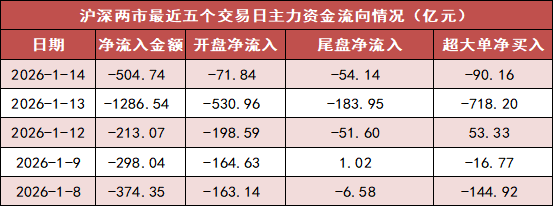
Group 1 - The core point of the article highlights that on January 14, the main funds in the Shanghai and Shenzhen markets experienced a net outflow of 504.74 billion yuan, with the ChiNext board seeing a net outflow of 210.18 billion yuan and the CSI 300 index stocks a net outflow of 154.4 billion yuan [1] - Among the 17 primary industries, the computer industry had the highest increase, rising by 3.42%, while the banking and real estate sectors saw declines exceeding 1% [1] - Ten industries experienced net inflows of main funds, with the computer industry leading at a net inflow of 46.7 billion yuan, followed by non-bank financials and telecommunications with inflows exceeding 11 billion yuan each [1] Group 2 - In individual stock performance, the automotive parts company Shanzi Gaoke had the highest net inflow of main funds at 21.18 billion yuan, with a trading volume of 128.48 billion yuan and a turnover rate of 24.14% [2] - PCB concept stock Hu Dian shares saw a net inflow of 13.28 billion yuan, ranking second, while AI financial stock Lakala had a net inflow of 12.91 billion yuan [2] - The article also notes that over 250 stocks had net outflows exceeding 1 billion yuan, with 10 stocks seeing outflows over 10 billion yuan [3] Group 3 - The article mentions that leading sectors for net outflows included robotics, electricity, and wind power, with each seeing outflows exceeding 21 billion yuan [4] - Hai Ge Communication experienced a net outflow of 14.3 billion yuan, with the company announcing expected losses for the 2025 fiscal year [4] - The tail-end trading session saw a net outflow of 54.14 billion yuan, with the CSI 300 index stocks experiencing a net outflow of 49.52 billion yuan [5]






【14日资金路线图】两市主力资金净流出超500亿元 计算机等行业实现净流入
证券时报· 2026-01-14 11:12
1月14日,A股市场主要指数涨跌不一。 截至收盘,上证指数收报4126.09点,下跌0.31%;深证成指收报14248.6点,上涨0.56%;创业板指收报 3349.14点,上涨0.82%。两市合计成交39413.89亿元,较上一交易日增加2904.04亿元。 1. 两市主力资金净流出超500亿元 今日沪深两市主力资金开盘净流出71.84亿元,尾盘净流出54.14亿元,全天净流出504.74亿元。 | | | 沪深两市最近五个交易日主力资金流向情况(亿元) | | | | --- | --- | --- | --- | --- | | 日期 | | 净流入金额 开盘净流入 | 人探求障礙 | 超大单净买入 | | 2026-1-14 | -504.74 | -71. 84 | -54. 14 | -90. 16 | | 2026-1-13 | -1286.54 | -530. 96 | -183. 95 | -718. 20 | | 2026-1-12 | -213.07 | -198.59 | -51. 60 | 53. 33 | | 2026-1-9 | -298.04 | -164. 63 | 1.02 ...

【14日资金路线图】两市主力资金净流出超500亿元 计算机等行业实现净流入
Zheng Quan Shi Bao· 2026-01-14 11:12
Market Overview - The A-share market showed mixed performance on January 14, with the Shanghai Composite Index closing at 4126.09 points, down 0.31%, while the Shenzhen Component Index rose 0.56% to 14248.6 points, and the ChiNext Index increased by 0.82% to 3349.14 points. The total trading volume for both markets reached 39,413.89 billion yuan, an increase of 2,904.04 billion yuan compared to the previous trading day [1]. Capital Flow - The net outflow of main funds from the Shanghai and Shenzhen markets exceeded 500 billion yuan, with a total net outflow of 504.74 billion yuan for the day, including an opening net outflow of 71.84 billion yuan and a closing net outflow of 54.14 billion yuan [2][3]. - The CSI 300 index experienced a net outflow of 154.4 billion yuan, while the ChiNext saw a net outflow of 210.18 billion yuan [4]. Sector Performance - The computer industry saw a net inflow of 208.24 billion yuan, with a growth of 3.44%, driven by stocks like Tonghuashun [6]. - The electronics sector recorded a net inflow of 101.23 billion yuan, increasing by 1.36%, led by Huadian Co. [6]. - The automotive sector faced a net outflow of 102.89 billion yuan, with a slight decline of 0.19%, primarily impacted by Jianghuai Automobile [6]. - The banking sector also saw a net outflow of 96.11 billion yuan, down 1.45%, with Beijing Bank being a significant contributor [6]. Institutional Activity - Notable institutional buying included Guangxun Technology, which saw a net purchase of 51,578.19 million yuan, reflecting a daily increase of 10.00% [8]. - Other significant purchases included Liou Co. with 39,662.88 million yuan and China Satellite Communications with a net outflow of 34,609.85 million yuan, down 10.00% [8]. Stock Recommendations - UBS has rated Shanghai Pharmaceuticals as a "Buy" with a target price of 22.3 yuan, indicating a potential upside of 26.85% from the latest closing price of 17.58 yuan [11]. - Other stocks recommended by UBS include Longi Green Energy with a target price of 54 yuan, suggesting a 51.69% upside from its current price of 35.60 yuan [11].

Barclays PLC减持南京熊猫电子股份(00553)643.6万股 每股均价约6.51港元
Zhi Tong Cai Jing· 2026-01-14 11:07
智通财经APP获悉,香港联交所最新数据显示,1月8日,Barclays PLC减持南京熊猫电子股份 (00553)643.6万股,每股均价6.5087港元,总金额约为4189万港元。减持后最新持股数目为1701.4万股, 最新持股比例为7.03%。 ...

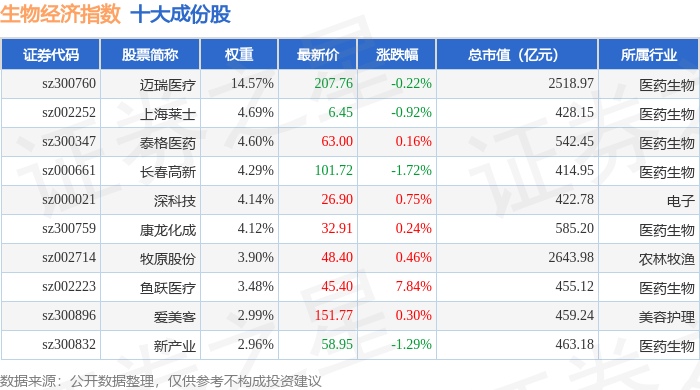
1月14日生物经济(970038)指数涨0.43%,成份股英科医疗(300677)领涨
Sou Hu Cai Jing· 2026-01-14 10:23
Group 1 - The Biotech Index (970038) closed at 2322.86 points, up 0.43%, with a total transaction volume of 50.71 billion yuan and a turnover rate of 3.77% [1] - Among the index constituents, 23 stocks rose, with Yingke Medical leading at an 8.37% increase, while 27 stocks fell, with Dabo Medical leading the decline at 3.28% [1] - The top ten constituents of the Biotech Index include major companies such as Mindray Medical, which has a weight of 14.57% and a market capitalization of 251.90 billion yuan, and Yuyue Medical, which has a weight of 3.48% and a market capitalization of 45.51 billion yuan [1] Group 2 - The net outflow of main funds from the Biotech Index constituents totaled 643 million yuan, while retail investors saw a net inflow of 771 million yuan [1] - Detailed fund flow data indicates that Yuyue Medical had a net inflow of 35.6 million yuan from main funds, while it experienced a net outflow of 66.06 million yuan from retail investors [2] - Mindray Medical saw a net inflow of 13.7 million yuan from main funds, with retail investors experiencing a net outflow of 36.97 million yuan [2]



母子基金群过640亿元!成都重产基金招引项目总投资近2100亿元
Sou Hu Cai Jing· 2026-01-14 10:18
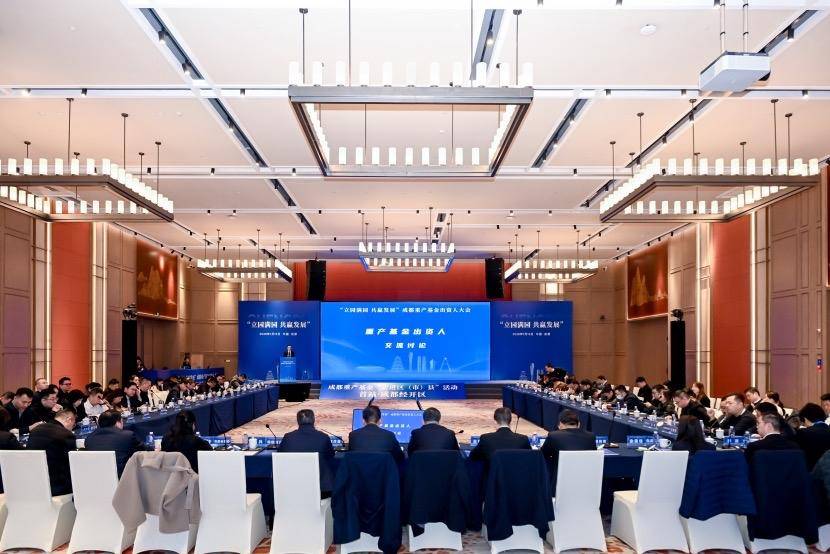
Core Insights - The Chengdu Major Industrialization Project Investment Fund (Chengdu Heavy Industry Fund) held an investor conference themed "Building Gardens and Achieving Win-Win Development" to summarize its operational achievements and mobilize further actions in line with Chengdu's industrial strategy [1][3] Group 1: Fund Operations and Achievements - The Chengdu Heavy Industry Fund has established a mother-son fund group exceeding 64 billion yuan, attracting total project investments of nearly 210 billion yuan through specialized operations [3] - The fund has played a significant role in major projects, such as the 63 billion yuan investment in the BOE B16 project, which is the largest single industrial project in Sichuan, contributing to Chengdu's goal of becoming a "World Flexible Valley" [4] Group 2: Strategic Focus and Industry Development - The fund has transitioned into a builder of industrial ecosystems, linking government, parks, and enterprises, addressing funding gaps while integrating upstream and downstream resources [4] - The investment strategy emphasizes a "one district, one main industry" approach, extending its reach to various districts and counties in Chengdu [5] Group 3: Sector-Specific Investments - In the aerospace sector, the fund has invested in key enterprises such as AVIC Chengfa in Xindu District and supported significant technological breakthroughs in tilt-rotor UAV technology in Jinniu District [6] - The fund is also focusing on future industries and strengthening supply chains, with investments in humanoid robotics and electronic information sectors, aiming to enhance the industrial foundation in Chengdu [6] Group 4: Future Plans - The Chengdu Heavy Industry Fund aims to continue its "patient capital" philosophy, enhancing brand influence and exploring more leading projects in commercial aerospace and advanced energy sectors [6]
1月14日国企改革(399974)指数跌0.53%,成份股东方电气(600875)领跌
Sou Hu Cai Jing· 2026-01-14 10:18
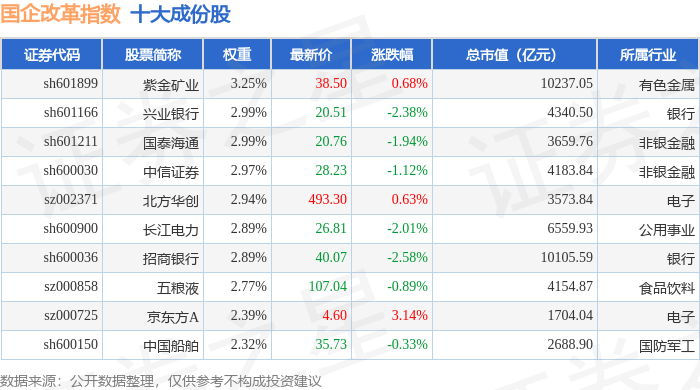
Core Viewpoint - The State-Owned Enterprise Reform Index (399974) closed at 1990.41 points, down 0.53%, with a trading volume of 297.446 billion yuan and a turnover rate of 1.42% [1] Group 1: Index Performance - On the day, 27 stocks in the index rose, with Guangdian Yuntong leading with a 5.19% increase, while 72 stocks fell, with Dongfang Electric leading the decline at 2.99% [1] - The top ten constituent stocks of the State-Owned Enterprise Reform Index are detailed, showing varying performance across sectors such as non-ferrous metals, banking, and electronics [1] Group 2: Stock Details - Key stocks include Zijin Mining with a weight of 3.25% and a price of 38.50 yuan, up 0.68%, and Industrial Bank with a weight of 2.99% and a price of 20.51 yuan, down 2.38% [1] - Other notable stocks include CITIC Securities, North Huachuang, and China Merchants Bank, with respective price changes of -1.12%, +0.63%, and -2.58% [1] Group 3: Capital Flow - The net outflow of main funds from the constituent stocks totaled 16.187 billion yuan, while retail investors saw a net inflow of 10.455 billion yuan [3] - Notable capital flows include a net inflow of 6.22 million yuan for BOE Technology Group, despite a net outflow from other stocks like China Great Wall and Hikvision [3]