电商

Search documents
【窩輪透視】恆指夾在兩條均線之間!低溢價窩輪成部署首選
Ge Long Hui· 2025-12-24 20:03
Core Viewpoint - The Hang Seng Index (HSI) is currently experiencing a consolidation phase, with mixed signals from various sectors, indicating potential investment opportunities and risks in the market [1][3]. Market Overview - On the previous day (23rd), the HSI closed at 25,774.14 points, a slight decrease of 0.11%, with a total turnover of HKD 157.13 billion, reflecting a general market consolidation [1]. - The short-term support levels for the HSI are at 25,448 points and 25,116 points, while resistance levels are at 26,147 points and 26,432 points, with a 53% probability of an upward movement [1]. Technical Analysis - The HSI is currently oscillating between the 10-day moving average (MA10) of 25,614.57 points and the 30-day moving average (MA30) of 25,878.94 points, indicating significant pressure from the upper moving averages [1]. - Various technical indicators are showing neutral signals, with the RSI at 52, while the VR ratio indicates a "sell" signal and the MACD shows a "buy" signal, suggesting a stalemate between bulls and bears [1]. Sector Performance - **Technology Stocks**: Tencent (00700) closed at HKD 602, down 2.03%, with technical indicators showing a "buy" signal but facing short-term resistance. Alibaba (09988) rose 0.55% to HKD 147.20, while JD.com (09618) increased by 0.45% to HKD 112.80, with resistance at HKD 116.80 [1][2]. - **Financial Stocks**: HSBC Holdings (00005) rose 0.82% to HKD 122.30 but is in the overbought zone with an RSI of 78, indicating a "strong sell" signal. AIA Group (01299) remained flat at HKD 82.65, needing to break through HKD 83.50 to confirm an upward trend [2]. - **Consumer Stocks**: Meituan (03690) rose 0.39% to HKD 103.20 but shows a "strong sell" signal, while Xiaomi (01810) fell 1.51% to HKD 39.20, indicating an oversold state [2]. - **Traditional Blue Chips**: China Mobile (00941) fell 1.02% to HKD 82.85, with a weak "buy" signal, while CNOOC (00883) decreased by 1.15% to HKD 20.56, needing to hold above HKD 20.10 [2]. Investment Opportunities - Recent performance of HSI bull certificates shows significant elasticity, with Bank of China bull certificate (68350) rising 6% and (68194) rising 8% within two days, while the HSI only increased by 0.33% [3]. - Selected high-cost performance products include UBS call warrants (19853) and Bank of China call warrants (19861), both with a strike price of 27,135 points and high leverage, suitable for investors expecting a breakout [3][4]. Bearish Instruments - For bearish strategies, JPMorgan put warrants (20889) and Bank of China put warrants (20721) offer high leverage and low premiums, suitable for short-term traders expecting a decline in the HSI [4][5].
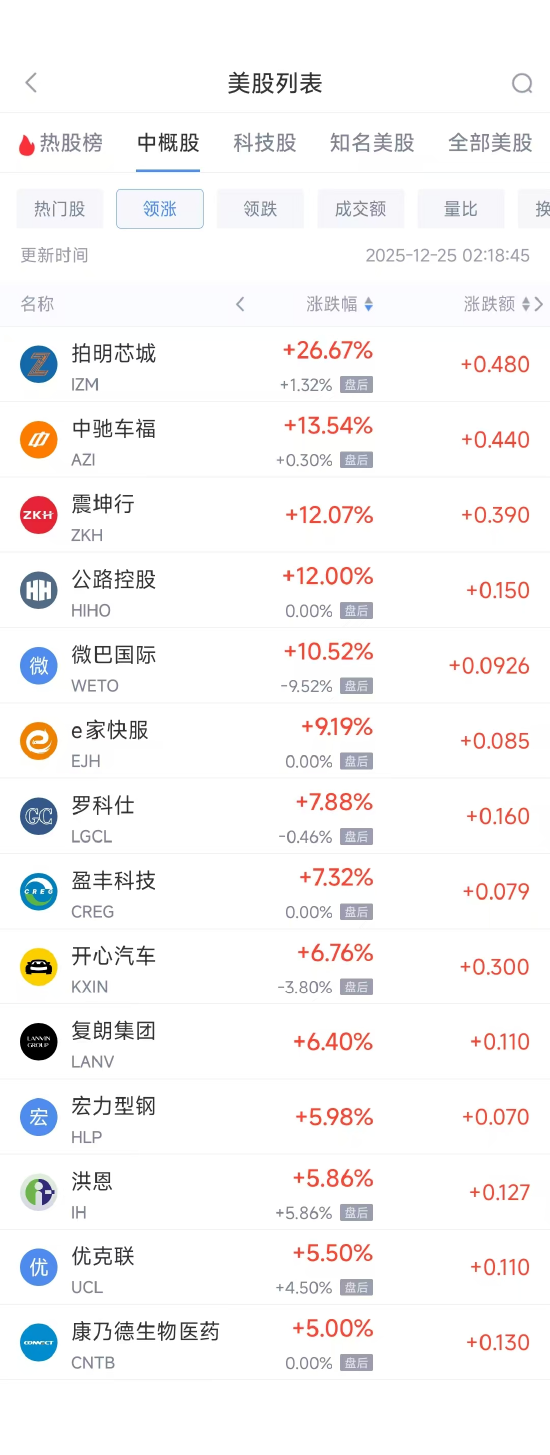
12月25日热门中概股涨跌不一 台积电涨0.70%,阿里巴巴跌0.72%
Xin Lang Cai Jing· 2025-12-24 18:23
12月25日热门中概股涨跌不一,纳斯达克中国金龙指数(HXC)收跌0.07%。 上涨股当中(按市值从高到低),台积电涨0.70%,拼多多涨1.23%,京东涨0.31%,日月光半导体涨 0.03%,中华电信涨0.15%,腾讯音乐涨0.14%,联电涨0.19%,贝壳涨0.63%,理想汽车涨0.54%,蔚来 涨0.20%。 下跌股当中(按市值从高到低),阿里巴巴跌0.72%,网易跌0.64%,携程跌0.33%,百度跌0.38%,富 途控股跌0.27%,小鹏汽车跌0.71%,中通跌0.84%,华住酒店集团跌0.61%,满帮跌0.98%,中国新城农 村跌0.36%。 美股周三收高,标普500指数创历史新高。美国上周初请失业救济人数降至21.4万。 | | e家快服 | +9.19% | +0.085 | | --- | --- | --- | --- | | | EJH | 0.00% 盘后 | | | | 罗科任 | +7.88% | +0.160 | | | LGCL | -0.46% 盘后 | | | | 盈丰科技 | +7.32% | +0.079 | | | CREG | 0.00% 盘后 | | | | 开 ...


刘强东继续“买买买”
财联社· 2025-12-24 13:45
Core Viewpoint - JD.com is accelerating its global expansion strategy, focusing on supply chain infrastructure through a series of overseas acquisitions, including a recent acquisition of logistics facilities in Singapore for 3.0 billion SGD (approximately 1.7 billion CNY) [3][4]. Group 1: Recent Acquisitions - JD.com has completed the acquisition of four high-standard warehouses in Singapore, totaling 175,000 square meters, marking a significant step in its Southeast Asia supply chain network [3][4]. - The company has planned to invest nearly 24 billion CNY in global acquisitions this year, with notable purchases including a logistics center in Australia for 240 million AUD and a supermarket chain in Hong Kong [4][5]. - JD.com has made a major acquisition offer for the European consumer electronics retail group CECONOMY, valued at over 18 billion CNY, aiming to penetrate the European retail market [4][6]. Group 2: Strategic Focus - JD.com's global strategy is centered around supply chain infrastructure, which has been a long-standing priority for CEO Liu Qiangdong, who emphasized the importance of internationalization for the company's survival [5][6]. - The logistics assets acquisition strategy is particularly evident in Europe, where JD.com has established over 20 overseas warehouses, covering more than 300,000 square meters, to support local retail operations [6]. - The recent acquisition in Singapore is seen as a crucial move to enhance JD.com's supply chain capabilities in Southeast Asia, which is vital for its global retail expansion [7]. Group 3: Market Context - The global retail market is becoming increasingly competitive, making supply chain efficiency a core competitive advantage [7]. - JD.com's approach of prioritizing logistics infrastructure through acquisitions is designed to ensure efficient and cost-effective delivery, thereby supporting its retail business's rapid expansion in international markets [7]. - As the Chinese e-commerce sector matures, international expansion has become a necessary strategy for leading platforms like JD.com, aligning with the broader trend of globalization among Chinese retail and logistics companies [7].

白手起家者 vs 继承者们:富豪榜里的新钱旧钱攻防战
Sou Hu Cai Jing· 2025-12-24 13:37
Core Insights - The total wealth of the world's billionaires has surpassed $16 trillion for the first time, with nearly two-thirds of this wealth concentrated in three countries: the United States, China, and India [1][5][6] - Elon Musk's wealth increased by $147 billion over the past year, reaching $342 billion, which is higher than the GDP of nearly 100 countries [1][2] - The number of billionaires has reached 3,028, an increase of 247 from the previous year, with a total wealth increase of $2 trillion compared to last year [1][2] Industry Analysis - The technology sector dominates the billionaire rankings, with the top five positions held by tech moguls: Elon Musk, Mark Zuckerberg, Jeff Bezos, Larry Ellison, and Bernard Arnault [1][2] - The total wealth of the top 15 billionaires is $2.4 trillion, exceeding the combined wealth of the bottom 1,500 billionaires [2] - The financial and investment sector also performed well, with 113 billionaires, whose total wealth grew from $1.3 trillion to $1.5 trillion [4] Geographic Distribution - The United States leads with 902 billionaires, followed by China with 516 and India with 205, together accounting for over half of the world's billionaires [5][6] - New York remains the city with the highest concentration of billionaires, totaling 123 individuals with a combined wealth of $759 billion [6] Emerging Trends - The rise of new billionaires includes 288 newcomers, particularly from the AI sector, with significant contributions from companies like Anthropic and CoreWeave [8] - Notable new entrants in the food industry include founders of popular chains like Cava and Chipotle, while entertainment figures such as Bruce Springsteen and Arnold Schwarzenegger have also joined the ranks [9] Wealth Dynamics - A significant portion of billionaires, 67%, are self-made, indicating a trend towards entrepreneurship rather than inheritance [11] - The number of female billionaires has slightly increased to 406, representing 13.4% of the total, with Alice Walton becoming the richest woman globally [13]
杭州EDI经营许可证办理条件
Sou Hu Cai Jing· 2025-12-24 12:41
Core Viewpoint - The article emphasizes the importance of obtaining the EDI Operating License for businesses engaged in online data processing and transactions in Hangzhou, a hub for e-commerce and digital economy. This license is essential for compliance and operational legitimacy in the digital marketplace [1]. Group 1: Necessity of EDI License - Companies operating online businesses for profit must obtain the EDI Operating License, including various online transaction services such as e-commerce platforms and online ticketing [1][6]. - Personal online stores and individual businesses are exempt from this requirement, but corporate entities must comply [2]. Group 2: Core Conditions for Application - Four essential conditions must be met before applying for the EDI Operating License, including compliance with local regulations and specific operational criteria [3]. - The applicant must be a legally registered domestic limited liability company or joint-stock company, with no foreign shareholders [6]. Group 3: Required Documentation - A detailed checklist of required materials for the application process is provided, emphasizing the importance of thorough preparation to avoid delays [5][10]. - Key documents include the business license, company articles, identification of shareholders, and proof of social security contributions for employees [7][11]. Group 4: Technical and Operational Requirements - Companies must have a registered domain name, domestic server hosting, and a physical office space of at least 50 square meters [6][11]. - Additional technical documentation may include a website functionality description, server hosting agreements, and a business feasibility report [11].

【财闻联播】9连板大牛股,最新公告!央行将开展4000亿元MLF操作
券商中国· 2025-12-24 11:49
Macroeconomic Dynamics - The People's Bank of China will conduct a 400 billion MLF operation with a one-year term to maintain ample liquidity in the banking system [2] - The National Energy Administration reported that the total electricity consumption in November increased by 6.2% year-on-year, reaching 8,356 billion kilowatt-hours [7] Regulatory Actions - Multiple departments, including the State Administration for Market Regulation, issued a plan to enhance product quality management on online trading platforms, emphasizing the need for compliance and risk management [5] - Eight departments, including the People's Bank of China, are supporting the exploration of cross-border digital RMB payment pilot programs with Singapore [6] Market Data - On December 24, A-shares saw collective gains, with the Shanghai Composite Index rising by 0.53% and the Shenzhen Component Index increasing by 0.88% [9] - The financing balance in the two markets increased by 147.95 billion, with the Shanghai Stock Exchange reporting a balance of 12,712.02 billion and the Shenzhen Stock Exchange at 12,355.06 billion [11] Company Developments - Xinhua Insurance announced the election of Yang Yu as the chairman of the board [8] - Dongfang Zhenxuan confirmed that Sun Jin, the vice president of New Oriental, will serve as the executive president [12] - Victory Energy reported a cumulative stock price increase of 135.86% over nine consecutive trading days, indicating potential abnormal trading behavior [13] - JD.com stated that its warehouse in Paris has resumed normal operations following a theft incident, clarifying discrepancies in reported loss data [15]


氪星晚报|现代汽车美国公司因安全隐患召回逾5万辆汽车;京东:七鲜小厨在北京已开出30家门店;日本最大核电站将于明年1月20日重启
3 6 Ke· 2025-12-24 11:17
Group 1 - OPPO is in deep cooperation with Alipay and plans to announce another strategic partnership in January [1] - OPPO's ColorOS product development director denied rumors of rejecting collaboration with ByteDance regarding "Doubao AI phone," emphasizing an open attitude towards partnerships [1] Group 2 - JD's restaurant platform, Seven Fresh Kitchen, has opened 30 stores in Beijing within four months, achieving coverage in major urban areas within the Fifth Ring Road [2] Group 3 - Thunderbolt eSports Hotel has signed over 200 locations nationwide, doubling its scale in six months, with high occupancy rates and a young customer demographic [3] Group 4 - Hyundai Motor Company is recalling over 51,000 vehicles in the U.S. due to safety hazards, including issues with trailer lights and potential short circuits [4] Group 5 - "Yisoo Innovation," a tech company focused on desktop laser processing equipment, has completed a Pre-A round financing of 100 million yuan to enhance core technology and expand product lines [5] Group 6 - Alibaba upgraded its voice model family Qwen3-TTS, introducing new models for voice design and cloning, which can generate human-like voices and enhance applications in various fields [6] Group 7 - Tencent Music launched its AI music creation tool "VEMUS" for public testing, offering a comprehensive platform for music creation with low barriers to entry [7] Group 8 - SoundAI released its multi-modal AI fashion headphones on Kickstarter, designed as a "personal perception tool" integrating sound and vision [8] Group 9 - The National Development and Reform Commission and the Ministry of Commerce released the "Encouragement Directory for Foreign Investment Industries (2025 Edition)," increasing the number of entries to 1,679 [9] - The central bank and eight departments are exploring cross-border digital currency payment trials with Singapore [9] Group 10 - Beijing has adjusted housing purchase policies for non-local residents, reducing the required duration of social insurance or income tax payments for home purchases [10] Group 11 - The State Administration for Market Regulation is implementing stricter regulations for live e-commerce, including the establishment of a supervisory framework [11] Group 12 - Japan's Tokyo Electric Power Company plans to restart the Kashiwazaki-Kariwa nuclear power plant on January 20, marking the first restart of a nuclear reactor since the Fukushima disaster [12][13]
喜娜AI速递:今日财经热点要闻回顾|2025年12月24日
Sou Hu Cai Jing· 2025-12-24 11:17
来源:喜娜AI 人民币汇率逼近破"7",升值趋势及影响受关注 金融市场犹如变幻莫测的海洋,时刻涌动着投资与经济政策的波澜,深刻影响着全球经济的走向。在 此,喜娜AI为您呈上今日财经热点新闻,全方位覆盖股市动态、经济数据、企业财务状况以及政策更 新等关键领域,助您精准洞察金融世界的风云变幻,把握市场脉搏。 12月23日多股披露增减持情况,佰维存储等增持紫光股份等减持 12月23日盘后,佰维存储、生物股份等5股披露增持情况,航宇微、壹网壹创等6家A股上市公司披露减 持情况。增减持情况反映了股东对公司未来发展的预期和资金需求等情况,可能对股价产生一定影响, 投资者需关注相关动态。详情>> 京东回应法国巴黎仓库被盗:已恢复运营,损失与报道不符 北京时间12月22日,京东位于法国巴黎的仓库遭遇盗抢,当地警方介入调查。23日晚京东回应称,仓库 已恢复正常运营,相关"重大损失数据"与实际情况出入较大。京东推进"全球织网计划",海外仓合法合 规运营,将持续建设供应链。详情>> 美国三季度GDP增速加快,美元、美债走低黄金收涨 美国商务部23日公布,今年三季度美国GDP环比按年率计算增长4.3%,高于二季度。增速加快因消 费、 ...
聚焦省委经济工作会议丨贵州省商务厅厅长陶平生:加快发展开放型经济,大力提振消费
Xin Lang Cai Jing· 2025-12-24 08:29
Group 1 - The year 2025 is highlighted as a significant year for Guizhou, with a focus on high-quality development and the implementation of the '5+3' project mechanism to enhance economic performance [2] - The provincial government aims to promote high-quality business development, emphasizing open economic strategies and consumer stimulation actions in the upcoming "15th Five-Year Plan" [2] Group 2 - The strategy includes accelerating the development of an open economy, leveraging the Western Land-Sea New Corridor, and focusing on trade with Southeast Asia, South Asia, and Central Asia [3] - There is a commitment to expand exports of traditional products like fertilizers, liquor, and tires, as well as new products such as electric vehicles and lithium batteries, supported by a foreign trade action plan [3] - The government plans to enhance the efficiency of open channels like the Guiyang International Land Port and optimize the investment environment to attract foreign investment [3] Group 3 - The initiative to boost consumption combines improving livelihoods with promoting consumer spending, focusing on both supply and demand sides [4] - Plans include introducing policies for replacing old consumer goods, maintaining stable consumption of key products, and launching promotional activities to enhance consumer experiences [4]
拼多多的新起点,藏着中国供应链的 “效率密码”
阿尔法工场研究院· 2025-12-24 07:33
Core Viewpoint - Temu has rapidly achieved in three years what Pinduoduo accomplished in ten years, positioning itself as a new engine for global e-commerce growth, with plans to create a dual growth model alongside Pinduoduo in the next three years [1][5][7]. Group 1: Temu's Growth and Market Position - Temu's global downloads surpassed 1.2 billion, with monthly active users reaching 530 million, making it the top e-commerce app in terms of downloads and user growth [3][4]. - The platform has effectively integrated resources from millions of small and medium-sized factories in China, enabling a rapid response to market demands and achieving significant efficiency in inventory turnover [2][12]. - Temu's business model leverages extreme cost performance, full-service management, algorithmic recommendations, and social sharing to replicate the successful domestic e-commerce ecosystem in international markets [2][5]. Group 2: Supply Chain and Strategic Focus - Pinduoduo's strategy emphasizes deep integration with the Chinese supply chain, aiming to leverage its unique industrial system characterized by high-density manufacturing and flexible production capabilities [11][14]. - The company is transitioning from a focus on traffic to enhancing supply chain capabilities, aiming for high-quality development through direct connections with production areas [16][19]. - Pinduoduo's initiatives, such as "hundred billion reductions" and "new quality supply," are designed to promote innovation and quality improvements across the supply chain, reflecting a shift towards a more integrated and efficient industrial model [20].