国防军工

Search documents
策略周观点:港股科技仍在布局区
2025-09-23 02:34
Summary of Key Points from Conference Call Records Industry Overview - The focus is on the Hong Kong stock market, particularly the technology sector, which is seen as having continued investment potential despite recent fluctuations in market performance [1][3][9]. Core Insights and Arguments - **Market Activity and Fund Flows**: High trading activity is noted, with net inflows in margin financing and a significant return of retail investors. Equity fund positions are above 80%, and new fund issuance in September has exceeded 100 billion [1][2]. - **Impact of Major Shareholder Actions**: Recent reductions in holdings by major shareholders and IPOs have had minimal impact on overall market capitalization [4]. - **Profitability and Market Sentiment**: Although the profit-making effect has slightly decreased, it remains at a high level. Positive sentiment indicators suggest a likelihood of market stability or upward movement, contingent on further accumulation of fundamental and industrial factors [5]. - **Sector Performance**: The technology, media, and telecommunications (TMT) sectors, along with high-end manufacturing, are expected to maintain high growth rates. Specific areas of interest include communication equipment, power grid equipment, computers, engineering machinery, batteries, rail transit equipment, and defense industries [6]. - **U.S. Federal Reserve's Interest Rate Policy**: The Fed's recent interest rate cuts are viewed as preemptive, with historical data indicating strong market performance following such actions. This supports a positive outlook for sectors like innovative pharmaceuticals, Hong Kong technology, consumer goods, and resource products [7]. - **Investment Strategy**: The recommendation is to maintain high portfolio positions, focusing on domestic computing power, Hong Kong technology, and innovative pharmaceutical trends, while also considering sectors related to capacity changes and consumer goods [8]. Additional Important Insights - **Valuation Comparisons**: Hong Kong's market valuation is considered balanced compared to global markets, with foreign investment still underweight in Hong Kong stocks. The appreciation of the RMB and favorable global valuation conditions are expected to attract more foreign capital [3][19][20]. - **Earnings Improvement**: The earnings growth rate for over 500 Chinese companies listed overseas is projected at 9%, indicating a stabilization in profitability after a downturn [21]. - **Technological Sector Dynamics**: Chinese technology companies are increasing capital expenditures, particularly in R&D, which is expected to enhance their growth potential and positively impact related industries [23]. - **Future Market Outlook**: The long-term outlook for the Hong Kong market is optimistic, driven by improving fundamentals, supportive policies, and the potential for significant earnings recovery in leading technology firms [24]. Conclusion - The Hong Kong technology sector is positioned for continued growth, supported by favorable market conditions, improving fundamentals, and strategic investment opportunities. The overall sentiment remains cautiously optimistic, with indicators suggesting that the market has room for further development [27][30].
国防ETF(512670)连续三天净流入,消息面上三型舰载机“上新”福建舰
Xin Lang Cai Jing· 2025-09-23 01:37
Core Viewpoint - The successful training of multiple advanced carrier-based aircraft on China's Fujian aircraft carrier marks a significant advancement in naval capabilities, enhancing operational range and combat effectiveness [1][2]. Group 1: Military Capabilities - The Fujian aircraft carrier's strike range can cover the second island chain, with the electromagnetic catapult system enabling carrier-based aircraft to take off with full fuel and armament, thus increasing operational radius and strike power [1]. - The electromagnetic catapult system has a fast response time, improving the sortie efficiency of carrier-based aircraft and allowing for a high-intensity combat mode known as "full deck launch" [2]. - The introduction of various aircraft types, such as the KJ-600 and J-35, highlights the systemic operational advantages of the Fujian carrier, significantly enhancing its comprehensive combat capabilities against air, sea, and land targets [2]. Group 2: Market Performance - The defense and military industry is steadily rising, with the CSI Defense Index experiencing a slight increase of 0.30%, although trading volume has significantly decreased to 24.3 billion [2]. - The market's reaction to the Bashar joint defense agreement has been relatively muted, with a focus on the lack of substantial orders, indicating that breakthroughs in advanced fighter aircraft military trade orders are crucial [2]. - The CSI Defense Index's PH value has recently risen from around 10% to approximately 33%, suggesting a positive trend, while monitoring single transaction volume or transaction volume ratio may provide more effective insights at market peaks [2]. Group 3: ETF and Index Tracking - The National Defense ETF closely tracks the CSI Defense Index, which includes listed companies under the ten major military industrial groups and those providing weaponry to the armed forces [3]. - Among the 13 ETFs tracking the defense and military sector, the National Defense ETF has the lowest management and custody fees at 0.40%, making it unique in its category [3]. - As of August 29, 2025, the top ten weighted stocks in the CSI Defense Index account for 43.88%, with companies like AVIC Shenyang Aircraft (600760) and AVIC Xi'an Aircraft (000768) among the leaders [3].


A股上行趋势仍将延续 三大主线投资机遇值得重视
Zhong Guo Zheng Quan Bao· 2025-09-22 22:31
Core Viewpoint - The A-share market has shown strong resilience in 2023, supported by macroeconomic stability, improving corporate earnings, attractive global valuations, and enhanced liquidity [1][2][3] Market Performance - Since April 8, 2023, the Shanghai Composite Index has risen by 23.64%, the Shenzhen Component Index by 40.51%, and the ChiNext Index by 71.97% [1] - The market is expected to maintain an upward trend due to robust macroeconomic data and positive corporate earnings growth, with a projected 3% increase in earnings for A-share companies this year [2][3] Investment Drivers - Key drivers for the market's future growth include the restructuring of the global monetary order, which is expected to benefit RMB assets and continue the revaluation of Chinese assets [3] - The improvement in the funding environment has led to increased investor confidence and liquidity in the market, with foreign capital beginning to flow back into A-shares [4][5] Funding Structure - As of September 19, 2023, the margin trading balance has reached approximately 2.4 trillion yuan, indicating a healthier funding structure compared to previous years [4] - The current margin trading balance represents about 2.4% of the A-share market's circulating market value, which is close to the historical average since 2014 [4] Sector Focus - The market is expected to focus on three main themes: technology innovation, overseas expansion advantages, and high-quality dividend stocks [1][7] - Growth sectors such as AI, innovative pharmaceuticals, high-end manufacturing, and military industries are anticipated to continue attracting investment [6][7] Short-term and Long-term Outlook - In the short term, the recovery of capital market sentiment is expected to boost the performance of the financial sector, particularly insurance and brokerage firms [7] - In the long term, industries with solid fundamentals, such as telecommunications, semiconductors, and defense, are recommended for investment [7]
0922港股日评:港股蓄势,回调迎新机
Xin Lang Cai Jing· 2025-09-22 16:01
Market Overview - The Hang Seng Index declined by 0.76% to 26,344.14, while the Hang Seng Technology Index fell by 0.58% to 6,257.91, and the Hang Seng China Enterprises Index decreased by 1.07% to 9,370.73 [3] - In the A-share market, the Shanghai Composite Index rose by 0.22%, the CSI 300 increased by 0.46%, and the Wind All A Index gained 0.52%, while the Dividend Index fell by 0.84% [3] Sector Performance - Among the sectors in the Hong Kong Stock Connect, Electronics (+1.85%), Steel (+1.58%), and Non-ferrous Metals (+1.39%) led the gains, while Defense and Military (-2.59%), Comprehensive Finance (-2.44%), and Comprehensive (-2.39%) were the biggest losers [3] - Concept indices showed significant movements, with the Foxconn Index rising by 15.02%, the OLED Index increasing by 10.30%, and the Apple Index up by 6.57%. Conversely, the Port Transportation Index fell by 3.57%, the Charging Pile Index decreased by 3.34%, and the Fuel Cell Index dropped by 3.19% [3] Market Commentary - On September 22, 2025, the total trading volume in the Hong Kong market reached HKD 290.54 billion, with net inflows from southbound funds amounting to HKD 12.736 billion [4] - The decline in the Hong Kong stock indices is attributed to macroeconomic factors, particularly the Federal Reserve's decision to cut interest rates by 25 basis points, which was already anticipated by the market [4] - The sentiment in the automotive sector was negatively impacted by news of overseas shareholders reducing their stakes, while upcoming increases in port service fees for Chinese vessels entering U.S. ports are expected to suppress the performance of the transportation sector [4] Future Outlook - The Hong Kong market may reach new highs driven by three key factors: 1) AI technology and new consumption trends, which are expected to have significant growth potential [5] 2) Continued inflows of southbound funds, enhancing marginal pricing power [5] 3) The transmission of wide monetary policy to wide credit, alongside potential further interest rate cuts in the U.S. to improve global liquidity [5]


2015年5100点以来,收益翻倍的Top50绩优基
点拾投资· 2025-09-22 11:01
Core Viewpoint - The A-share market has shown strong upward momentum in the first eight months of this year, with public equity funds experiencing significant performance gains, leading to the emergence of over 30 "doubling funds" [1][2]. Fund Performance - As of September 1, the average net value growth rate of actively managed equity funds exceeded 25%, with over 95% of products achieving positive returns, many reaching historical highs [1]. - The top 50 funds since the peak in June 2015 have all doubled their net value, with 22 funds achieving over 200% growth and 17 funds having annualized returns exceeding 15% [4][9]. Notable Funds - The top five funds by net value growth since June 2015 include: 1. Huashang Advantage Industry A: 464.66% growth 2. Dongwu Mobile Internet A: 423.71% growth 3. Huashang New Trend Preferred: 338.52% growth 4. Anxin Advantage Growth A: 290.97% growth 5. Invesco Great Wall Stable Return A: 279.28% growth [4][10]. Fund Manager Insights - The success of these funds is attributed to skilled active equity fund managers who have demonstrated solid research capabilities and consistent stock-picking skills, validating the value of active management [6][7]. - Notable fund managers include Zhang Mingxin for Huashang Advantage Industry A and Liu Yuanhai for Dongwu Mobile Internet A, both of whom have shown exceptional long-term performance [12][18]. Market Trends - The A-share market has undergone significant changes over the past decade, with shifts in industry structure, funding preferences, and investment philosophies, particularly since the "9.24" market event last year [2][3]. - The focus on passive investment strategies, such as ETFs, has led to questions regarding the ability of active equity funds to consistently generate excess returns [2]. Future Outlook - The article suggests that the ongoing trends in AI and technology will present substantial investment opportunities, with a focus on sectors like AI hardware and autonomous driving [13].

一图看懂历年国庆前后A股市场表现
天天基金网· 2025-09-22 09:06
Group 1 - The core viewpoint indicates that the A-share market shows a low probability of rising in the five trading days before the National Day holiday, but the last trading day before the holiday has a 70% probability of an increase, while the market tends to rise after the holiday [1][6] - Historical data from 2015 to 2024 shows that the Shanghai Composite Index has a 70% probability of rising on the first trading day after the holiday and a 60% probability of rising in the following five trading days [2][6] - The leading sectors in the A-share market before and after the National Day holiday exhibit significant rotation, covering various fields such as consumption, pharmaceuticals, and technology [6][7] Group 2 - The leading sectors for the five trading days before the holiday from 2020 to 2024 include Food & Beverage, Social Services, and Defense & Military, while the sectors leading after the holiday include Electronics, Automotive, and Pharmaceuticals [4][6] - The market is expected to maintain a volatile pattern before the holiday, influenced by factors such as the Federal Reserve's interest rate decisions and potential profit-taking by investors [6][7] - The financing trend typically shows a pattern of "contraction before the holiday and explosion after," indicating a shift in risk appetite post-holiday [7]

华泰金工:A股仍维持看多趋势
Sou Hu Cai Jing· 2025-09-21 14:28
Group 1 - The multi-dimensional timing model by Huatai Jin Gong has achieved a cumulative return of 40.77% since the beginning of the year, indicating a bullish outlook for the A-share market despite relatively high valuations [1][2] - The model predicts that the strongest performing sectors for the upcoming trading week will be precious metals, liquor, food, steel, and banking, reflecting a balanced allocation across consumption, cyclical, and financial sectors [1] - The technology sector remains active, benefiting from domestic "AI+" policies, while the US stock market's positive performance, particularly the Nasdaq's 2.21% increase, has boosted confidence in the A-share market [1][2] Group 2 - The ChiNext 50 ETF rose by 2.84% last week, and the Sci-Tech Innovation ETF increased by 2.47%, driven by expectations of Federal Reserve rate cuts and domestic policy support [2] - The automotive ETF emerged as a leader with a 4.26% increase, supported by a growth plan for the automotive sector released by eight departments, enhancing sales expectations for new energy vehicles [2] - The multi-dimensional timing model indicates that the A-share market remains in a bullish window, with a year-to-date increase of 26.98% for the Wind All A index, outperforming the model's 40.77% return [2][3] Group 3 - The timing model signal briefly switched to bearish on September 17 but quickly returned to bullish, influenced by the member holding ratio signal, which indicates strong market sentiment [3] - The industry rotation model shows optimism for specific sectors, with a cumulative return of 36.07% this year, surpassing the industry equal-weight benchmark by 17.01 percentage points [3] - The absolute return ETF simulation portfolio has increased by 7.34% since the beginning of the year, maintaining a positive overall performance despite a slight decline of 0.10% last week [3]
险资配置A股行业ETF规模已翻倍,电子行业ETF持仓总规模最大
Xin Lang Cai Jing· 2025-09-21 07:19
Core Viewpoint - The insurance capital is gradually increasing its risk appetite and expanding its investment in the equity market, particularly in industry ETFs, as the A-share market shows a "slow bull" trend with significant index gains this year [1][2]. Group 1: Market Performance - As of September 19, the Shanghai Composite Index has risen nearly 14% this year, while the ChiNext Index has increased over 44%, and the Sci-Tech 50 Index has grown by 37.79% [2]. - Insurance companies' investment balance reached 36.23 trillion yuan by the end of Q2 2025, marking a year-on-year growth of 17.4% [2]. Group 2: Investment Trends - Insurance capital is increasingly investing in equity markets, with a notable trend of moving from traditional broad-based ETFs to growth-oriented industry ETFs [4][5]. - The total scale of equity ETFs held by insurance companies surged from 57.4 billion yuan at the end of 2022 to 258.4 billion yuan by mid-2025 [4]. - In the first half of 2025, insurance entities significantly reduced their holdings in broad-based ETFs like the CSI 300, while increasing their positions in the CSI 500 index [5]. Group 3: Sector Focus - The total scale of insurance capital holdings in industry ETFs exceeded 64.2 billion yuan in mid-2025, nearly doubling from 32.3 billion yuan in the previous year [5]. - The sectors with the largest ETF holdings by insurance capital include electronics, defense, non-bank financials, pharmaceuticals, and computers [5]. Group 4: Regulatory Environment - Recent regulatory changes have optimized the solvency supervision standards for insurance companies, encouraging them to invest more in equity markets [10][11]. - The risk factor for investments in the CSI 300 index has been adjusted from 0.35 to 0.3, and for stocks listed on the Sci-Tech board from 0.45 to 0.4, promoting a more favorable investment environment [10]. Group 5: Future Outlook - The second and third batches of long-term capital exclusive funds for insurance capital exceeded 172 billion yuan, with expectations for significant annual investments in A-shares starting from 2025 [11]. - The correlation between net inflows of insurance capital into stocks and new premium income has become more pronounced, with projections of an additional 300 to 400 billion yuan allocated to A+H shares in the second half of the year [11].

【19日资金路线图】煤炭板块净流入28亿元居首 龙虎榜机构抢筹多股
证券时报· 2025-09-19 15:33
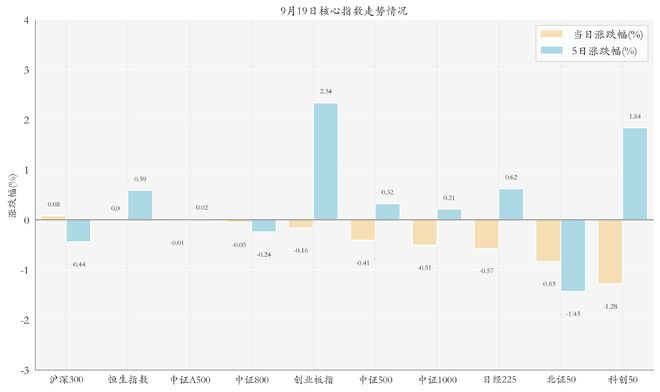
Market Overview - The A-share market experienced a decline, with the Shanghai Composite Index closing at 3820.09 points, down 0.3%, and the Shenzhen Component Index at 13070.86 points, down 0.04% [1] - Total market turnover was 23497.61 billion, a decrease of 8172.7 billion compared to the previous trading day [1] Capital Flow - The A-share market saw a net outflow of 431.42 billion in main funds, with an opening net outflow of 147.94 billion and a closing net outflow of 31.05 billion [2][3] - The CSI 300 index had a net outflow of 63.64 billion, while the ChiNext saw a net outflow of 189.81 billion and the STAR Market had a net outflow of 22.65 billion [4][5] Sector Performance - Among the primary sectors, the coal industry led with a net inflow of 28.22 billion, while six sectors experienced net inflows [6][8] - The top five sectors with net inflows included coal, building materials, defense and military, non-ferrous metals, and banks, with coal showing a gain of 1.85% [8] Individual Stock Activity - O-film Technology saw the highest net inflow of main funds at 20.27 billion [9] - Institutions showed interest in several stocks, with Ganfeng Lithium and others receiving significant net purchases, while Shanzi Gaoke experienced net selling [11] Institutional Focus - Recent institutional ratings highlighted several stocks with potential upside, including Caijun Biological, Huakai Yibai, and Chujian New Materials, with target price increases ranging from 17.05% to 38.74% [13]

多只军工ETF上涨;银行板块调整,ETF越跌越买丨ETF晚报
2 1 Shi Ji Jing Ji Bao Dao· 2025-09-19 12:09
ETF Industry News - The three major indices experienced fluctuations and declines, with the Shanghai Composite Index down by 0.3%, the Shenzhen Component Index down by 0.04%, and the ChiNext Index down by 0.16%. However, several ETFs in the defense and military sector saw increases, such as the Military Leader ETF (512710.SH) rising by 2.39%, the Defense ETF (512670.SH) increasing by 1.77%, and the High-end Equipment ETF (159638.SZ) up by 1.62% [1] - According to Founder Securities, the military industry is expected to enter a long-term prosperity phase driven by both domestic demand and foreign trade. The industry is projected to enter a new upward cycle from 2025 to 2027, with the military trade market in China likely to continue expanding [1] Market Performance Overview - On September 19, the market saw collective declines in the three major indices, with the Shanghai Composite Index closing at 3820.09 points, the Shenzhen Component Index at 13070.86 points, and the ChiNext Index at 3091.0 points. The highest intraday points were 3843.17, 13182.6, and 3128.38 respectively [3] - The coal, non-ferrous metals, and construction materials sectors performed well today, with daily increases of 1.97%, 1.19%, and 1.05% respectively. Conversely, the automotive, pharmaceutical, and computer sectors lagged behind with declines of 1.94%, 1.41%, and 1.26% [7] ETF Market Performance - The overall performance of ETFs was mixed, with strategy ETFs showing the best average performance at 0.45%, while thematic ETFs had the worst average performance at -0.49% [8] - The top-performing ETFs today included the Coal ETF (515220.SH) with a gain of 2.52%, the 180 Governance ETF (510010.SH) at 2.43%, and the Military Leader ETF (512710.SH) at 2.39% [10][11] Trading Volume and Fund Size - The top three ETFs by trading volume were the Sci-Tech 50 ETF (588000.SH) with a trading volume of 6.36 billion, the ChiNext ETF (159915.SZ) at 5.27 billion, and the A500 ETF (512050.SH) at 4.69 billion [13][14]