
消费品行业

Search documents
国家统计局:9月份制造业PMI为49.8%,指数继续回升
Guo Jia Tong Ji Ju· 2025-09-30 01:37
Core Viewpoint - The manufacturing purchasing managers' index (PMI) in September 2025 shows a slight recovery, indicating an overall acceleration in economic output in China, while the non-manufacturing business activity index remains stable at the critical point [1][5]. Group 1: Manufacturing PMI Insights - The manufacturing PMI rose to 49.8%, an increase of 0.4 percentage points from the previous month, indicating improved economic conditions [2]. - The production index reached 51.9%, up 1.1 percentage points, marking the highest level in nearly six months, reflecting active manufacturing activities [2]. - The new orders index increased to 49.7%, indicating a slight improvement in market demand, with certain industries like food and beverage, automotive, and aerospace showing strong performance [2][3]. - Small enterprises saw a PMI increase to 48.2%, up 1.6 percentage points, suggesting a recovery in their economic conditions [2]. Group 2: Non-Manufacturing PMI Insights - The non-manufacturing business activity index stood at 50.0%, down 0.3 percentage points, indicating stability at the critical point [4]. - The service sector's business activity index was 50.1%, remaining in the expansion zone, with strong performance in sectors like postal and financial services [4]. - The construction sector's business activity index slightly improved to 49.3%, indicating a minor recovery in construction activities [4]. Group 3: Comprehensive PMI Insights - The comprehensive PMI output index rose to 50.6%, an increase of 0.1 percentage points, indicating continued acceleration in production and business activities across sectors [5].
国家统计局:9月制造业生产活动加快,PMI升至49.8%,景气水平继续改善
Guo Jia Tong Ji Ju· 2025-09-30 01:37
Group 1: Manufacturing PMI Insights - The manufacturing purchasing managers' index (PMI) rose to 49.8% in September, an increase of 0.4 percentage points from the previous month, indicating continued improvement in economic conditions [2][3] - The production index reached 51.9%, up 1.1 percentage points, marking a six-month high, while the new orders index increased to 49.7%, suggesting a slight improvement in market demand [3] - Key industries such as food and beverage, automotive, and aerospace showed production and new orders indices above 54.0%, indicating robust activity, while sectors like wood processing and non-metallic mineral products remained below the critical threshold [3][4] Group 2: Non-Manufacturing PMI Insights - The non-manufacturing business activity index stood at 50.0%, down 0.3 percentage points, indicating stability in overall business volume [5] - The service sector maintained expansion with a business activity index of 50.1%, while industries like postal and financial services reported indices above 60.0%, reflecting strong growth [5] - The construction sector saw a slight recovery with a business activity index of 49.3%, and the business activity expectation index rose to 52.4%, indicating improved confidence among construction firms [5] Group 3: Composite PMI Insights - The composite PMI output index increased to 50.6%, up 0.1 percentage points, suggesting a continued acceleration in production and business activities across sectors [6] - The manufacturing production index and non-manufacturing business activity index contributed to the composite PMI, standing at 51.9% and 50.0% respectively [6]
国家统计局:9月份装备制造业、高技术制造业和消费品行业PMI分别为51.9%、51.6%和50.6%
Guo Jia Tong Ji Ju· 2025-09-30 01:36
国家统计局服务业调查中心首席统计师霍丽慧解读2025年9月中国采购经理指数。9月份,制造业生产活 动加快,PMI升至49.8%,景气水平继续改善。装备制造业、高技术制造业和消费品行业PMI分别为 51.9%、51.6%和50.6%,均明显高于制造业总体,同时上述重点行业生产指数和新订单指数均位于扩张 区间,企业供需两端较为活跃;高耗能行业PMI为47.5%,比上月下降0.7个百分点。 (文章来源:国家统计局) ...
2025年8月经济数据点评:重“质”稳“量”,经济阶段性回调
Jing Ji Guan Cha Wang· 2025-09-29 22:48
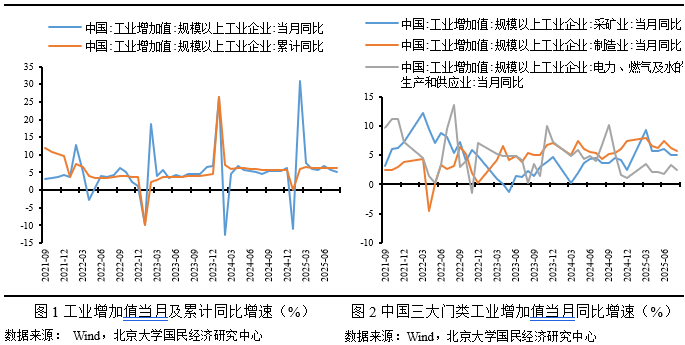
Economic Outlook - The overall policy tone remains "seeking progress while maintaining stability," with signals of policy adjustments indicating increased economic downward pressure in the second half of the year [2][3] - Short-term economic pressures exist, but long-term benefits are expected for high-quality development, with "anti-involution" potentially influencing economic trends [2][3] Supply Side - In August 2025, China's industrial added value for large-scale industries grew by 5.2% year-on-year, a slowdown of 0.5 percentage points from July, with cumulative growth at 6.2% [3][9] - The slowdown is attributed to supply chain disruptions due to extreme summer heat, seasonal fluctuations in export orders, and continued weakness in real estate investment [3][9] - High-tech industries show resilience, indicating a shift towards high-quality industrial transformation [3][9] Demand Side - Retail sales of consumer goods in August 2025 increased by 3.4% year-on-year, a decrease of 0.3 percentage points from the previous month, reflecting policy adjustments and a slowdown in consumption growth [4][16] - Fixed asset investment from January to August 2025 grew by 0.5% year-on-year, a decline of 1.1 percentage points from the previous period, indicating a phase of adjustment in investment growth [4][20] - Exports totaled $321.81 billion in August, up 4.4% year-on-year, but down 2.8 percentage points from the previous month, with structural changes in exports continuing [4][23] Price Trends - In August 2025, the Consumer Price Index (CPI) decreased by 0.4% year-on-year, while the Producer Price Index (PPI) fell by 2.9%, with both indices showing signs of narrowing the gap due to base effects [7][34][47] - The CPI's decline is influenced by high base effects in food prices, while the PPI's decrease reflects external uncertainties and domestic market adjustments [7][34][47] Monetary and Financial Conditions - In August 2025, the new social financing scale was 25.693 billion yuan, a decrease of 15.3% year-on-year, indicating seasonal adjustments in credit and off-balance-sheet financing [8][51] - The M1 money supply grew by 6% year-on-year, reflecting an acceleration in corporate demand for liquidity, while M2 remained stable at 8.8% [8][70] - The overall financing environment shows signs of improvement, but structural challenges in economic recovery persist [8][70]

美联储重启宽松周期,历史高位的美股将如何演绎?
Di Yi Cai Jing Zi Xun· 2025-09-18 00:09
Core Viewpoint - The Federal Reserve's recent interest rate cut marks the end of a prolonged period of monetary policy stagnation, raising questions about market reactions and investment strategies moving forward [1][2]. Group 1: Market Reactions to Fed's Rate Cut - Investors are speculating on how the market will respond to the restart of the easing cycle, with some betting on further gains in risk assets [1]. - Société Générale has increased its recommended equity allocation from 44% to 50% while reducing cash holdings from 10% to 5%, indicating a bullish outlook on risk assets [1]. - Historical data shows that U.S. equities typically deliver strong returns immediately following the first rate cut and continue to perform well over the next 12 to 24 months [1]. Group 2: Sector Rotation and Investment Strategies - The Fed's rate cut is expected to drive sector rotation, with funds moving from defensive sectors like utilities and healthcare to high-risk growth sectors such as technology and consumer discretionary [3]. - In the early stages of a rate cut cycle, defensive sectors tend to perform better, but as the policy effects materialize, growth and cyclical sectors are likely to take the lead [3]. - High-growth sectors, particularly communication services and consumer discretionary, have shown significant gains this year, with increases of 27.4% and 17.6% respectively [3]. Group 3: Small-Cap Stocks as Beneficiaries - Small-cap stocks are gaining attention as potential beneficiaries of the Fed's rate cut, with the Russell 2000 index rising nearly 10.5% this quarter, outperforming major large-cap indices [4]. - Small-cap stocks, which are sensitive to interest rate changes, still have upside potential despite recent rebounds, as their valuations remain relatively low compared to large-cap stocks [4]. - The future performance of small-cap stocks is contingent on the Fed's signaling regarding further rate cuts, which could support their upward momentum [4][5].
8月制造业采购经理指数小幅回升
Zhong Guo Hua Gong Bao· 2025-09-08 02:24
Group 1 - The manufacturing Purchasing Managers' Index (PMI) for August is 49.4%, showing a slight increase of 0.1 percentage points from the previous month, indicating an improvement in manufacturing sentiment [1] - The production index is at 50.8%, up by 0.3 percentage points, signaling accelerated manufacturing production; the new orders index is at 49.5%, increasing by 0.1 percentage points [1] - The prices index has continued to rise, with the main raw materials purchasing price index at 53.3% and the factory price index at 49.1%, increasing by 1.8 and 0.8 percentage points respectively, indicating an overall improvement in market prices [1] Group 2 - Large enterprises' PMI is at 50.8%, indicating an accelerated expansion; medium enterprises' PMI is at 48.9%, showing a decline in sentiment; small enterprises' PMI is at 46.6%, reflecting an improvement in sentiment [1] - Key sectors such as high-tech manufacturing and equipment manufacturing have PMIs of 51.9% and 50.5%, respectively, both showing increases of 1.3 and 0.2 percentage points, while the consumer goods sector PMI is at 49.2%, down by 0.3 percentage points [1] - The production and business activity expectation index is at 53.7%, up by 1.1 percentage points, marking two consecutive months of increase in market expectations [2]
扩内需等政策效果初步显现 8月份PMI三大指数均有所回升
Zhong Guo Chan Ye Jing Ji Xin Xi Wang· 2025-09-08 01:23
Group 1: Manufacturing Sector - In August, the manufacturing PMI rose to 49.4%, indicating an improvement in economic conditions compared to July [2][3] - The production index reached 50.8%, up 0.3 percentage points from July, marking an acceleration in manufacturing production [2] - The new orders index increased to 49.5%, reflecting a slight recovery in demand [2] - High-tech manufacturing and equipment manufacturing PMIs were 51.9% and 50.5%, respectively, showing continued strength in these sectors [3] - The prices of major raw materials and factory output prices rose to 53.3% and 49.1%, respectively, indicating an overall improvement in market price levels [2][3] Group 2: Non-Manufacturing Sector - The non-manufacturing business activity index was 50.3%, a 0.2 percentage point increase from July, indicating continued expansion [5] - The service sector's business activity index reached 50.5%, the highest point of the year, reflecting a significant recovery [5] - The construction sector's business activity index fell to 49.1%, down 1.5 percentage points from July, due to adverse weather conditions [6] Group 3: Market Expectations - The production and business activity expectations index was 53.7%, up 1.1 percentage points from July, suggesting increased confidence among manufacturing firms [4] - The business activity expectations index for the service sector was 57.0%, indicating optimism about future market developments [5]
8月PMI数据点评:经济延续弱复苏
Yong Xing Zheng Quan· 2025-09-05 11:31
Economic Indicators - The manufacturing PMI for August is 49.40%, an increase of 0.1 percentage points from the previous value[1] - The production index rose by 0.3 percentage points to 50.80%, while the new orders index increased by 0.1 percentage points to 49.50%[1] - The new export orders index recorded 47.20%, up by 0.1 percentage points, and the import index rose to 48.00%, an increase of 0.2 percentage points[1][2] Price Trends - The raw material purchase price index increased by 1.8 percentage points to 53.30%, marking three consecutive months of rise[2] - The factory price index rose by 0.8 percentage points to 49.10%, also showing a three-month upward trend[2] - The price gap between raw material purchases and factory prices increased by 1.00 percentage point to 4.20 percentage points[2] Sector Performance - The non-manufacturing PMI for August is 50.3%, up by 0.2 percentage points, indicating accelerated expansion[2] - The service sector PMI reached 50.5%, an increase of 0.5 percentage points, with capital market services showing strong growth[2][3] - The construction sector PMI fell to 49.1%, down by 1.5 percentage points, affected by adverse weather conditions[2][3] Investment Recommendations - The economic weak recovery pattern continues, with manufacturing supply PMI above the critical point for four consecutive months[3] - Focus on high-rated short-duration credit bonds while controlling low-rated risks in credit bonds[3] - The bond market is expected to maintain a "bull steep" trend, with long-end bonds offering better value[3]
美企迎来高管离职潮 为何“换帅”速度达20年来最快?
Di Yi Cai Jing· 2025-09-02 09:36
Core Insights - The U.S. is experiencing an unprecedented wave of CEO departures, with 1,358 CEOs leaving in the first half of the year, a 9% increase from the previous year, marking the highest level since 2002 [1] - The turnover rate for CEOs in publicly traded companies has reached a 20-year high, with at least 41 CEOs leaving S&P 500 companies by July, compared to 49 for the entire previous year [1] - Factors contributing to this high turnover include economic uncertainty, changing corporate values, tariffs, regulatory changes, evolving consumer behavior, and rapid implementation of new technologies [1] Industry Impact - The government and non-profit sector has seen the highest CEO turnover, with 286 departures, followed by technology (149) and healthcare (133) [3] - The consumer goods sector experienced 41 CEO departures, while retail saw 38, both representing a 100% increase from the previous year due to declining consumer confidence and tariff impacts [4] Leadership Trends - There is a notable trend of companies opting for interim successors, with 33% of new CEOs being temporarily appointed in the first half of the year, compared to only 9% in the same period last year [4] - The turnover rate for CFOs has also reached a historical high of 56%, influenced by rising retirement rates and the record CEO turnover [4]
解读2025年8月中国采购经理指数
Guo Jia Tong Ji Ju· 2025-09-02 00:46
Group 1: Manufacturing Sector - The manufacturing Purchasing Managers' Index (PMI) rose to 49.4% in August, indicating a slight improvement in economic conditions compared to the previous month [1] - The production index increased to 50.8%, remaining above the critical point for four consecutive months, signaling accelerated manufacturing production [2] - The new orders index reached 49.5%, showing a marginal increase, with notable performance in the pharmaceutical and computer communication sectors [2] - The procurement activities have accelerated, with the procurement volume index rising to 50.4% [2] - The price indices for major raw materials and factory prices increased to 53.3% and 49.1%, respectively, indicating an overall improvement in market price levels [2] Group 2: Non-Manufacturing Sector - The non-manufacturing business activity index rose to 50.3%, continuing to show expansion [4] - The service sector's business activity index reached 50.5%, marking a significant recovery and the highest point of the year [4] - Certain industries, such as capital market services and transportation, reported business activity indices above 60.0%, indicating robust growth [4] - The construction sector's business activity index fell to 49.1% due to adverse weather conditions, reflecting a slowdown in production [4] Group 3: Overall Economic Outlook - The comprehensive PMI output index increased to 50.5%, indicating an overall acceleration in production and business activities across sectors [5] - The production index for manufacturing and the business activity index for non-manufacturing were 50.8% and 50.3%, respectively, contributing to the positive outlook [5] - The production and operational activity expectation index rose to 53.7%, suggesting increased confidence among manufacturing enterprises regarding future market conditions [3]