航天

Search documents
深度解析马斯克最新访谈:无法忍受平庸带来的“慢性折磨”
Sou Hu Cai Jing· 2026-02-11 13:15
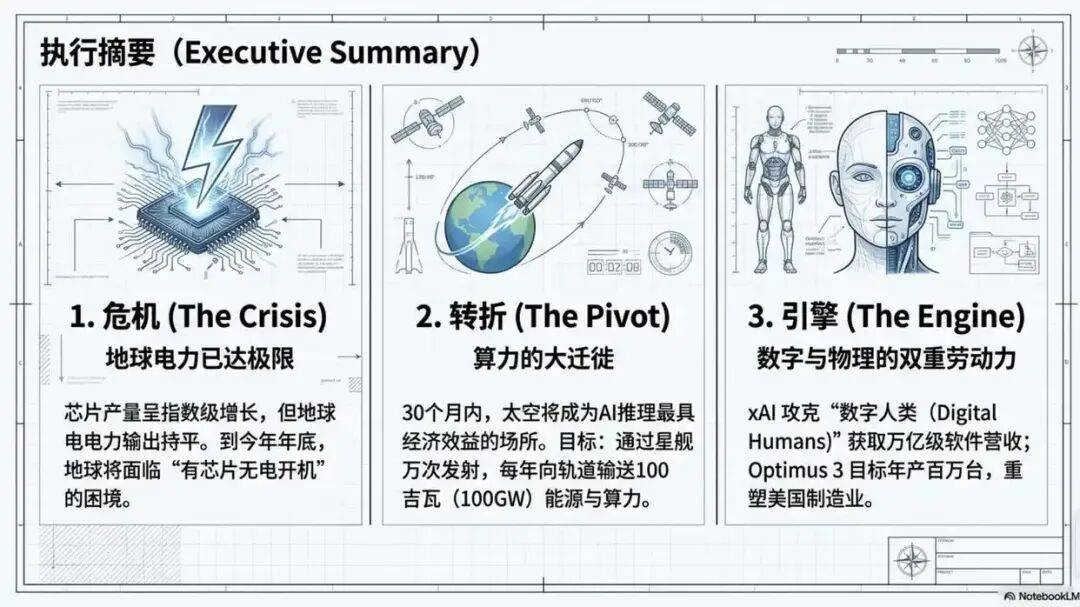
Group 1: Management Philosophy - Musk's management style is characterized by a sense of urgency and a high pain threshold, focusing on addressing acute pain rather than chronic bottlenecks in organizations [4][6][7] - He emphasizes "constraint analysis" to identify and eliminate inefficiencies, directly engaging with engineers to resolve issues without lengthy presentations [7][8] Group 2: AI and Human Intelligence - Musk predicts that within five years, AI intelligence will surpass the total human intelligence, potentially reducing human intelligence's share in the universe to less than 1% [8][10] - He argues that AI will not eliminate humanity but may find value in human irrationality and creativity, which are rare variables in the universe [10][11] Group 3: US-China Manufacturing Competition - Musk expresses a high regard for Chinese manufacturing capabilities, warning that without breakthrough innovations, the US risks losing dominance in the industrial chain [12][14] - He notes that China's electricity output is three times that of the US, indicating a significant gap in industrial capacity and manufacturing scale [14][15] - Musk highlights the US's loss of foundational smelting capabilities, relying on China for processing rare earth materials [15][16] Group 4: AI Infrastructure Challenges - Musk identifies a "hardware wall" for AI development, primarily due to limitations in electricity supply and the slow expansion of ground power plants [21][22] - He proposes a "space AI data center" plan to overcome these challenges, leveraging the efficiency of solar energy in space, which can be five times more effective than on Earth [23][25] Group 5: xAI and Digital Human Simulation - Musk outlines xAI's strategy focusing on Digital Human Simulation, aiming to create AI that can operate like a human by the end of 2026 [26][28] - He plans to bypass complex API integrations by enabling AI to learn to interact directly with screens and software [29] Group 6: Robotics and Recursive Manufacturing - The development of the Optimus humanoid robot is seen as a transformative force in labor dynamics, with a focus on creating dexterous hands for complex tasks [31][32] - Musk envisions a recursive manufacturing model where robots produce other robots, leading to exponential increases in productivity [33][34] Group 7: Future Outlook - Musk's vision intertwines various technological advancements, suggesting that the future will be shaped by the convergence of rocket capabilities, chip performance, robotic labor, and space energy [35]


马斯克:将在月球上建造AI卫星工厂
财联社· 2026-02-11 11:44
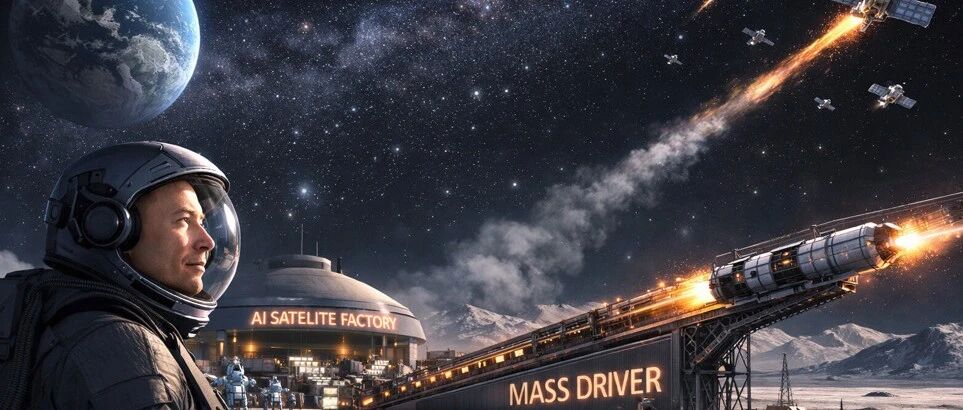
Group 1 - The core idea presented by Musk is the vision of establishing an artificial intelligence satellite factory on the Moon, which will include a mass driver for launching satellites into space [2][3]. - Musk emphasized that this initiative will enhance xAI's computational power for developing artificial intelligence, expressing excitement about the potential intelligence that could emerge from such a scale [3]. - The plan has evolved from merely establishing an AI data center in space to constructing a self-sustaining city on the Moon, which Musk views as a stepping stone to Mars [4][5]. Group 2 - Musk indicated that the timeline for building a lunar city could be achieved within 10 years, while a Martian city would take at least 20 years [5]. - The company xAI, which recently merged with SpaceX, aims to create an upgraded version of WeChat, with current monthly active users around 600 million, and Musk anticipates this number could exceed 1 billion [6]. - Upcoming features for the platform include a banking function called X Money and a standalone chat application [7]. Group 3 - Musk addressed the departure of several founding team members from xAI, stating that rapid progress in technology leads to leadership, and the company is restructuring to enhance efficiency as it scales [8].
新火箭、新飞船、海上回收梦舟闯过发射阶段“最危险时刻”,我国载人登月新突破
Mei Ri Jing Ji Xin Wen· 2026-02-11 09:33
Core Viewpoint - The successful test of the "Mengzhou" crewed spacecraft's maximum dynamic pressure escape flight marks a significant milestone in China's crewed lunar exploration program, showcasing advancements in rocket and spacecraft technology [1][3]. Group 1: Test and Technology Advancements - The maximum dynamic pressure escape test is a critical evaluation in the development of the Mengzhou crewed spacecraft, which is designed for high safety and reliability standards, especially during launch and return phases [3]. - The Mengzhou spacecraft is a next-generation reusable crewed spacecraft developed based on the Shenzhou spacecraft, featuring a modular design with a return capsule and service module, intended for near-Earth space station operations and crewed lunar exploration [2][3]. Group 2: Rocket Development - The Long March 10 rocket, a new generation of crewed launch vehicle, will support the Mengzhou Y crewed spacecraft and lunar lander missions, with the Long March 10A being a reusable variant designed for low Earth orbit missions [4]. - The successful controlled splashdown of the Long March 10 rocket's first stage represents a significant breakthrough in reusable rocket technology, laying the groundwork for future full-profile flights and sea-based net recovery systems [5][6]. Group 3: Recovery Technology - The net recovery system, which captures the rocket from above, offers greater stability compared to traditional landing leg systems, allowing for more payload capacity by eliminating the need for heavy landing gear [6]. - The challenges of the net recovery method include the need for a sufficiently large ground or sea recovery facility to accurately capture the rocket, which requires precise coordination with the rocket's descent [7].
马斯克酝酿在月球造AI卫星工厂,此前称要10年内建成月球城市
Sou Hu Cai Jing· 2026-02-11 08:43
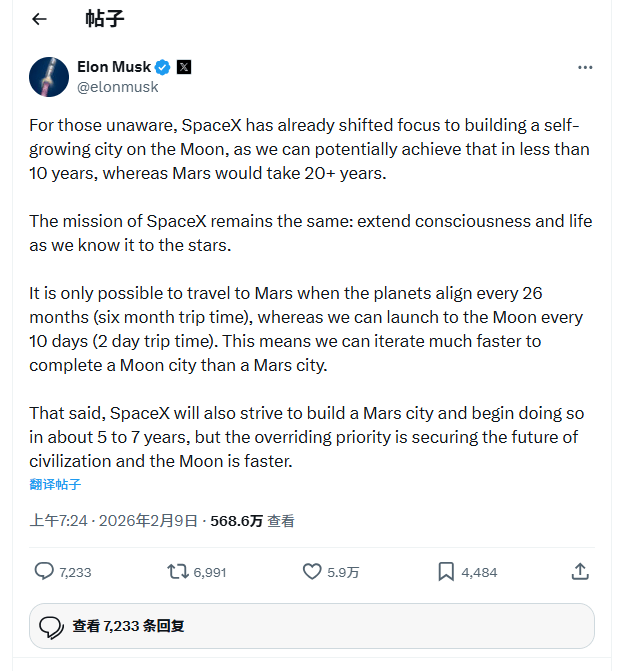
Group 1 - Elon Musk outlined plans for a lunar satellite factory during an all-hands meeting at his AI company xAI, emphasizing the need to build AI satellites on the Moon to enhance computational capabilities for AI development [1] - SpaceX has shifted its focus to constructing a "self-expanding city" on the Moon, with expectations to achieve this within a decade, while still pursuing the long-term vision of Mars colonization [1][3] - Musk stated that the construction of a lunar city can progress much faster than a Martian city due to the shorter travel times and more frequent launch opportunities, with lunar missions possible every 10 days compared to Mars missions every 26 months [3]
马斯克“进军月球”野心披露:未来将建厂生产AI卫星
Sou Hu Cai Jing· 2026-02-11 08:43
Core Insights - Elon Musk proposed a visionary plan during an xAI all-hands meeting to build factories on the Moon for producing AI satellites, equipped with a large catapult system called "mass driver" to launch satellites into space, thereby providing substantial computational power for AI [1][3] - Musk emphasized the necessity of establishing a presence on the Moon to give xAI a competitive edge in computational resources, expressing excitement about the potential intelligence that could emerge from such advancements [1] Company Developments - Musk recently announced the merger of xAI with SpaceX to advance plans for constructing AI data centers in outer space, expanding the vision to include a lunar base, although specific construction pathways were not detailed [3] - SpaceX is preparing for an initial public offering (IPO), potentially as early as June, marking a significant step in the company's growth trajectory since its founding in 2002 [3] - Historically, SpaceX's focus has been on Mars, but recent discussions have shifted towards the Moon as a stepping stone for future Mars missions, indicating a strategic pivot in the company's long-term goals [3] User Engagement - Musk shared that the X platform currently has approximately 600 million monthly active users, a figure that has not been independently verified, contrasting with the 237.8 million daily active users reported during the acquisition of Twitter in 2022 [3]
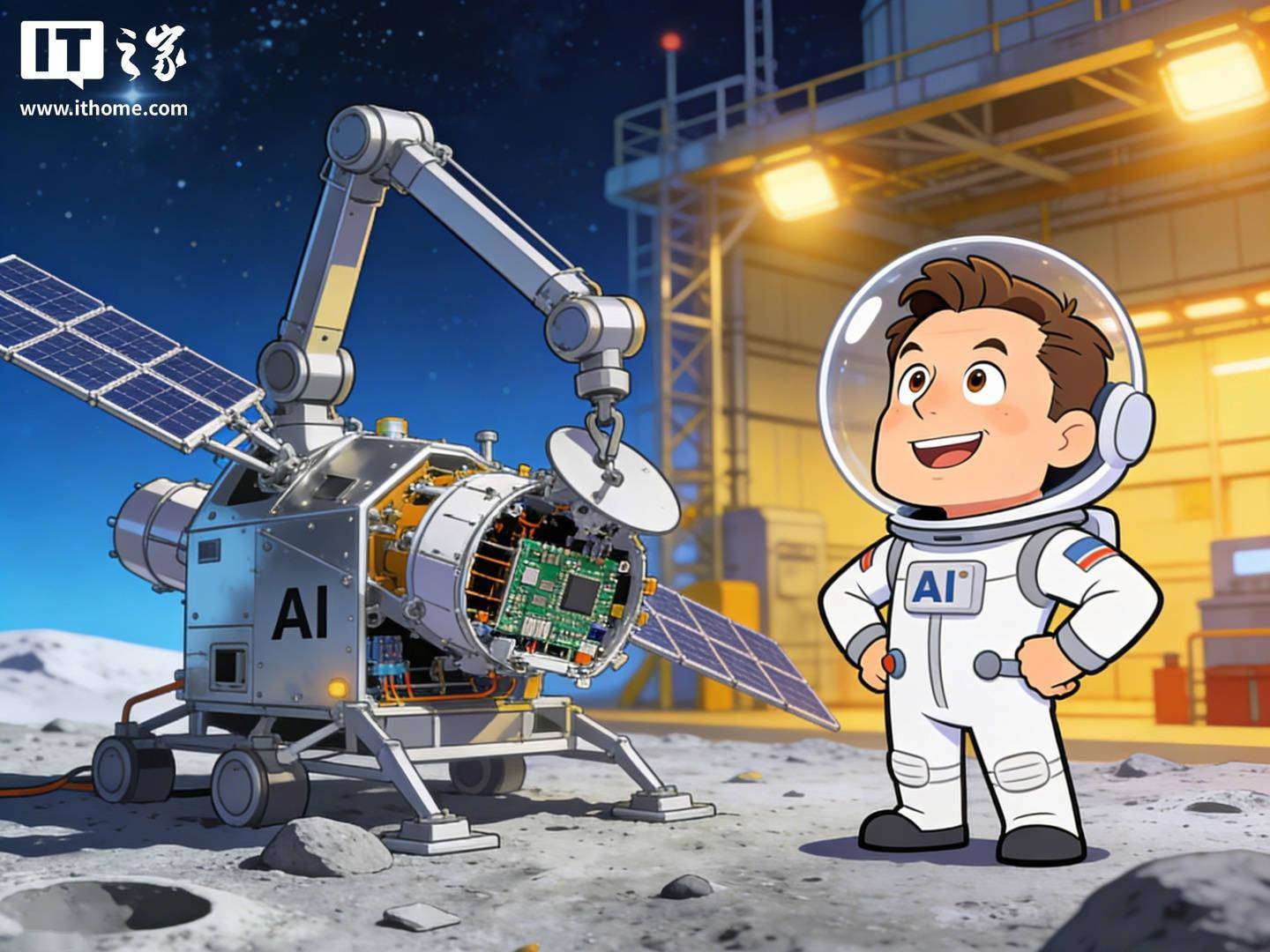
马斯克放话:要在月球建卫星工厂,用“弹射器”送上太空
Xin Lang Cai Jing· 2026-02-11 07:55
来源:金十数据 当地时间周二晚间,马斯克在其人工智能公司xAI的一次员工会议上表示,公司需要在月球上建一座工 厂,用来制造AI卫星,并配备一台巨大的弹射装置,将这些卫星发射到太空。 受这位亿万富翁对科幻作品的热爱启发,这种太空弹射装置将被称为"质量驱动器",并成为设想中的月 球设施的一部分。该设施将负责生产卫星,为公司的AI提供所需的计算能力。 "你必须前往月球。"马斯克在一次全员大会上表示,这一举措将帮助xAI获得比其他公司更强大的能 源,从而构建其AI系统。他还补充说: "很难想象如此规模的智能会思考什么,但看到这一切发生将会令人无比兴奋。" 上周,马斯克表示,他正在将xAI与自己的火箭公司SpaceX合并,以推动其在外太空建设AI数据中心的 计划。此时正值SpaceX准备最早在6月进行IPO。 如今,这一设想进一步扩展,纳入了月球设施的内容,不过在这场持续约一小时、也有其他高管发言的 讲话中,他并未说明这一设施将如何建成。 马斯克对月球的痴迷是近来才出现的。两名前SpaceX高管曾向美国《纽约时报》透露,月球从未是公 司的主要关注点。自2002年创立SpaceX以来,马斯克一直表示,让人类成为多行星物种 ...
帮主早观察:从黄金到卡奥斯,市场在焦虑什么?又在寻找什么?
Sou Hu Cai Jing· 2026-02-11 00:22
Group 1 - The core message of the article highlights a shift in market sentiment, where investors are increasingly anxious about long-term uncertainties and are seeking new investment narratives amidst traditional growth challenges [3][5] - Gold prices have been experiencing significant volatility, with traditional drivers like real interest rates weakening, while global debt and geopolitical risks are becoming more central to price movements [3][4] - The IPO of Haier's industrial internet platform, Kaos, represents a self-revolution for traditional manufacturing giants, as they seek to tell a new story about digital economy and platform ecosystems to reshape their valuations and competitiveness [4][5] Group 2 - The simultaneous investment of 10 billion by prominent investors in Jianghuai Automobile's collaboration with Huawei on high-end smart electric vehicles indicates a strong consensus among capital regarding disruptive industry trends [4][5] - The market's enthusiasm for "commercial aerospace" is exemplified by the nearly 600% surge in shares of Electric Power Blue Sky on its first trading day, reflecting a willingness to pay a premium for hard tech with high barriers and clear growth paths [4][5] - The current market landscape shows a dual approach: a defensive strategy using assets like gold to hedge against long-term uncertainties, and an offensive strategy investing in sectors like smart electric vehicles, commercial aerospace, industrial internet, and AI computing [5][6] Group 3 - Traditional giants like Haier and Jianghuai, which are willing to undergo significant transformations or cross-industry collaborations, may present substantial mid-term investment opportunities [6] - Understanding national strategic directions, such as commercial aerospace and nuclear power, is crucial for investors, as capital trends align closely with national strategies [6] - The article emphasizes the importance of recognizing underlying market fears and desires to make informed investment decisions, rather than being swayed by surface-level market noise [6]
【早知道】央行:继续实施好适度宽松的货币政策;上海已开放超5200公里自动驾驶测试道路
Sou Hu Cai Jing· 2026-02-11 00:11
Group 1 - The central bank continues to implement a moderately loose monetary policy [1] - The central bank focuses on ensuring the effective implementation of financial policies such as re-loans for affordable housing [1] - Multiple departments have released opinions on accelerating the application of artificial intelligence in the bidding and tendering sector [1] Group 2 - Five departments are enhancing the integration and innovation of low-altitude equipment and low-altitude information communication [1] - Shanghai has opened over 5,200 kilometers of autonomous driving test roads [1] - Zhejiang supports the establishment of a community of upstream and downstream enterprises in the photovoltaic industry chain [1] - Deep Blue Aerospace has made significant progress in the development of the core propulsion system for the "Yunxing No. 2" large reusable launch vehicle [1]
影响市场重大事件:依托“天关”卫星,黑洞研究又有新发现;深蓝航天“星云二号”大型可回收火箭第二批次发动机首台产品热试车考核成功
Mei Ri Jing Ji Xin Wen· 2026-02-10 23:29
Group 1 - The "Tian Guan" satellite has captured an unprecedented high-energy cosmic explosion, suggesting it may be the process of a medium-mass black hole tearing apart a white dwarf star [1] - Deep Blue Aerospace's "Star Cloud No. 2" large reusable rocket has successfully completed key tests of its core propulsion system, marking a significant advancement in China's largest thrust liquid oxygen-kerosene engine [2] - The Ministry of Industry and Information Technology and other departments have issued guidelines to enhance network coverage in low-altitude airspace, utilizing existing 5G infrastructure and satellite communication [3][4] Group 2 - The State Council has mandated a comprehensive safety risk assessment for elderly care institutions by the end of 2026, aiming to eliminate safety hazards and enhance management mechanisms [5] - The National Copyright Administration and other departments have launched a special initiative to protect the copyrights of theatrical films, focusing on combating piracy and illegal distribution [6] - Zhejiang Province aims for its core artificial intelligence industry to achieve a revenue of 1.2 trillion yuan by 2030, promoting innovation and collaboration between tech and manufacturing sectors [7] - The same province is exploring the construction of a comprehensive computing power system and planning for advanced digital infrastructure, including 5G-A networks and future communication technologies [8] Group 3 - Over 60% of private equity firms are heavily invested going into the holiday, with nearly 70% optimistic about the market's performance post-holiday, indicating a potential upward trend in A-shares [9] - Alibaba Cloud has become the first Chinese cloud provider to pass comprehensive technical tests by ICANN, enabling it to offer end-to-end services for top-level domain management [10]
2天会谈结束,中美都没签字
Xin Lang Cai Jing· 2026-02-10 23:24
Core Viewpoint - The third "Responsible Use of Artificial Intelligence in Military" summit held in Spain saw 85 countries participating, but neither the US nor China signed the joint declaration, reflecting underlying strategic concerns from both nations [1][2][6]. Group 1: US Concerns - The US is wary that binding international rules could limit its technological flexibility and competitive edge in military AI, as it seeks to accelerate development through a "rapid iteration" model similar to SpaceX [1][2]. - The US aims to maintain a technological gap and a "technological crushing" advantage by combining rapid iteration with measures to contain competitors, particularly China, through export controls and investment reviews [2][4]. - The US prefers to establish a "Western-centric" governance system by creating standards with allies outside of multilateral frameworks, thereby excluding countries like China and reinforcing its own technological and regulatory dominance [2][4]. Group 2: China's Position - China refrained from signing the declaration due to concerns over vague principles regarding "responsible use" and the lack of mechanisms to balance the technological advantages of leading nations, fearing it could entrench Western dominance [6][8]. - China advocates for multilateral governance and emphasizes that international rules should consider both security and development, opposing the politicization of technology issues [6][8]. - The Chinese delegation highlighted the importance of risk prevention in military AI applications and reiterated its commitment to a human-centered approach to military AI, aiming to ensure national sovereignty and security [6][8]. Group 3: Structural Challenges - The sensitivity of military AI, involving national defense secrets, presents verification and enforcement challenges for any international rules, leading to a "prisoner's dilemma" where countries are hesitant to commit [8]. - The rapid pace of AI technological advancement outstrips the rule-making process, rendering the principles in the declaration inadequate to address specific risks associated with autonomous weapons and algorithmic biases [8].