软件

Search documents
当市场高喊“软件已死”,红杉与德银给出相反判断
Jin Shi Shu Ju· 2026-02-26 06:34
Core Viewpoint - The impact of AI on the software industry has raised widespread concern, but some experts remain optimistic about the potential for AI to enhance rather than replace existing software systems [1][2][3]. Group 1: AI's Role in the Software Industry - AI is viewed as an extension of software, with traditional software companies like Oracle remaining resilient [1]. - Deutsche Bank analysts believe that AI platforms are unlikely to replace existing software systems but will complement them, driving overall progress in the software industry [1][3]. - The integration of AI is expected to significantly improve operational efficiency and employee capabilities, enabling tasks that were previously unachievable [1]. Group 2: Investment Perspectives - Alfred Lin from Sequoia Capital emphasizes a focus on long-term value in investments, citing past investments in companies like Nvidia and Snowflake that have consistently pursued their visions [2]. - Deutsche Bank maintains a positive outlook on the software industry despite ongoing AI-related concerns, suggesting that the advancements in AI could serve as a catalyst for the tech sector [2][3]. - Analyst Brad Zelnick asserts that AI model providers are more likely to position themselves as orchestration layers built on existing mature systems rather than replacing them [3]. Group 3: Market Sentiment and Predictions - Despite some contrasting views from financial experts predicting a wave of bankruptcies in the software industry, Deutsche Bank remains bullish, believing that the market can accommodate both software and AI winners [3]. - Zelnick notes that the increase in queries from humans and agents regarding underlying enterprise data is beneficial for infrastructure and computational layers [4].
全网疯传的报告血洗美股,33岁创始人震惊:早知道不免费给了
凤凰网财经· 2026-02-26 06:28
Core Viewpoint - The report titled "The Global AI Crisis of 2028" by James van Geelen from Citrini Research depicts a dystopian future with massive unemployment, rising unemployment rates above 10%, deflationary spirals, and stock market crashes, which triggered significant market sell-offs on Wall Street [1] Group 1: Market Reaction - The report quickly became a focal point for market discussions, leading to a drop of over 1% in the S&P 500 index, marking one of the worst single-day performances in months, with financial stocks experiencing their most severe decline since April [1] - Companies directly mentioned in the report, such as ServiceNow, DoorDash, and American Express, saw their stock prices plummet [1] - The market's reaction was exacerbated by existing anxieties regarding AI's potential disruptive impact on businesses, alongside other pressures like tariff uncertainties and geopolitical news [4] Group 2: Clarification of Intent - Van Geelen clarified that the report was intended to simulate a scenario rather than make a prediction, emphasizing that it aimed to prepare readers for potential left-tail risks associated with AI [3] - The report repeatedly stated that the content was a scenario and not a forecast, with a final note asserting that some of the scenarios presented were unlikely to occur [3] Group 3: Market Sentiment and AI Perception - The intense market reaction indicates that investors are highly sensitive to any signals suggesting disruptive risks from AI, reflecting a shift from enthusiasm for growth to deep unease about potential upheaval [6] - Despite the panic, Citrini Research itself holds several AI-related positions, including stocks in Nvidia, Alphabet, and others, and has historically been viewed as overly bullish on AI [5]


应对意料之外的改变
Jing Ji Guan Cha Wang· 2026-02-26 04:17
Group 1 - The introduction of AI technologies, such as Anthropic's "Cowork" and ByteDance's "seedance2.0," has significantly impacted the software and video industries, leading to a decline in stock prices for several companies [2] - The emergence of the "K-shaped economy" highlights the divergence in performance between high-tech industries and traditional sectors, with new industries thriving while traditional ones face challenges [4][5] - In early 2026, various provinces in China have lowered their GDP growth targets, indicating a more pragmatic approach to economic growth and reflecting potential constraints on the economy [3] Group 2 - The ongoing changes in the economy suggest that the struggling sectors may begin to recover, supported by fiscal reforms and improved real estate policies, potentially leading to a "V" shaped recovery for traditional industries [6] - AI applications are expected to undergo large-scale validation, with some products redefining industry expectations shortly after their release, indicating a deeper integration of AI into various sectors [6] - The dual changes in the economy and technology are expected to create new challenges and opportunities for businesses and individuals, necessitating careful decision-making regarding investments and adaptations to new technologies [7]

闻泰科技回应安世半导体控制权进展;英伟达业绩再超预期
2 1 Shi Ji Jing Ji Bao Dao· 2026-02-26 03:35
Group 1 - The Supreme People's Court ruled in favor of Yuzhu Technology in a patent infringement case against Luweimei, allowing Yuzhu to proceed with its IPO plans [2] - Tencent's Yuanbao team apologized for generating inappropriate content in user-created New Year greeting cards, addressing the issue and optimizing the model [2] - Hillhouse Capital plans to reduce its stake in Gree Electric Appliances by up to 112 million shares, with proceeds used to repay bank loans, marking its first reduction since becoming the largest shareholder [3] Group 2 - WeChat introduced new features for users to quickly locate images in chats and to receive photos and files face-to-face, enhancing user experience [4] - Yonyou Network clarified that its AI products are not intended to fully replace existing software but to enhance enterprise operations, focusing on knowledge workers [5] - Blue Arrow Aerospace announced plans to conduct recovery tests for its reusable rocket, Zhuque-3, in the second quarter of this year [6][7] Group 3 - Meizu's mobile business is reportedly ceasing operations, with plans to delist by March 2026, while its FlymeAuto division will operate independently [8] - Shunhao Co. announced that its subsidiary, Treadlight, plans to mass-produce satellites and establish a large-scale space data center between 2031 and 2035 [8] - The International Star Alliance updated its organizational structure to enhance technology implementation and scene promotion in smart home and terminal industries [9] Group 4 - Wingtech Technology is actively addressing the control rights issue of Anshi Semiconductor, focusing on maintaining business stability and communication with clients [10] - NVIDIA reported a revenue of $68.127 billion for Q4 of fiscal year 2026, a 73% year-over-year increase, with a net profit of $42.96 billion, reflecting a 94% growth [11] - Jiangsu Hongwei Technology announced a price increase for IGBT and MOSFET products due to rising manufacturing costs driven by fluctuations in core metal material prices [12][13] Group 5 - TrendForce predicts that the combined capital expenditure of eight major cloud service providers will exceed $710 billion by 2026, driven by AI server investments [14] - Manycore Tech Inc. updated its prospectus, reporting a revenue of 820 million yuan in 2025, with a gross margin of 82.2% [15] - Canaan Inc. completed the acquisition of several mining assets from Cipher Mining Technologies, shifting its strategy towards systematic upstream development in the U.S. power assets [16] Group 6 - Zhiyang Innovation plans to invest 300 million yuan in Lingming Photon Technology, acquiring a stake of approximately 9.09% to 10% [17]


受美国关税引发的不确定性影响,爱2025年风险投资额下降
Shang Wu Bu Wang Zhan· 2026-02-26 02:47
Core Insights - The report indicates a 23% decline in Irish venture capital funding in 2025, totaling €1.1 billion, marking the first decrease since 2018 [1] - The decline in funding is attributed to the "Trump effect" caused by uncertainties related to U.S. tariffs, leading to a significant 46% drop in funding for Irish SMEs in Q4 2025, amounting to €291.4 million [1] - Larger deals exceeding €30 million decreased by one-third year-on-year to €540.8 million, while funding in the €10 million to €30 million range fell by 14% [1] Funding Trends - Smaller funding rounds showed resilience, with the €3 million to €5 million range increasing by nearly 40% to €113.8 million, and the €1 million to €3 million range only slightly declining by 3% [1] - Seed funding rounds experienced a 5% decrease [1] - A total of 186 deals were completed in 2025, compared to 217 in 2024 [1] Sector Performance - The life sciences sector received the most funding, accounting for 40% of the total, followed by software at 14% [1] - Cybersecurity companies outperformed artificial intelligence firms, which attracted 9% of the total funding, while fintech secured 8% [1]
又一家居企业冲击港股上市,2025年营收超8亿元,主要客户有顾家、索菲亚等
Sou Hu Cai Jing· 2026-02-26 02:29
Core Viewpoint - Company is preparing for an IPO on the Hong Kong Stock Exchange, with J.P. Morgan and CCB International as joint sponsors, aiming to become the first listed company among the "Six Little Dragons of Hangzhou" [3] Group 1: Financial Performance - Company is projected to achieve revenue of 820 million yuan in 2025, with a gross margin of 82.2% and an adjusted net profit of 57.1 million yuan, marking a turnaround from previous losses [1] - The company's net losses according to accounting standards are expected to be 646 million yuan in 2023, 513 million yuan in 2024, and 428 million yuan in 2025, with an adjusted net profit of 57.1 million yuan [1] Group 2: Market Position and Growth - As of 2024, the company is a leading provider of spatial design software in China, holding a market share of 23.2%, with business expansion into international markets including South Korea, Southeast Asia, the United States, and India [3] - The Chinese spatial design software market is anticipated to grow from 3.3 billion yuan in 2024 to 6.6 billion yuan by 2029, with a compound annual growth rate (CAGR) of 18.9% for cloud software, significantly outpacing traditional on-premise software [3] Group 3: Company Background and Products - Company was co-founded by Huang Xiaohuang, Chen Hang, and Zhu Hao, who are university classmates with prior experience at renowned companies such as NVIDIA, Microsoft, Amazon, and the National Center for Supercomputing Applications [3] - The company offers a core cloud-native platform "CoolJiaLe," a localized solution for international markets "Coohom," and professional services providing 3D composite datasets "SpatialVerse," utilizing cloud-native architecture and AI-driven technology [3] Group 4: Investment and Shareholding - Company has received investments from multiple institutions including IDG Capital, GGV Capital, and Hillhouse Capital among others [4] - Pre-IPO shareholding includes Huang Xiaohuang with 15.46%, Chen Hang with 11.04%, Zhu Hao with 4.22%, and Wide Future Group Limited with 3.67% [4] - "CoolJiaLe" has established strategic partnerships with several well-known home furnishing companies, including Kuka Home and Sophia [4]

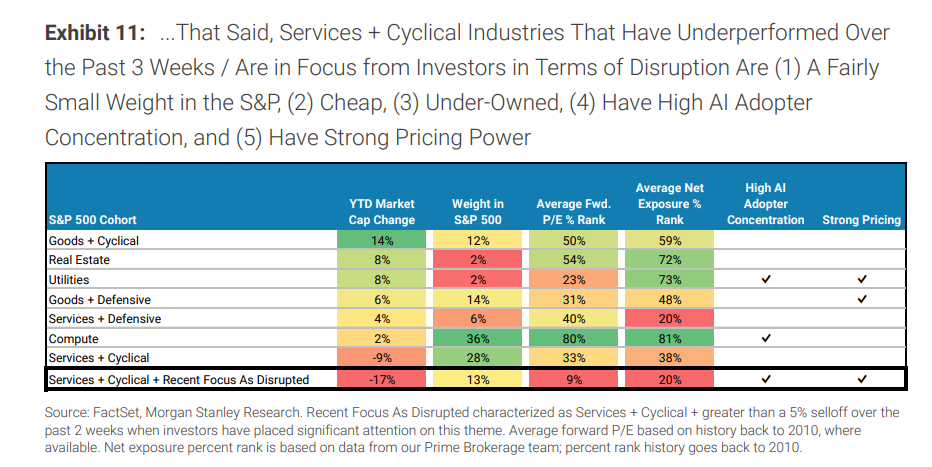
拆解上万份财报后,大摩发现:遭抛售的“服务+周期”反而AI采用率最高、议价能力最强
Hua Er Jie Jian Wen· 2026-02-26 01:35
Core Viewpoint - The recent market panic regarding the potential disruption caused by generative AI (GenAI) and agentic AI is seen as an overreaction, particularly affecting traditional "services + cyclical" companies, especially in software, information services, and financial intermediaries [1][2]. Group 1: Market Reaction and Valuation - The group of companies perceived as "disrupted" currently represents only 13% of the total market capitalization of the S&P 500, explaining the limited overall market decline despite significant internal volatility [1]. - The relative valuation of the "services + cyclical" sector is at the 9th percentile since 2010, indicating it is near historical lows, while institutional net exposure has dropped to the 20th percentile, suggesting extreme underweighting [1]. - Morgan Stanley argues that the bearish outlook on GenAI underestimates the ability of established software providers to participate in the current innovation cycle [1]. Group 2: AI Adoption and Financial Impact - Data from Morgan Stanley shows that 30% of companies identified as "AI adopters" reported at least one quantifiable financial impact from AI in their Q4 2025 earnings calls, up from 24% in Q3 2025 and 16% in Q4 2024 [4]. - The anticipated profit margin growth for the S&P 500 due to AI adoption is projected to contribute 40 basis points by 2026 [4]. - AI adopters experienced a 310 basis point expansion in EBIT margins from 2024 to 2025, which is twice the rate of the MSCI global index during the same period [7]. Group 3: Industry-Specific Insights - In the software industry, concerns about AI startups taking market share and the collapse of traditional business models are misplaced; generative AI enhances existing software capabilities rather than replacing them [14]. - In consumer finance and payments, the trust and compliance aspects are critical, and AI is unlikely to disrupt traditional credit card networks significantly [15]. - The transportation sector shows a split; heavy asset operators will benefit from AI, while light asset freight brokers face disruption due to commoditization of freight matching capabilities [18]. Group 4: Historical Context and Future Employment - Historical parallels are drawn to the smartphone era, where initial fears of disruption led to significant market differentiation based on companies' ability to adapt and leverage new technologies [10][11]. - Technological advancements historically create new job opportunities rather than eliminate existing ones, with new roles expected to emerge alongside AI integration [22][23].
格林期货早盘提示:全球经济-20260226
Ge Lin Qi Huo· 2026-02-26 01:33
Report's Investment Rating - No information provided on the industry investment rating Core Viewpoints - The global economy has passed its peak in late 2025 and started to decline due to the continuous wrong policies of the United States [3] - The return of the US to the Monroe Doctrine will have a profound and subversive impact on major asset classes such as the global economy, US bonds, US stocks, the US dollar, precious metals, and industrial metals [3] - Wash's combination of interest - rate cuts and balance - sheet reduction indicates a major shift in the Fed's monetary policy, creating a strong expectation of liquidity contraction for equity assets [3] Summary by Related Information Categories Software Industry - JPMorgan Chase CEO Dimon warns that the current high asset prices and blind profit - seeking are reminiscent of the 2008 financial crisis, and the credit cycle reversal may trigger an unexpected wave of defaults, with the AI - disrupted software industry as a potential hard - hit area [1] - Arini's founder warns that even without a substantial impact from AI, market panic can raise financing costs and trigger large - scale defaults in the software industry, as software companies generally operate with high leverage and rely on private credit for financing [1] - Traders are short - selling ETFs holding a large number of software company loans through record - high put options, with a focus on Invesco's BKLN [1] - OpenAI aims to replace giants like Salesforce and Workday, while Anthropic emphasizes collaboration with existing software, leading to a general rebound in enterprise software stocks [1] Global Economy and Finance - Hedge funds have been net - selling US stocks at the fastest pace since March last year [2] - Bridgewater's Dalio warns that the world is on the verge of a "capital war" due to geopolitical tensions and capital market volatility [2] - The expected balance - sheet reduction policy of the Fed's nominee Wash has a strong negative impact on global equity and commodity assets [2] - Nomura predicts that the Fed's uncertainties will peak from July to November 2026, and there may be a trend of "fleeing US assets" [2] - High - end consumer spending remains resilient, but middle - and low - income families are cutting back, and funds are flowing from tech stocks to defensive sectors [2] Technology and Business Cooperation - AMD and Meta have a five - year strategic partnership, with Meta getting 6GW of AMD GPU and AMD offering up to 1.6 billion performance - based warrants (about 10% equity) in exchange for a $100 billion order [1] - Google will build a new data center in Minnesota and cooperate with Xcel Energy to implement innovative energy solutions [1] AI - related Technology Trends - OpenClaw's Steinberger submits 90,000 lines of code in a year with AI, stating that AI can solve problems autonomously, and he predicts a full - scale technological explosion in 2026 [1] US Policy - making and International Relations - The Trump administration plans to use the Pentagon's AI project to set reference prices for key minerals and build a global metal trading group, initially focusing on four metals: germanium, gallium, antimony, and tungsten [1] - The US has released a new National Security Strategy, giving up global hegemony and adjusting economic relations with China to revive its economic autonomy [2] - The US has taken actions such as attempting to arrest the Venezuelan president, control Venezuelan oil, and buy Greenland, bringing great uncertainty to the global economy [2]
帮主郑重:美股两连阳,但这次涨的逻辑不一样
Sou Hu Cai Jing· 2026-02-26 01:22
美股又涨了。道指三连阳,纳指涨超1%,AI概念股普涨。 但你要看清一个细节——这次涨的,和上周跌完之后那波反弹,不太一样。 上周跌,是恐慌。市场听说AI要颠覆软件业,先卖为敬。赛富时、ServiceNow这些软件股,一周跌掉 20%。 这周涨,是提问。资金开始坐下来问:AI到底会颠覆谁?谁会从中受益? 第三,关税这事,别忽略。10%已经落地,15%还在路上,出口相关的板块要有心理准备。 最后问你一句:你觉得AI这轮资本开支,还能烧多久?评论区聊聊。 Meta跟AMD签了多年协议,软件股反弹,Anthropic的工具可以连DocuSign了,软件股又涨。 安吉利斯投资的首席投资官说得很透:市场已经从"先卖再问",进入了"提问阶段"。 恐慌退了,理性回来了。但最关键的考验,还在今晚。 英伟达要发财报了。过去一年,它每次都能超预期,然后股价再上一层楼。但这次不一样——市场开始 质疑,AI这轮资本开支到底能不能持续。华尔街对英伟达的期望,不只是"超预期",是"大幅超预期"。 瑞银说得很直白:未来几天信心能不能持续,部分取决于英伟达的业绩。 另一边,特朗普的关税也落地了。10%的全球关税生效,他说还要再推到15%。贸易 ...

道指涨超300点,半导体存储板块走强,金银尾盘跳水
Di Yi Cai Jing Zi Xun· 2026-02-25 23:45
Market Overview - US stock market rose on Wednesday, continuing the upward trend from the previous trading day, as concerns over the impact of artificial intelligence (AI) on costs diminished, replaced by renewed optimism about the potential benefits of this emerging technology [2] - The Dow Jones Industrial Average increased by 307.65 points, or 0.63%, closing at 49,482.15 points; the Nasdaq rose by 1.26% to 23,152.08 points; and the S&P 500 gained 0.81%, ending at 6,946.13 points [2][3] Technology Sector Performance - Major tech stocks saw gains, with Nvidia up 1.44%, Microsoft rising 2.99%, Meta increasing by 2.25%, Tesla up 1.94%, Amazon rising 1%, and Apple and Google both gaining approximately 0.7% [3][4] - The Philadelphia Semiconductor Index rose over 1.5%, with Intel increasing by 1.65% and Broadcom up 2.10% [5] Financial Sector Activity - The financial sector showed strong performance, with Citigroup rising 4.35% and Goldman Sachs, Bank of America, JPMorgan Chase, and Wells Fargo all increasing by over 2% [4] Software and Storage Sector Developments - The storage sector performed well, with Western Digital up 7.53% and Seagate Technology rising 6.52%, while SanDisk fell 0.96% due to short-selling by Citron [6] - The software sector continued its upward trend, with the iShares Tech Software ETF (IGV) rising 2%, Oracle increasing by 1.19% after Oppenheimer upgraded its rating, and IBM recovering with a 3.62% increase [6] Market Sentiment and Future Outlook - Investors are reassessing the high valuations of tech stocks and are increasingly skeptical about the substantial capital expenditures of large cloud providers related to AI [6][7] - Market focus is shifting towards Nvidia's upcoming earnings report, with expectations that the company will exceed revenue forecasts and provide strong guidance, particularly in AI-driven data center demand [7][8] - Analysts suggest that the market is transitioning from a broad-based rally to a more selective approach in identifying companies with competitive advantages [8]