
农产品加工

Search documents
从丰收节看中国农业转型升级
Jing Ji Guan Cha Wang· 2025-09-24 11:52
Core Insights - The article highlights the significance of the 8th China Farmers' Harvest Festival, emphasizing the theme of celebrating agricultural abundance and improving quality of life, marking a pivotal moment in China's agricultural development during the "14th Five-Year Plan" period [1][2] Agricultural Production and Security - China's grain production is projected to exceed 1.4 trillion jin (approximately 700 million tons) in 2024, an increase of 74 billion jin (approximately 37 million tons) compared to 2020, ensuring food security for 1.4 billion people [1] - The per capita grain availability in China has reached 500 kg, achieving basic self-sufficiency in grains and absolute safety in staple food supply [1] Agricultural Innovation and Value Addition - The festival serves as a platform for promoting agricultural innovation, with participants focusing on high-quality seeds, deep processing of agricultural products, and brand differentiation to enhance value and income for farmers [2] - The shift from quantity-based growth to value-based development in agriculture is emphasized, aiming to synchronize farmers' income with industry resilience [2] Seed Industry Developments - The seed industry is recognized as the foundation of agricultural security, with advancements in breeding technologies leading to the emergence of new varieties of fruits, such as the Huami pear, which showcases improved traits and disease resistance [4] - The introduction of the "Guangming No. 2" white feather chicken marks a significant breakthrough in China's poultry breeding, reducing reliance on imported breeds and enhancing domestic production capabilities [5][6] Agricultural Processing and Economic Impact - The deep processing of agricultural products is becoming essential for stabilizing farmers' incomes and addressing market volatility, with companies like Bosida focusing on value-added products such as apple slices and vinegar [8] - The total output value of the pomelo industry in Yuhuan City, Zhejiang Province, has surpassed 506 million yuan, significantly boosting local farmers' incomes [9] Digital and Smart Agriculture - The integration of smart agricultural equipment, such as the DJI T100 agricultural drone, is revolutionizing farming practices by increasing efficiency and reducing resource waste [11][12] - Innovations in beekeeping, such as smart beehives, allow for remote monitoring and management, significantly improving labor efficiency and reducing operational costs [13] Conclusion - The article underscores the transformative journey of China's agriculture towards high-quality, sustainable development through innovation, value addition, and the integration of technology, which collectively enhance productivity and farmer livelihoods [2][10]
天津:多措并举赋能协作支援工作提升水平
Zhong Guo Fa Zhan Wang· 2025-09-24 09:53
Core Viewpoint - The article highlights the effective implementation of collaboration and support initiatives in Tianjin, focusing on talent, funding, project, technology, market, and employment guarantees to enhance development in paired regions such as Gansu, Tibet, and Qinghai [1][2][3]. Talent Guarantee - Tianjin has successfully completed the selection of a new batch of cadres to support Gansu, Tibet, and Qinghai, emphasizing the "frontline work method" to enhance the capabilities of personnel in key positions [1]. - A total of 200 paired regional cadres are being trained and placed in Tianjin for practical experience [1]. Funding Guarantee - The city has allocated 2.85 billion yuan in financial support, aiming to enhance the internal development dynamics of impoverished areas and ensure sustainable income for the impoverished [1]. - By the end of August, social mobilization efforts have raised approximately 208 million yuan in donations [1]. - Following severe flooding in Xingtai County, Tianjin quickly mobilized around 2.1 million yuan in materials for disaster recovery [1]. Project Guarantee - A total of 935 support projects have been initiated, with a focus on local needs and resources [2]. - Projects include essential infrastructure improvements such as safe drinking water and road hardening to address urgent community needs [2]. Technology Guarantee - The city has collected 176 technical needs from paired regions and is promoting technology transfer through a structured approach [2]. - Collaborative projects in green agriculture and food processing are prioritized for support [2]. Market Guarantee - New consumption support initiatives have been launched, including the promotion of service platforms and innovative consumption models [3]. - By the end of August, sales of agricultural products from paired regions reached 3.435 billion yuan [3]. Employment Guarantee - The "Tianjin-Gansu Skilled Worker" labor cooperation brand has been enhanced, with new sub-brands being developed [3]. - By the end of August, 51,900 rural laborers from Gansu have been assisted in finding employment, including 39,500 who were previously impoverished [3].
农产品加工板块9月24日跌0.73%,中粮糖业领跌,主力资金净流出1042.57万元
Zheng Xing Xing Ye Ri Bao· 2025-09-24 08:39
Core Viewpoint - The agricultural processing sector experienced a decline of 0.73% on September 24, with COFCO Sugar leading the drop [1] Group 1: Market Performance - The Shanghai Composite Index closed at 3853.64, up 0.83% [1] - The Shenzhen Component Index closed at 13356.14, up 1.8% [1] Group 2: Individual Stock Performance - COFCO Sugar (600737) closed at 16.67, down 1.77% with a trading volume of 381,800 shares and a turnover of 642 million yuan [1] - Andeli (605198) closed at 44.43, down 0.58% with a trading volume of 15,100 shares and a turnover of 67.59 million yuan [1] - Sanxiang Economy (600191) closed at 7.91, down 0.50% with a trading volume of 47,100 shares and a turnover of 37.40 million yuan [1] - Morning Bio (300138) closed at 12.72, down 0.39% with a trading volume of 45,700 shares and a turnover of 58.10 million yuan [1] - ST Jiawo (300268) closed at 10.18, unchanged with a trading volume of 9,715 shares and a turnover of 989,780 yuan [1] - Yongshuntai (001338) closed at 11.35, up 0.18% with a trading volume of 32,000 shares and a turnover of 36.18 million yuan [1] - Daodaoquan (002852) closed at 10.82, up 0.37% with a trading volume of 46,400 shares and a turnover of 50.32 million yuan [1] - Jinlongyu (666000E) closed at 31.68, up 0.44% with a trading volume of 72,300 shares and a turnover of 229 million yuan [1] - Shengen Holdings (000019) closed at 6.60, up 0.46% with a trading volume of 64,100 shares and a turnover of 42.20 million yuan [1] - Jingliang Holdings (000505) closed at 6.47, up 0.47% with a trading volume of 58,800 shares and a turnover of 37.94 million yuan [1] Group 3: Capital Flow - The agricultural processing sector saw a net outflow of 10.43 million yuan from main funds, while speculative funds had a net inflow of 19.89 million yuan, and retail investors experienced a net outflow of 9.47 million yuan [1]


既是田间喜讯 更是民生福祉提升 多视角看农民生活变迁 感受乡村振兴新图景
Yang Shi Wang· 2025-09-24 06:54
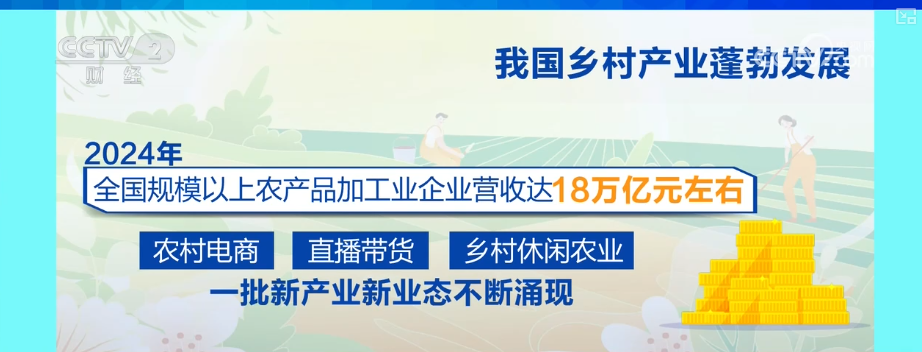
Core Viewpoint - The article highlights the significant improvements in rural livelihoods and the development of rural industries in China, driven by the comprehensive promotion of rural revitalization initiatives. Group 1: Rural Economic Development - In 2024, the revenue of large-scale agricultural processing enterprises in China reached approximately 18 trillion yuan, with new business models such as rural e-commerce and live streaming sales emerging [3] - The revenue from leisure agriculture in 2024 was nearly 900 billion yuan, an increase of about 50 billion yuan compared to 2020 [3] Group 2: Income Growth - The per capita disposable income of rural residents increased from 17,131 yuan in 2020 to 23,119 yuan in 2024, a rise of 5,988 yuan, averaging an increase of nearly 1,500 yuan per year [5] Group 3: Infrastructure and Living Conditions - Rural infrastructure has seen significant improvements, with the total length of rural roads exceeding 4.64 million kilometers and the coverage of tap water reaching 94% [8] - The rural sanitation toilet coverage rate is approximately 76%, and 140,000 villages have undergone greening and beautification [8] Group 4: Healthcare Improvements - Since the 14th Five-Year Plan, healthcare accessibility has improved, with 2,199 counties and districts establishing integrated medical communities, and 95% of village clinics included in the medical insurance system [11] Group 5: Cultural and Recreational Development - The economic development in villages has allowed residents to engage in various cultural activities, with the village of Dahu Chenjia in Shandong integrating agriculture, culture, and tourism, generating over 20 million yuan in annual tourism revenue [15][23] Group 6: Agricultural Production and Innovation - In Shandong's Zhaoyuan, the apple planting area is 190,000 acres, with an annual production of about 690,000 tons, while also developing brands for grapes and autumn pears to increase farmers' income [23] - The introduction of new apple varieties and technologies in collaboration with the Chinese Academy of Agricultural Sciences has significantly improved planting efficiency [24] - The use of smart agricultural management platforms in grape cultivation has led to over 10% yield increase and substantial savings in fertilizer and water [28] Group 7: Future Projections - The total apple production in Shandong is expected to slightly increase by 2025, with an anticipated 10% increase in income per acre from integrated processing and leisure picking of fruits [30]
“粮食安全看山东”之保龄宝公司:小玉米造就中国功能糖产业领军者
Zhong Guo Fa Zhan Wang· 2025-09-24 05:35
Group 1 - The company, Baolingbao Biotech Co., Ltd., established in 1997, specializes in the production of functional sugar products using corn as raw material and has become a leader in China's functional sugar industry [1] - The company has a comprehensive production capacity of over 1 million tons, with 16 production lines and a workforce of approximately 1,400 employees [1] - Baolingbao is recognized as a national high-tech enterprise and has been the first in China to achieve industrial-scale production of oligosaccharides [1] Group 2 - The company has implemented a rigorous grain safety management system to ensure the quality and safety of corn supply, with a planned storage of 320,000 tons of corn in 2024, averaging 1,000 tons per day [2] - The procurement process is transparent, utilizing mobile apps and WeChat mini-programs to publish purchasing information and ensure timely payment to farmers [2] - The company monitors market prices dynamically to ensure reasonable procurement prices and protect farmers' interests [2] Group 3 - The company has increased investment in storage facilities, with 13 grain storage units and a total storage capacity of 80,000 tons [3] - New storage facilities are equipped with intelligent systems for real-time monitoring of temperature, humidity, and grain conditions, enhancing operational efficiency [3] - Upgrades to existing storage facilities are ongoing to improve automation and smart technology [3] Group 4 - The company focuses on innovation in deep processing of corn, extending the value chain from starch to functional sugars and high-value products [4] - Recent product developments include erythritol, allulose, and DHA, contributing to significant value addition and economic benefits [4] - The company's efforts in deep processing not only enhance its economic performance but also support local agricultural development and food security [4]

养殖油脂产业链日报策略报告-20250924
Fang Zheng Zhong Qi Qi Huo· 2025-09-24 05:22
Report Industry Investment Rating No relevant information provided. Report's Core View - **Soybean Oil**: The intraday soybean oil futures price dropped significantly due to Argentina's decision to cancel export taxes on soybeans, soybean meal, and soybean oil before October 31. With sufficient domestic supply and the fermentation of negative news, the price has a technical breakdown. It is expected to fluctuate widely in the near term. The Y2601 contract is recommended for temporary observation, with support at 7950 - 8000 yuan/ton and resistance at 8330 - 8350 yuan/ton [3]. - **Rapeseed Oil**: China's temporary anti - dumping measures on Canadian rapeseed imports may reduce Canadian rapeseed purchases. Russian/Dubai rapeseed oil and Australian rapeseed imports can partially compensate. If Canadian rapeseed imports are significantly reduced, domestic rapeseed oil will continue the de - stocking process. It is recommended to go long with a light position, with support at 9655 - 9698 and resistance at 10300 - 10333 [3]. - **Palm Oil**: Argentina's temporary cancellation of export taxes on soybeans and their derivatives brings cost - side negatives. Combined with phased sales pressure, the oil and oilseed sector has a need for a bearish adjustment. Although Malaysian palm oil production in September 1 - 20 decreased, exports increased, and there is no obvious inventory accumulation pressure. Indonesia may increase the mandatory palm oil blending ratio in biodiesel. It is expected to have a bearish adjustment, with support at 8756 - 8800 and resistance at 9570 - 9590 [4]. - **Soybean Meal and Soybean No. 2**: Due to Argentina's cancellation of export taxes and potential delays in biofuel rules, with high domestic inventories and negative news, the prices are expected to be weak in the near term. It is recommended to exit long positions in the main contracts [5]. - **Rapeseed Meal**: With the expected increase in Canadian rapeseed production, the price of rapeseed at the origin is under pressure. If Canadian rapeseed imports are significantly reduced, domestic rapeseed meal may have a de - stocking expectation. It is expected to have a bearish adjustment, with support at 2300 - 2365 and resistance at 2552 - 2572 [6]. - **Corn and Corn Starch**: The external market has both positive and negative factors, and the domestic market is in a game between low - channel inventory procurement enthusiasm and seasonal pressure. The 11 - contract is expected to continue to find the bottom. Options strategies such as selling wide - straddle combinations or out - of - the - money call options are recommended [7]. - **Soybean No. 1**: With the new domestic soybeans gradually coming onto the market and Argentina's export tax cancellation, the price is under pressure. It is recommended to hold short positions, with resistance at 3950 - 4000 yuan/ton and support at 3800 - 3830 yuan/ton [8]. - **Peanut**: With an expected increase in production and a decrease in planting costs, there is seasonal supply pressure. However, the futures price has partially reflected the increase in production, and Mid - Autumn Festival stocking has boosted demand. It is expected to fluctuate in the short term, with support at 7500 - 7510 and resistance at 8020 - 8162 [9]. - **Live Pig**: The futures price is in a process of finding the bottom. It is recommended to wait for capacity reduction to be confirmed and then consider buying at low prices. Cautious investors can hold long - short spreads, and it is advisable to wait and see for single - side trading [10]. - **Egg**: The futures price has fallen below historical lows. It is not recommended to chase short positions. Cautious investors can wait and see, while aggressive investors can consider buying the 2511 contract at low prices, with a reference range of 3000 - 3200 points [10]. Summary by Relevant Catalogs First Part: Sector Strategy Recommendation 1. Market Judgment - Various varieties in the feed, livestock, and oil sectors are analyzed, including their market logic (supply - demand), support and resistance levels, market trends, and reference strategies. For example, the soybean No. 1 11 - contract is expected to fluctuate bearishly, and it is recommended to hold short positions [13]. 2. Commodity Arbitrage - Cross - period and cross - variety arbitrage strategies for different sectors are provided, including reference strategies and target levels. For example, for the 01 - contract soybean oil - palm oil spread, a bearish operation is recommended [15]. 3. Basis and Spot - Futures Strategies - Spot prices, price changes, and basis changes of different varieties in each sector are presented [16]. Second Part: Key Data Tracking Table 1. Oil and Oilseed - **Daily Data**: Import costs of soybeans, rapeseeds, and palm oil from different origins and shipping periods are provided, including arrival premiums, CBOT or ICE futures prices, CNF prices, and arrival - duty - paid prices [17]. - **Weekly Data**: Inventory and operating rates of various oil and oilseed products are given, such as soybean port inventory, soybean meal factory inventory, etc. [19]. 2. Feed - **Daily Data**: Import costs of corn from Argentina and Brazil in different months are presented [19]. - **Weekly Data**: Consumption, inventory, operating rates, and other data of corn and corn starch in deep - processing enterprises are provided [20]. 3. Livestock - **Daily Data**: Spot prices, price changes, and other data of live pigs and eggs in different regions are given [21][22]. - **Weekly Data**: Key weekly data of live pigs and eggs, including prices, costs, profits, inventory, and sales, are provided [23][25]. Third Part: Fundamental Tracking Charts - **Livestock (Live Pigs and Eggs)**: Charts show the closing prices of live pig and egg futures contracts, spot prices, and related prices such as piglet prices and chicken fry prices [28][29]. - **Oil and Oilseed**: - **Palm Oil**: Charts display Malaysian palm oil production, exports, inventory, import profits, and domestic inventory and trading volume [37][38]. - **Soybean Oil**: Charts show US soybean crushing volume, soybean oil inventory, domestic soybean oil factory operating rates, and inventory [45][46]. - **Peanut**: Charts present peanut arrival and shipment volumes, processing profits, and inventory [54][57]. - **Feed**: - **Corn**: Charts show corn futures and spot prices, inventory, import volume, and processing profits [60][64]. - **Corn Starch**: Charts display corn starch futures and spot prices, operating rates, and inventory [67][68]. - **Rapeseed**: Charts show rapeseed meal and rapeseed oil spot prices, inventory, and basis [70][74]. - **Soybean Meal**: Charts present US soybean growth indicators, domestic inventory, basis, and spreads [77][89]. Fourth Part: Feed, Livestock, and Oil Options Situation - Charts show the historical volatility of various products such as rapeseed meal, rapeseed oil, and soybean oil, as well as the trading volume, open interest, and put - call ratio of corn options [92][93]. Fifth Part: Feed, Livestock, and Oil Warehouse Receipt Situation - Charts display the warehouse receipt situations of various products such as rapeseed meal, rapeseed oil, and soybean oil, as well as the futures warehouse receipt volume and open interest of corn, live pigs, and eggs [95][96].
福建:地标产品走向全国
Jin Rong Shi Bao· 2025-09-24 03:39
Core Insights - The launch of a financial empowerment initiative for geographical indication products in Fujian aims to enhance market competitiveness and brand influence while supporting rural revitalization [1][2] Group 1: Financial Empowerment and Support - Fujian province is actively promoting financial support for geographical indication industries by encouraging banks and insurance institutions to innovate specialized credit products and explore insurance options [2] - A financial cooperation framework has been established between the Minhou Olive Industry Association and China Bank, with a credit line of 1 billion yuan allocated to support the geographical indication industry [2] - As of now, banks in Fujian have provided loans totaling 65.1 billion yuan to 480 geographical indication-related industries, with trademark pledge loans amounting to 1.003 billion yuan [3] Group 2: Technological Integration and Digital Transformation - The initiative emphasizes the integration of technology with financial services, including the use of data analytics and intelligent systems to enhance risk decision-making for geographical indication products [3] - The application of blockchain and IoT technologies in the traceability system for geographical indication products aims to build consumer trust and enhance purchasing willingness [4] - Digital transformation is being embraced across the entire geographical indication industry ecosystem, with recent e-commerce events showcasing local products through live streaming [3][4] Group 3: Market Impact and Consumer Engagement - The geographical indication products in Fujian, such as Minhou olives, have significant market value, with the brand value of "Minhou Olive" estimated at nearly 1.3 billion yuan [1] - The introduction of a traceability system using QR codes on product packaging enhances consumer confidence and willingness to purchase [4] - The initiative aims to leverage agricultural big data to analyze consumer preferences and regional demands, facilitating precise matching between production and sales [4]
商品日报20250924-20250924
Tong Guan Jin Yuan Qi Huo· 2025-09-24 02:32
1. Report Industry Investment Rating No relevant content provided. 2. Core Views of the Report - Overseas, Powell mentioned that there are risks of rising inflation and falling employment, and the Fed needs to balance. The US September PMI was in line with expectations, with stocks adjusting, the dollar index fluctuating weakly, gold hitting a new high, and oil prices rising due to supply disruptions. Domestically, the stock, bond, and commodity markets all adjusted on Tuesday. The stock market is expected to continue to fluctuate, and the bond market is in a wait - and - see state with limited allocation space. [2][3] - Precious metals continued to rise, driven by factors such as the Fed's expected interest rate cut, geopolitical risks, a weak dollar, and the repair of the gold - silver ratio. They may show a volatile trend in the short term. [4] - Copper prices are expected to remain stable and volatile in the short term, with limited downward adjustment space, considering the Fed's policy stance and fundamental factors. [6][7] - Aluminum is expected to have a slow adjustment in the short term, with limited downside space, as market sentiment is cautious and fundamentals show improving consumption. [8][10] - Alumina continues to be weak, dominated by supply - side pressure. [11] - Zinc prices are expected to continue to trade in a narrow range at a low level, with limited downward adjustment space, as the market stabilizes and short - term consumption is disrupted by weather. [12] - Lead prices may decline as supply is expected to increase, although short - term support from pre - holiday stocking exists. [13][14] - Tin prices will maintain a high - level volatile trend, with their movement following market sentiment, as the raw material supply and demand contradiction is not significantly improved. [15] - Industrial silicon is expected to have a weak and volatile trend, considering supply growth and demand - side factors. [16][17] - Lithium carbonate prices are oscillating as the market is avoiding policy risks, although there are signs of marginal improvement in fundamentals. [18][19] - Nickel prices are fluctuating with limited driving factors, and the short - term trend may be adjusted under technical guidance. [20][21] - Oil prices are expected to be volatile in the short term, with a clear long - term downward trend due to supply surplus, but geopolitical factors are causing short - term disruptions. [22][23] - For soda ash and glass, the fundamentals are stable, and there are opportunities in the price spread. [24] - Steel prices are expected to oscillate and adjust as spot trading is poor. [25] - Iron ore prices are expected to maintain a high - level volatile trend, with supply and demand factors affecting the market. [26] 3. Summary According to Relevant Catalogs 3.1 Macro - Overseas: Powell stated that inflation and employment risks coexist, and the Fed's decision - making is not driven by political factors. The US September S&P manufacturing and services PMI were in line with expectations, both in the expansion range. Stocks adjusted, the dollar index was weak, gold reached a new high, and oil prices rose. [2] - Domestic: The stock, bond, and commodity markets adjusted on Tuesday. The stock market is expected to continue to fluctuate, and the bond market is in a wait - and - see state. The 10Y and 30Y interest rates rose to 1.79% and 2.09% respectively. [3] 3.2 Precious Metals - COMEX gold futures rose 0.58% to $3796.9 per ounce, and COMEX silver futures rose 0.12% to $44.265 per ounce. Driven by multiple factors, precious metals are expected to maintain a strong performance in the long term but may show a volatile trend in the short term. [4][5] 3.3 Copper - Shanghai copper's main contract had a narrow - range oscillation, and LME copper hovered around the $10,000 mark. Considering the Fed's policy and fundamentals, copper prices are expected to remain stable and volatile in the short term, with limited downward adjustment space. [6][7] 3.4 Aluminum - Shanghai aluminum's main contract closed at 20,685 yuan per ton, down 0.41%. Due to market caution and improving fundamentals, it is expected to have a slow adjustment in the short term, with limited downside space. [8][10] 3.5 Alumina - The futures main contract closed at 2877 yuan per ton, down 1.94%. With supply pressure, it continues to be weak. [11] 3.6 Zinc - Shanghai zinc's main contract had an intraday decline and a night - session sideways movement. Affected by weather and market sentiment, it is expected to continue to trade in a narrow range at a low level, with limited downward adjustment space. [12] 3.7 Lead - Shanghai lead's main contract declined. With the expected increase in supply, lead prices may decline after the pre - holiday stocking phase. [13][14] 3.8 Tin - Shanghai tin's main contract had a high - level volatile trend. Although consumption improvement is limited, the raw material supply and demand contradiction supports tin prices, and its movement follows market sentiment. [15] 3.9 Industrial Silicon - The main contract of industrial silicon declined. With supply growth and demand - side factors, it is expected to have a weak and volatile trend. [16][17] 3.10 Lithium Carbonate - Lithium carbonate prices oscillated. Although there are signs of marginal improvement in fundamentals, the market is avoiding the risk of the September 30 lithium mine ruling. [18][19] 3.11 Nickel - Nickel prices fluctuated. With limited driving factors and unclear disturbances from Indonesian mine suspensions, the short - term trend may be adjusted under technical guidance. [20][21] 3.12 Crude Oil - Oil prices had a night - session gap - up opening. In the short term, they are expected to be volatile due to geopolitical factors, while in the long term, a downward trend is clear due to supply surplus. [22][23] 3.13 Soda Ash and Glass - The soda ash main contract oscillated, and the glass main contract was slightly stronger. The fundamentals are stable, and there are opportunities in the price spread. [24] 3.14 Steel (Screw and Coil) - Steel futures oscillated and declined slightly. With poor spot trading, prices are expected to oscillate and adjust. [25] 3.15 Iron Ore - Iron ore futures oscillated and adjusted. With supply and demand changes, it is expected to maintain a high - level volatile trend. [26] 3.16 Metal Main Varieties Trading Data - The report provides trading data for various metals such as copper, aluminum, zinc, etc., including closing prices, price changes, trading volumes, and positions on September 23. [27] 3.17 Industrial Data Perspective - It presents detailed industrial data for metals such as copper, nickel, zinc, etc., including inventory, spot quotes, and price differentials on September 23 and September 22. [29][33]
海南农民别样形式“晒”丰收
Zhong Guo Xin Wen Wang· 2025-09-24 02:30
Core Points - The 2025 China Farmers' Harvest Festival celebration in Hainan featured unique activities such as showcasing local specialties, participating in fun sports events, and singing harvest songs to celebrate agricultural achievements and share joy [1][2]. Group 1: Event Highlights - The main venue in Danzhou showcased a variety of activities, including a display of Hainan's intangible cultural heritage and an exhibition of the "Party Building + Industry Chain" interactive model, highlighting innovative practices in Hainan's tropical efficient agriculture [2]. - The fun sports event included local-themed competitions such as "catching Danzhou chicken," "Haitou sweet potato obstacle relay," and "competing for Danzhou dried fish," emphasizing teamwork and local culture [5]. - The harvest song event featured performances that celebrated local culture, including a mix of lion dance, calligraphy, and product displays, culminating in a performance by the national-level intangible cultural heritage group, showcasing the vibrant spirit of Hainan's farmers [7].
棕榈油:原油反弹,国际油脂存在支撑,豆油:阿根廷取消豆类出口税,美豆偏弱震荡
Guo Tai Jun An Qi Huo· 2025-09-24 01:32
Report Summary 1) Report Industry Investment Rating No relevant content provided. 2) Core Viewpoints - Crude oil rebound provides support for international oils and fats [1] - Argentina's cancellation of the export tax on beans leads to a weak and volatile trend in US soybeans [1] 3) Summary by Related Catalogs Fundamental Tracking - **Futures Prices**: Palm oil reached 9,054 yuan/ton (down 3.27% during the day, up 0.27% at night); soybean oil hit 8,086 yuan/ton (down 3.35% during the day, up 0.17% at night); rapeseed oil stood at 9,996 yuan/ton (down 1.45% during the day, down 0.77% at night); Malaysian palm oil was 4,341 ringgit/ton (down 2.27% during the day, up 0.23% at night); CBOT soybean oil was 49.84 cents/pound (up 0.30%) [2] - **Trading Volume and Open Interest**: Palm oil's trading volume was 1,021,148 lots (an increase of 459,441 lots), and open interest was 387,927 lots (a decrease of 15,956 lots); soybean oil's trading volume was 817,864 lots (an increase of 527,798 lots), and open interest was 545,909 lots (a decrease of 23,441 lots); rapeseed oil's trading volume was 419,360 lots (an increase of 143,932 lots), and open interest was 328,042 lots (a decrease of 38,435 lots) [2] - **Spot Prices**: 24 - degree palm oil in Guangdong was 8,920 yuan/ton (down 350 yuan/ton); first - grade soybean oil in Guangdong was 8,390 yuan/ton (down 320 yuan/ton); fourth - grade imported rapeseed oil in Guangxi was 9,980 yuan/ton (down 160 yuan/ton); Malaysian palm oil FOB was 1,105 dollars/ton (up 5 dollars/ton) [2] - **Basis**: Palm oil in Guangdong was - 134 yuan/ton; soybean oil in Guangdong was 304 yuan/ton; rapeseed oil in Guangxi was - 16 yuan/ton [2] - **Price Spreads**: The spread between rapeseed oil and palm oil futures was 942 yuan/ton; the spread between soybean oil and palm oil futures was - 968 yuan/ton; the 1 - 5 spread of palm oil was 198 yuan/ton; the 1 - 5 spread of soybean oil was 238 yuan/ton; the 1 - 5 spread of rapeseed oil was 529 yuan/ton [2] Macro and Industry News - **Malaysian Palm Oil**: MPOC expects Malaysia's palm oil inventory to rise slightly from September to October and start to decline in November. The production in Sabah and Sarawak has not reached the seasonal peak, and the reserve is still within a controllable range [3] - **Indonesian Palm Oil Producer**: Agrinas Palma Nusantara aims for a crude palm oil production of 415,000 tons in 2025 and 1.07 million tons in 2026 [5] - **Indonesia - EU Agreement**: Indonesia and the EU signed the Comprehensive Economic Partnership Agreement, which is expected to benefit Indonesia's palm oil and other exports [5] - **Pakistan's Soybean Import**: Pakistani importers purchased about 180,000 tons of soybeans in September, with shipments expected from the US in January 2026 [5] - **Indian Crop Outlook**: India's 2025/26 monsoon - season food production is expected to exceed the target. Oilseeds and pulses are also optimistic despite reduced planting areas [6] - **EU's Oil and Fat Imports**: As of September 21, the EU's 2025/26 palm oil imports were 600,000 tons (compared to 800,000 tons last year), soybean imports were 2.86 million tons (compared to 2.98 million tons last year), soybean meal imports were 4.01 million tons (compared to 4.16 million tons last year), and rapeseed imports were 790,000 tons (compared to 1.22 million tons last year) [6] - **EU's Anti - Deforestation Regulation**: The EU will postpone the implementation of the anti - deforestation regulation for the second time to solve IT system problems [7] Trend Intensity - Palm oil's trend intensity is 0, and soybean oil's trend intensity is 0, indicating a neutral stance [8]