
稀土

Search documents
稀土战略价值地位凸显,稀土ETF嘉实(516150)连续5日获资金净流入近30亿元!
Xin Lang Cai Jing· 2025-10-17 02:33
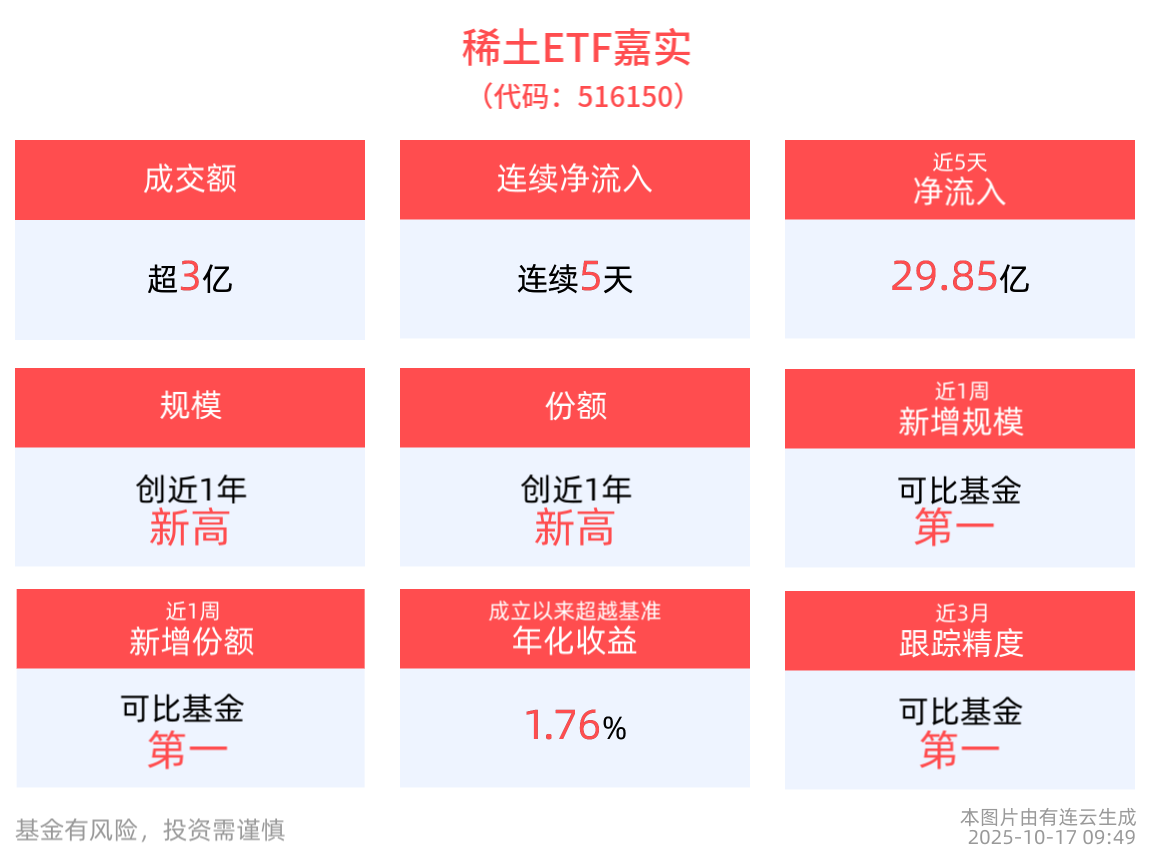
Core Viewpoint - The rare earth industry is experiencing fluctuations in stock performance, with significant movements in the ETF market and new regulatory measures enhancing the strategic value of rare earth elements [1][2][3]. Group 1: Market Performance - As of October 17, 2025, the China Rare Earth Industry Index decreased by 0.08%, with stocks showing mixed results; Shengxin Lithium Energy led with a 6.22% increase, while Galaxy Magnetic Materials saw the largest decline [1]. - The rare earth ETF managed by Harvest (516150) is showing positive momentum, with a trading volume of 3.99 billion yuan and a turnover rate of 3.7% [2]. - The latest scale of the Harvest Rare Earth ETF reached 106.63 billion yuan, marking a new high since its inception and ranking first among comparable funds [2]. Group 2: Fund Performance - The Harvest Rare Earth ETF has seen continuous net inflows over the past five days, with a peak single-day net inflow of 1.184 billion yuan, totaling 2.985 billion yuan [2]. - Over the past year, the net value of the Harvest Rare Earth ETF has increased by 96.96%, ranking 8th out of 3069 index equity funds, placing it in the top 0.26% [2]. - Since its inception, the ETF has recorded a maximum monthly return of 41.25% and an average monthly return of 10.78% during rising months [2]. Group 3: Regulatory Environment - Recent announcements from the Ministry of Commerce regarding export controls on rare earth-related technologies highlight the strategic importance of rare earths [2]. - The release of four policy documents aims to strengthen the management of the rare earth industry, including stricter controls on processing equipment and raw materials [3]. - New regulations expand the scope of export controls to include additional rare earth elements and require export licenses for products containing Chinese-origin rare earth materials [3].




稀土行业周刊:中国政府实施稀土出口管制,加快产业链技术攻关
Chan Ye Xin Xi Wang· 2025-10-17 01:24
Key Events - Brazil is advancing its rare earth reserve plan, with the São Paulo government announcing the launch of its first rare earth and critical mineral processing plant, which aims to utilize billions of dollars in business potential and reduce reliance on external suppliers [1] - Pensana has completed preliminary drilling at the Coola carbonatite, located approximately 30 kilometers north of its flagship Longonjo rare earth project, marking an important milestone in evaluating the area's potential [2][4] - WA1 Resources announced high-grade mineralization results from its Luni project in Western Australia, with significant niobium grades reported [13][14] - Lynas Rare Earths and Noveon Magnets signed a preliminary agreement to develop a permanent magnet supply chain in the U.S., with Lynas constructing a processing plant in Texas [22][25] - The U.S. government is reportedly interested in acquiring a stake in the Tanbreez rare earth project in Greenland, which is one of the largest rare earth deposits globally [28][30] - Momentum Technologies has launched commercial recycling of rare earth elements from magnetic scrap and tailings at its Texas facility, marking a significant step in enhancing U.S. rare earth supply [33] - Aldoro Resources has begun exploration for rare earth elements in Namibia, potentially confirming a new REE-Nb discovery [34][35] - The Chinese Ministry of Commerce announced export controls on certain rare earth-related items, including equipment and technologies [36][38] Company Highlights - Northern Rare Earth plans to adjust its rare earth concentrate trading price to 26,200 yuan per ton for Q4 2025, reflecting a 37% increase from the previous quarter [65] - Jilin Permanent Magnet's net profit for the first three quarters of 2025 is expected to increase by 157% to 179% year-on-year [66] - Northern Rare Earth anticipates a net profit increase of 272.54% to 287.34% for the first three quarters of 2025 [67] Industry Developments - The establishment of the Rare Earth Industry Collaborative Innovation Network in Baotou aims to enhance resource integration and technological innovation in the rare earth sector [74] - Jiangxi University of Science and Technology has launched three innovation centers focused on rare earth and critical minerals, aiming to strengthen research and development capabilities [75]


稀土之战:中国手中这张“泥巴牌”,威力有多大?
Sou Hu Cai Jing· 2025-10-16 23:18
Core Viewpoint - The recent easing of tensions in the US-China trade war, particularly regarding rare earth exports, highlights the strategic leverage China holds in the global market, raising questions about how long this leverage can last [1]. Group 1: Understanding Rare Earths - Rare earths refer to a group of 17 chemical elements essential for modern industry, despite their name suggesting scarcity [3]. - These elements are crucial for various applications, categorized into three types based on their uses [4]. - China is the only country capable of completing the entire production process of rare earths, from mining to manufacturing [5]. Group 2: China's Control Measures - In April, China implemented export licensing for seven types of medium and heavy rare earths, critical for military and semiconductor industries [7]. - By October, China expanded its control to include five additional types of medium and heavy rare earths and imposed restrictions on 26 types of related equipment and materials [8]. - This signifies a comprehensive control from raw materials to equipment [9]. Group 3: The Value of Rare Earths - Rare earths are not merely cheap commodities; they are considered "technology goods" due to their minimal cost impact on final products [13]. - The true dependency of Western industries on China lies in the complete supply chain, which includes complex processes that are difficult to replicate [14][15]. Group 4: Challenges for the US - The US has initiated plans to reduce reliance on Chinese rare earths, but current capabilities are limited, with 90% of mined materials still needing to be sent to China for processing [23]. - The only US rare earth miner, MP Materials, aims to establish a complete supply chain by 2026, but this is just the beginning of a long process [25]. Group 5: Future of China's Rare Earth Leverage - In the short term, China holds a strategic advantage, as the US will require at least five years to establish an alternative supply chain [26]. - Long-term challenges include Western nations accelerating their decoupling efforts, forming alliances to create alternative supply routes, and potential domestic economic impacts on China's rare earth industry [28]. - The recent easing of export restrictions suggests a strategic approach to maintain balance without severing ties completely [29]. Group 6: Conclusion on Global Supply Chains - The ongoing rare earth conflict reflects a broader supply chain restructuring, emphasizing the risks of single-source dependencies [32]. - Historical patterns indicate that no single entity can maintain a monopoly over critical industrial resources indefinitely [32].
关注黄金及稀土磁材龙头企业
Sou Hu Cai Jing· 2025-10-16 23:08
Group 1: Industry Performance - The non-ferrous metal industry has shown significant performance, with the Shenwan Non-ferrous Metal Index rising 74% year-to-date as of October 14, compared to an 18% increase in the CSI 300 Index, making it the top-performing sector among Shenwan's primary industries [1] - Key sectors driving this growth include gold, rare earths, and minor metals [1] Group 2: Gold Market Insights - The Federal Reserve has initiated a rate-cutting cycle, with the federal funds target rate decreasing from 5.25%-5.5% to below 4.5%, and further cuts are expected, which will support gold prices [2] - Recent gold prices have surpassed $4,100 per ounce, with historical data indicating that during the last rate-cutting cycle (2019), gold prices increased by over 40% [2] - The current rate-cutting space is larger than the previous cycle, suggesting a high probability of sustained high gold prices [2] Group 3: Economic Indicators - The U.S. economy is showing signs of pressure, with a decrease of 32,000 in ADP employment numbers for September, marking the largest decline since March 2023 [3] - The Consumer Price Index (CPI) data aligns with market expectations, indicating stable inflation rates, which may influence the Fed's decision to continue rate cuts [3] - The ongoing rate cuts are expected to provide strong support for gold prices amid economic pressures [3] Group 4: Central Bank Gold Purchases - Global central banks have continued to increase gold reserves, with a net addition of 22 tons in June 2025, marking the third consecutive month of slight increases [3] - China's central bank has also increased its gold reserves to 7.406 million ounces as of September 2025, continuing a trend of monthly increases for 11 months [3] Group 5: Rare Earth Export Controls - China has intensified export controls on rare earth materials, with new regulations requiring export licenses for certain items containing Chinese components, particularly for military and advanced technology applications [5] - The new regulations will take effect immediately for items originating from China and from December 1 for other items, highlighting the strategic importance of rare earths [5] Group 6: Rare Earth Supply and Demand - China holds over 50% of global rare earth reserves and produces over 70% of the total, with supply largely regulated by government-issued separation and smelting quotas [6] - Demand for rare earths is expected to grow significantly in the next three years, particularly in the electric vehicle sector, with projected growth rates of approximately 25% [6] - The humanoid robot sector is anticipated to be a new growth point for rare earth demand, with a projected compound annual growth rate exceeding 150% [6] Group 7: Investment Summary - The rare earth industry is characterized by tight supply and promising demand prospects, with current prices at historical averages and potential for upward movement [7] - It is recommended to focus on leading companies in the rare earth magnet sector [7]
三季报披露窗口来临公募机构提前入驻绩优股
Zhong Guo Zheng Quan Bao· 2025-10-16 20:12
Core Viewpoint - The A-share market is currently in the disclosure window for Q3 2025 financial reports, with many companies reporting significant net profit growth for the first three quarters of the year, attracting substantial investments from public funds [1][2]. Company Performance - Several companies have reported positive earnings forecasts, with Guanghua Technology and Daoshi Technology both seeing net profit growth exceeding 100% year-on-year for Q3 2025 [2]. - Xian Da Co., a herbicide manufacturer, is expected to achieve a net profit of between 180 million to 205 million yuan, representing a year-on-year increase of 2807.87% to 3211.74% [2]. - Other companies with significant expected net profit growth include Chuanjiang New Materials and Yinglian Co., both involved in new materials, with expected growth rates exceeding 1000% [2]. Net Profit Scale - Xinhua Insurance and Luxshare Precision are projected to have net profits exceeding 10 billion yuan for Q3 2025, with Xinhua Insurance estimating a profit of 29.986 billion to 34.122 billion yuan, a year-on-year increase of 45% to 65% [3]. - Luxshare Precision expects a net profit of 10.890 billion to 11.344 billion yuan, reflecting a growth of 20% to 25% [3]. - Other companies like Yilake Co., Shandong Gold, and Dongwu Securities also anticipate net profits exceeding 1 billion yuan [3]. Fund Investment Trends - High-performing companies have seen significant stock price increases, with Zhenyu Technology's stock rising over 240% year-to-date, and Northern Rare Earth's stock increasing over 150% [3]. - Public funds have heavily invested in these companies, with 96 fund companies holding Northern Rare Earth and 68 holding Zhenyu Technology as of mid-year [3][4]. - Xian Da Co. and Yinglian Co. are also popular among public funds, with 19 and 17 fund companies holding their stocks, respectively [4]. Market Outlook - The market is expected to continue its upward trend, supported by the influx of incremental capital and the anticipated rebound in earnings growth across various sectors due to low performance bases from the previous year [5]. - Investment strategies suggest focusing on sectors benefiting from "anti-involution" policies, such as new energy, steel, and non-ferrous metals, as well as growth sectors like AI computing and semiconductors [6].




稀土上市公司前三季业绩大涨 广晟有色预计扭亏为盈
Zheng Quan Shi Bao· 2025-10-16 18:41
Core Viewpoint - The overall performance of companies in the rare earth industry is significantly improving, driven by rising market prices and effective management strategies. Group 1: Company Performance - Guangsheng Nonferrous (600259) expects a net profit attributable to shareholders of 100 million to 130 million yuan for the first three quarters of 2025, an increase of 376 million to 406 million yuan compared to the same period last year [1] - The company reported a total profit of -352 million yuan and a net profit attributable to shareholders of -276 million yuan in the same period last year [1] - The company focuses on rare earth mining, smelting separation, deep processing, and non-ferrous metal trading, aiming to build a complete rare earth industry chain [1] Group 2: Reasons for Performance Increase - Guangsheng Nonferrous attributes its performance increase to the overall rise in the rare earth market, scaling up production, and enhancing marketing strategies [2] - The company has also focused on managing loss-making enterprises and optimizing trade structures, leading to increased profitability [2] Group 3: Industry Trends - Shenghe Resources (600392) anticipates a net profit of 740 million to 820 million yuan for the first three quarters, representing a year-on-year increase of 696.82% to 782.96% [3] - The company has developed a complete industrial chain for rare earths and is benefiting from favorable market conditions and improved product pricing [3] - Northern Rare Earth (600111) expects a net profit of 1.51 billion to 1.57 billion yuan, reflecting a year-on-year increase of 272.54% to 287.34% [4]

为啥有人说稀土牌只能用一次,之后想再用的可能性就不大了?
Sou Hu Cai Jing· 2025-10-16 17:54
Core Viewpoint - The article argues that China's control over rare earth elements is not a one-time strategy but a long-term, evolving approach that enhances its position in the global supply chain [1][11]. Group 1: Historical Context and Current Dynamics - In 2010, China limited rare earth exports to Japan, leading to Japan's increased dependency on China, which rose from 90% to 98% by 2025 [3]. - China's strategy involves not just resource management but also institutional capability, as seen in the consolidation of rare earth groups and stricter export regulations [3][5]. Group 2: Industry Capabilities - China dominates the global rare earth market, accounting for 60% of production and 90% of refining capabilities, highlighting its comprehensive industry chain from mining to end-use applications [5]. - The article emphasizes that the real strength lies in China's ability to manage the entire supply chain rather than just mining [5][9]. Group 3: International Relations and Supply Chain Strategy - The concept of a "moral alliance" among Western countries is questioned, as their reliance on Chinese high-purity rare earths contradicts their political rhetoric [7]. - China's new regulations requiring permits for overseas use of its rare earths signify a shift from merely controlling exports to managing technology pathways and end products [7][9]. Group 4: Market Implications and Future Outlook - The article suggests that China's rare earth strategy is not about imposing export bans but about reshaping the global market to compel foreign companies to collaborate with Chinese firms [9][11]. - The ongoing evolution of China's rare earth strategy indicates that it is not a finite resource but a continuously developing asset that strengthens China's market position [11][13].
稀土管制:卡住全球半导体与军工命脉的战略博弈
材料汇· 2025-10-16 15:28
Core Viewpoint - The article discusses China's strict export controls on rare earth elements, which are crucial for the semiconductor and military industries, highlighting the strategic implications for global supply chains and the competitive landscape between China and the U.S. [2][4][17] Semiconductor Industry - The semiconductor industry is heavily reliant on rare earth elements, with every item on the control list corresponding to critical processes, achieving 100% coverage [6][12]. - Key applications include chemical mechanical polishing (CMP) using high-purity cerium oxide, essential for achieving atomic-level flatness in wafers, with significant implications for chip yield [12][6]. - The EUV lithography machines, vital for advanced chip manufacturing, depend entirely on controlled rare earth materials, with no substitutes available [9][10]. Military Applications - Rare earth elements are termed "war metals" in defense, with 87% of U.S. weapon systems relying on these materials, which lack mature alternatives [17][18]. - The F-35 fighter jet requires 417 kg of rare earth materials, with critical components sourced from China, indicating a significant vulnerability in U.S. military capabilities [19][22]. - The Virginia-class submarines and missile systems also depend on rare earth materials for performance and reliability, underscoring the strategic importance of these resources [24][27]. Domestic Rare Earth Industry - China's rare earth industry is characterized by a complete ecosystem from mining to application, with six major groups controlling over 90% of resources and refining capacity [32][31]. - The industry has seen significant consolidation, enhancing resource utilization and technological collaboration, which supports the effective implementation of export controls [35][34]. Strategic Value of Export Controls - The export controls are not merely supply restrictions but represent a strategic shift from resource-based to value-driven industry leadership, reshaping global supply dynamics [37][36]. - The controls have led to a significant increase in prices and profit margins for domestic rare earth companies, breaking the previous low-price export model [38][39]. Impact on the U.S. - The U.S. faces a critical dependency on China for rare earth imports, with 77% of its supply coming from China, leading to severe supply chain vulnerabilities [43][41]. - Efforts to establish a domestic supply chain for rare earths are hindered by high costs, lengthy approval processes, and technological barriers, making it difficult to replace Chinese sources [44][45]. - The military and semiconductor sectors are experiencing significant operational impacts due to supply shortages, with production capabilities being curtailed [45][41]. Geopolitical Implications - The article emphasizes the ongoing geopolitical struggle over resource sovereignty and technological dominance, with China leveraging its rare earth resources to enhance its strategic position globally [46][48]. - The current situation illustrates that technological advancement alone does not equate to industrial control, as resource advantages combined with regulatory frameworks create a more resilient strategic force [48][47].


大摩闭门会-中美出口管制:策略性升级与市场影响
2025-10-16 15:11
Summary of Conference Call on US-China Export Controls and Market Impact Industry Overview - The discussion primarily revolves around the **US-China trade relations**, focusing on **export controls** and **tariff negotiations** related to **rare earth elements** and **semiconductors** [1][2][3]. Key Points and Arguments 1. **Limited Agreement Possibility**: There is a potential for a limited agreement between the US and China to pause mutual tariffs, but the execution risk is high, and further verbal confrontations are expected [1][2]. 2. **Rare Earth Supply Chain Dynamics**: Both countries maintain a stable balance in the rare earth supply chain, with neither wanting to completely sever ties, despite short-term tensions [1][3]. 3. **China's Export Control Measures**: China has tightened its export controls by adding five new rare earth elements to the list, now totaling 17, and has included semiconductor manufacturing in these controls [1][5]. 4. **US's Competitive Advantage**: The US is actively working to establish alternative rare earth production capabilities, which may enhance its competitive edge [1][3]. 5. **Trade Tensions Impact on Asia**: Ongoing trade tensions are expected to constrain economic growth in Asia, with uncertainty affecting business sentiment and economic cycles [2][13]. 6. **Investor Focus**: Investors should monitor companies' profitability, risk resilience, and dividend yields, as high-quality tech stocks may still hold potential due to the theme of self-sufficiency [2][12]. 7. **Negotiation Outcomes**: The upcoming APEC summit may yield temporary relief measures, but the fragility of these measures is a concern [1][10]. 8. **US Tariff Rates**: As of last week, the US imposed tariffs on China at approximately 40%, with previous rates having escalated to 145% [2][10]. 9. **China's Learning Curve**: China is still developing its export control system, which may lead to over-execution or the provision of exemptions [1][6][8]. 10. **Global Trade Policy Trends**: The control of rare earth resources is likely to influence trade agreements globally, prompting countries like Europe to reassess their dependencies [4][10]. Additional Important Insights - **US Inventory and Economic Impact**: Current US retail sales and inventory data do not indicate significant increases, but the potential for 100% tariffs could disrupt trade severely [10][15]. - **China's Export Growth**: Despite trade tensions, China's export growth remains around 8%, supported by increased exports to regions like India [15]. - **Long-term Economic Outlook**: The uncertainty from export control policy changes poses a significant threat to the business cycle, particularly in Asia, where economic development may be hindered [13][12]. This summary encapsulates the critical aspects of the conference call, highlighting the ongoing complexities in US-China trade relations and their implications for the global market.
外资大行谈中国稀土政策调整:德银看大国博弈,美银看非中供应链替代机会
Zhi Tong Cai Jing· 2025-10-16 14:41
Group 1 - The adjustment of China's rare earth export policy is interpreted as a strategic move in response to U.S. pressure, aiming to gain negotiation leverage in semiconductor discussions [2][3] - The U.S. has expanded export restrictions, which has weakened China's trust in trade negotiations, indicating a potential backlash against U.S. policies [2] - China has linked rare earth controls directly to semiconductor parameters, establishing a negotiation logic of "equivalent exchange" with the U.S. [3] Group 2 - Bank of America predicts a price differentiation trend in rare earths, forecasting that the average price of neodymium-praseodymium will reach $85 per kilogram by the second half of 2025, with significant increases for heavy rare earths by 2030 [4][5] - Non-Chinese rare earth supply chains are considered "scarce assets," with limited companies capable of large-scale production outside of China, leading to a buy rating for Lynas Rare Earths and MP Materials [5] - Lynas Rare Earths is the only company outside China with significant production capacity for both light and heavy rare earths, benefiting from government support and potential valuation increases [5]