石油化工

Search documents
【光大研究每日速递】20251201
光大证券研究· 2025-11-30 23:06
Group 1: Market Strategy - The market is likely still in a bull phase, but may enter a wide fluctuation stage in the short term. Compared to previous bull markets, there is still significant room for index growth, but the duration of the bull market may be more important than the magnitude of the increase due to government guidance on a "slow bull" policy [5][6] - Short-term market catalysts may be lacking, and year-end investor behavior may trend towards caution, leading to a focus on consolidation in the stock market [5] Group 2: Financial Engineering - A-shares experienced a rebound this week, with the ChiNext index leading major broad indices. However, trading volume has decreased, indicating a mismatch between volume and market performance, which may limit the strength of future rebounds [5] - Financing amounts have turned positive this week, but stock-type ETFs continue to see net outflows, suggesting that the rebound may weaken and the market could re-enter a consolidation phase [5] Group 3: Oil and Chemical Industry - The resumption of peace talks between Russia and Ukraine has led to increased volatility in oil prices, although no progress has been made on core issues. OPEC+ is expected to slow down production increases, resulting in low-level fluctuations in oil prices [7] - As of November 28, Brent and WTI crude oil prices were reported at $62.32 and $58.48 per barrel, reflecting changes of -0.3% and +0.9% respectively from the previous week [7] Group 4: Basic Chemicals - A major contract for potash fertilizer was signed at $348 per ton for 2026, maintaining China's position as a "price lowland" globally. This secures winter storage and spring planting needs, reflecting tight supply and demand conditions [8] - From January to October, China imported 9.88 million tons of potassium chloride, with Laos's share increasing to 18%. Chinese enterprises are expanding production capacity in Laos, significantly enhancing China's potash supply capabilities [8] Group 5: Company Performance - Bosideng (3998.HK) reported a revenue of 8.93 billion yuan for the first half of the fiscal year 2026 (April to September 2025), a year-on-year increase of 1.4%. The net profit attributable to shareholders was 1.19 billion yuan, up 5.3% year-on-year [8] - The gross margin slightly increased by 0.1 percentage points, and a decrease in expense ratio contributed to a net profit margin increase of 0.5 percentage points to 13.3% [8]


化工周报:发改委持续推进“反内卷”进程,多地MDI停车检修致价格上涨,钾肥进口大合同同比持稳-20251130
Shenwan Hongyuan Securities· 2025-11-30 14:29
行 业 及 产 业 行 业 研 究 / 行 业 点 评 相关研究 证券分析师 马昕晔 A0230511090002 maxy@swsresearch.com 宋涛 A0230516070001 songtao@swsresearch.com 研究支持 任杰 A0230522070003 renjie@swsresearch.com 赵文琪 A0230523060003 zhaowq@swsresearch.com 邵靖宇 A0230524080001 shaojy@swsresearch.com 周超 A0230525090001 zhouchao@swsresearch.com 李绍程 A0230525070002 lisc@swsresearch.com 联系人 马昕晔 A0230511090002 maxy@swsresearch.com 2025 年 11 月 30 日 发改委持续推进"反内卷"进程, 多地 MDI 停车检修致价格上涨, 钾肥进口大合同同比持稳 看好 ——《化工周报 25/11/24-25/11/28》 本期投资提示: 请务必仔细阅读正文之后的各项信息披露与声明 本研究报告仅通过邮件提 ...

【广发宏观团队】人民币在过去一个月里为何升值加快
郭磊宏观茶座· 2025-11-30 09:16
Group 1 - The rapid appreciation of the RMB in the past month is attributed to domestic economic resilience, a weaker USD, and active domestic capital markets, with the RMB appreciating 1.5% against the USD and 3.6% in offshore markets as of November 28 [1][2] - The RMB's appreciation accelerated in November, driven by a reduction in uncertainty regarding China's export environment following a joint arrangement between China and the US to address trade concerns [1][2] - The "14th Five-Year Plan" emphasizes economic construction and aims for a significant increase in the consumption rate, which positively influences both domestic and foreign expectations for the Chinese economy and RMB assets [2] Group 2 - The fourth week of November saw a rebound in global markets, with the expectation of interest rate cuts leading to a weaker USD, which in turn facilitated a rise in stock and bond markets, as well as the appreciation of the RMB [3][4] - The US stock market showed significant rebounds, with the S&P 500 and Nasdaq rising 3.73% and 4.91% respectively, while the VIX index indicated improved market confidence [4][5] - Commodities, particularly precious metals, benefited from the weaker USD, with gold and silver prices rising significantly, reflecting a strong demand for safe-haven assets [5][6] Group 3 - The US and European bond markets experienced a bullish trend, with the 10-year US Treasury yield dropping below 4%, while the dollar weakened, contributing to the RMB's appreciation [7][8] - The euro gained against the dollar due to easing geopolitical risks, while the Japanese yen remained weak, indicating a divergence in currency performance influenced by regional economic conditions [8][9] Group 4 - Chinese assets across the board rebounded, with technology stocks leading the charge, while trading volumes decreased, indicating a shift in market focus towards technology and cyclical sectors [9][10] - The overall A-share market saw a 2.9% increase, with significant participation from technology and cyclical stocks, while the trading volume showed a decline, suggesting a concentration of investment in fewer stocks [10][11] Group 5 - The recent government initiatives, including the establishment of a dedicated regulatory body for commercial aerospace, aim to enhance the development of strategic emerging industries such as aerospace and new materials [23][24] - The "14th Five-Year Plan" outlines measures to accelerate the growth of strategic emerging industries, with a focus on innovation and large-scale application of new technologies [23][25]

石油化工行业周报第430期(20251124—20251130):地缘缓和预期下油价低位震荡,关注OPEC+产量政策-20251130
EBSCN· 2025-11-30 08:36
2025 年 11 月 30 日 行业研究 地缘缓和预期下油价低位震荡,关注 OPEC+产量政策 ——石油化工行业周报第 430 期(20251124—20251130) 要点 地缘冲突缓和预期走强,本周油价低位震荡。本周俄乌和平谈判重启,地缘 冲突缓和预期驱动油价振荡加剧,但俄乌双方在核心问题的谈判尚未取得进 展,且 OPEC+增产幅度有望放缓,使得本周油价整体呈低位震荡态势。截至 11 月 28 日,布伦特、WTI 原油分别报收 62.32、58.48 美元/桶,较上周收盘 分别-0.3%、+0.9%。 俄乌谈判核心问题仍存分歧,地缘风险有望持续支撑油价。本周美国与乌克 兰代表在日内瓦举行谈判,美国宣布在达成和平协议方面取得巨大进展,使得 市场对俄乌实现和平预期走强,原油的地缘政治溢价下跌。但是,美乌谈判代 表未透露涉及俄乌重大分歧的具体解决方案,包括领土、乌克兰军队规模、乌 克兰加入北约等众多核心问题。截至本周五,谈判尚未取得任何成果。今年以 来美国数次试图调停俄乌冲突,但我们认为目前美、俄、乌、欧四方就俄乌冲 突的核心问题达成一致的可能性较低,俄乌冲突仍存长期化趋势。此外,委内 瑞拉局势紧张程度不断升 ...



【图】2025年9月四川省柴油产量统计分析
Chan Ye Diao Yan Wang· 2025-11-30 02:12
摘要:【图】2025年9月四川省柴油产量统计分析 2025年9月柴油产量统计: 柴油产量:22.8 万吨 同比增长:9.1% 增速较上一年同期变化:低26.7个百分点 据统计,2025年9月四川省规模以上工业企业柴油产量与上年同期相比增长了9.1%,达22.8万吨,增速 较上一年同期低26.7个百分点,增速放缓,增速较同期全国高6.0个百分点,约占同期全国规模以上企业 柴油产量1741.8万吨的比重为1.3%。 详见下图: 图1:四川省柴油产量分月(当月值)统计图 据统计,2025年1-9月,四川省规模以上工业企业柴油产量与上年同期相比增长了10.3%,达183.4万 吨,增速较上一年同期低4.0个百分点,增速放缓,增速较同期全国高12.8个百分点,约占同期全国规模 以上企业柴油产量14691万吨的比重为1.2%。详见下图: 图2:四川省柴油产量分月(累计值)统计图 注:主要能源产品产量月度统计范围为规模以上工业法人单位,即年主营业务收入2000万元及以上的工 业企业。 产业调研网为您提供更多 2025年1-9月柴油产量统计: 柴油产量:183.4 万吨 同比增长:10.3% 增速较上一年同期变化:低4.0个 ...

中石化申请硬碳材料及其制备方法、电池负极和钠离子电池专利
Sou Hu Cai Jing· 2025-11-29 13:20
Core Viewpoint - The State Intellectual Property Office of China has reported that China Petroleum & Chemical Corporation (Sinopec), Sinopec Petroleum and Chemical Research Institute Co., Ltd., and Shanghai Jiao Tong University have applied for a patent titled "A Hard Carbon Material and Its Preparation Method, Battery Anode, and Sodium-Ion Battery" with publication number CN121020544A, filed on May 2024 [1] Group 1 - The patent application involves a hard carbon material and its preparation method, which is relevant for battery anodes and sodium-ion batteries [1] - The method described in the patent includes specific steps, starting with the precursor at a temperature T [1]
航油“巨无霸”,真的要来了
Jing Ji Guan Cha Bao· 2025-11-29 08:53
Core Viewpoint - The relative stability of China's aviation fuel market has been disrupted, initiating a transformation led by industry giants that aims to reshape the competitive landscape and industry structure [2][8]. Group 1: Announcement and Reorganization - On October 30, 2025, China Aviation Oil (Singapore) Co., Ltd. announced that its controlling shareholder, China Aviation Oil Group, is undergoing a reorganization with another enterprise group [3][9]. - The reorganization is characterized as a comprehensive integration of assets, channels, and personnel, indicating a significant shift beyond mere capital cooperation to a restructuring of the entire industry chain [4][5]. Group 2: Market Impact and Industry Response - Analysts suggest that if the reorganization is successful, it will reshape the domestic aviation fuel market's competitive dynamics, focusing on enhancing efficiency across the entire supply chain from refining to refueling [7][15]. - Various stakeholders in the industry, from major corporations to smaller firms, are reacting swiftly to the news, with concerns about pricing power and supply stability emerging as key issues [8][20]. Group 3: Strategic Goals and Future Outlook - The reorganization aims to create a "giant" capable of competing with international energy giants, driven by dual strategies of achieving carbon neutrality and ensuring supply chain autonomy [8][12]. - The integration of China Aviation Oil Group's extensive distribution network with the energy giant's refining capabilities is expected to optimize costs and enhance operational efficiency [11][13]. Group 4: Competitive Landscape and Challenges - The aviation fuel market, previously characterized by a stable triangular structure dominated by state-owned giants, is facing a potential shift towards a more competitive environment where efficiency and cost become the primary competitive factors [16][15]. - Smaller companies express concerns about being squeezed out of the market as a result of the emergence of a dominant player, leading to strategic reassessments and adaptations [18][19]. Group 5: Sustainable Aviation Fuel (SAF) Initiatives - China Aviation Oil Group is actively positioning itself in the sustainable aviation fuel (SAF) sector, with strategic investments and partnerships aimed at preparing for future regulatory requirements and market demands [25][26]. - The reorganization raises questions about how the new entity will approach the SAF market, particularly regarding the treatment of private sector players [26][27]. Group 6: Investment and Market Opportunities - Investors are reevaluating the energy sector landscape, focusing on the integration of companies within the newly formed industry ecosystem rather than solely on individual technological advancements [29].

航油“巨无霸”真的要来了!
经济观察报· 2025-11-29 07:30
Core Viewpoint - The relative stability of the Chinese aviation fuel market has been disrupted, initiating a transformation led by industry giants that aims to reshape the rules and landscape of the sector [1][6]. Restructuring Announcement - On October 30, 2025, China Aviation Oil (Singapore) Corporation Limited announced that its controlling shareholder, China Aviation Oil Group, is undergoing a restructuring with another enterprise group [2][8]. - The restructuring involves comprehensive integration of assets, channels, and personnel, marking a significant shift from mere capital cooperation to a full industry chain reconstruction [3][4]. Market Dynamics and Reactions - The restructuring has prompted swift and complex reactions from various enterprises within the industry, with concerns about pricing power and supply stability being paramount among aviation companies and smaller refining firms [6][10]. - The restructuring aims to create a "super supply chain" that integrates distribution networks and refining capabilities, potentially enhancing efficiency from refining to refueling [9][10]. Competitive Landscape - The merger of China Aviation Oil Group and a major energy enterprise could significantly alter the competitive landscape of the domestic aviation fuel market, focusing on efficiency improvements across the entire supply chain [5][11]. - The restructuring is expected to elevate competition from channel-based to efficiency and cost-based competition across the entire industry chain [10][11]. Industry Structure and Market Share - Historically, the aviation fuel market in China has been characterized by a stable structure dominated by state-owned giants, with China Aviation Oil Group acting as a key intermediary [13][14]. - China Aviation Oil Group holds approximately 40% of the market share in the distribution and terminal service segments, while state-owned enterprises like Sinopec and PetroChina dominate the production side with about 81% market share [14]. Future Opportunities and Challenges - The restructuring is anticipated to create both pressures and opportunities for smaller players in the market, as they may face challenges in maintaining market share against a newly formed giant [14][21]. - The focus on sustainable aviation fuel (SAF) is emerging as a critical area, with China Aviation Oil Group actively investing in SAF production to align with future regulatory requirements [20][21]. Strategic Adjustments - Companies within the industry are reassessing their strategies in light of the restructuring, with some exploring partnerships or alternative supply channels to mitigate risks associated with the potential dominance of the new entity [16][18]. - The restructuring is seen as a catalyst for a new wave of differentiation and consolidation within the aviation fuel market, prompting companies to adapt to the evolving competitive landscape [11][21].

【图】2025年9月上海市原油加工量数据
Chan Ye Diao Yan Wang· 2025-11-29 06:02
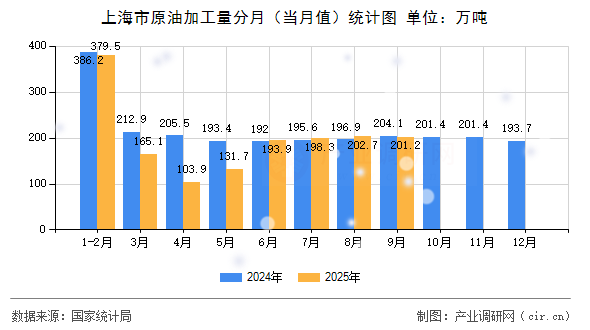
Core Insights - The crude oil processing volume in Shanghai for September 2025 was 2.012 million tons, reflecting a year-on-year decrease of 1.4% [1] - For the first nine months of 2025, the total crude oil processing volume was 15.763 million tons, showing a significant year-on-year decline of 11.8% [2] Group 1: Monthly Data - In September 2025, the crude oil processing volume in Shanghai was 2.012 million tons, which is 1.4% lower than the same month last year [1] - The growth rate for September 2025 was 1.1 percentage points lower than the previous year [1] - The processing volume accounted for 3.2% of the national total of 62.687 million tons for the same period [1] Group 2: Cumulative Data - From January to September 2025, the crude oil processing volume reached 15.763 million tons, down 11.8% compared to the same period last year [2] - The growth rate for this nine-month period was 8.8 percentage points lower than the previous year [2] - The processing volume represented 2.9% of the national total of 550.815 million tons during the same timeframe [2]
中国石油化工股份(00386.HK)11月28日回购4099.14万港元,年内累计回购15.66亿港元
Zheng Quan Shi Bao Wang· 2025-11-28 15:35
Core Points - China Petroleum & Chemical Corporation (Sinopec) has been actively repurchasing its shares, with a total of 9.25 million shares bought back on November 28 at a price range of HKD 4.400 to HKD 4.480, amounting to HKD 40.99 million [1] - The stock closed at HKD 4.410 on the same day, reflecting a decline of 1.34%, with a total trading volume of HKD 394 million [1] - Since October 30, the company has conducted share repurchases for 22 consecutive days, totaling 114 million shares and a cumulative repurchase amount of HKD 500 million, during which the stock price increased by 4.50% [1] Repurchase Summary - Year-to-date, Sinopec has executed 55 repurchase transactions, acquiring a total of 336 million shares for a total amount of HKD 1.566 billion [1] - Detailed repurchase data shows the highest repurchase price reached HKD 4.640 and the lowest at HKD 4.100 during the recent transactions [1][2] - The repurchase activity indicates a strategic move by the company to support its stock price and enhance shareholder value [1]