ETF基金

Search documents
上周ETF全市场净流入239.45亿,超百亿资金抄底港股ETF
Ge Long Hui· 2025-11-11 01:10
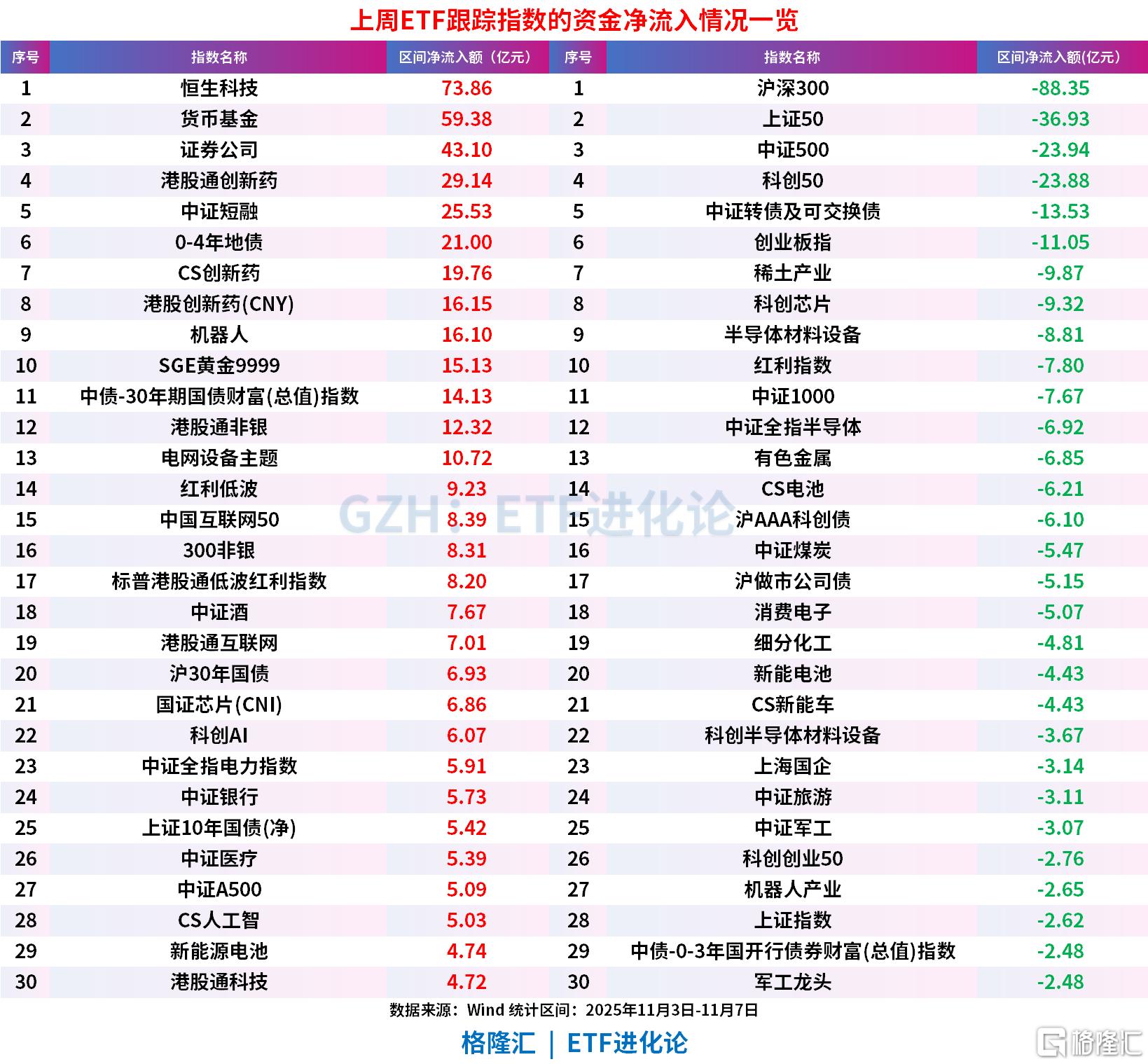
Market Performance - The A-share market showed a mixed performance last week, with the Shanghai Composite Index, CSI 300, and ChiNext Index gaining 1.08%, 0.82%, and 0.65% respectively, while the SME Board Index, CSI 500, and STAR 50 Index recorded losses of -0.59%, -0.04%, and 0.01% respectively [1] - In terms of sectors, power equipment and new energy, steel, and oil and petrochemicals performed well with gains of 5.10%, 4.57%, and 4.56% respectively, while pharmaceuticals, computers, and comprehensive finance lagged with losses of -2.36%, -2.08%, and -1.98% respectively [1] Fund Flows - Last week, the total net inflow for ETFs across the market was 239.45 billion yuan, with stock ETFs experiencing a net outflow of 10.35 billion yuan, while cross-border stock ETFs saw a net inflow of 116.3 billion yuan [2] - The net inflows for various indices included 73.86 billion yuan for Hang Seng Technology, 59.38 billion yuan for money market funds, and 43.10 billion yuan for securities companies, while the CSI 300 and CSI 500 experienced net outflows of 88.35 billion yuan and 23.94 billion yuan respectively [2][4] ETF Performance - The median weekly return for stock ETFs was 0.43%, with the CSI 300 ETF and the Shanghai Composite 50 ETF showing median returns of 0.82% and 0.89% respectively [11] - The top-performing ETFs included the Electric Grid Equipment ETF and various photovoltaic ETFs, which saw returns of 10.92%, 10.80%, and 9.30% respectively [12][14] - Conversely, the worst performers included the Sci-Tech Innovation Drug ETFs, which experienced declines of -7.59% and -7.38% [16][18] New Fund Launches - A total of 45 funds were reported last week, maintaining the same number as the previous week, including three FOFs and one QDII [19] - Upcoming launches include several ETFs focused on photovoltaic industries and internet sectors, indicating a continued interest in these areas [19][20]

旅游ETF领涨;南向ETF通扩容今日生效丨ETF晚报
2 1 Shi Ji Jing Ji Bao Dao· 2025-11-10 10:13
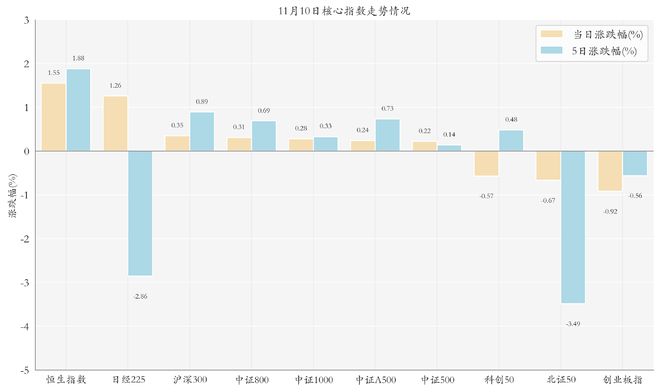
ETF Industry News - The Shanghai Composite Index rose by 0.53%, with the tourism ETFs leading the gains, increasing by 5.99% and 5.66% respectively [1] - Multiple Hong Kong ETFs have attracted over 20 billion yuan in net inflows this year, with the Hong Kong Internet ETF receiving nearly 54.4 billion yuan [1] - The Southbound ETF Connect has expanded, now including six new ETFs, with the first inclusion of ETFs containing US stock assets [1] Market Overview - On November 10, the Shanghai Composite Index closed at 4018.6 points, with a daily high of 4018.7 points, while the Shenzhen Component Index and the ChiNext Index saw minor increases and a decrease of 0.92% respectively [2] - The Hang Seng Index and Nikkei 225 showed strong performance, with daily increases of 1.55% and 1.26% respectively [2] Sector Performance - The beauty care, food and beverage, and retail sectors performed well, with daily increases of 3.6%, 3.22%, and 2.69% respectively [5] - Conversely, the electric equipment, machinery, and electronics sectors lagged behind, with declines of -1.09%, -0.71%, and -0.51% respectively [5] ETF Market Performance - Cross-border ETFs showed the best performance with an average increase of 1.48%, while stock index ETFs had the worst performance with an average decrease of -0.06% [7] - The top-performing ETFs included tourism ETFs with gains of 5.99% and 5.66%, and a wine ETF with a gain of 4.50% [9] Trading Volume of ETFs - The top three ETFs by trading volume were the A500 ETF Fund, the CSI A500 ETF, and the A500 ETF from E Fund, with trading volumes of 5.102 billion yuan, 4.449 billion yuan, and 4.179 billion yuan respectively [11]
指数双双“四连阳”,关注价值ETF(159263)、自由现金流ETF易方达(159222)投资价值
Mei Ri Jing Ji Xin Wen· 2025-11-10 09:02
Group 1 - The core viewpoint of the article highlights the strong performance of value stocks, with the Guozheng Value 100 Index rising by 1.3% and over 10% since October, while the Guozheng Free Cash Flow Index increased by 1.1%, achieving four consecutive days of gains [1] - The recent rise in value stocks is attributed not only to a "high-cut-low" market trend but also to expectations of economic recovery and the resonance of dividend premiums [1] - The current non-manufacturing PMI in China has crossed the threshold, indicating potential benefits for traditional value sectors such as home appliances and banking due to recovering demand [1] Group 2 - The Guozheng Value 100 Index employs a three-dimensional screening system based on "high dividends + high free cash flow + low price-to-earnings ratio" to select value stocks, demonstrating stable historical performance [1] - The Guozheng Free Cash Flow Index selects assets based on free cash flow rates, focusing on cash-rich value assets, with the top three weighted industries being non-ferrous metals, automotive, and oil and petrochemicals [1] - The Value ETF (159263) and the E Fund Free Cash Flow ETF (159222) track the aforementioned indices, providing investors with convenient tools to invest in undervalued quality assets and capitalize on style-switching opportunities [1]
“反弹先锋”创业板ETF天弘(159977)近5日净流入1.23亿元,“末班车效应”发力,车企集中争抢宁德时代电池产能!
Xin Lang Cai Jing· 2025-11-10 06:37
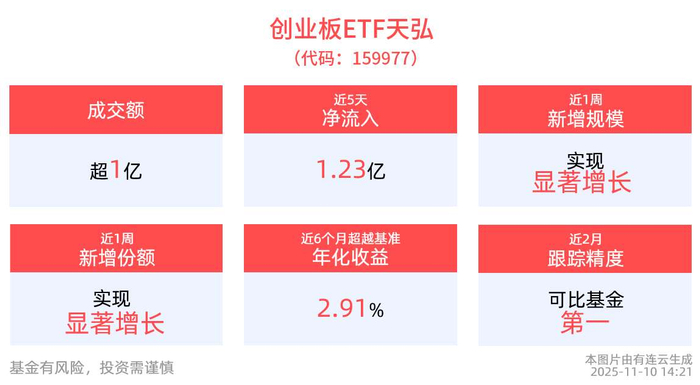
Core Viewpoint - The news highlights the significant growth and investment opportunities in the ChiNext ETF Tianhong (159977), driven by a surge in demand for electric vehicle batteries amid upcoming changes in tax policies for new energy vehicles [3][4][5]. Group 1: ETF Performance - As of November 10, 2025, the ChiNext ETF Tianhong (159977) recorded a transaction volume of 1.47 billion yuan, with notable stock performances including Beijing Junzheng (300223) up by 7.85%, Maiwei Co. (300751) up by 6.69%, and Yingke Medical (300677) up by 6.28% [3]. - Over the week leading up to November 7, the ChiNext ETF Tianhong (159977) saw an increase in scale by 1.40 billion yuan and a rise in shares by 64 million [3]. - The latest net inflow of funds into the ChiNext ETF Tianhong (159977) was 19.99 million yuan, with a total of 123 million yuan net inflow over four out of the last five trading days [3]. Group 2: Market Trends and Events - The adjustment of the new energy vehicle purchase tax is expected to create a "last train effect," leading to a significant increase in orders for new energy vehicles in October, as companies rush to meet delivery targets before the tax changes take effect [4][5]. - The upcoming tax policy changes, which will see the exemption of purchase tax for new energy vehicles from January 1, 2024, to December 31, 2025, followed by a halved tax rate from 2026 to 2027, are driving fierce competition among car manufacturers for battery supplies, particularly from CATL [4][5]. - The competition for high-nickel batteries from CATL highlights the tight supply situation for power batteries in the fourth quarter [3][5]. Group 3: Institutional Insights - China Galaxy Securities indicates that the market is gearing up for a new upward trend, with third-quarter reports from listed companies showing resilience in fundamentals and structural highlights [6]. - The "14th Five-Year Plan" emphasizes high-quality development and technological self-reliance, aiming to enhance macroeconomic governance effectiveness, which is expected to support a long-term positive trend in the A-share market [6].

A股本周小幅反弹,A500ETF易方达(159361)、沪深300ETF易方达(510310)助力布局核心资产
Sou Hu Cai Jing· 2025-11-07 11:19
Market Overview - A-shares experienced a volatile rebound this week, with the Shanghai Composite Index briefly surpassing 4000 points [1] - The Shanghai and Shenzhen 300 Index rose by 0.8%, the CSI A500 Index increased by 0.7%, the ChiNext Index grew by 0.6%, the STAR Market 50 Index saw a marginal increase of 0.01%, and the Hang Seng China Enterprises Index climbed by 1.1% [1][3] Sector Performance - Leading sectors included lithium battery electrolyte, phosphorus chemical, photovoltaic inverters, and charging piles, which saw significant gains [1] - Conversely, sectors such as innovative drugs, CRO (Contract Research Organization), software, and diversified finance experienced declines [1] Index Details - The CSI A500 Index consists of 500 securities with large market capitalization and good liquidity, covering 91 out of 93 tertiary industries [4] - The ChiNext Index is composed of 100 stocks from the ChiNext board, with a high proportion in strategic emerging industries, particularly in power equipment, communication, and electronics, which together account for nearly 60% [4] - The STAR Market 50 Index includes 50 stocks from the STAR Market, prominently featuring "hard technology" leaders, with semiconductors making up over 50% and combined with medical devices and photovoltaic equipment, accounting for nearly 75% [4] - The Hang Seng China Enterprises Index includes 50 large-cap, actively traded stocks of mainland Chinese companies listed in Hong Kong, with a broad industry coverage where consumer discretionary, information technology, finance, and energy sectors together represent nearly 85% [4] Performance Metrics - The rolling P/E ratios for the indices are as follows: Shanghai and Shenzhen 300 Index at 14.3 times, CSI A500 Index at 16.8 times, ChiNext Index at 41.4 times, STAR Market 50 Index at 163.9 times, and Hang Seng China Enterprises Index at 10.7 times [3] - The rolling P/E ratio percentiles indicate that the CSI A500 Index is at 66.9%, ChiNext Index at 36.4%, STAR Market 50 Index at 96.6%, and Hang Seng China Enterprises Index at 65.6% [3] Historical Performance - Year-to-date performance shows the Shanghai and Shenzhen 300 Index up by 18.9%, CSI A500 Index up by 22.0%, ChiNext Index up by 49.8%, STAR Market 50 Index up by 43.2%, and Hang Seng China Enterprises Index up by 27.1% [7] - Over the past three years, the Shanghai and Shenzhen 300 Index has increased by 24.8%, while the Hang Seng China Enterprises Index has risen by 65.4% [7]

天孚通信逆市暴涨14%!创业板人工智能ETF(159363)冲击三连阳!阿里打造超级AI云,算力持续受益
Xin Lang Ji Jin· 2025-11-07 03:54
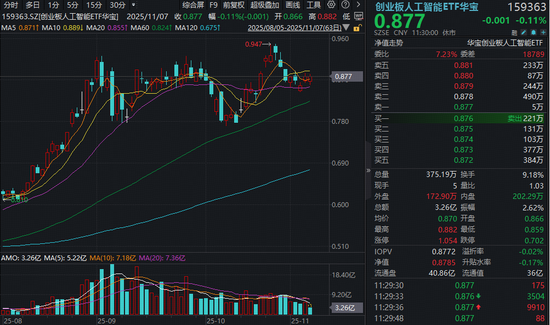
Group 1 - The core viewpoint of the news highlights a significant rise in the stock prices of optical module companies, with Tianfu Communication surging by 14% and Tai Chen Guang increasing by over 2% [1] - The AI-focused ETF, specifically the ChiNext AI ETF (159363), experienced a positive trading session, with a transaction volume exceeding 300 million yuan, indicating strong investor interest in the optical module sector [1][3] - The report emphasizes the optimistic outlook for the optical module industry, driven by increased capital expenditures in North America and the anticipated growth in AI computing power [3] Group 2 - Shanxi Securities suggests capitalizing on the short-term performance mismatch in the optical module sector, particularly with the investment certainty enhanced by NVIDIA's guidance of $500 billion for the Blackwell-Rubin project [3] - The report notes that leading companies in the optical module space, such as Zhongji Xuchuang and Xinyi Sheng, continue to expand their fixed assets and production capacity, maintaining stable gross profit margins [3] - The ChiNext AI ETF (159363) is highlighted as the first ETF tracking the ChiNext AI index, with a recent scale exceeding 3.5 billion yuan and an average daily trading volume of over 700 million yuan, making it a key player in capturing AI-related market trends [3]

Dividend Dogs ETFs Show Geographic Performance Split
Etftrends· 2025-11-05 22:39
Core Insights - The ALPS International Sector Dividend Dogs ETF (IDOG) has significantly outperformed its domestic counterpart, the ALPS Sector Dividend Dogs ETF (SDOG), with a year-to-date gain of 33.4% compared to SDOG's 7.8% return [1] Group 1 - The performance of IDOG indicates that geographical investment choices can have a more substantial impact than the investment strategy itself [1] - The data is sourced from ETF Database, highlighting the comparative performance of these two funds [1]

加仓还看港股科技板块!恒生科技ETF(513130)近两个交易日净申购超10亿份
Xin Lang Ji Jin· 2025-11-05 07:03
Core Viewpoint - The Hong Kong technology sector has experienced fluctuations since late October 2025, but investment through ETFs remains strong, particularly in the Hang Seng Tech ETF, which has seen significant inflows and record net subscriptions [1] Group 1: ETF Performance - The Hang Seng Tech ETF (513130) has accumulated 931 million yuan in inflows over two trading days (November 3-4), making it the only ETF tracking the Hang Seng Tech Index to attract over 800 million yuan during this period [1] - On November 4, the ETF recorded a net inflow of 656 million yuan, marking a new high in over eleven trading days [1] - The total net subscription for the ETF over the two days reached 1.188 billion units, increasing its total shares to 53.616 billion, a new record since its inception [1] Group 2: Market Outlook - As the Hong Kong market approaches year-end adjustments, macroeconomic benefits from policies like the "14th Five-Year Plan" are emerging, although short-term catalysts may be lacking [1] - Despite market fluctuations, the technology sector is viewed as a long-term investment focus, especially with expectations of continued interest rate cuts by the Federal Reserve and strong performance from overseas AI leaders [1] - The current valuation of the Hang Seng Tech Index, with a PE-TTM of 22.59, is relatively low compared to major tech indices in A-shares and US markets, indicating potential for value reassessment [1] Group 3: Policy Support - The China Securities Regulatory Commission announced plans to expand the scope of stocks eligible for trading under the Shanghai-Hong Kong Stock Connect, which could enhance capital inflows into the Hong Kong market [1] - The Hang Seng Tech ETF tracks 30 leading companies in the technology sector, covering high-growth areas such as the internet, AI, chips, and smart driving, making it a key tool for investing in Chinese tech assets [1] - The ETF has a large scale and high liquidity, supporting T+0 trading, and investors can also participate through linked funds [1]
创业板ETF博时(159908)盘中翻红,短期情绪扰动不改长期高景气度
Xin Lang Cai Jing· 2025-11-05 03:55
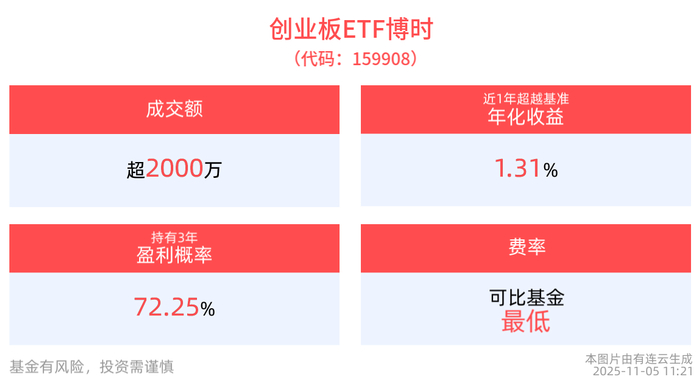
Group 1 - The ChiNext Index rose by 0.05% as of November 5, 2025, with notable increases in stocks such as Yiwei Lithium Energy (up 5.23%) and Yangguang Electric (up 3.20%) [3] - The ChiNext ETF by Bosera (159908) increased by 0.10%, with a latest price of 2.91 yuan, and has seen a cumulative rise of 1.57% over the past two weeks [3] - The trading volume for the ChiNext ETF reached 20.63 million yuan, with a turnover rate of 1.71% [3] Group 2 - The North American cloud giants (MAMG: Microsoft, Amazon, Meta, Google) reported a 68% year-on-year increase in capital expenditure for Q3 2025, totaling 96.4 billion USD, with a positive outlook for 2025 and 2026 [3] - The latest scale of the ChiNext ETF by Bosera is 1.222 billion yuan, closely tracking the ChiNext Index, which consists of 100 stocks with high market capitalization and liquidity [4] - As of October 31, 2025, the top ten weighted stocks in the ChiNext Index accounted for 58.2% of the index, including companies like CATL and Zhongji Xuchuang [4]

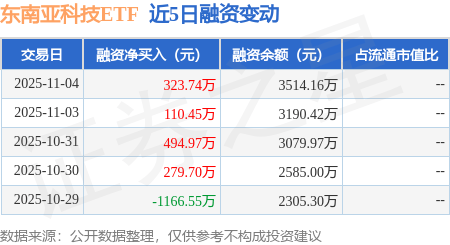
东南亚科技ETF:11月4日融资净买入323.74万元,连续3日累计净买入929.16万元
Sou Hu Cai Jing· 2025-11-05 02:16
Core Insights - Southeast Asia Technology ETF (513730) experienced a net purchase of 3.24 million yuan on November 4, 2025, with a total financing balance of 35.14 million yuan, marking a continuous net purchase of 9.29 million yuan over the last three trading days [1][2][3] Financing Activity Summary - On November 4, 2025, the financing net purchase was 3.24 million yuan, with a financing balance of 35.14 million yuan, reflecting a 10.15% increase from the previous day [2][3] - The financing activities over the past five trading days showed fluctuations, with the highest net purchase recorded on October 31, 2025, at 4.95 million yuan, and a significant outflow of 11.67 million yuan on October 29, 2025 [2][3] - The financing balance has shown a consistent upward trend, with increases noted on November 3 (3.59%) and October 31 (19.15%) [3] Margin Trading Knowledge - Current requirements for individual investors to participate in margin trading include having at least six months of trading experience and an average account asset of 500,000 yuan over the previous 20 trading days [4] - The number of margin trading stocks on the Shanghai Stock Exchange is set to increase from 800 to 1,000, while the Shenzhen Stock Exchange will expand its eligible stocks from 800 to 1,200 [4]