
饮料

Search documents
小罐茶无糖茶赛道:以“高香”破局,引领行业品质升级
Jin Tou Wang· 2025-09-15 09:08
Core Insights - The sugar-free tea market is rapidly growing, becoming a vibrant segment within the beverage industry, driven by increasing health-conscious consumer behavior [1] - Traditional and emerging brands are entering the market, with differentiation becoming crucial for survival as competition intensifies [1][5] Group 1: Market Dynamics - The competition in the sugar-free tea market has shifted from a focus on health to a comprehensive experience, with consumers demanding diverse flavors and high quality [2] - The introduction of the "High Aroma Sugar-Free Tea" series by Xiaoguan Tea, featuring products like Jasmine Pu'er, Rose Black Tea, and Oriental Beauty, has garnered significant industry attention [2][5] Group 2: Regional Success - Guangdong has emerged as a key testing ground for new products due to its established tea culture and convenience store network, with Xiaoguan Tea achieving over 50,000 distribution points in just three months [3] - The series has surpassed one million boxes in cumulative sales, indicating strong market acceptance and validating the effectiveness of the "High Aroma" positioning [3] Group 3: National Expansion - Following success in Guangdong, Xiaoguan Tea is accelerating its national expansion, now covering 26 provinces and cities, with over 2,000 potential distributors expressing interest [4] - New products like "Coffee Aroma Oolong" and "Orchid Aroma Green Tea" are set to launch, targeting young professionals and emphasizing unique flavor profiles [4] Group 4: Industry Transformation - The sugar-free tea market has reached a scale of billions, with competition evolving towards flavor experience rather than just health benefits [5] - Xiaoguan Tea is positioned as a representative brand merging traditional tea culture with modern consumer demands, potentially reshaping the future landscape of the sugar-free tea industry [5]
欢乐家:豪兴投资累计质押股数约为1.61亿股
Mei Ri Jing Ji Xin Wen· 2025-09-15 08:13
Company Summary - Huanlejia (SZ 300997) announced that as of the date of the announcement, Haoxing Investment has pledged approximately 161 million shares, accounting for 70.29% of its holdings [1] - Li Xing has pledged 38.7 million shares, representing 74.88% of his holdings [1] - Zhu Wenzhan has pledged 23.43 million shares, which is 61.46% of his holdings [1] - Li Kangrong has pledged 1.15 million shares, making up 30.17% of his holdings [1] - As of the announcement, Huanlejia's market capitalization is 8.5 billion yuan [1] Industry Summary - For the first half of 2025, Huanlejia's revenue composition is as follows: the beverage industry accounts for 55.73%, the canned food industry accounts for 38.66%, and other businesses account for 5.61% [1]
浙江省台州市市场监督管理局食品安全监督抽检信息通告(2025年第20期)
Zhong Guo Zhi Liang Xin Wen Wang· 2025-09-15 06:44
Group 1 - The Taizhou Market Supervision Administration conducted food safety inspections on 328 samples across 29 categories, with 311 passing and 17 failing the safety standards [3][4] - The non-compliance issues primarily involved excessive food additives and pesticide residues [3][4] Group 2 - Specific products found to be non-compliant include year cake sold by Taizhou Lianshang Supermarket, which contained excessive dehydroacetic acid [5] - Other non-compliant items include steamed buns with sweeteners and sauces, and various vegetables with pesticide residues exceeding safety limits [5][6] Group 3 - The local market supervision departments have been instructed to take immediate actions such as recalling and removing non-compliant products from shelves [4] - A report on the handling of these non-compliant products must be submitted to the Taizhou Market Supervision Administration within three months [4]

食饮 :如何展望H2重点标的投资机会
2025-09-15 01:49
Summary of Key Points from the Conference Call Industry Overview: Baijiu (Chinese Liquor) Industry Sales Performance - The Baijiu industry is expected to see a year-on-year decline in terminal sales of 5%-15%, despite a low base from last year. However, the decline has narrowed from over 40% in June [1][2] - Major brands like Moutai and Wuliangye reported significant month-on-month growth in August, with Moutai's sales in Nanjing increasing by 30% and other cities like Zhengzhou and Guangzhou recovering by 15%-35% [1][2] Price Trends - Core product wholesale prices have shown fluctuations due to the upcoming double festival, with Moutai's price dropping to around 1,780 RMB, influenced by restaurant demand and Moutai's increased supply [1][4] - Wuliangye's price has decreased to around 820 RMB, while Luzhou Laojiao's Guojiao 1573 maintains a price range of 830-860 RMB [1][4] Product Strategy - Baijiu companies are adjusting their product lines by introducing lower-alcohol products and light bottle options, targeting younger consumers. For instance, Wuliangye launched a 29-degree product, and Luzhou Laojiao promoted 38/28-degree products [1][5] - Companies are focusing on channel profitability, with Pearl Lidu launching a "Great Competition Alliance" equity incentive plan, aiming to sign 3,000 distributors and generate 5-6 billion RMB in revenue [1][6][7] Market Outlook - The second quarter saw a slowdown in performance, with growth rates in the single digits, primarily driven by leading brands. The third quarter is expected to see performance stabilize or slightly decline, which could benefit future growth [1][8] - Positive catalysts for the Baijiu sector include expectations for better sales during the double festival and market adjustments post the Autumn Sugar Conference [1][10][11] Recommended Stocks - Key recommendations include Luzhou Laojiao, Gujing Gongjiu, and Yingjia Gongjiu, with Luzhou Laojiao highlighted for its price leadership and national strategy [1][12][13] - Gujing Gongjiu and Yingjia Gongjiu are noted for their low valuations and strong recovery potential [1][14][15] Company-Specific Insights - Luzhou Laojiao is recognized for its price-setting ability and effective product diversification, which alleviates cash flow pressures and enhances performance [1][13] - Gujing Gongjiu and Yingjia Gongjiu are seen as having strong investment value due to their competitive mid-range products and potential for recovery [1][14][15] Other Relevant Industry Insights - The overall beverage industry is projected to grow by 4% in revenue and 14% in profit in the first half of 2025, with significant growth in functional drinks and carbonated beverages [3][38][39] - Companies like Nongfu Spring and Uni-President have reported strong performance, with Nongfu Spring's profitability significantly improving due to lower raw material costs [40][41][42] This summary encapsulates the key points from the conference call regarding the Baijiu industry and related beverage sectors, highlighting sales performance, pricing trends, product strategies, market outlook, and specific company recommendations.

农夫山泉20250912
2025-09-15 01:49
Summary of Nongfu Spring Conference Call Company Overview - **Company**: Nongfu Spring - **Industry**: Beverage Industry Key Points and Arguments 1. **Market Positioning**: Nongfu Spring has successfully differentiated itself by promoting the concept of natural water, achieving a market share of 23.6% in 2023, making it the leader in the bottled water sector in China [2][11]. 2. **Founder Influence**: Founder Zhong Shanshan's marketing skills have significantly impacted the company's product selection and marketing strategies, such as the introduction of large-packaged water and sports event marketing [2][5]. 3. **Product Performance**: The introduction of the sugar-free tea brand, Dongfang Shuye, initially received lukewarm market response but has seen explosive growth, with tea beverage revenue expected to surpass bottled water in 2024, becoming the company's largest profit segment [2][6]. 4. **High Profit Margins**: The company employs a high-quality, high-pricing strategy to achieve high gross margins, distributing profits to channel partners to maintain loyalty [2][9]. 5. **Supply Chain Stability**: Nongfu Spring has established a robust supply chain by supporting upstream tea and juice factories, ensuring stable raw material supply [2][12]. 6. **Industry Growth Trends**: The bottled water industry is expected to slow to a growth rate of around 2% in 2024, but there is still potential for increased per capita consumption in China, driven by new consumption scenarios [2][10]. 7. **Crisis Management**: The company has actively responded to public relations crises to maintain its brand image, transitioning from a broad channel strategy to a more refined and exclusive dealer model [3][15][16]. 8. **Revenue Growth**: From 2017 to 2023, the company's revenue compound annual growth rate (CAGR) was approximately 16%, with net profit growth at 24% [4][8]. 9. **Market Strategy**: Nongfu Spring has strategically avoided highly competitive markets, focusing on nurturing niche segments, such as the sugar-free tea market, which has seen significant growth [11][14]. 10. **Channel Management Evolution**: The company's channel management has evolved through various stages, enhancing flexibility and control over distribution channels [3][16][18]. Additional Important Content 1. **Stock Structure**: Zhong Shanshan holds 84% of the company's shares and voting rights, providing him with significant decision-making power [8]. 2. **Crisis Response Examples**: The company has demonstrated effective crisis management, such as responding to media inquiries during the 2013 standards incident and addressing negative public sentiment in 2024 [15]. 3. **Future Market Expansion**: Nongfu Spring plans to expand into international markets, having entered the Hong Kong market in June 2025 [17]. This summary encapsulates the essential insights from the conference call, highlighting Nongfu Spring's strategic positioning, market performance, and future outlook in the beverage industry.
租房新规今起实施;央行开展 6000亿元买断式逆回购操作|南财早新闻
2 1 Shi Ji Jing Ji Bao Dao· 2025-09-14 23:44
今日关注 当地时间9月14日下午,中美双方在西班牙马德里就有关经贸问题开始举行会谈。 宏观经济 1、从9月15日开始,我国首部专门规范住房租赁活动的行政法规《住房租赁条例》正式施行,这标志着 住房租赁市场将从"野蛮生长"迈入依法规范成长的新阶段。 2、新华社:消费者对预制菜的安全性、营养性和价值存疑,是长期信息不透明、标准差异大、监管执 行不一造成的。要重拾消费者的信任,先得把预制菜拿到阳光下晒一晒。 3、为保持银行体系流动性充裕,中国人民银行将在9月15日以固定数量、利率招标、多重价位中标方式 开展6000亿元6个月期限买断式逆回购操作。 4、2025年夏粮旺季收购进入收尾阶段。国家粮食和物资储备局最新统计数据显示,全国各类粮食经营 主体累计收购小麦超1亿吨,收购进展整体顺利。 5、为加强食品安全监管队伍建设,提升食品安全检查员专业化水平,市场监管总局研究起草了《食品 安全检查员管理暂行办法(征求意见稿)》,近期面向社会公开征求意见,意见反馈截止日期为2025年10 月13日。 6、为期三天的2025中国文化旅游产业博览会现场达成60项合作成果,签约总金额达到240.921亿元。 1、据中国证券报,近期,证 ...

娃哈哈变娃小宗 消费者能接受吗?
Nan Fang Du Shi Bao· 2025-09-14 23:18
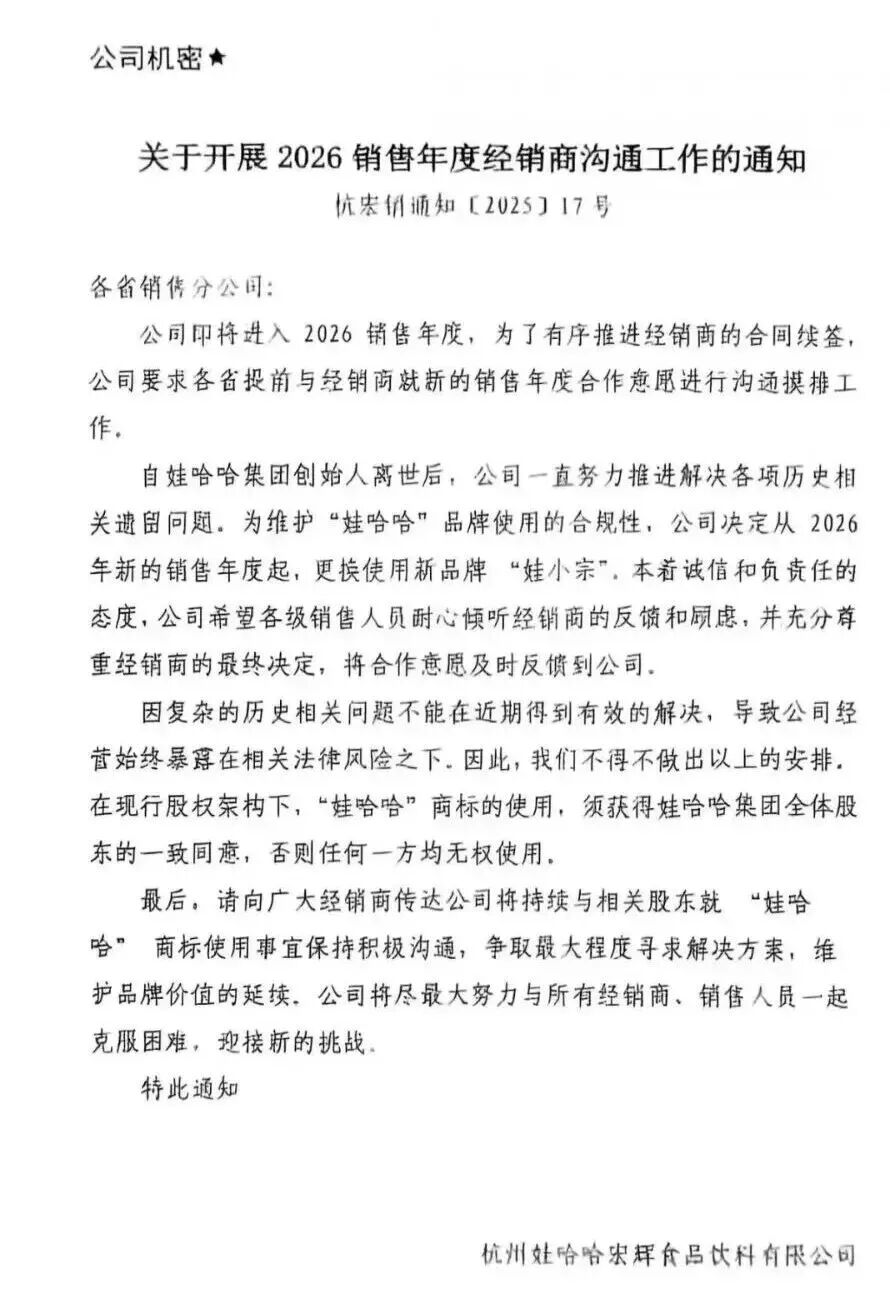
Core Viewpoint - The company Wahaha, under the leadership of Zong Fuli, will change its brand to "Wah Xiaozong" starting from the 2026 sales year, as indicated in a widely circulated notification aimed at maintaining compliance with the use of the "Wahaha" brand [1][2]. Group 1: Brand Change Announcement - A notification has been issued requiring provinces to communicate with distributors about their willingness to cooperate in the new sales year, emphasizing the need for compliance with the "Wahaha" brand [1][2]. - The notification highlights that the decision to change to the new brand "Wah Xiaozong" is to maintain brand compliance, and sales personnel are encouraged to listen to distributor feedback [2][4]. - The macro-level response from consumers has been overwhelmingly negative, with many expressing their inability to accept the name change, reflecting a strong emotional connection to the original brand [2][3]. Group 2: Challenges Ahead - The emotional resistance from consumers is just the first hurdle; the attitude of distributors is likely to be more critical, as they prioritize commercial interests over emotional connections [4]. - The transition to a new brand will require significant market education and promotional resources, with uncertain market acceptance posing a risk to the brand's visibility and availability [4]. - The company has a vast network of nearly 10,000 distributors, and any large-scale withdrawal or lack of cooperation from them could severely impact market presence [4]. Group 3: Strategic Implications - The brand change may reflect a deeper strategic adjustment, with recent name changes of several Wahaha-related companies to "Hongsheng" indicating a systematic transformation [5][6]. - There are speculations that Zong Fuli may not have permission to use the "Wahaha" trademark, prompting the need for a new brand to mitigate legal risks associated with trademark usage [6]. - Zong Fuli's efforts to rejuvenate the brand and connect with younger consumers may be a driving force behind the new brand strategy, aiming for a gradual transition rather than a sudden shift [6].
刷屏!宗馥莉另立门户?欲启用新品牌“娃小宗”取代“娃哈哈”?
Zhong Guo Ji Jin Bao· 2025-09-14 14:47
Core Viewpoint - The company Hongsheng Beverage, led by Zong Fuli, is planning to launch a new brand "Wawa Xiaozong" in response to ongoing trademark transfer issues related to the "Wahaha" brand following the founder's passing [1][7]. Group 1: Brand Transition - An internal document from Hangzhou Wahaha Honghui Food and Beverage Co., Ltd. indicates that starting from the 2026 sales year, the company will replace the "Wahaha" brand with "Wawa Xiaozong" to ensure compliance with trademark usage [1][3]. - The document highlights that under the current shareholding structure, the use of the "Wahaha" trademark requires unanimous consent from all shareholders of Wahaha Group [3]. Group 2: Trademark Issues - The trademark transfer process for the "Wahaha" series is currently underway, with 387 trademarks being transferred from Wahaha Group to Hangzhou Wahaha Food Co., Ltd., which is controlled by Zong Fuli [7]. - The trademark transfer has faced public scrutiny, with accusations of potential asset stripping of the Wahaha brand [7]. Group 3: New Product Development - In May, a new product named "Wawa Xiaozong" was revealed, which is a sugar-free tea beverage aimed at the health drink market, targeting the Gen Z consumer demographic [8][11]. - The company has applied for 45 trademarks under the "Wawa Xiaozong" name across various sectors, including beverages, food, and apparel, indicating a broad market strategy [7].
华润饮料(02460):2025年中报业绩点评:渠道调整致短期波动,静待重新起航
Changjiang Securities· 2025-09-14 11:12
Investment Rating - The investment rating for the company is "Buy" and it is maintained [6]. Core Views - In the first half of 2025, the company achieved revenue of 6.206 billion HKD, a year-on-year decrease of 18.5%, and a net profit attributable to shareholders of 0.805 billion HKD, down 28.6% year-on-year [2][4]. - The company is facing intensified market competition, leading to pressure on revenue. The packaging water segment generated revenue of 5.25 billion HKD, down 23.1% year-on-year, while the beverage business saw revenue of 0.95 billion HKD, an increase of 21.3% year-on-year [6]. - The company is actively optimizing and expanding its distribution channels, which has resulted in an increase in expense ratios. The sales and management expense ratios rose by 2.9 and 0.4 percentage points respectively, with the net profit margin decreasing by 1.8 percentage points to 13% [6]. - The company is focusing on long-term growth despite short-term impacts, with plans to launch three new factories in 2025 and enhance its product development capabilities through partnerships with research institutions and universities [6]. Summary by Sections Financial Performance - Revenue for H1 2025 was 6.206 billion HKD, down 18.5% year-on-year, and net profit was 0.805 billion HKD, down 28.6% year-on-year [2][4]. Market Dynamics - The packaging water segment's revenue decreased by 23.1% to 5.25 billion HKD, while the beverage segment's revenue increased by 21.3% to 0.95 billion HKD [6]. - The company is facing increased competition in the packaging water industry, which is affecting revenue growth [6]. Strategic Initiatives - The company is enhancing its channel strategy by diversifying customer types and focusing on brand building through outdoor advertising and sports marketing [6]. - Plans for production capacity optimization include the launch of three new factories in 2025, aimed at reducing reliance on the packaging water business and expanding the beverage product line [6].
宗馥莉“去娃哈哈”,难以完成的告别
Mei Ri Jing Ji Xin Wen· 2025-09-14 10:41
Core Viewpoint - The internal document leak reveals significant internal issues within the Wahaha Group, indicating a shift towards a new brand "Wah Xiaozong" to replace "Wahaha" starting in 2026, which suggests a brand reconstruction rather than an upgrade [1] Group 1: Brand Transition - The transition to "Wah Xiaozong" is not merely a rebranding but signifies a complete departure from the "Wahaha" brand, which is seen as a liability following the death of founder Zong Qinghou [1][4] - The ownership structure of Wahaha Group complicates the brand transition, as the "Wahaha" trademark belongs to the group and cannot be used without unanimous consent from all shareholders [1][2] Group 2: Legal and Historical Issues - The company faces various historical issues, including disputes over employee stock ownership, stock buyback agreements, and the legality of trademark authorization, alongside ongoing family inheritance disputes [2] - Zong Fuli's attempts to transfer the "Wahaha" trademark to her controlled company were rejected by major shareholders, highlighting her limited control and the high legal risks involved [2] Group 3: Market Challenges - The new brand "Wah Xiaozong" lacks the historical significance, emotional connection, and market recognition that "Wahaha" has built over nearly 40 years, making it unlikely to inherit the brand's estimated value of 90 billion [3] - The current beverage market is highly competitive, with established players like Yuanqi Forest and Nongfu Spring, making it difficult for a new brand without a compelling narrative or differentiation to succeed [3] Group 4: Leadership and Brand Integrity - Zong Fuli's legitimacy as a successor is questioned; her connection to the "Wahaha" brand is seen as a moral obligation to uphold its legacy, which is jeopardized by the shift to "Wah Xiaozong" [4][5] - Abandoning the "Wahaha" brand could lead to a loss of authenticity and consumer trust, positioning Zong Fuli in a precarious situation regarding public perception and brand loyalty [5]