
券商

Search documents
帮主郑重:A股过山行情藏玄机!恐高不如看懂节奏
Sou Hu Cai Jing· 2025-09-18 01:31
Market Overview - The A-share market is experiencing significant volatility, with the Shanghai Composite Index fluctuating around 3850 points, showing a slight increase of 0.37% yesterday followed by a minor pullback today, as over 2800 stocks declined [3] - The trading volume has decreased to 2.38 trillion yuan, nearly 400 billion less than the peak at the end of August, indicating a cautious stance from major players ahead of the Federal Reserve's decision [3] Historical Context - A comparison is made to January 2019 when the Shanghai Index fell to 2440 points, with widespread panic about further declines, yet it rebounded over 30% to 3200 points within three months [4] - The current price-to-earnings ratio of the CSI 300 is 13.75, which, while higher than last year, remains significantly lower than historical bubble levels, suggesting that the real risk lies in the quality of stocks rather than their price levels [4] Economic Drivers - The Federal Reserve is expected to lower interest rates by 25 basis points, which would signal the start of a global liquidity easing cycle [5] - Domestic policies are also supportive, with initiatives to boost growth in the power equipment sector and advancements in AI chip testing, indicating a dual drive of liquidity and industrial policy supporting the market [5] Investor Behavior - The primary risk in the current market is not the pullback itself but the emotional reactions of retail investors, particularly younger ones who make up over 60% of new stockholders and tend to hold positions for an average of only three days [5] - Successful long-term investments are likely to be in companies with strong earnings certainty, such as Ningde Times and SMIC, which are benefiting from significant order increases [5] Investment Strategy - Recommendations include maintaining a flexible position of 50-70%, focusing on policy-driven sectors like wind power and energy storage, and avoiding high-flying speculative stocks [6] - Investors are advised to steer clear of two main traps: high-position speculative stocks lacking performance and defensive sectors that are currently under pressure [7] Conclusion - The market is currently in a phase of hesitation, with major players using volatility to wash out weaker hands, while historical patterns suggest that this could be a significant opportunity for patient investors [8]


故意压盘,快压不住了
Sou Hu Cai Jing· 2025-09-18 01:08
Market Overview - On September 17, the market experienced a significant rise, while brokerage stocks saw a consistent decline, interpreted as a result of the Federal Reserve's interest rate cut expectations and GJD's directive to slow down market pressure [1] Sector Performance - Four sectors showed notable performance: - The Hang Seng Technology and semiconductor equipment sectors surged, driven by Baidu Kunlun's GPU gaining significant market share in China Mobile's bidding, alongside increased capital expenditure from tech giants due to AI narratives and global liquidity easing [3] - The semiconductor equipment sector's rise was attributed to rumors of SMIC testing domestic DUV lithography machines, marking a significant milestone in semiconductor equipment technology [3] - The Hong Kong innovative drug sector faced a sharp decline due to panic triggered by the plummeting stock of Yaokang Pharmaceutical, compounded by previous threats from Trump, although the sector is now showing signs of value after recent corrections [4] - Gold stocks also fell, reflecting the market's tendency to "buy the expectation, sell the fact," despite rising expectations for Fed rate cuts and international gold prices reaching historical highs [4] Capital Flow Trends - Market funds continue to gravitate towards robotics, Hang Seng Technology, and semiconductor equipment sectors, indicating a strong interest in large tech directions [5] Regulatory Influence - Recent market trends indicate a pattern where technology stocks decline while consumer and banking stocks rise, suggesting regulatory efforts to channel funds towards technology sectors while intentionally managing market pressure to achieve a slow bull market [6] Market Outlook - Concerns are raised about the market's sustainability without loose credit and monetary policies, as well as the potential impact of major shareholders reducing their stakes and the absence of large financial institutions to support the market [7]

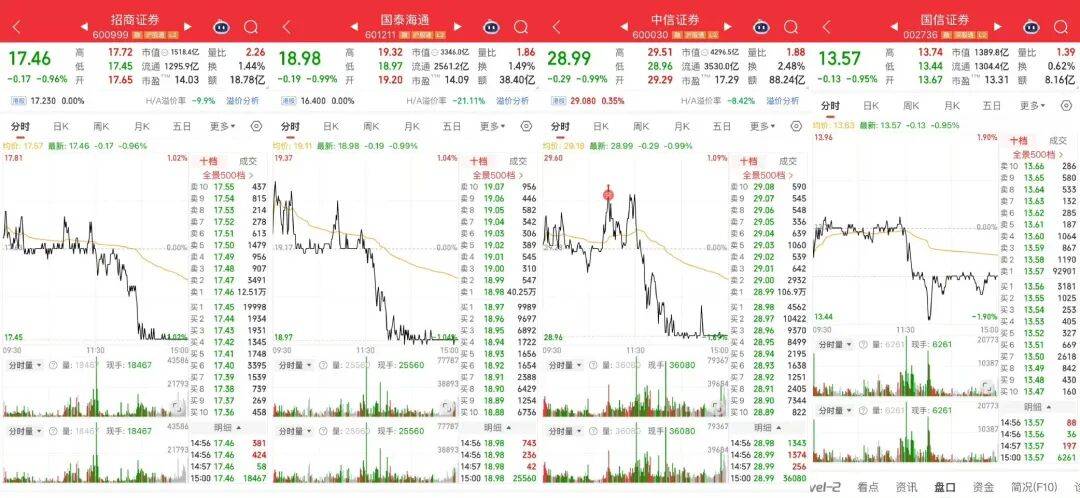
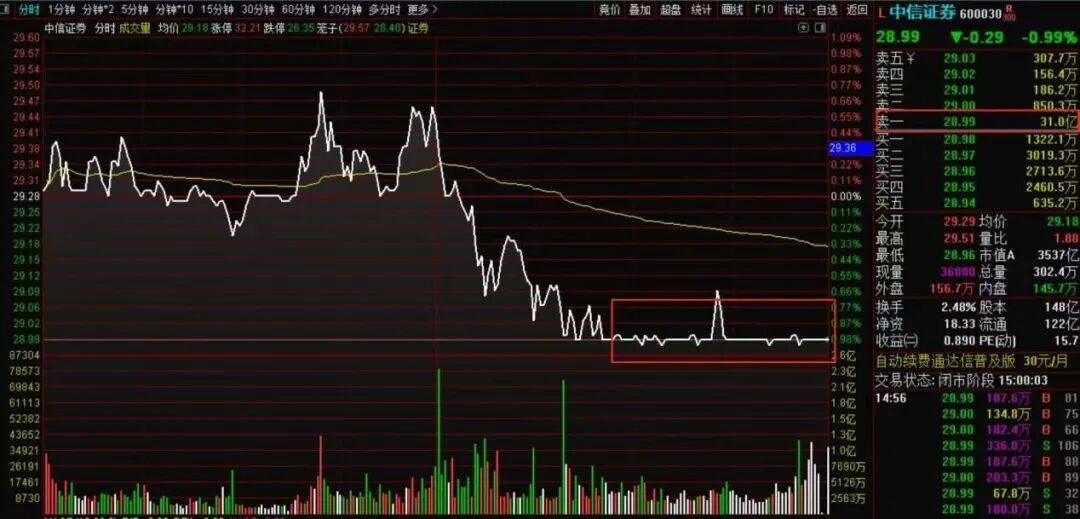
中信证券惊现31亿元压盘大单,昨日多只券商股午后直线跳水,怎么回事?
Mei Ri Jing Ji Xin Wen· 2025-09-18 00:36
只要在资本市场时间够久,你总能看到各种各样做梦也想不到的事儿。 9月17日午后,"券商一哥"中信证券突然直线跳水。但若说是跌幅,仅仅从上涨0.61%,到最多下跌1.02%,振幅还不足2%。13:00至13:30,中信证券成交 金额为18.48亿元,换手率0.52%。 然后,13:30至15:00,中信证券一直低位徘徊。其中14:24到14:26有短暂小反抽,但只是昙花一现,最后半小时几乎走成了一条直线。而卖一压单高达31 亿元之多。 作为A股流通市值超过3500亿元的"券商一哥",大单压顶之下,分时图乍一看仿佛跌停板,再仔细一看原来才跌了不到1%。 不仅是中信证券,多只头部券商股也出现了类似的走势。 仿佛有一只无形的手,在调控券商股。尤其是3900点关口,这种走势引发了众多投资者好奇,也有不少人在股吧中讨论。 有投资者就表示:"可能是某些资金担心券商拉得太快,一把将指数带飞吧,良苦用心压。" | | | · 60 55 155 55 155 30分 · | | | | | | F9 盘前盘后 叠加 九转 画线 工具 6 2 » | | | | | | --- | --- | --- | --- | --- | ...

A股收评:不用猜了!降息已经明牌,周四股准备好拉升了
Sou Hu Cai Jing· 2025-09-17 17:48
Core Viewpoint - The market anticipates a 25 basis point rate cut by the Federal Reserve, with a probability of 95.9%, driven by both economic conditions and political pressure from President Trump [1][3]. Group 1: Impact of Federal Reserve Rate Cut - The upcoming rate cut is viewed as a "preventive rate cut" rather than a response to recession, which historically has led to increased liquidity and market recovery in A-shares and Hong Kong stocks [3]. - A significant valuation gap exists between A-shares and U.S. equities, with the CSI 300 index trading at a price-to-earnings ratio of approximately 14 times, about 60% of the S&P 500's valuation [3]. - Historical data shows that during Fed rate cut cycles, foreign capital tends to flow into A-shares, with a notable increase of $18.8 billion in net purchases following the Fed's first rate cut in September 2024 [3]. Group 2: Currency and Policy Effects - A rate cut typically weakens the dollar, reducing depreciation pressure on the yuan, which encourages foreign investment in A-shares [4]. - As of September 15, the yuan appreciated by 1.2% to 7.1056, lowering the exchange cost for foreign investors and enhancing the attractiveness of A-shares [6]. - The Fed's rate cut opens up more operational space for the People's Bank of China, potentially leading to a 10-15 basis point reduction in the Loan Prime Rate (LPR) to further lower corporate financing costs [7]. Group 3: Sector-Specific Opportunities - The technology growth sector is expected to be the primary beneficiary of the rate cut, as it lowers financing costs for research-intensive industries [8]. - Foreign capital has shown increased interest in semiconductor and AI companies, with significant investments noted in leading firms like Zhongwei and Northern Huachuang [8]. - The financial sector stands to gain from improved market activity and liquidity, with leading brokerage firms like CITIC Securities and Dongfang Wealth seeing stock price increases of over 20% following the Fed's rate cut [9]. Group 4: Commodities and Resource Sector - The resource sector benefits from dual drivers: a weaker dollar boosting commodity prices and improved global liquidity increasing demand for resources [11]. - Gold prices have been positively impacted by the liquidity boost from the rate cut, although future economic recovery may lead to a downward trend in gold prices [12]. Group 5: Historical Context and Market Behavior - Historical trends indicate that gold has an 83% success rate in the 10 trading days following a rate cut since 1990, but caution is advised regarding potential profit-taking [13]. - The A-share market experienced a "good news priced in" correction after the Fed's previous rate cuts, with significant foreign capital outflows noted [14]. - The effectiveness of the Fed's rate cut is contingent on coordinated domestic policies, as a lack of substantial action from the People's Bank of China could diminish foreign capital inflow [15][17].

A股:不用猜!反弹就在眼前,加速时刻即将到来?
Sou Hu Cai Jing· 2025-09-17 17:02
Core Viewpoint - The market is approaching a potential upward trend, with key sectors like brokerage firms expected to lead the charge, supported by favorable external conditions such as interest rate cuts and strong performances in overseas markets [1][5]. Market Environment - External factors contributing to a positive outlook for the A-share market include rising expectations for interest rate cuts, rebounds in major global indices, and appreciation of the RMB [1]. - The internal market dynamics show a reduction in short-selling pressure, with major moving averages converging below the index, indicating a potential breakout [3]. Sector Performance - The Hong Kong stock market's strong performance, particularly in technology stocks, signals potential upward momentum for A-shares, as many companies are listed in both markets [3]. - The anticipated interest rate cut by the Federal Reserve is seen as a pivotal moment, with historical data suggesting that A-shares typically perform well during such periods, particularly in technology and consumer sectors [5]. Investment Trends - There is a notable shift in capital allocation within the market, with rapid rotation among sectors such as semiconductors, AI, consumer goods, and healthcare, indicating a search for new investment directions [5]. - Large institutional investors hold significant stakes in key stocks, suggesting that they can influence index movements with minimal retail participation [5]. Resource and Commodity Outlook - Historical trends indicate that during interest rate cuts, commodities like gold, silver, and copper often perform well due to their financial attributes, with small metal indices and rare earth sectors showing substantial gains this year [6]. Market Sentiment - Overall market sentiment appears to be gradually improving, supported by ongoing policy efforts and marginal improvements in economic data, although short-term volatility may still occur [8]. - Investors are adopting a dual strategy, monitoring both heavyweight stocks and structural opportunities in consumer spending and resource sectors, emphasizing the importance of position management [8].

三大利好!港股科技爆发!震惊,券商被近40亿元压盘
2 1 Shi Ji Jing Ji Bao Dao· 2025-09-17 15:09
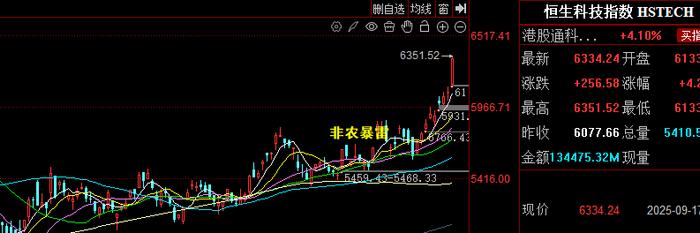
Group 1 - The core viewpoint of the article highlights the significant surge in Hong Kong's technology sector, with Baidu's stock rising by nearly 20% and the Hang Seng Technology Index increasing by 4.3%, reaching a four-year high [1][3] - Alibaba's strong performance in AI infrastructure and its capital expenditure exceeding expectations have contributed to the revaluation of AI stocks, positively impacting its e-commerce business [3][4] - The self-developed AI chips narrative is gaining traction, with Alibaba and Baidu following Google's model of providing chips to other companies, thus generating additional revenue [4][6] Group 2 - Foreign capital is returning to the market, with global active funds underweighting Chinese stocks by 2.3%, while passive fund inflows are increasing, indicating a growing interest in internet stocks related to AI [6][9] - Southbound capital has seen a net purchase of approximately 1.1 trillion HKD this year, totaling nearly 4.8 trillion HKD [8] - The current bull market is driven by a dual mechanism of interest rate cuts in both the US and China, suggesting a potential for a prolonged and significant bull market [10][12] Group 3 - There is notable pressure from large funds on certain stocks, with significant sell orders observed in Citic Securities and Guotai Junan, indicating a cautious market sentiment [14][15] - The market is experiencing a volume of 35.9 billion HKD, with sectors like robotics, new energy, and chips seeing upward movement [17]
美联储今夜降息!对中国市场与汽车行业影响全解析
Sou Hu Cai Jing· 2025-09-17 14:24
Group 1: Federal Reserve Rate Cut - The Federal Reserve is expected to announce a rate cut of 25 basis points, marking the first cut in nine months, aimed at addressing signs of economic slowdown rather than a full-blown crisis [1][2] - The current economic context is characterized by "stagflation," with slowing growth and relatively high inflation, as indicated by a core PCE year-on-year growth of 2.86% and a core CPI growth of 3.2% [2] Group 2: Impact on Chinese Assets - The rate cut is anticipated to have a threefold positive impact on Chinese assets, including expanded monetary policy space, stabilization and appreciation of the RMB exchange rate, and accelerated capital reallocation [2][5] - The Chinese capital market is expected to see a wave of foreign capital inflow, benefiting from the easing of external monetary policy constraints [5] Group 3: Opportunities in A-shares and H-shares - In the A-share market, three sectors are identified as clear beneficiaries: technology growth sectors (TMT, semiconductors, AI), large financial sectors (banks, brokerages, insurance), and high-dividend stocks (electricity, oil, state-owned enterprises) [2][10] - The H-share market is more sensitive to external liquidity, with significant foreign capital allocation towards software, services, and technology hardware sectors, driven by advancements in AI technologies [3] Group 4: Automotive Industry Benefits - The automotive industry is poised to benefit from both policy and funding advantages, with a target of achieving approximately 32.3 million vehicle sales in 2025, a year-on-year growth of about 3% [6] - The expected sales of new energy vehicles (NEVs) are projected to reach around 15.5 million, reflecting a growth of approximately 20% [6] - The rate cut will lower financing costs for automakers, enhance consumer confidence, and support overall consumption, particularly in the automotive sector [7][8] Group 5: Commodity and Bond Market Effects - The rate cut is expected to positively influence the commodity and bond markets, with industrial metals like copper and aluminum anticipated to break upward, and gold prices receiving short-term support [9] - The bond market is likely to see a clear downward trend in interest rates, enhancing the investment value of government and interest rate bonds [9] Group 6: Asset Allocation Strategy - Experts recommend prioritizing equity assets in the current environment, particularly in technology growth, high-dividend blue chips, and large financial sectors, while suggesting moderate allocation to bond assets [10] - Investors are advised to be cautious of potential overvaluation in certain sectors due to pre-existing rate cut expectations [10]
消息称Trade Republic股东正处于推进大规模股票二次出售的初期阶段
Ge Long Hui A P P· 2025-09-17 13:13
格隆汇9月17日|有媒体援引知情人士称,德国在线券商Trade Republic的股东正处于推进大规模股票二 次出售的初期阶段,一些投资者已在讨论以约120亿欧元的估值进行潜在交易,但目前交易尚未最终敲 定。 ...
重磅, 降息要来了!
摩尔投研精选· 2025-09-17 10:42
Core Viewpoint - The article discusses the positive market sentiment in the A-share market, driven by expectations of a Federal Reserve interest rate cut, which is anticipated to attract international capital to emerging markets like A-shares [1][5][6]. Group 1: Market Performance - The A-share market showed a rebound with all three major indices closing in the green, and the ChiNext Index reaching a new high [1]. - Over 2,500 stocks in the market rose, with a trading volume of 2.38 trillion yuan, an increase of 35.3 billion yuan compared to the previous trading day [2]. Group 2: Federal Reserve Meeting - The Federal Reserve's meeting is highly anticipated, with a 95.8% probability of a 25 basis point rate cut, marking the first cut since December 2024 [4]. - The expected rate cut is seen as a signal to stabilize the economy and boost investor confidence, particularly benefiting high-valuation growth sectors like technology [7][8]. Group 3: Impact of Rate Cut on Investment Market - Beneficial sectors include technology growth stocks (semiconductors, new energy, innovative pharmaceuticals), consumer sectors, and financial sectors (brokerage and fintech) due to increased market activity [8]. - Sectors that may face pressure include banks, coal, and steel industries due to compressed interest margins and weakened growth expectations [9]. Group 4: Seasonal Trends in A-shares - Historical analysis indicates that A-shares typically face adjustments in the 10 days leading up to the National Day holiday, with a recovery in the last three days before the holiday and a high probability of gains post-holiday [14][16].

市场抢跑,新一轮上涨行情启动?
Sou Hu Cai Jing· 2025-09-17 10:21
Core Viewpoint - The A-share and Hong Kong stock markets experienced a strong rally, driven by the technology growth sector, with significant gains in the ChiNext Index and the Hang Seng Technology Index, indicating a positive market sentiment ahead of anticipated Federal Reserve interest rate cuts [1][2]. Market Performance - A-share market continued its upward trend, with the ChiNext Index breaking through 3100 points, closing up 1.95% at 3147.35 points. The Shanghai Composite Index rose 0.37% to 3876.34 points, while the Shenzhen Component increased by 1.16% to 13215.46 points. The total market turnover reached 2.4 trillion yuan, an increase of 359 billion yuan from the previous trading day [2]. - In the Hong Kong market, the Hang Seng Index rose 1.78% to 26908.39 points, and the Hang Seng Technology Index surged 4.22% to 6334.24 points, with significant inflows from southbound funds totaling 9.441 billion HKD [2]. Industry Highlights and Driving Logic - The A-share market saw a dual drive from high-end manufacturing and technology sectors, with the new energy industry chain experiencing a broad rally. The power equipment sector led with a 2.55% increase, while the automotive sector rose 2.05%, supported by better-than-expected new energy vehicle export data [3]. - In the Hong Kong market, technology and education sectors saw significant gains, with the Sapphire Index soaring 7.45% and the online education index rising 6.66%, driven by improved policy expectations [3]. Underperforming Sectors and Driving Logic - In the A-share market, consumer and cyclical sectors showed weak performance, with the agriculture, forestry, animal husbandry, and fishery sector declining by 1.02% due to falling pork prices. The retail and social services sectors also faced declines of 0.98% and 0.86%, respectively, due to weak consumption data [4]. - In the Hong Kong market, the precious metals and healthcare sectors faced significant declines, with the precious metals index dropping 2.20% amid concerns over overbought conditions in gold [4]. Investment Strategy Recommendations - The market exhibited a structural characteristic of "growth dominance, value consolidation," with a focus on technology and high-end manufacturing in the medium to long term. The A-share market is advised to focus on "new energy + hard technology" dual lines, particularly in the lithium battery and semiconductor sectors [5][6]. - For the Hong Kong market, a strategy focusing on "technology leaders + policy beneficiaries" is recommended, particularly in AI chips and cloud computing sectors, which still have upward potential [5][6].