云计算

Search documents
CoreWeave的668亿美元订单,可能是AI泡沫的第一道裂缝
美股研究社· 2026-02-27 10:23
Core Viewpoint - The article discusses the risks associated with companies like CoreWeave that rely on debt to fuel growth in the AI computing market, highlighting that rapid revenue growth can mask underlying financial vulnerabilities [2][4]. Financial Performance - CoreWeave achieved the fastest-ever $5 billion in annual revenue in 2025, surpassing early-stage AWS and Azure, with a backlog of remaining performance obligations (RPO) reaching $66.8 billion, more than tripling from the beginning of the year [4]. - However, the financial report reveals alarming figures: Q4 earnings per share (EPS) loss of $0.89, a 1.6 times year-over-year increase, and an operating loss of $89 million, with a net loss of $452 million, nearly nine times that of the previous year [6][7]. Capital Expenditure and Debt - CoreWeave anticipates capital expenditures (CapEx) of at least $30 billion in 2026, three times that of 2025, indicating a reliance on future cash flow to finance current GPU and data center investments [7]. - The business model involves borrowing to purchase GPUs and build data centers, betting on future demand, which raises concerns about sustainability given the high levels of debt and losses [7][9]. Market Structure and Risks - The AI computing market mirrors the telecom bubble of the early 2000s, where companies over-leveraged based on perceived unlimited demand, leading to systemic risks when actual demand fell short [9][10]. - CoreWeave's customer base is highly concentrated among major tech companies, which possess strong bargaining power. If these companies increase in-house computing capabilities or demand lower prices, CoreWeave's profit margins could be severely impacted [10]. Cash Flow and Valuation Concerns - The backlog of $66.8 billion in orders does not equate to cash on hand, and the $30 billion CapEx represents real cash outflow, creating potential cash flow issues if customer deployments are delayed or actual usage rates fall [10][11]. - The risk of asset depreciation is significant, as GPUs are fast-depreciating assets. If CoreWeave incurs high debt to purchase GPUs at peak prices, a decline in rental prices could lead to substantial asset write-downs [11][14]. Debt as a Risk Amplifier - The article identifies three scenarios that could exacerbate CoreWeave's debt issues: a slowdown in computing demand, a drop in GPU prices leading to asset impairment, and pressure from major clients to lower prices or delay payments [14]. - The financial structure of companies like CoreWeave serves as a barometer for the overall health of the AI infrastructure sector, indicating that high leverage could lead to significant vulnerabilities in the event of market shifts [13][14]. Conclusion - The article concludes that while the AI boom is real, the tolerance for high leverage and rapid expansion is cyclical. Companies relying on borrowed capital for growth may face severe challenges during periods of tightening liquidity [16].

【美股盘前】英伟达反弹0.8% CoreWeave跌近10%;拒绝提高对华纳兄弟的收购报价 奈飞涨近9%;Meta据悉与谷歌达成AI芯片租用协议
Mei Ri Jing Ji Xin Wen· 2026-02-27 10:02
Market Overview - Major U.S. index futures are down, with Dow futures falling by 0.40%, S&P 500 futures down by 0.22%, and Nasdaq futures decreasing by 0.10% [1] Chinese Stocks - Chinese stocks are mixed in pre-market trading, with Alibaba down by 0.95%, Pinduoduo up by 0.41%, Baidu up by 0.88%, and JD.com down by 0.59% [1] AI Sector Developments - Nvidia rebounded by 0.8% after a previous decline of 5.46%. Reports indicate that China's AI model API usage reached a historic high of 41.2 trillion tokens in the week of February 9-15, surpassing the U.S. usage of 29.4 trillion tokens during the same period. This raises concerns about Nvidia's demand for GPUs as China's MoE system drives token usage [1] Capital Expenditure Concerns - CoreWeave, a cloud infrastructure provider, saw a pre-market drop of nearly 10% due to concerns over massive capital expenditures projected between $30 billion to $35 billion for 2026, significantly higher than $10.31 billion in 2025. This has raised fears of substantial short-term losses [2] Netflix Acquisition Strategy - Netflix shares rose nearly 9% after the company refused to increase its acquisition offer for Warner Bros, stating that the deal no longer holds financial appeal [2] AI Market Sentiment - Morgan Stanley suggests that fears regarding AI replacing enterprise software are overstated, predicting that full replacement will not occur until at least 2028. Current AI tools are seen as augmentative rather than fully substitutive [2] Meta and Google Partnership - Meta has reportedly signed a multi-billion dollar agreement with Google to rent AI chips for developing new AI models [2] Rare Earth Supply Issues - U.S. aerospace and semiconductor suppliers are facing severe shortages of rare earth elements, particularly yttrium and scandium, leading at least two suppliers to refuse certain customer orders [3] Duolingo Performance - Duolingo's stock fell nearly 23% in pre-market trading after the company reported a 35% year-over-year revenue increase to $282.9 million for Q4, but provided a conservative Q1 2026 revenue guidance of $288.5 million, below market expectations [3]

【美股盘前】英伟达反弹0.8%,CoreWeave跌近10%;拒绝提高对华纳兄弟的收购报价,奈飞涨近9%;Meta据悉与谷歌达成AI芯片租用协议
Mei Ri Jing Ji Xin Wen· 2026-02-27 09:53
Group 1 - Major stock index futures are experiencing declines, with Dow futures down 0.40%, S&P 500 futures down 0.22%, and Nasdaq futures down 0.10% [1] - Chinese concept stocks show mixed performance in pre-market trading, with Alibaba down 0.95%, Pinduoduo up 0.41%, Baidu up 0.88%, and JD.com down 0.59% [1] - Nvidia rebounds by 0.8% after a previous drop of 5.46%, amid concerns regarding the demand for Nvidia GPUs due to a significant increase in AI model usage in China [1] Group 2 - CoreWeave, a cloud infrastructure provider, sees a pre-market drop of nearly 10% due to concerns over massive capital expenditures projected to be between $30 billion and $35 billion for 2026, significantly higher than $10.31 billion in 2025 [2] - Netflix rises nearly 9% after rejecting a proposal to increase its acquisition offer for Warner Bros, stating the deal is no longer financially attractive [2] - Morgan Stanley suggests that fears regarding AI replacing enterprise software are overstated, predicting that full replacement will not occur until after 2028 [2] Group 3 - A shortage of rare earth elements is impacting U.S. aerospace and semiconductor suppliers, with at least two suppliers reportedly refusing to accept certain customer orders due to the scarcity of yttrium and scandium [3] - Duolingo experiences a significant pre-market drop of nearly 23% after providing conservative guidance for Q1 2026, with expected revenue of $288.5 million and adjusted EBITDA of approximately $73.6 million, both below market expectations [3]



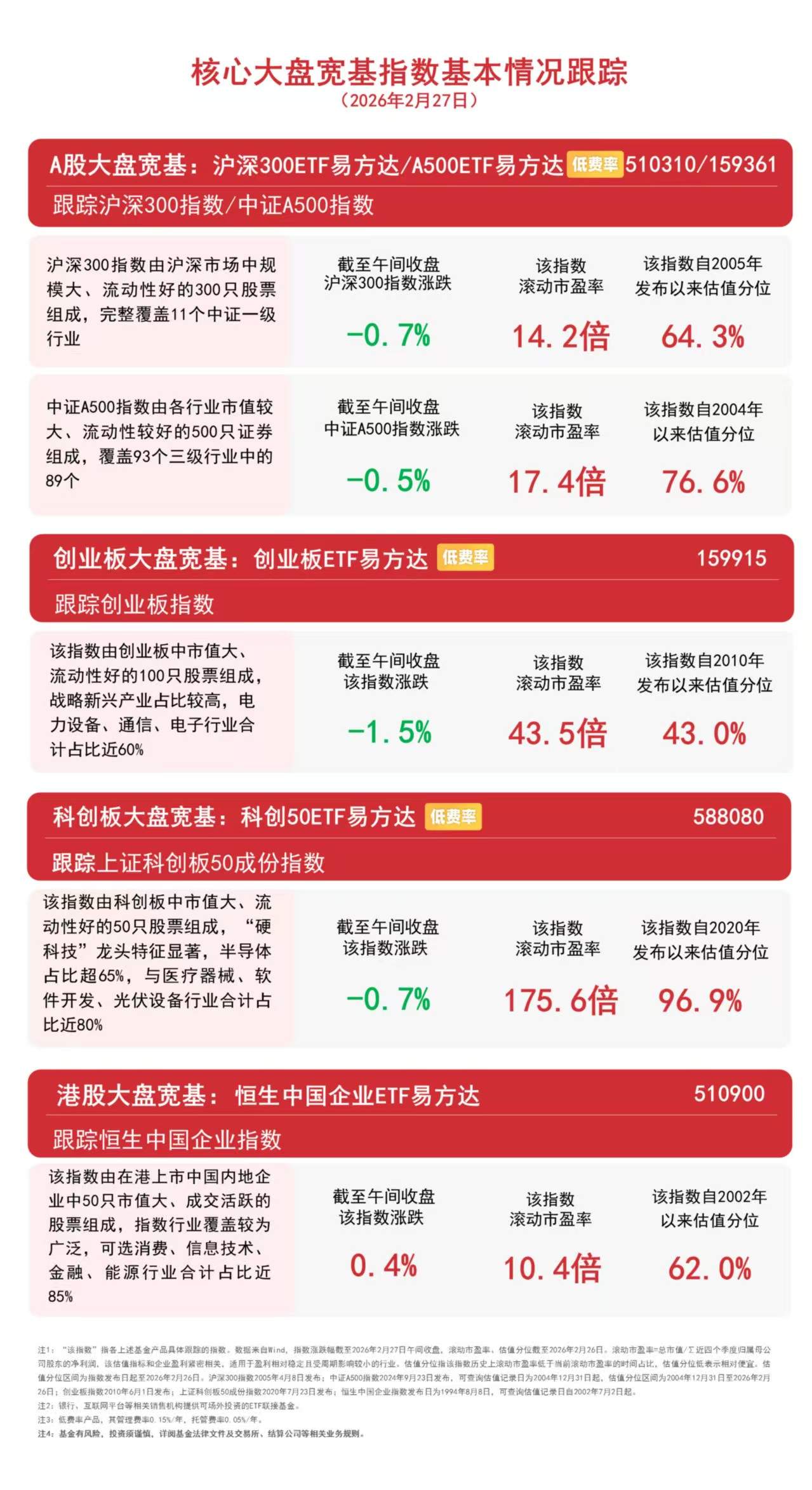
A股三大指数低开震荡,关注沪深300ETF易方达(510310)、A500ETF易方达(159361)等产品投资机会
Mei Ri Jing Ji Xin Wen· 2026-02-27 09:35
Core Viewpoint - The A-share market experienced a low opening and fluctuated throughout the morning session, with significant trading activity across various sectors, indicating mixed investor sentiment and sector performance [1]. Group 1: Market Performance - The three major A-share indices opened lower, with the Shanghai Composite Index briefly turning positive, while the total trading volume in the Shanghai, Shenzhen, and Beijing markets reached 1.6 trillion yuan [1]. - By midday, the CSI 500 Index fell by 0.5%, the CSI 300 Index decreased by 0.7%, the ChiNext Index dropped by 1.5%, and the STAR Market 50 Index declined by 0.7% [1]. - The Hang Seng China Enterprises Index increased by 0.4%, contrasting with the declines in the A-share indices [1]. Group 2: Sector Performance - Sectors such as rare earths, rare metals, cloud computing, software, and tourism showed notable gains, while construction materials, engineering machinery, wafer industry, copper-clad laminates, and CPO sectors faced declines [1]. - The CSI 300 Index consists of 300 stocks with good liquidity, covering 11 primary industries, and has a rolling P/E ratio of 14.2 times [3]. - The CSI 500 Index is made up of 500 securities with good liquidity, covering 89 out of 93 tertiary industries, and has a rolling P/E ratio of 17.4 times [3].
小摩下调Snowflake目标价至245美元
Ge Long Hui A P P· 2026-02-27 09:08
Group 1 - Morgan Stanley has lowered the target price for Snowflake from $268 to $245 while maintaining an "overweight" rating [1]


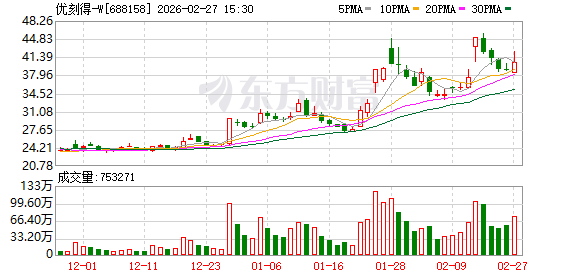
优刻得(688158.SH):2025年净亏损7668.32万元
Ge Long Hui A P P· 2026-02-27 08:58
Core Viewpoint - The company reported a significant improvement in its financial performance for the year 2025, with a notable increase in revenue and a substantial reduction in losses compared to the previous year [1] Financial Performance Summary - The company achieved an operating revenue of 1,699.9461 million yuan, representing a year-on-year increase of 13.11% [1] - The operating profit was reported at -63.7625 million yuan, reflecting a year-on-year reduction in losses by 72.02% [1] - The total profit amounted to -64.0489 million yuan, with a year-on-year reduction in losses of 72.44% [1] - The net profit attributable to the parent company's owners was -76.6832 million yuan, showing a year-on-year reduction in losses by 68.19% [1] - The net profit attributable to the parent company's owners, excluding non-recurring gains and losses, was -146.1467 million yuan, with a year-on-year reduction in losses of 41.32% [1] Factors Influencing Performance - The increase in operating revenue by 13.11% was a key factor in the improved financial results [1] - The gross profit margin improved from 18.86% in the previous year to 25.83% [1] - There was a significant increase in investment income from associated enterprises, contributing positively to the overall performance [1]

中国AI调用量首超美国,引发冰火两重天!国产算力、云计算、数据中心掀涨停潮,英伟达一天蒸发1.77万亿
Mei Ri Jing Ji Xin Wen· 2026-02-27 08:45
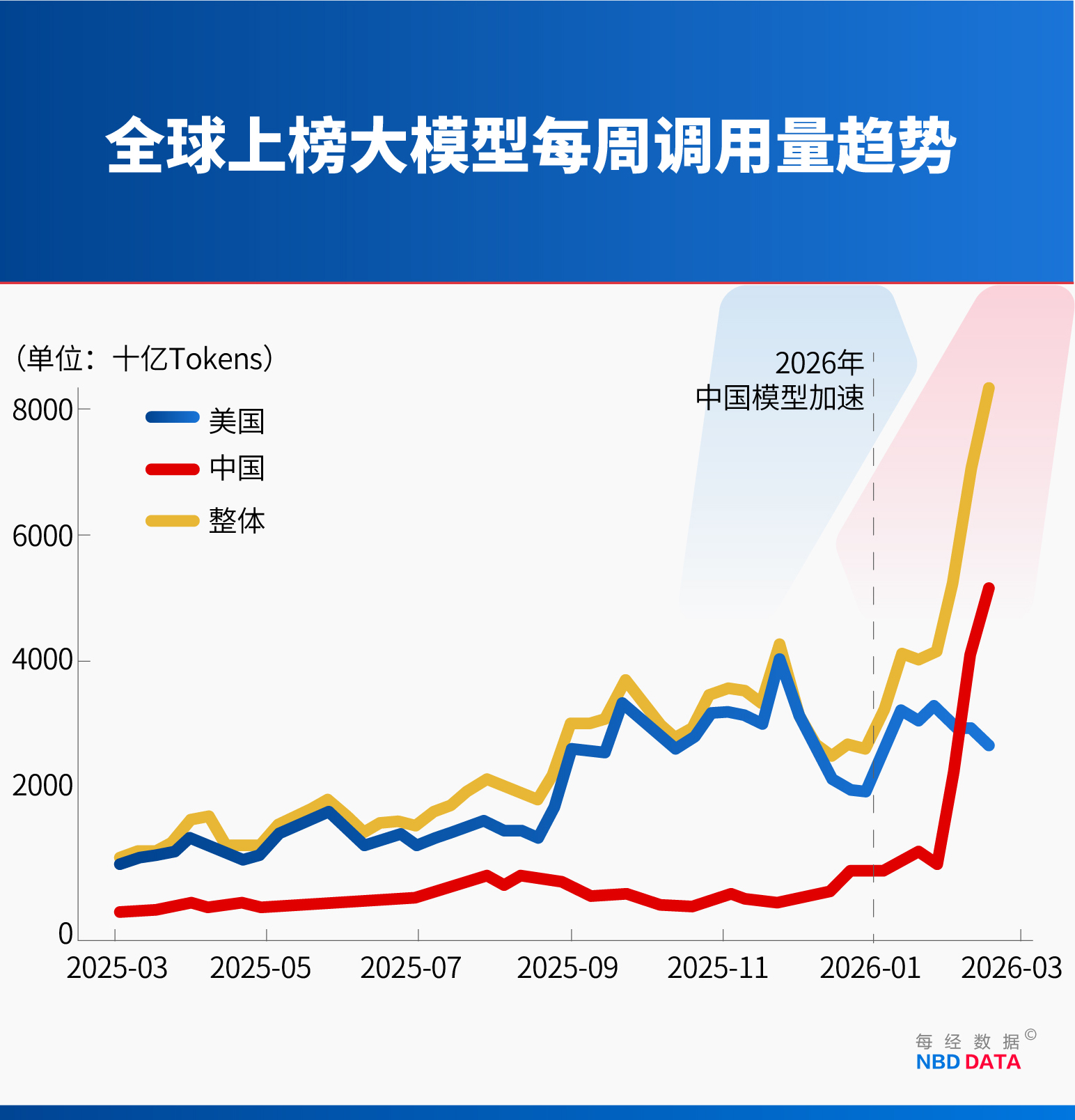
Core Viewpoint - The dramatic market reactions highlight a shift in perception regarding AI chip demand, with Chinese AI models gaining traction and impacting the valuation of companies like Nvidia, which saw a significant drop in market capitalization following its earnings report [1][3][22]. Group 1: Nvidia's Earnings and Market Reaction - Nvidia reported a record Q4 revenue of $68.1 billion, a 73% increase year-over-year, with an adjusted gross margin of 75.2%, exceeding market expectations [3][22]. - Despite strong earnings, Nvidia's stock fell by 5.5%, resulting in a market cap loss of nearly $260 billion (approximately ¥1.77 trillion), marking its largest single-day drop since April 2025 [1][3]. - The decline in Nvidia's stock also affected other chip manufacturers, including Broadcom, AMD, and TSMC, which experienced varying degrees of stock price decreases [3][22]. Group 2: Rise of Chinese AI Models - Data from OpenRouter indicates that, as of February 2026, the weekly API call volume for Chinese AI models surpassed that of the U.S. for the first time, reaching 4.12 trillion tokens compared to the U.S.'s 2.94 trillion tokens [16][19]. - The call volume for Chinese models further increased to 5.16 trillion tokens in the following week, representing a 127% growth over three weeks [16][19]. - Four out of the top five global AI models by call volume are now from China, showcasing a "cluster rise" in the Chinese AI sector [19][22]. Group 3: Market Dynamics and Future Outlook - The market is reassessing the distribution of computational power value, moving away from a linear dependence on high-end GPUs, as Chinese models utilize more efficient architectures [3][22]. - The "Mixture-of-Experts" (MoE) architecture used by many Chinese models significantly reduces the computational cost per token, with a reported 60% reduction in memory usage and up to 19 times improvement in throughput [25][27]. - The cost of processing tokens with Chinese models is substantially lower, with prices around $0.3 per million tokens compared to $5 for comparable overseas products, indicating a cost advantage for Chinese AI [27][28]. Group 4: Implications for Domestic Infrastructure - The success of Chinese AI models is driving a massive demand for domestic computational infrastructure, as global developers increasingly favor these models [22][27]. - China's lower electricity costs, which can be as low as ¥0.2-0.3 per kilowatt-hour compared to $1-1.5 in the U.S. and Europe, further enhance the competitiveness of Chinese AI models [27][28]. - Morgan Stanley predicts a compound annual growth rate of 330% for China's token consumption from 2025 to 2030, suggesting a potential 370-fold increase in just five years [27][28].


优刻得:2025年净利润同比减亏68.19%
Xin Lang Cai Jing· 2026-02-27 08:31
Core Viewpoint - The company UCloud reported a significant reduction in net loss for the year 2025, with a focus on growth in AI-related revenue and improved investment returns from affiliated enterprises [1] Financial Performance - Total operating revenue for 2025 reached 1.7 billion yuan, representing a year-on-year increase of 13.11% [1] - The net profit attributable to the parent company was -76.68 million yuan, showing a year-on-year reduction in loss by 68.19% [1] AI and Investment Insights - Continuous investment in the AIGC sector has led to sustained growth in intelligent computing product revenue, with AI-related income increasing by over 40% year-on-year [1] - The company also experienced a notable improvement in investment income from its affiliated enterprises [1] Quarterly Performance - In Q4, the net profit was 7 million yuan, marking a turnaround from a net loss of 4 million yuan in Q3 [1]
优刻得:2025年营收同比增13.11% Q4净利环比扭亏
Ge Long Hui A P P· 2026-02-27 08:31
Core Viewpoint - The company, Youke De (688158.SH), reported a total operating revenue of 1,699.9461 million yuan for 2025, reflecting a year-on-year increase of 13.11% [1] Financial Performance - Operating profit, total profit, and net profit attributable to the parent company decreased by 72.02%, 72.44%, and 68.19% year-on-year, respectively [1] - The company's Q4 net profit was 0.07 million yuan, marking a turnaround from losses [1] Sector Performance - Continuous investment in the AIGC sector has led to sustained growth in intelligent computing product revenue, with AI-related revenue increasing by over 40% year-on-year [1] - The company also saw a significant improvement in investment income from its equity investments [1]
优刻得:2025年归母净利润亏损7668.32万元
Mei Ri Jing Ji Xin Wen· 2026-02-27 08:25
Group 1 - The company reported a total operating revenue of 1.7 billion yuan for the fiscal year 2025, representing a year-on-year growth of 13.11% [2] - The net profit attributable to the owners of the parent company was -76.68 million yuan, compared to -241 million yuan in the same period last year [2]