
美容护理

Search documents
A股市场大势研判:三大指数跌超1%
Dongguan Securities· 2025-12-16 23:30
Market Performance - The three major indices in the A-share market fell by over 1%, with the Shanghai Composite Index closing at 3824.81, down 1.11% [2] - The Shenzhen Component Index decreased by 1.51% to 12914.67, while the ChiNext Index dropped by 2.10% to 3071.76 [2] Sector Rankings - The top-performing sectors included retail trade (up 1.32%), beauty care (up 0.66%), and social services (up 0.13%) [3] - The worst-performing sectors were telecommunications (down 2.95%), comprehensive (down 2.81%), and non-ferrous metals (down 2.81%) [3] Future Outlook - The report indicates a cautious market sentiment as the year-end approaches, with all three major indices experiencing declines [4][5] - The report highlights that recent meetings, including the December Federal Reserve meeting, align with market expectations, which may help stabilize risk appetite in the equity market [5] - Economic policies are expected to continue supporting growth, with a projected 14% year-on-year increase in total installed power generation capacity by 2025, and total electricity consumption expected to exceed 10 trillion kilowatt-hours for the first time [5] - Sectors to watch include non-ferrous metals, banking, public utilities, transportation, and TMT (Technology, Media, and Telecommunications) [5]
【16日资金路线图】两市主力资金净流出超520亿元 美容护理行业实现净流入
Zheng Quan Shi Bao· 2025-12-16 12:44
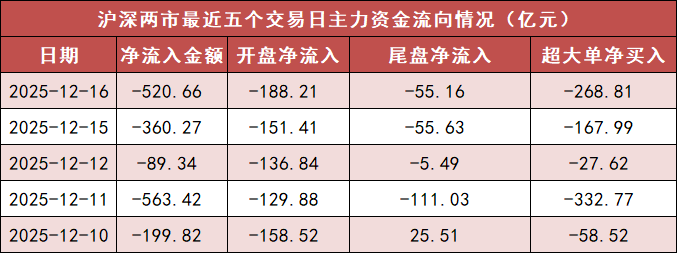
12月16日,A股市场整体下跌。 截至收盘,上证指数收报3824.81点,下跌1.11%;深证成指收报12914.67点,下跌1.51%;创业板指收报3071.76点,下跌2.1%。两市合计成交17241.73亿 元,较上一交易日减少492.66亿元。 1.两市主力资金净流出超520亿元 今日沪深两市主力资金开盘净流出188.21亿元,尾盘净流出55.16亿元,两市全天主力资金净流出520.66亿元。 | | | 沪深两市最近五个交易日主力资金流向情况(亿元) | | | | --- | --- | --- | --- | --- | | 日期 | | 净流入金额 开盘净流入 | 尾盘净流入 | 超大单净买入 | | 2025-12-16 | -520. 66 | -188. 21 | -55. 16 | -268. 81 | | 2025-12-15 | -360. 27 | -151.41 | -55. 63 | -167.99 | | 2025-12-12 | -89.34 | -136. 84 | -5.49 | -27. 62 | | 2025-12-11 | -563.42 | -129.88 | ...

【16日资金路线图】两市主力资金净流出超520亿元 美容护理行业实现净流入
证券时报· 2025-12-16 12:42
12月16日,A股市场整体下跌。 截至收盘,上证指数收报3824.81点,下跌1.11%;深证成指收报12914.67点,下跌1.51%;创业板指收报3071.76点,下跌2.1%。两市合计成交17241.73亿元,较上一 交易日减少492.66亿元。 1. 两市主力资金净流出超520亿元 今日沪深两市主力资金开盘净流出188.21亿元,尾盘净流出55.16亿元,两市全天主力资金净流出520.66亿元。 3.美容护理行业实现净流入 | 行业 | 涨跌幅 | 净流入资金 | 资金流入较多个股 | | --- | --- | --- | --- | | | | (亿元) | | | 美容护理 | 0. 32% | 1.42 | 爱美客 | | 商贸零售 | 1. 32% | -1. 62 | 供销大集 | | 社会服务 | -0. 29% | -3. 10 | 中公教育 | | 食品饮料 | 0. 28% | -4. 12 | 伊利股份 | | 综合 | -2. 33% | -4. 55 | 南京新自 | | | | 资金净流出居前的行业 | | | 行业 | 涨跌幅 | 净流入资金 | 资金流出较多个股 | | ...

美容护理行业今日净流入资金1.05亿元,爱美客等5股净流入资金超千万元
Zheng Quan Shi Bao Wang· 2025-12-16 09:17
Core Insights - The beauty care industry experienced a net inflow of funds amounting to 105 million yuan on December 16, with a sector increase of 0.66% despite the Shanghai Composite Index declining by 1.11% [1] Industry Performance - Among the sectors, beauty care ranked second in terms of growth, following retail trade and social services, which rose by 1.32% and 0.13% respectively [1] - The beauty care sector had 29 stocks, with 15 rising and 14 falling in value [1] Fund Flow Analysis - The total net inflow of funds in the beauty care sector was 105 million yuan, with 17 stocks experiencing net inflows [1] - The top three stocks with significant net inflows were: - Aimeike (爱美客) with 39.98 million yuan - Qingsong Co. (青松股份) with 20.96 million yuan - Shuiyang Co. (水羊股份) with 20.30 million yuan [1] - The stocks with the highest net outflows included: - Proya (珀莱雅) with 8.62 million yuan - Zhongshun Jierou (中顺洁柔) with 6.81 million yuan - Yanjian Co. (延江股份) with 5.90 million yuan [1] Stock Performance - Notable stock performances included: - Aimeike (爱美客) increased by 2.02% - Qingsong Co. (青松股份) increased by 1.03% - Shuiyang Co. (水羊股份) increased by 1.20% [1] - Conversely, stocks like Proya (珀莱雅) and Zhongshun Jierou (中顺洁柔) saw declines in their values [1]






“扩大内需”战略定调,大消费板块掀涨停潮
Huan Qiu Wang· 2025-12-16 08:11
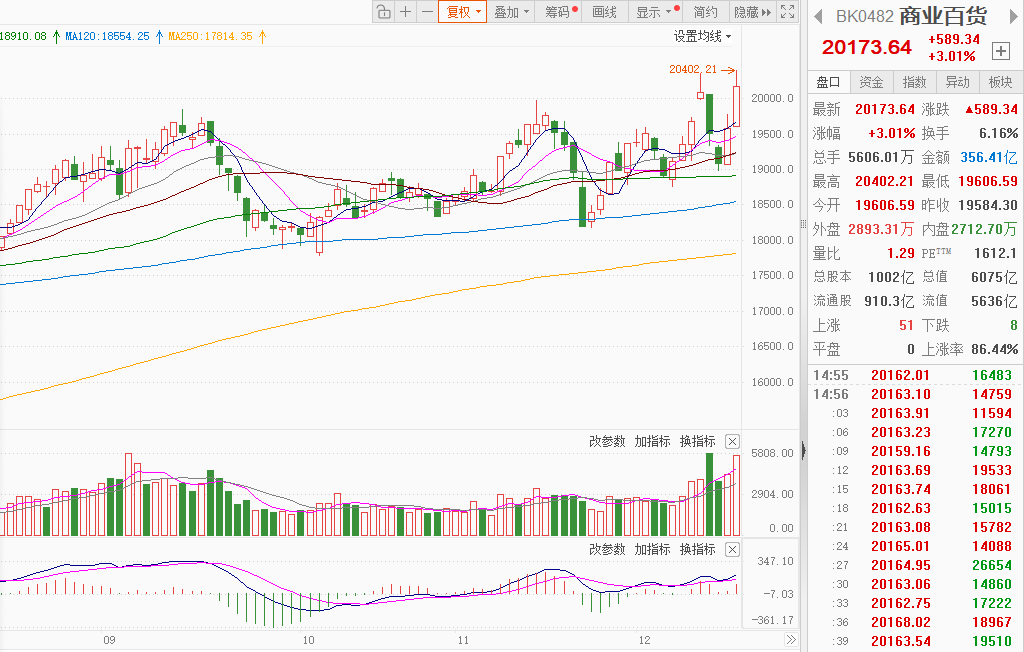
Core Viewpoint - The consumer sector experienced a significant rally on December 16, driven by supportive policies aimed at expanding domestic demand, which has been elevated to a strategic priority for the economy [1][4]. Group 1: Policy Support - The article emphasizes that expanding domestic demand is crucial for economic stability and security, and it is not merely a temporary measure but a strategic initiative [1]. - The National Development and Reform Commission highlighted the need to unleash consumer potential through various measures, including special actions to boost consumption and plans to increase residents' income [1][4]. - The Central Economic Work Conference has prioritized "maintaining demand as the main driver and building a strong domestic market" as a key task for the upcoming year, reflecting the government's commitment to boosting consumption [1]. Group 2: Market Dynamics - The consumer sector's attractiveness is underscored by its current low valuation after a prolonged adjustment period, indicating a significant technical rebound demand [3]. - For instance, the food and beverage sector has a current price-to-earnings (P/E) ratio of 20.8, with a percentile ranking of only 13.04%, compared to over 64 times at its peak in February 2021, highlighting its investment value [3]. - Major consumer companies like Kweichow Moutai, Midea Group, and Haier Smart Home reported year-on-year profit growth in the first three quarters, demonstrating strong operational resilience [3]. Group 3: Investment Opportunities - A number of consumer stocks are showing characteristics of a "golden pit," where stock prices have declined despite strong earnings growth, presenting potential investment opportunities [3]. - Examples include leading condiment company Haitian Flavoring, which saw its stock price drop over 18% while achieving a 10.54% increase in net profit, and TCL Technology, which experienced a 16% decline in stock price with an 18.45% rise in net profit [3]. - Other companies like Xiangyuan Cultural Tourism, Xueda Education, and Bear Electric also fit this profile, offering potential for value investors [3]. Group 4: Future Outlook - Recent initiatives by the Ministry of Commerce and financial regulators to expand and upgrade rural consumption, along with credit support, open new avenues for market expansion [4]. - Analysts expect that the focus on expanding domestic demand will lead to more specific policies in the future, enhancing investor confidence in the consumer sector [4]. - The outlook for traditional consumption is anticipated to improve, while new consumption trends may experience rotation, but overall, the consumer sector is expected to maintain sustainability underpinned by both policy and market fundamentals [4].






今日22只A股跌停 有色金属行业跌幅最大
Zheng Quan Shi Bao Wang· 2025-12-16 04:36
证券时报·数据宝统计,截至上午收盘,今日沪指跌1.22%,A股成交量782.45亿股,成交金额11396.19 亿元,比上一个交易日减少4.85%。个股方面,917只个股上涨,其中涨停35只,4467只个股下跌,其 中跌停22只。从申万行业来看,商贸零售、美容护理等涨幅最大,涨幅分别为1.11%、0.86%;有色金 属、综合、电力设备等跌幅最大,跌幅分别为3.52%、3.18%、3.02%。(数据宝) (文章来源:证券时报网) | 申万行业 | 行业涨跌(%) | 成交额(亿元) | 比上日(%) | 领涨(跌)股 | 涨跌幅(%) | | --- | --- | --- | --- | --- | --- | | 商贸零售 | 1.11 | 360.75 | 50.13 | 永辉超市 | 10.10 | | 美容护理 | 0.86 | 32.62 | 15.33 | 百亚股份 | 4.08 | | 石油石化 | -0.25 | 57.76 | 17.23 | 恒逸石化 | -8.87 | | 食品饮料 | -0.32 | 227.32 | 1.03 | 交大昂立 | -6.38 | | 银行 | -0.37 ...
【盘中播报】沪指跌0.96% 有色金属行业跌幅最大
Zheng Quan Shi Bao Wang· 2025-12-16 03:36
| 申万行业 | 行业涨跌(%) | 成交额(亿元) | 比上日(%) | 领涨(跌)股 | 涨跌幅(%) | | --- | --- | --- | --- | --- | --- | | 商贸零售 | 1.85 | 308.27 | 61.38 | 永辉超市 | 10.10 | | 美容护理 | 1.21 | 24.77 | 21.85 | 百亚股份 | 3.73 | | 社会服务 | 0.23 | 74.81 | 30.43 | 中公教育 | 9.92 | | 食品饮料 | -0.18 | 180.17 | -1.44 | 交大昂立 | -5.53 | | 纺织服饰 | -0.28 | 65.88 | -2.50 | 兴业科技 | -5.19 | | 家用电器 | -0.32 | 97.81 | -18.71 | 海立股份 | -3.82 | | 农林牧渔 | -0.39 | 157.05 | -0.35 | 中粮糖业 | -5.41 | | 轻工制造 | -0.46 | 146.07 | -14.36 | 中源家居 | -10.01 | | 非银金融 | -0.47 | 178.60 | -22.24 ...
湘财证券晨会纪要-20251216
Xiangcai Securities· 2025-12-16 00:52
Industry Overview - The retail trade sector experienced a slight decline of 0.21% last week, closing at 2305.32 points, underperforming the CSI 300 index by 0.13 percentage points [2] - The performance of various segments within the retail sector varied, with general retail increasing by 1.37% while trade II and professional chain segments saw declines of 3.48% and 1.49% respectively [2] - Notable performers included Dongbai Group (+46.2%) and Yonghui Supermarket (+27.2%), while companies like Huihong Group (-8.4%) and ST Huke (-8.4%) lagged behind [2] Financial Metrics - The current Price-to-Earnings (PE) ratio for the retail sector stands at 48.75X, reflecting a week-on-week increase of 0.15 percentage points, with a one-year range of 31.27X to 51.44X [5] - The Price-to-Book (PB) ratio is currently at 1.96X, with a one-year range between 1.52X and 2.1X [5] Economic Conference Insights - The National Retail Innovation Development Conference highlighted the retail sector's critical role in boosting domestic consumption and economic recovery, emphasizing the need for a modern retail system [6] - The conference underscored the shift from scale expansion to quality and service-driven growth, positioning retail as a key focus for fostering a complete domestic demand system [7] - Emphasis was placed on integrating online and offline channels, with successful companies in supply chain collaboration expected to gain favor [8] Consumer Trends and Recommendations - The consumer market is showing steady growth, with a notable increase in demand for upgraded products, particularly in categories like communication equipment and jewelry [9] - The rise of new and green consumption trends is creating new market growth points, with significant sales increases in smart health devices and organic foods [9] - The report suggests focusing on domestic beauty care brands, especially high-end domestic products, and industries related to emotional consumption as potential investment opportunities [10]
大消费行业周报(12月第2周):坚持内需主导、提振消费-20251215
Century Securities· 2025-12-15 09:40
Investment Rating - The report maintains a positive outlook on the consumer sector, emphasizing the importance of domestic demand and consumption recovery [1]. Core Insights - The consumer sector experienced a decline across various segments, with notable drops in retail, social services, food and beverage, beauty care, home appliances, and textiles [3]. - High-end liquor, particularly Moutai, is showing signs of bottoming out despite a significant price drop, indicating potential recovery as demand stabilizes [3]. - The central economic work conference highlighted the commitment to boosting domestic consumption, with policies aimed at increasing residents' income and optimizing supply of quality goods and services [3]. - The report suggests focusing on service consumption sectors, which have room for growth compared to developed countries [3]. Summary by Sections Market Weekly Review - The consumer sector saw a broad decline, with specific weekly performance metrics indicating negative trends across various sub-sectors [3][5]. - Notable stock performances included significant gains for certain companies, while others faced substantial losses [3][13][14]. Industry News and Key Company Announcements - Recent regulatory approvals and policy initiatives are expected to impact various sectors, including tourism and electric vehicles, with a focus on enhancing consumer experiences and market growth [15][16][19]. - Companies like Tim Hortons and others reported positive financial results, indicating resilience in the consumer market despite broader sector challenges [19][20].

把握年前行情的布局点
Orient Securities· 2025-12-15 00:16
Core Viewpoints - The market is expected to experience a "first dip, then rise" pattern next week, presenting a favorable opportunity for positioning before the year-end market [3][13]. Market Analysis - After a high on Monday, the market entered a phase of fluctuation and adjustment, indicating significant investor divergence. The recent developments, including the Federal Reserve's interest rate decision and the economic work conference, aligned with expectations, providing more certainty and potentially lowering risk assessments. The upcoming "super central bank week" and Japan's interest rate trends may introduce uncertainties that could temporarily suppress risk evaluations [4][14]. Industry Comparison - From March 2023 to the present, the market has seen a consensus expectation for technology and dividend stocks. The report suggests that the trend of extreme risk styles is nearing its end, with future investment opportunities likely to emerge in mid-cap blue-chip stocks, which are anticipated to rise again after a four-year lull [5][15]. Industry Allocation - Investment opportunities are identified in mid-risk stocks, focusing on three main lines: 1. The consumer sector, which has been dormant for years, is approaching a turning point. Stocks in this sector, such as mid-sized liquor, restaurant supply chains, snacks and beverages, home appliances, hotels, human resources, and beauty care, are expected to rebound due to price corrections and supply constraints [6][16]. 2. The cyclical sector is undergoing a revaluation driven by technological empowerment and supply constraints. Attention is drawn to new materials and strategic minor metals (like antimony and rare earths), as well as industrial metals (copper and aluminum) that are experiencing improved supply-demand dynamics, alongside traditional commodities like live pigs and rubber [6][16]. Thematic Investments - The report highlights several thematic investment areas: - **Aerospace and Satellites**: The sector is gaining strength, with expectations for continued event-driven catalysts, particularly in reusable rockets and accelerated industry IPOs [7][17]. - **Nuclear Fusion**: After a prolonged adjustment, the nuclear fusion sector is beginning to rebound, with anticipated industrial catalysts and a shift from theoretical research to engineering practice, suggesting significant future investment demand [7][17]. - **Consumer Sector**: Recent government initiatives to boost consumption indicate that policies aimed at improving domestic demand may become a central theme in 2026, particularly in service consumption [7][17]. - **Semiconductors**: Anticipated expansions in domestic wafer fabrication and the capitalization of leading domestic storage chip manufacturers present opportunities in domestic chip manufacturers, equipment suppliers, and semiconductor materials [8][18]. - **Upstream Price Increases**: The report notes a continuing trend of price increases in the short term, with structural growth in demand and supply constraints providing upward price elasticity for related commodities, particularly in non-ferrous metals, new energy upstream, and chemicals [8][17].