
航运业

Search documents
中远海控(601919.SH)累计回购4053.36万股 耗资6.07亿元
智通财经网· 2025-11-21 10:36
智通财经APP讯,中远海控(601919.SH)公告,公司截至2025年11月21日以集中竞价交易方式累计回购A 股股份4053.36万股,占公司截至2025年10月31日总股本的比例为0.262%,已支付的总金额为6.07亿元 (不含交易费用)。 ...

中远海控累计回购4053.36万股 耗资6.07亿元
Zhi Tong Cai Jing· 2025-11-21 10:34
Group 1 - The company, COSCO SHIPPING Holdings Co., Ltd. (601919.SH), announced that it has repurchased a total of 40.53 million A-shares through centralized bidding transactions as of November 21, 2025 [1] - The repurchased shares account for 0.262% of the company's total share capital as of October 31, 2025 [1] - The total amount paid for the repurchased shares is 607 million yuan, excluding transaction fees [1]
中远海控(01919)11月21日斥资4058.95万港元回购300万股
智通财经网· 2025-11-21 09:29
于同日,斥资1.54亿元人民币回购1031.07万股A股,每股回购价格为14.95-14.98元人民币。 智通财经APP讯,中远海控(01919)发布公告,该公司于2025年11月21日斥资4058.95万港元回购300万股 股份,每股回购价格为13.43-13.63港元。 ...
FICC日报:盘面走势震荡-20251121
Hua Tai Qi Huo· 2025-11-21 02:42
FICC日报 | 2025-11-21 地缘端:以色列国防部长:必须摧毁哈马斯在加沙的地道网络,以色列军队正在不间断地工作以完成这项任务。 动态供给:动态供给:11月份剩余3周周均运力27.58万TEU,WEEK47/48/49周运力分别为27.87/26.9/27.96万TEU。 12月份月度周均运力31.3万TEU,WEEK50/51/52/53周运力分别为33.3/27/31.42/33.47万TEU。11月份共计10个空 班和1个TBN(其中MSC/PA联盟4个空班,双子星联盟1个空班,OA联盟5个空班,OA联盟的1个TBN后续预计均 转为空班)。12月份共计4个TBN和1个空班(OA联盟3个TBN,MSC/PA联盟1个TBN,MSC/PA联盟1个空班)。 12月合约:12月合约交易更多关注节奏问题,预期和现实交相辉映,估值逐步清晰,关注12月份挺价落地成色。四 季度船司需要为下一年长协谈判做准备,为了保证来年收入基本盘稳固,船司会通过供应端调节使得运价处于较 高位置。节奏方面,12月合约节奏预计首先交易涨价预期(10月中旬左右宣布11月份涨价函,10月底有部分船司 再度发布11月下半月涨价函),然后 ...
1-10月第一、二产业固定资产投资完成额同比增速维持正增长 | 高频看宏观
Sou Hu Cai Jing· 2025-11-20 12:58
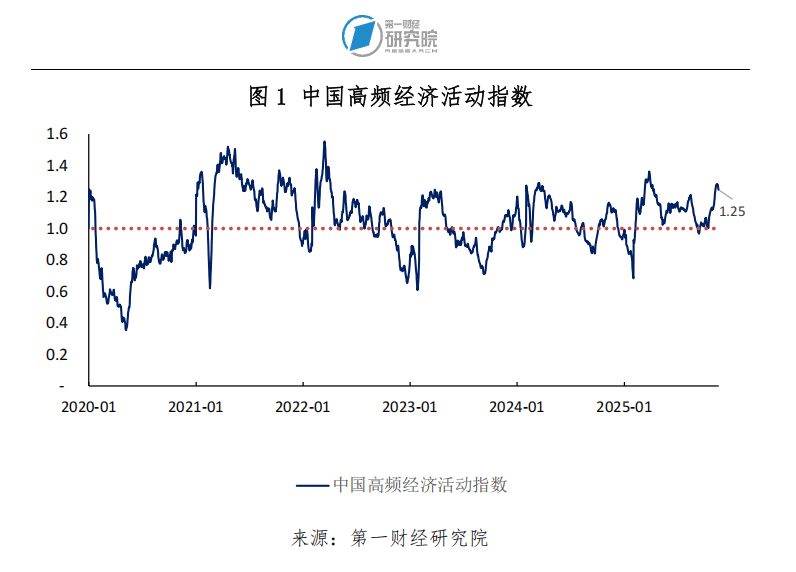
Economic Activity Index - The China High-Frequency Economic Activity Index (YHEI) as of November 18, 2025, is 1.25, a decrease of 0.03 from November 11 [1][3] - Industrial indicators such as the "coastal coal freight index" and "import dry bulk freight index" fell by 0.21 and 0.03 respectively, contributing to the decline in YHEI [1][3] Consumption and Retail - In October, the total retail sales of consumer goods reached 46,291.3 billion yuan, with a year-on-year growth of 2.9%, which is 0.1 percentage points lower than the previous month [25] - The growth rate of commodity retail sales decreased by 0.5 percentage points to 2.8%, marking five consecutive months of decline; however, catering revenue increased by 2.9 percentage points to 3.8%, the highest level since June [25] Foreign Trade - In October, the total import and export value was 520.632 billion USD, a year-on-year decrease of 0.3%, marking the first negative growth since March this year [25] - The import growth rate dropped from 7.4% in September to 1.0%, while the export growth rate fell from 8.3% to -1.1% [25] Industrial Production - The industrial added value for enterprises above designated size grew by 4.9% year-on-year in October, a decrease of 1.6 percentage points from the previous month [2][25] - The mining and manufacturing sectors saw their added value growth rates decline to 4.5% and 4.9% respectively, while the production and supply of electricity, gas, and water rebounded to 5.4% [2][25] Monetary Policy and Interest Rates - As of November 18, the central bank net injected 465.1 billion yuan through open market operations, with a 7-day reverse repurchase rate of 1.4% [6] - The overnight interbank rate rose by 3 basis points to 1.58%, and the 7-day repurchase rate increased by 2 basis points to 1.54% [8][10] Real Estate Market - New housing transaction areas in first and third-tier cities decreased by 1.31% and 12.7% respectively, while second-tier cities saw a significant increase of 39.19% [41][42] - The average daily transaction area for second-hand homes increased by 9.02%, 5.04%, and 15.21% in first, second, and third-tier cities respectively [44] Shipping and Logistics - The coastal bulk freight index rose by 14.65 points to 1250.56, while the Baltic Dry Index increased by 144 points to 2216 [37] - The container freight index for exports was 1094.03, up by 35.86 from November 7 [37] Global Economic Indicators - The US dollar index increased by 0.11 points to 99.59, and the RMB to USD exchange rate rose by 82 basis points to 7.1125 [50][52] - The VIX index rose by 7.41 points to 24.69, indicating increased market volatility [57]

期待香港发挥枢纽作用 赋能全球绿色航运——专访国际航运公会主席格里马尔迪
Xin Hua She· 2025-11-20 02:27
Core Viewpoint - Hong Kong possesses unique competitive advantages in the green shipping sector, positioning itself as a promising center for green marine fuel supply and trading, crucial for the decarbonization of the shipping industry [1][2]. Group 1: Hong Kong's Role in Green Shipping - Hong Kong is recognized as one of the world's top four international shipping centers, characterized by its advanced port facilities, a diverse group of shipowners, and a mature maritime service ecosystem [1]. - The city is expected to play an indispensable role in the global shipping industry's transition towards decarbonization, supported by its open and collaborative approach [1][3]. - The ongoing "Hong Kong Maritime Week 2025" serves as a significant opportunity for the shipping industry to enhance communication and build cooperative bridges, reaffirming support for open free trade and a shared commitment to decarbonization [1]. Group 2: China's Contribution to Green Fuel - China, as the world's largest shipbuilding nation, has made significant advancements in new fuel technologies, including methanol, ammonia, and hydrogen, providing critical opportunities for the global shipping industry [2]. - The country’s ports are equipped to offer specialized new fuel supply services, which is essential for the shipping corridors that facilitate global trade [2]. Group 3: Challenges in the Shipping Industry - The global shipping industry faces a shortage of approximately 100,000 seafarers, with about 200,000 currently employed, necessitating skill upgrades and retraining for around 40% of seafarers to ensure safety [2]. - China's large population can help alleviate the potential worsening of the seafarer shortage, supported by a robust labor force and a clear training direction for green shipping [2]. Group 4: Policy and Collaboration - The decarbonization of the shipping industry relies heavily on clear policy direction, with Hong Kong's government actively engaging with the industry through policy guidance, regulatory optimization, and tax incentives [3]. - Hong Kong's unique positioning under the "One Country, Two Systems" framework allows it to leverage its connection to the mainland and enhance its status as an international shipping center [3]. - There is an expectation for continuous upgrades to port facilities and shore power infrastructure, along with collaboration with other ports in the Guangdong-Hong Kong-Macao Greater Bay Area to facilitate energy transition [3].
美国图谋破产,中国决定暂停反制措施,2个细节表明中方奉陪到底
Sou Hu Cai Jing· 2025-11-19 06:37
Core Viewpoint - The recent suspension of maritime sanctions by both the US and China reflects a strategic retreat by the US, highlighting China's determination to counteract US pressures and protect its interests [4][15][27] Group 1: US Intentions and Actions - The US claims to restore its shipbuilding competitiveness and ensure national security, but it has resorted to administrative measures like the "301 investigation" to impose trade barriers against China [3][5] - The US has enacted a law imposing port fees and tariffs up to 100% on Chinese vessels and equipment, establishing significant trade barriers [3][5] Group 2: China's Response - China has implemented reciprocal measures against the US, aligning its fees with those imposed by the US and expanding the scope to include vessels with over 25% US ownership [6][12] - The Chinese response is structured to minimize global supply chain disruptions, with flexible terms such as limiting fees to five voyages per year and charging only at the first port of call [10][12] Group 3: Impact on US Companies - The measures have financially impacted US companies, with statistics showing that Matson Navigation Company incurred $640,000 in special port fees within a month, potentially leading to an annual cost of $8 million [9][10] - The economic pressure on US firms is significant, especially in light of existing economic challenges [9] Group 4: Global Implications - The suspension of sanctions has broader implications for global trade dynamics, challenging the US's dominant position and raising doubts among allies about US leadership [17][20] - The situation reflects a growing skepticism towards administrative interventions in market competition, with calls for fair competition and multilateral trade reforms gaining traction [19][20] Group 5: Future Outlook - The current suspension of sanctions is seen as a temporary measure, with potential for continued negotiations in maritime and logistics sectors [23][25] - The ongoing competition between the US and China is expected to persist, with China poised to respond firmly to any future US sanctions [27][29]
红利策略阶段占优,防御属性凸显配置价值,国企红利ETF(159515)上涨0.08%
Xin Lang Cai Jing· 2025-11-19 02:45
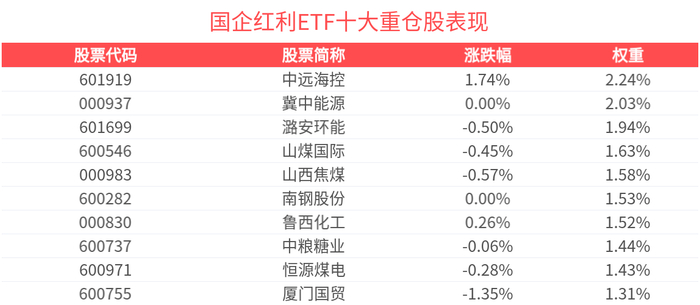
Core Insights - The China Securities State-Owned Enterprises Dividend Index has shown a slight increase of 0.12% as of November 19, 2025, with notable gains in constituent stocks such as Sinopec (up 4.14%) and China National Petroleum (up 3.24%) [1] - The National State-Owned Enterprises Dividend ETF (159515) has also increased by 0.08%, indicating a positive trend in dividend-focused investments [1] - In a weak recovery environment, dividend strategies are currently favored over TMT (Technology, Media, and Telecommunications) sectors, as the latter shows signs of profit-taking [1] - The index reflects the performance of 100 listed companies with high and stable cash dividend yields, selected from state-owned enterprises [1] Market Performance - The top ten weighted stocks in the China Securities State-Owned Enterprises Dividend Index account for 17.08% of the index, with companies like COSCO Shipping and Jizhong Energy leading the list [2] - The trading volume for the National State-Owned Enterprises Dividend ETF reached 203.39 million yuan, with a turnover rate of 4.55% [1] Investment Strategy - Financial analysts suggest focusing on stable dividend assets due to their defensive attributes in the current market environment, as uncertainties remain high [1] - The preference for stable dividend stocks over cyclical ones is emphasized, given the ongoing challenges in global demand and domestic infrastructure development [1]
国元香港晨报-20251117
Guoyuan International· 2025-11-17 05:53
Economic Data - In October, China's retail sales increased by 2.9% year-on-year, while industrial added value rose by 4.9% year-on-year[4] - The housing prices in 70 major cities in China experienced an overall decline in October[4] - The new energy storage installation capacity in China surged over 3000%[4] Market Trends - The U.S. and Switzerland reached a trade agreement, reducing tariffs on Swiss products from 39% to 15%[4] - The 2-year U.S. Treasury yield rose by 1.90 basis points to 3.606%[4] - The 10-year U.S. Treasury yield increased by 2.71 basis points to 4.146%[4] Stock Market Performance - The Nasdaq index closed at 22,900.59, up by 0.13%[5] - The Dow Jones Industrial Average closed at 47,147.48, down by 0.65%[5] - The Hang Seng Index closed at 26,572.46, down by 1.85%[5]
COP30“中国角”边会关注应对气候变化和促进绿色低碳转型国际合作
人民网-国际频道 原创稿· 2025-11-14 03:39
Group 1 - The event "International Cooperation on Climate Change and Promoting Green Low-Carbon Transition" was held during COP30, focusing on global climate change, green economic cooperation, and international collaboration for low-carbon transition [1] - China's Special Envoy for Climate Change Liu Zhenmin emphasized the importance of building a fair, efficient, and inclusive environment for green technology innovation and industrial cooperation [1] - The event featured discussions among experts from various countries, highlighting the need for collaboration in addressing climate challenges [1] Group 2 - The session on "Deepening Green Economic Cooperation to Accelerate Global Climate Goals" highlighted significant advancements in low-carbon technologies like solar and wind energy, with China playing a crucial role in research and large-scale application [2] - Recommendations were made for China and Europe to adopt rational perspectives on supply chain stability and employment concerns, advocating for dialogue over division [2] - Calls were made to reduce trade barriers in green technology and enhance supply chain resilience to promote global low-carbon transition [2] Group 3 - The discussion on "Exploring Paths and Experiences in Green Low-Carbon Transition Cooperation" emphasized the importance of local integration and shared pathways in successful project implementation [3] - The Three Gorges International Energy Investment Group's practices in Brazil showcased the integration of Chinese technology with local needs, creating jobs and protecting biodiversity [3] - Various Chinese representatives shared successful experiences in promoting green development through diverse and systematic approaches [3] Group 4 - The session on "Supporting Global South Countries in Transitioning to Enhance Inclusivity and Fairness" focused on providing favorable financing and technical assistance to ensure equitable benefits from green transitions for developing countries [3]