航空航天

Search documents
“十五五”规划首提航天强国,航空航天ETF(159227)连续12日净流入,规模再创新高
Sou Hu Cai Jing· 2025-11-04 03:13
Core Insights - The A-share market experienced a collective pullback on November 4, with the Aerospace ETF (159227) declining by 1.30% and achieving a transaction volume of 65.51 million yuan, maintaining its position as the leader in its category [1] - The Aerospace ETF has seen a continuous inflow of funds for 12 trading days, accumulating a total of 476 million yuan, with its latest scale reaching a record high of 1.781 billion yuan since its inception [1] - The Fourth Plenary Session of the Central Committee has included "building a strong aerospace nation" in the 14th Five-Year Plan, emphasizing the development of strategic emerging industries such as aerospace and low-altitude economy [1] Industry Developments - The national 14th Five-Year Plan suggests accelerating the development of the aerospace and low-altitude economy industries, with various regions implementing policies to support low-altitude economic development [1] - State-owned enterprises are increasingly establishing low-altitude economic companies, indicating a strategic focus on this new sector [1] - Application scenarios such as low-altitude logistics and low-altitude cultural tourism are leading the way, with major eVTOL manufacturers securing orders and expanding overseas, showcasing a clear trend towards large-scale development of the industry [1] ETF Composition - The Aerospace ETF closely tracks the National Aerospace Index, covering key industry chain segments including aerospace equipment, satellite navigation, and new materials [2] - The constituent stocks are selected from leading companies in the field, with a significant focus on emerging areas such as large aircraft manufacturing and commercial aerospace, where the commercial aerospace concept accounts for 51.83% of the ETF's weight [2]
翻倍龙头股,拟并购重组!获深交所受理
Zhong Guo Zheng Quan Bao· 2025-11-03 23:47
Company News - Yaxing Chemical is planning to acquire control of Tianyi Chemical through a combination of share issuance and cash payment, with the stock suspended from trading starting November 4, 2023, for up to 10 trading days [5] - Daon Co. intends to acquire 100% of Shandong Daon Titanium Industry through share issuance and cash payment, with the application accepted by the Shenzhen Stock Exchange. The company has seen a stock price increase of 110.62% this year, with a recent price of 24.6 yuan per share and a market capitalization of 11.769 billion yuan [6] - Shengli Co. is planning to acquire gas-related assets from its controlling shareholder and its affiliates, with stock suspended since October 28, 2023, for up to 10 trading days [6] - Hangxin Technology announced the resumption of trading for its stock and convertible bonds starting November 4, 2023, following a share transfer agreement that resulted in a change of control [7] - Bihua Co. reported abnormal stock price fluctuations, with a cumulative increase of over 20% in three consecutive trading days. The actual reduction in shares by the controlling shareholder exceeded the planned amount due to an operational error [8] - Siwei Liekong's vice president has been placed under investigation, leading to a 9.87% drop in stock price on November 3, 2023 [9] - Biangao Co. is in the process of planning a change of control, with stock suspended since October 31, 2023, and further suspension expected [9] - Chihong Zn & Ge announced a cash dividend distribution plan, with a total payout of 151 million yuan based on a share base of 5.04 billion shares [10] - Hailianxun is set to suspend trading starting November 5, 2023, due to a share exchange and acquisition process [11] - *ST Gaohong received a decision for stock delisting due to continuous low trading prices, with the delisting process expected to occur within 15 trading days [12] Industry News - The People's Bank of China and the Bank of Korea have renewed a bilateral currency swap agreement with a scale of 400 billion yuan, effective for five years, aimed at enhancing financial cooperation and trade facilitation [2] - The Ministry of Industry and Information Technology and the Ministry of Water Resources have jointly released a development plan for high-quality water-saving equipment from 2025 to 2030, focusing on smart manufacturing and the integration of new technologies [3] - The National Standards Committee has approved a national standard for commercial cleaning robots, set to be implemented on May 1, 2026, to improve product quality and user experience [4] - High-end equipment for large-size OLED screen production has been launched, marking a breakthrough in China's display equipment sector [4]

21评论丨为何要保持制造业合理比重?
2 1 Shi Ji Jing Ji Bao Dao· 2025-11-03 22:35
Core Insights - The recent proposal by the Central Committee emphasizes the importance of a modern industrial system as the material and technological foundation for Chinese-style modernization, focusing on the real economy and aiming for intelligent, green, and integrated development [2][3] Group 1: Strategic Focus - The primary strategic task for the 15th Five-Year Plan has shifted from technological innovation to industrial system construction and real economy development, with technology now serving as a supporting role [2][3] - The dual motivations for this strategic shift include the transition of development stages and the evolution of competitive paradigms, highlighting the need for innovation to be rooted in the industrial context to enhance economic resilience and competitiveness [3] Group 2: Manufacturing Sector Importance - The proposal underscores the critical role of maintaining a reasonable proportion of manufacturing in the economy, which is essential for strengthening the foundation of the real economy [3][4] - Historical data indicates that countries like Japan and Germany maintain a stable manufacturing value-added ratio of around 20% of GDP, which supports their international competitiveness [4] Group 3: Development Pathways - The construction of a modern industrial system should focus on four key areas: optimizing the manufacturing tier, promoting service industry development, solidifying infrastructure, and enhancing the market environment [5][6] - Specific actions include upgrading traditional industries, fostering new industries as core pillars, and innovating regulatory frameworks to support future industries [5][6] - The service sector is to be expanded and improved, integrating with advanced manufacturing and modern agriculture to enhance overall economic efficiency [6]

把经济建设这个中心抓得更牢
Sou Hu Cai Jing· 2025-11-03 21:52
Core Insights - The latest data from the National Bureau of Statistics indicates that China's automotive manufacturing, railway, shipping, aerospace, and other transportation equipment manufacturing industries have maintained double-digit growth year-on-year in the first three quarters [1] - High-tech manufacturing sectors, such as intelligent drone manufacturing and intelligent vehicle-mounted equipment manufacturing, have seen significant increases in value added, with growth rates of 59.9% and 25.1% respectively [1] - The 20th Central Committee of the Communist Party emphasizes the importance of economic construction, high-quality development, reform and innovation, and the need to meet the growing demands of the people [1] Investment and Economic Strategy - The focus on enhancing quality while expanding total volume is crucial, with a need to balance reasonable growth rates with structural optimization [2] - Key performance indicators will include total factor productivity, innovation capability, industrial resilience, resource allocation efficiency, and public service quality [2] - The approach aims to stabilize short-term growth while laying a foundation for long-term high-quality development [2] Industrial Development - Strengthening and optimizing the real economy is essential for implementing the focus on economic construction at the industrial and supply side [3] - The development of the domestically produced C919 aircraft exemplifies the need for a coordinated system involving research, manufacturing, certification, market expansion, and talent cultivation [3] - There is a call to address weaknesses in the industrial supply chain, particularly in core components, basic processes, and key materials [3] Market Integration - Promoting a unified national market is vital for enhancing domestic circulation and strengthening the domestic market [4] - Efforts will be made to streamline regulations and eliminate unreasonable regional barriers to improve the business environment [4] - The focus will also be on optimizing consumer environments and directing investments towards key areas that address shortcomings and enhance capabilities [4] Innovation and Productivity - Cultivating new productive forces is essential for aligning economic construction with innovation across various chains, including industry, finance, and talent [5] - Emphasis will be placed on demand-driven research organization and improving the efficiency of transitioning from pilot projects to large-scale applications [5] - Continuous reforms in key areas such as property rights protection, market-oriented resource allocation, and financial systems are necessary to remove obstacles to high-quality development [5]
常州今创航空航天产业投资有限公司成立
Zheng Quan Ri Bao· 2025-11-03 13:40
Group 1 - The establishment of Changzhou Jinchang Aerospace Industry Investment Co., Ltd. has been announced, with a registered capital of 100 million yuan [1] - The legal representative of the new company is Gao Feng, and it is wholly owned by Jinchang Group (603680) [1] - The business scope includes research and testing of micro-satellites, production and manufacturing of micro-satellites, and research and manufacturing of rocket launch equipment [1]

华秦科技(688281)季报点评:Q3环比好转 在手订单充足
Xin Lang Cai Jing· 2025-11-03 10:39
Core Insights - The company reported a revenue of 801 million yuan for the first three quarters of 2025, representing a year-over-year increase of 8.6%, while the net profit attributable to shareholders was 243 million yuan, down 21.5% year-over-year [1] - The third quarter of 2025 saw a revenue of 285 million yuan, up 12.9% year-over-year and 3.7% quarter-over-quarter, with a net profit of 97 million yuan, reflecting a year-over-year increase of 3.73% and a quarter-over-quarter increase of 17.3% [1] - The gross margin faced pressure, decreasing to 47.7%, down 6.9 percentage points year-over-year, attributed to product structure transformation and high costs during the ramp-up phase of subsidiaries [1] Financial Performance - The operating expense ratio increased to 24.6%, up 6.8 percentage points year-over-year, with R&D expense ratio at 13.1%, an increase of 5.3 percentage points [2] - Operating cash flow for the first three quarters was 251 million yuan, a significant increase of 60.6% year-over-year [2] - Contract liabilities rose to 32 million yuan, a 60.5% increase from the beginning of the year, indicating a substantial increase in orders [2] Business Development - The company is diversifying its product offerings, with significant growth in special functional materials and aerospace components, and several new products in the trial production phase [2][4] - Subsidiaries are showing rapid growth, with Huayin Hangfa achieving a revenue of 103 million yuan, up 143% year-over-year, and signing contracts worth approximately 244 million yuan [2][3] - Huayin Guangsheng reported a revenue of 10 million yuan, up 184.9% year-over-year, with a strong order backlog [3] Capacity Expansion - The company is accelerating the construction of its main and subsidiary projects, with production capacity gradually ramping up [4] - The Huayin Hangfa project is nearing full production by the end of 2025, while the second phase of the Ruihua Sheng project is expected to enhance capacity by the end of 2025 [4] Investment Outlook - The company is focusing on a diversified product layout, covering five main business areas, which is expected to enhance business scale as products transition to mass production [4] - Projected net profits for 2025-2027 are estimated at 401 million, 535 million, and 729 million yuan, with corresponding EPS of 1.47, 1.96, and 2.68 yuan, indicating a favorable investment outlook [4]

中国开放新格局:为全球经济巨轮注入"定海神针"
Sou Hu Cai Jing· 2025-11-03 08:57
Group 1 - China's total import and export value of goods exceeded 42 trillion yuan in 2023, maintaining its position as the world's largest goods trading nation for six consecutive years, driven by a market of 1.4 billion people [1] - The Shanghai Free Trade Zone sees over 10 billion yuan worth of cross-border goods flowing daily, while Hainan Free Trade Port showcases duty-free products from over 150 countries, reflecting China's commitment to global trade [3] - The China-Europe Railway Express has reached 25 European countries and 217 cities, with over 80,000 trains operated, enhancing logistics connectivity between China and Southeast Asia [5] Group 2 - Major foreign investment projects in China, such as Tesla's Shanghai Gigafactory and BASF's integrated base in Zhanjiang, indicate international capital's confidence in the Chinese economy, with actual foreign investment surpassing 1.2 trillion yuan in 2022 [7] - National-level exhibitions like the Canton Fair and the China International Import Expo facilitate global trade, with the sixth CIIE featuring over 3,400 companies from 128 countries and an intended transaction amount of 78.4 billion USD [9] - Financial openness is accelerating, with the "Southbound Bond Connect" leading to a threefold increase in domestic investors holding Hong Kong and Macau bonds, and the RMB's share in global payments rising to 3.2%, making it the fourth most used currency [9] Group 3 - China continues to lower import tariffs on 1,585 items and has signed 19 free trade agreements with 26 countries and regions, contributing to the formation of the world's largest free trade area under RCEP [9] - China's role as a "world factory," "global market," and "innovation hub" is crucial for stabilizing the global economy, as highlighted by the UN Conference on Trade and Development [9] - China's higher level of openness is shaping a new development pattern, with its economic growth providing strong momentum for the global economy [10]
天津前三季度固定资产投资同比增长3%
Zhong Guo Fa Zhan Wang· 2025-11-03 08:45
Core Viewpoint - Tianjin's investment growth in the first three quarters reached 3% year-on-year, ranking 10th nationwide, indicating a consistent performance above the national average amid a slowdown in overall investment growth [1] Group 1: Project Construction Support - The city is implementing a project-driven strategy, focusing on major industrial projects as a foundation for high-quality development, with significant media coverage highlighting the effectiveness of these initiatives [2] - A total of 668 ongoing projects with an investment of 1.32 trillion yuan have resumed work, and 248 new projects with an investment of 241.6 billion yuan have commenced [2] - The city aims to ensure that key projects contribute to over 80% of the total investment in construction projects [2] Group 2: Financial Support Measures - Tianjin is actively seeking national policy opportunities and establishing a top-down planning mechanism to secure funding from various sources, including central budget investments and local government bonds [3] - The city is managing a dynamic list of issues related to central policy funding projects to promote project acceleration [3] Group 3: Service and Guarantee Mechanisms - A three-dimensional service mechanism has been established to enhance support for key enterprises and projects, improving investment confidence [3] - The city is focusing on providing essential resources such as land and energy to ensure project success [3] Group 4: Investment Quality and Structure - The city is expanding industrial investments, with a 6.5% growth in industrial investment, slightly above the national average [4] - Infrastructure investment has increased by 12.8%, maintaining double-digit growth for two consecutive years [4] - Strategic emerging industries saw a 15.2% increase in investment, accounting for 37.9% of total investments [5] Group 5: Social Investment and Public Welfare - Social sector investments grew by 22.6%, enhancing the well-being of the population through various projects [5] Group 6: Collaborative Efforts - The city is fostering a collaborative environment among various districts and departments to ensure project accountability and accelerate investment growth [7] - Fourteen out of sixteen districts achieved positive growth, with twelve districts outpacing the city's overall growth rate [7] - Key enterprises are playing a crucial role in supporting major projects and driving investment [8]
午后拉升,航空航天ETF(159227)翻红,已连续11日净流入
Mei Ri Jing Ji Xin Wen· 2025-11-03 07:38
11月3日,A股三大指数午后反弹,先后翻红,截至14点26分,航空航天ETF(159227)涨幅0.44%,成 交额达1.32亿元,稳居同类第一,持仓股中国海防、中国卫星、航宇科技、国博电子、亚光科技、华力 创通、海特高新等股涨幅居前。 近期,《中共中央关于制定国民经济和社会发展第十五个五年规划的建议》发布,提出培育壮大新兴产 业和未来产业。加快新能源、新材料、航空航天、低空经济等战略性新兴产业集群发展。 方正证券表示,根据测算,2028年GW星座将达成"百箭千星"计划,2035年将完成全年近2500颗卫星的 发射,对火箭发射的需求将大幅增加。随着星网及垣信的突破,组网密集期已经到来,火箭发射、卫星 制造及下游应用迎来加速拐点。我国商业航天正式进入复苏期开端,后势强劲,产业加速期已经到来。 航空航天ETF(159227)紧密跟踪国证航天指数,堪称全市场"纯度"最高的指数,覆盖航空装备、航天 装备、卫星导航、新材料等关键产业链环节,成分股精选领域头部企业,涵盖大飞机研制、低空经济、 商业航天等新兴领域,商业航天概念权重占比高达51.83%。 (文章来源:每日经济新闻) 航空航天ETF(159227)已连续11个 ...
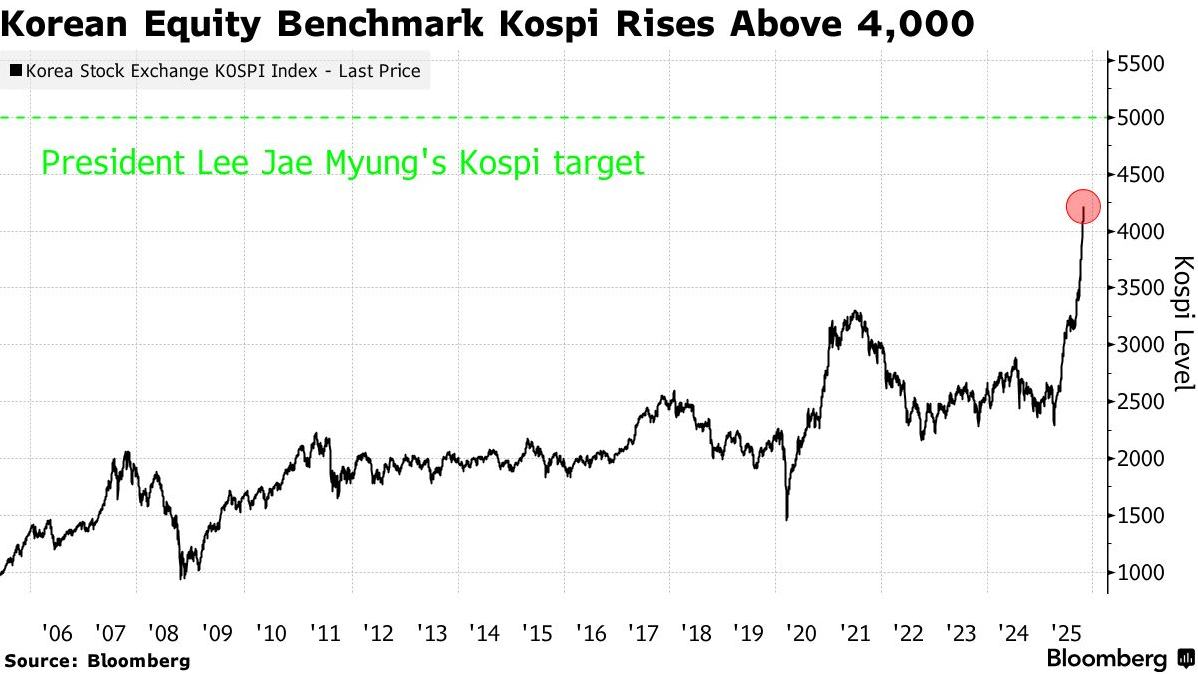
“黄仁勋效应”点燃KOSPI:韩国股市10月飙20%,创2001年来最佳单月
智通财经网· 2025-11-03 07:05
Group 1 - The KOSPI index is experiencing its strongest monthly performance in over 20 years, with a 20% increase in October, marking its best month since 2001, and has risen 76% year-to-date, leading global major indices [1] - The recent surge is attributed to growing confidence in South Korean tech giants like Samsung Electronics and SK Hynix in the AI innovation space, bolstered by a landmark agreement reached during Trump's visit to South Korea [4] - SK Hynix's stock surged 11% following record quarterly profits and a target price increase from 480,000 KRW to 1,000,000 KRW, reflecting a shift in valuation methods in light of new AI paradigms [4] Group 2 - Samsung Electronics also saw a 3.5% increase in stock price due to the same analyst's target price adjustment, alongside additional momentum from partnerships with Nvidia [4] - The positive sentiment has spread to supporting industries, with companies like HD Hyundai Electric and defense stocks rising due to agreements related to nuclear submarine construction [5] - Since early July, global investors have injected $12.8 billion into the South Korean stock market, indicating strong confidence in the market, partly due to supportive policies from the opposition leader Lee Jae-myung [6]