消费品制造业

Search documents
3月物价数据点评:警惕关税带来的价格压力
Soochow Securities· 2025-04-10 13:35
Price Data Overview - In March, CPI decreased by 0.4% month-on-month (previous value: -0.2%) and by 0.1% year-on-year (previous value: -0.7%), indicating a narrowing decline[2] - PPI also fell by 0.4% month-on-month (previous value: -0.1%) and by 2.5% year-on-year (previous value: -2.2%), showing an expanded decline[2] Key Influencing Factors - The decline in CPI was primarily driven by three factors: a 3.5% decrease in domestic gasoline prices due to falling international oil prices, which contributed approximately 0.12 percentage points to the CPI decline[2] - Food prices fell by 1.4% month-on-month, impacting CPI by about 0.24 percentage points, with significant drops in fresh vegetables (5.1%), pork (4.4%), and eggs (3.1%)[2] - Weak terminal consumption and industrial demand continued to exert downward pressure, with service prices slightly below historical levels[2] Future Price Trends - Moving forward, tariff impacts are expected to become a significant factor in price evolution, with supply and demand dynamics shifting[2] - The interplay between excess supply and weakening domestic demand will influence price stability, while tariff shocks may lead to lower prices through increased domestic supply[2] Policy Implications - Incremental policies to counter tariff impacts will be crucial, particularly in promoting consumption and stabilizing the real estate market[2] - The effectiveness of these policies will be key in determining future price trends[2] Risks and Challenges - Potential risks include a weakening real estate market, declining exports, and the possibility that incremental policies may not meet expectations[4] - The go-capacity policy may face tougher decisions, as the short-term pain from capacity reduction could be challenging for the domestic economy to absorb[2]
3月制造业PMI回升至50.5%,需求回暖提振企业生产意愿
2 1 Shi Ji Jing Ji Bao Dao· 2025-03-31 12:09
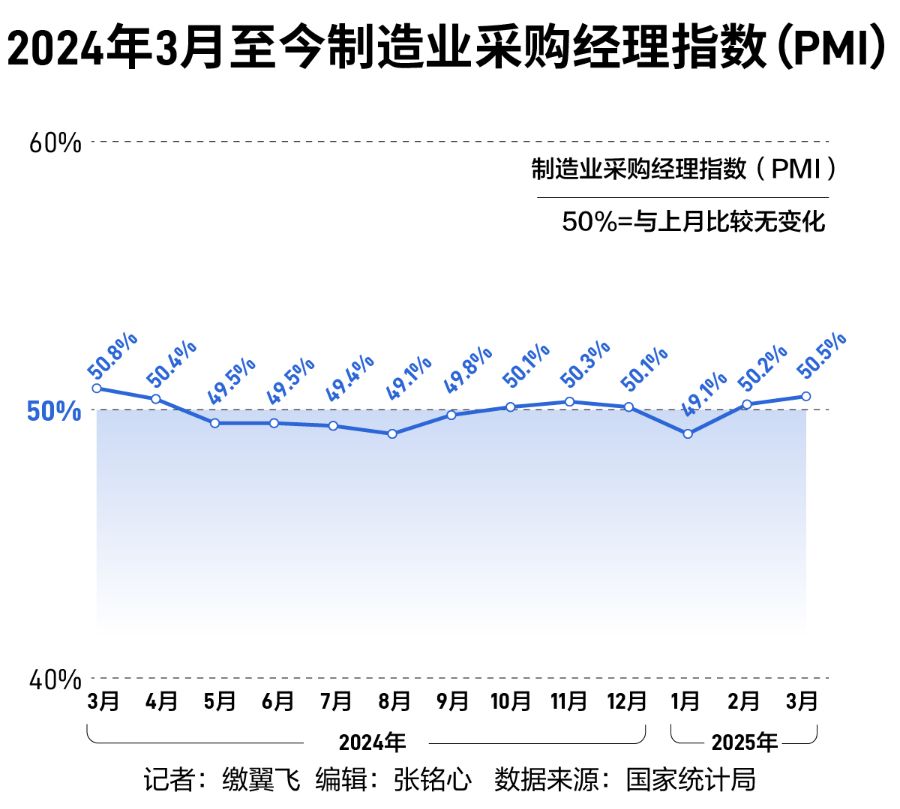
Core Viewpoint - The manufacturing Purchasing Managers' Index (PMI) in March rose to 50.5%, indicating a slight improvement in manufacturing activity compared to February, driven by seasonal factors, policy support, and technological innovations [1][4]. Manufacturing PMI Analysis - The production index, new orders index, new export orders index, and raw materials inventory index all increased, with rises between 0.1 to 0.7 percentage points [1]. - The new orders index reached 51.8%, up 0.7 percentage points from February, indicating sustained demand [4]. - The production index was at 52.6%, reflecting a continuous upward trend for two months [4]. Sector Performance - High-tech manufacturing sectors, such as railway, aerospace, and electronics, showed strong performance with production and new orders indices above 55.0% [6]. - Conversely, industries like wood processing and coal showed indices below the critical point, indicating supply-demand imbalances [6]. - The consumer goods manufacturing PMI rose to 50.0%, driven by policies promoting consumption [6]. Price Indices and Market Dynamics - The main raw materials purchase price index fell to 49.8%, while the factory price index dropped to 47.9%, indicating a supply surplus [7][8]. - The decline in prices is attributed to weak demand and increased production, particularly in the basic raw materials sector [7][8]. Future Outlook - The manufacturing sector is expected to continue its stable recovery in the second quarter, supported by government policies aimed at expanding domestic demand and promoting new urbanization [9]. - The manufacturing production and business activity expectation index was at 53.8%, indicating optimism among enterprises [9]. - However, potential challenges include the impact of increased tariffs on exports and the need for further stabilization in the real estate market [9].

如何理解PMI与EPMI背离?
申万宏源宏观· 2025-03-31 08:10
Core Viewpoint - The divergence between PMI and EPMI is primarily due to the differentiation in the economic conditions of emerging and traditional industries, with the former showing stronger performance in March [1][8]. Manufacturing Sector - In March, the manufacturing PMI increased moderately by 0.3 percentage points to 50.5%, which is below market expectations [1][8]. - The EPMI for strategic emerging industries rose significantly by 10.6 percentage points to 59.6%, indicating a strong recovery in these sectors [1][8]. - High-tech and equipment manufacturing sectors saw substantial PMI increases of 1.4 and 1.2 percentage points, reaching 52.3% and 52% respectively, while traditional sectors like consumer goods manufacturing only saw a marginal increase of 0.1 percentage points to 50% [2][13]. - The production index for EPMI surged by 21.6 percentage points, contrasting with a slight increase of 0.1 percentage points in the manufacturing PMI production index, which reached 52.6% [2][17]. Non-Manufacturing Sector - The non-manufacturing PMI rose by 0.4 percentage points to 50.8%, with the construction sector's PMI increasing by 0.7 percentage points to 53.4%, although this was weaker than seasonal expectations [3][5]. - The service sector's PMI increased by 0.3 percentage points to 50.3%, but this was also below the same period in previous years [3][5]. - The construction sector remains constrained by weak real estate investment, while the service sector is limited by the performance of life services [3][22]. Future Outlook - There are increasing risks to exports, but potential improvements in the economy may arise from accelerated import substitution and recovery in the service sector and real estate sales [3][31]. - The manufacturing sector may receive support from accelerated import substitution in industries like electrical and mechanical equipment, while the construction and service sectors show signs of recovery [3][31]. Regular Tracking - The manufacturing PMI continues to show a mild recovery, with production and new order indices slightly increasing [4][37]. - The non-manufacturing PMI reflects a general improvement, with both construction and service sectors showing slight increases [5][46].
张瑜:信息业或将再次引领资本开支——宏观看科技股系列一
一瑜中的· 2025-03-16 14:42
文 : 华创证券研究所副所长 、首席宏观分析师 张瑜(执业证号:S0360518090001) 联系人: 陆银波(15210860866) 前言 本文聚焦今年产业层面的重大变化。将所有行业基于一定的共性分为 11 个板块 ,今年或是信息业引领资本 开支(领头羊)。这一判断基于当前的宏观环境依然存在一定的供需矛盾以及有多股力量正合力促进信息 业的发展。信息业的引领下,会有哪些宏观影响?这涉及科技进步的方向以及科技会推广于何处,较难回 答。但若与 2014-2015 年对比,或有区别,彼时借助 4G 的普及以及" C 端补贴"催生了较多消费"新业 态"。参考 2022 年以来的美国,或指向的是互联网企业增加资本开支,互联网企业及"卖铲者"业绩受益。 报告摘要 一、信息业或将再次引领资本开支 根据行业特性(如科技含量、政府参与程度、用途等)可以将全社会固定资产投资分为 11 个板块。将当年 投资增速最快的板块称之为资本开支的领头羊。 我们发现: 1 )资本开支的领头羊发生过数次更迭 。 2008-2009 年:电气机械; 2010-2013 年:频繁轮动,先后是电子设备、电气机械、汽车、消费品制造 业; 2014- ...





CPI暂回踩,后续易升难降——2月物价数据解读【财通宏观•陈兴团队】
陈兴宏观研究· 2025-03-09 07:44
Group 1: CPI Analysis - The CPI year-on-year growth rate decreased to -0.7% in February, down 1.2 percentage points from the previous month, primarily due to the impact of the Spring Festival timing [1][4] - Excluding the Spring Festival effect, the CPI year-on-year increased by 0.1% in February, indicating a moderate recovery in prices [1][4] - Food prices contributed over 80% to the total decline in CPI, with fresh vegetable prices dropping by 12.6% year-on-year [5][6] Group 2: PPI Analysis - The PPI year-on-year decline narrowed to 2.2% in February, with the average for January-February also showing a 2.2% decrease compared to the previous year [2][7] - The main reasons for the PPI decline include the off-peak industrial production season and weak demand for construction materials [2][7] - The prices of production materials fell by 2.5%, while living materials prices decreased by 1.2%, with specific industries like coal processing seeing significant price drops [7][8] Group 3: Market Sentiment and Future Outlook - The PMI data indicated an increase in raw material and finished product price indices, but the PPI only slightly narrowed, suggesting a discrepancy between perceived and actual market conditions [3] - The current policy uncertainty may lead to a cautious approach from enterprises, affecting production enthusiasm [3] - Positive signals from the upcoming Two Sessions may help restore market demand and improve production and demand dynamics [3]

刚刚公布!↓0.7%
券商中国· 2025-03-09 01:54
Core Viewpoint - The article discusses the decline in consumer prices (CPI) and producer prices (PPI) in February 2025, highlighting the impact of seasonal factors and international commodity price fluctuations on these indices [9][10][11]. Group 1: Consumer Price Index (CPI) Analysis - In February 2025, the national CPI decreased by 0.7% year-on-year, with urban and rural areas both experiencing a decline of 0.7% [1] - The average CPI for January-February 2025 showed a slight decrease of 0.1% compared to the same period last year [1] - Food prices fell by 3.3%, significantly impacting the CPI, while non-food prices saw a minor decline of 0.1% [1][10] - The decline in fresh vegetable prices by 12.6% was a major contributor to the CPI drop, affecting it by approximately 0.31 percentage points [4][10] - Seasonal factors, such as the timing of the Spring Festival, contributed to the CPI's year-on-year decline, with a calculated impact of -1.2 percentage points from last year's price changes [10] Group 2: Producer Price Index (PPI) Analysis - The PPI for February 2025 decreased by 2.2% year-on-year and by 0.1% month-on-month, with the decline in producer prices showing a slight narrowing compared to the previous month [2][9] - The drop in industrial producer prices was primarily driven by a 2.5% decrease in production material prices, which affected the overall PPI by approximately 1.86 percentage points [6] - The construction sector faced reduced demand due to seasonal factors, leading to a 10.6% decline in black metal smelting and rolling prices [11] - International commodity price fluctuations, particularly in coal and oil, also contributed to the PPI decline, with coal processing prices down by 24.7% year-on-year [11] Group 3: Price Changes in Specific Categories - In February, the prices of food, tobacco, and alcohol categories decreased by 1.9% year-on-year, impacting the CPI by about 0.54 percentage points [4] - The prices of other categories showed mixed results, with clothing prices increasing by 1.2% while transportation and communication prices fell by 2.5% [4] - The industrial producer prices for food decreased by 1.6%, while durable consumer goods prices fell by 2.5% [6][8] - Some sectors, such as energy and certain consumer goods, experienced price increases, indicating a mixed recovery in demand [12]

PMI:无喜无忧、结构分化
赵伟宏观探索· 2025-03-01 12:16
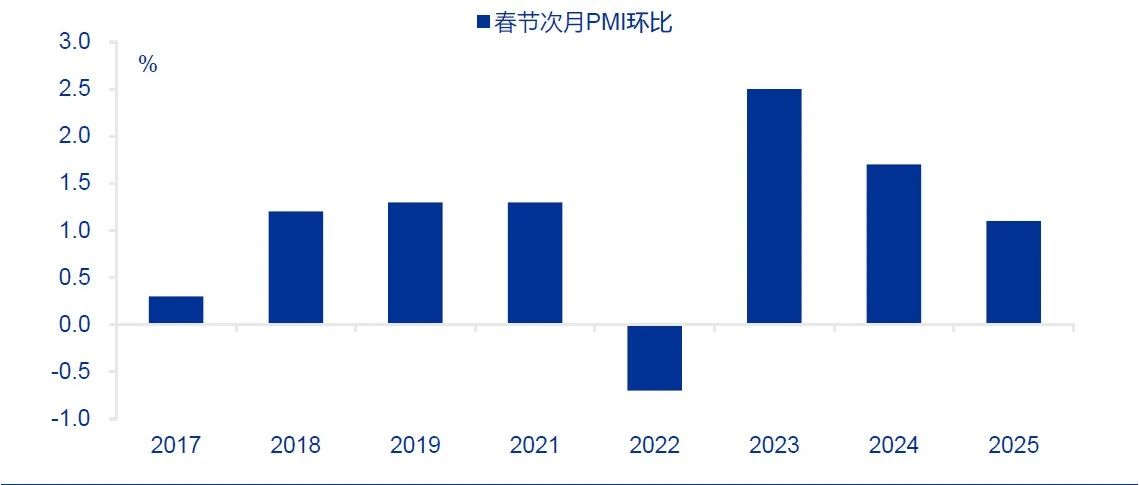
Core Viewpoint - The February PMI shows a mild recovery post-Spring Festival, with a clear "strong-weak" differentiation in structure [2][9]. Manufacturing Sector - The manufacturing PMI rose to 50.2%, up 1.1 percentage points from the previous month, indicating a recovery, albeit moderate [5][16]. - Key sub-indices such as production and new orders showed significant recovery, with production index increasing by 2.7 percentage points to 52.5% and new orders index rising by 1.9 percentage points to 51.1% [5][16]. - The new export orders index remains in contraction at 48.6%, despite a 2.2 percentage point increase [5][17]. Non-Manufacturing Sector - The non-manufacturing PMI increased by 0.2 percentage points to 50.4%, with construction PMI showing a notable rise of 3.4 percentage points to 52.7% [5][18]. - Service sector PMI declined by 0.3 percentage points to 50.0%, with significant drops in consumer-related sectors such as retail, accommodation, and catering [4][19]. Industry Observations - Capital-intensive industries like high-tech and equipment manufacturing show higher PMI levels, while labor-intensive sectors such as consumer goods and high-energy industries remain below the expansion threshold [3][12]. - In the construction sector, the increase in the construction PMI indicates accelerated infrastructure work, while real estate performance appears weaker [3][13]. Future Outlook - The economic recovery foundation remains fragile, with potential export risks increasing. Continuous monitoring of incremental policy changes is necessary [4][15]. - The manufacturing PMI's slight recovery above the neutral line suggests a moderate recovery level, with ongoing export pressures evident [4][15].