
乳制品

Search documents
消费ETF嘉实(512600)连续9天净流入近亿元,机构:关注白酒板块估值修复机会
Sou Hu Cai Jing· 2025-09-08 03:05
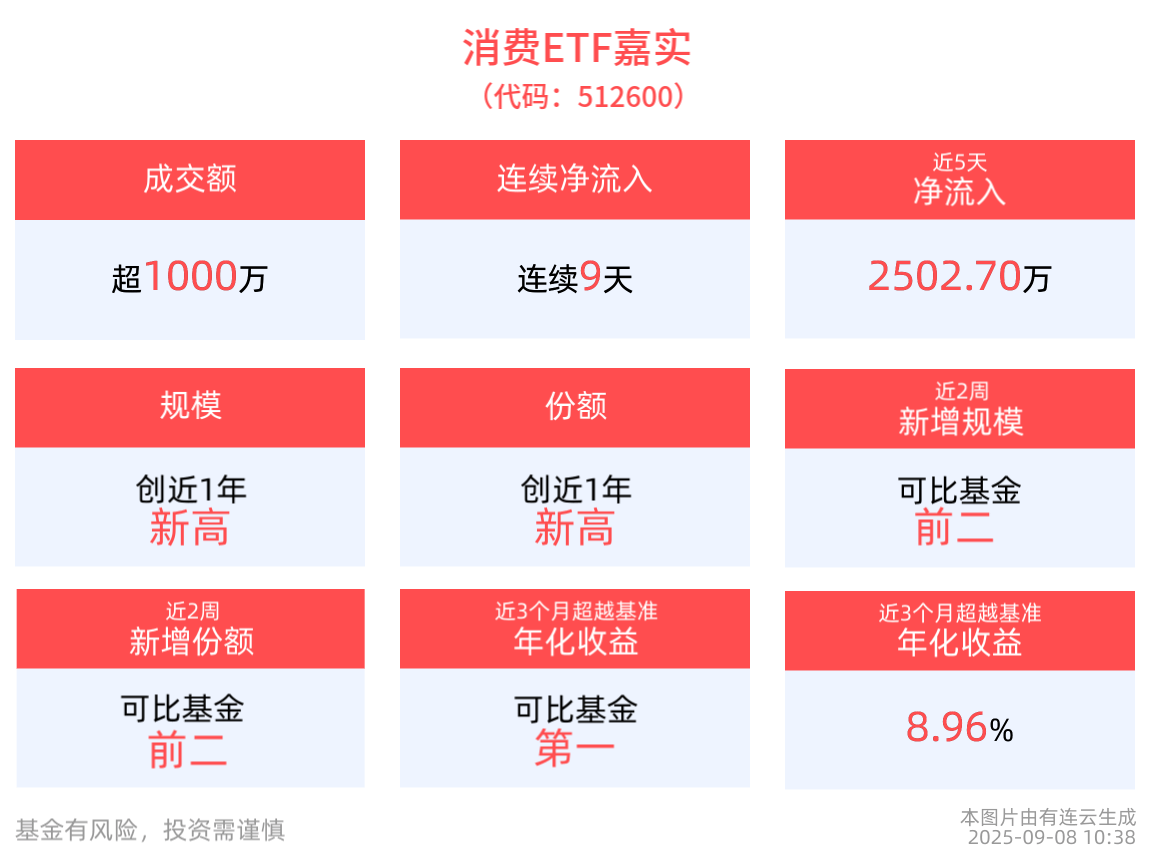
Core Viewpoint - The consumer sector is showing resilience with significant gains in key stocks and a strong performance of the consumption ETF, indicating potential investment opportunities in the market [1][3][4]. Group 1: Market Performance - The CSI Major Consumer Index rose by 1.04%, with notable increases in stocks such as Beitaini (+6.41%), Huaxi Biological (+4.67%), and New Hope (+3.69%) [1]. - The Consumption ETF (512600) experienced a trading volume of 16.28 million yuan, with a turnover rate of 2.29% [3]. - The Consumption ETF's latest scale reached 702 million yuan, marking a one-year high, and its shares totaled 955 million, also a one-year high [3]. Group 2: Fund Performance - Over the past six months, the Consumption ETF has seen a net value increase of 9.74%, ranking in the top two among comparable funds [3]. - Since its inception, the ETF has recorded a maximum monthly return of 24.50% and a longest consecutive monthly gain of 66.83% [3]. - The ETF's annualized return over the past three months surpassed the benchmark by 8.96%, ranking first among comparable funds [3]. Group 3: Valuation Insights - The latest price-to-earnings ratio (PE-TTM) for the CSI Major Consumer Index is 19.85, which is in the 11.11% percentile over the past three years, indicating a valuation lower than 88.89% of the historical period [3]. Group 4: Sector Analysis - The CSI Major Consumer Index includes leading consumer stocks across various sectors, with liquor accounting for 45% of the index weight [4]. - Despite weak demand in the consumer goods sector, leading companies are showing strong operational resilience and gaining market share [6]. - Analysts suggest that positive policy guidance and healthy supply-demand interactions will improve the supply-demand landscape, particularly in the liquor sector [7].

食品饮料行业研究方法与框架
2025-09-07 16:19
Summary of Key Points from the Conference Call Industry Overview - The conference call discusses the **food and beverage industry**, focusing on various segments such as **liquor, beer, soft drinks, dairy products, snacks, condiments, and frozen foods** [1][2][3]. Core Insights and Arguments Liquor Market - The **liquor market** is impacted by the downturn in the real estate sector, but the rigid demand leads to relatively small fluctuations. The demand during the Spring Festival supports self-drinking and gifting needs [1][9]. - Investment and collection attributes of liquor have weakened since 2021, leading to risk release. Future growth drivers depend on price increase capabilities, relying on social and investment attributes [1][12]. - The **white liquor market** has a production scale of **800 billion RMB**. The market is characterized by strong price increase potential and a shift towards premiumization [4][10]. Beer Industry - The **beer industry** has seen slow sales growth, with a production scale of **300 billion RMB**. The competition is characterized by multiple strong players, each with their profit pools [4][13]. - The high-end beer segment is growing, but the overall market is experiencing a slow recovery post-pandemic. The immediate consumption market is weak, while instant retail is rising rapidly [14]. Soft Drinks - The **soft drink market** is nearly **700 billion RMB** in size, with a diverse range of products. The market is witnessing a significant health trend, with rapid growth in sugar-free tea and energy drinks [1][17]. - The carbonated beverage market is dominated by **Coca-Cola and Pepsi**, with pricing strategies impacting competition. Coca-Cola plans to increase prices from **3 RMB to 3.5 RMB** [18]. Dairy Products - The **dairy industry** is valued at approximately **300 billion RMB**, with a duopoly between **Yili and Mengniu**. The market for long-life milk and yogurt is saturated, while fresh milk and cheese have growth potential [4][22]. Snacks - The **snack industry** benefits from channel transformations, with increased price sensitivity driving the growth of discount stores and e-commerce. The health trend is significant, with healthier snack options emerging [1][23]. Condiments and Frozen Foods - The **condiment market** is valued at nearly **500 billion RMB**, with soy sauce and pickled vegetables performing well. The market shows high consumer stickiness and pricing power [2][24]. - The **frozen food sector** faced challenges post-pandemic, requiring innovation and new channels for growth [2][24]. Lifecycle Stages of Segments - Different segments are at various lifecycle stages, with craft beer and coconut water in the introduction phase, while high-end liquor and sugar-free tea are in the growth phase [6]. Competitive Landscape - The competitive landscape varies, with some segments dominated by a single player (e.g., high-end liquor) and others exhibiting a more fragmented structure [7][8]. Future Trends and Challenges - The liquor industry faces challenges from the real estate downturn but maintains rigid demand due to its social attributes. Future price increases depend on economic conditions [9][12]. - The beer industry is adapting to changes in consumer behavior and channel dynamics, with a focus on high-end products [14][13]. Conclusion - The food and beverage industry is characterized by diverse segments, each with unique growth drivers, competitive dynamics, and challenges. The focus on health trends, premiumization, and channel innovation will shape the future landscape of the industry [1][2][3].
伊利股份(600887):2025年半年报点评:收入稳中求进,盈利加速改善
Changjiang Securities· 2025-09-07 13:14
Investment Rating - The investment rating for the company is "Buy" and is maintained [8]. Core Views - The company achieved a total revenue of 61.933 billion yuan in H1 2025, representing a year-on-year increase of 3.37%. The net profit attributable to shareholders was 7.2 billion yuan, down 4.39% year-on-year, while the net profit excluding non-recurring items was 7.016 billion yuan, up 31.78% year-on-year [2][4]. - In Q2 2025, the company reported total revenue of 28.915 billion yuan, a year-on-year increase of 5.77%, with a net profit of 2.326 billion yuan, up 44.65% year-on-year, and a net profit excluding non-recurring items of 2.387 billion yuan, up 49.48% year-on-year [2][4]. - The company is actively exploring business growth, with notable performance in new products and channels, alongside improved internal profitability due to lean management [6]. Summary by Sections Revenue and Profitability - In H1 2025, revenue from liquid milk was 36.126 billion yuan (down 2.06% year-on-year), while revenue from milk powder and dairy products was 16.578 billion yuan (up 14.26% year-on-year). Revenue from ice cream products reached 8.229 billion yuan (up 12.39% year-on-year) [5]. - The company’s gross profit margin improved to 36.21%, up 1.18 percentage points year-on-year, while the net profit margin for H1 2025 was 11.63%, down 0.94 percentage points year-on-year [6]. Cost Management and Efficiency - The company has seen a reduction in capital expenditures, with 2024 capex expected to be approximately 3.978 billion yuan (down 42.8% year-on-year) and H1 2025 capex down to 1.453 billion yuan (down 24.4% year-on-year) [6]. - The company’s marketing expenses have decreased, contributing to improved profit margins [6]. Future Earnings Projections - The expected earnings per share (EPS) for 2025 and 2026 are projected to be 1.80 yuan and 1.95 yuan, respectively, with corresponding price-to-earnings (PE) ratios of 15.5 and 14.3 times [6].

新乳业(002946):2025年中报点评:结构优化驱动量、利双改善
Changjiang Securities· 2025-09-07 13:14
Investment Rating - The investment rating for the company is "Buy" and is maintained [8] Core Views - The company's total revenue for H1 2025 reached 5.526 billion yuan, representing a year-on-year increase of 3.01%. The net profit attributable to shareholders was 397 million yuan, up 33.76% year-on-year, while the net profit excluding non-recurring items was 411 million yuan, an increase of 31.17% year-on-year [2][4] - In Q2 2025, the company reported total revenue of 2.901 billion yuan, a year-on-year increase of 5.46%. The net profit attributable to shareholders was 263 million yuan, up 27.37% year-on-year, and the net profit excluding non-recurring items was 270 million yuan, an increase of 26.85% year-on-year [2][4] - The improvement in gross margin is primarily driven by structural optimization, with the gross margin for H1 2025 increasing by 0.79 percentage points to 30.02% [6] - The company has focused on regional deep cultivation and differentiated innovation strategies, achieving a competitive edge against leading dairy companies [7] Summary by Sections Revenue and Profitability - The company's H1 2025 total revenue was 5.526 billion yuan, with a net profit of 397 million yuan, reflecting strong growth in profitability [2][4] - The Q2 2025 results showed continued revenue growth and significant profit increases, indicating a positive trend in financial performance [2][4] Structural Optimization - New product revenue accounted for over 10% of total sales, with low-temperature product sales growing over 10% year-on-year. The high-end fresh milk and "Today's Fresh Milk Shop" sales also saw growth exceeding 10% [5] - The company has adopted a "fresh and sour dual strong" product development strategy, leveraging technological breakthroughs and supply chain integration to enhance market presence [5][6] Financial Metrics - The net profit margin for H1 2025 improved by 1.65 percentage points to 7.18%, while the gross margin increased to 30.02% [6] - The company has maintained a focus on cost control, with a decrease in the expense ratio by 1.15 percentage points to 20.82% [6] Future Outlook - The company is expected to achieve net profits of 703 million yuan and 830 million yuan for 2025 and 2026, respectively, with corresponding PE valuations of 22 and 18 times [7]

IPO周报 | 摩尔线程更新科创板招股书并回复问询;琻捷电子赴港IPO
IPO早知道· 2025-09-07 12:19
Group 1: Company Overview - Banjie Electronics, founded in 2015, focuses on the research, design, and sales of high-performance automotive-grade chips and has submitted its IPO application to the Hong Kong Stock Exchange [3][4] - Banjie Electronics has become the largest automotive wireless sensor chip company in China and the third largest globally, breaking the dominance of foreign manufacturers in the domestic market [3][4] - The company has achieved a cumulative shipment of 160 million automotive sensor chips, covering 100% of the top 10 automotive OEM brands in China as of June 30, 2025 [4] Group 2: Financial Performance - Banjie Electronics reported revenues of 100 million yuan, 220 million yuan, and 350 million yuan for the years 2022, 2023, and 2024, respectively, with a compound annual growth rate of 83% [4] - Yipin Nutrition Technology, established in 1956, specializes in goat milk powder and special medical formula foods, and has also submitted its IPO application to the Hong Kong Stock Exchange [6][7] - Yipin's revenue for 2022, 2023, and 2024 was 1.402 billion yuan, 1.614 billion yuan, and 1.762 billion yuan, respectively, with a revenue of 806 million yuan in the first half of 2025 [7] Group 3: Market Position - Yipin holds a 14.0% market share in the Chinese goat milk powder market, ranking second, and a 17.6% market share in the infant goat milk powder market, also ranking second [6][7] - Dingxiangyuan, a digital healthcare technology company, is preparing for an IPO in Hong Kong, marking a significant milestone after 25 years of operation [10][12] - Dingxiangyuan has served over 100 million users and has more than 9 million professional users, including over 4.05 million doctors, covering over 90% of doctors in China [10] Group 4: Recent Developments - Moer Thread updated its IPO prospectus for the Sci-Tech Innovation Board, reporting a revenue of 702 million yuan in the first half of 2025, surpassing the total revenue from 2022 to 2024 [14][15] - The company has achieved a compound annual growth rate of over 200% from 2022 to 2024, with cumulative revenue of approximately 608 million yuan during that period [14][15] - Moer Thread's net losses have narrowed significantly, with losses of 1.839 billion yuan, 1.673 billion yuan, and 1.491 billion yuan from 2022 to 2024, and a further reduction to 270 million yuan in the first half of 2025 [15]

乳企加速抢滩B端市场
东京烘焙职业人· 2025-09-07 08:32
Core Viewpoint - The domestic liquid milk market has seen a significant slowdown in growth over the past five years, becoming a burden for major dairy companies, while solid dairy products like cheese and butter are experiencing rapid growth driven by the B-end food service sector [8][9]. Market Overview - The B-end dairy product market in China is projected to exceed 40 billion yuan by 2024, with expectations to reach 70.3 billion yuan by 2028 [8]. - The B-end market, particularly for high-end dairy products, has been dominated by international brands, with domestic production accounting for less than 30% [9]. Industry Dynamics - The demand for solid dairy products is increasing in various sectors such as baking, coffee, and tea, with the B-end coffee segment expected to generate 26.5 billion yuan for the dairy industry by 2025 [12]. - The rapid growth of new consumption trends has expanded the usage scenarios for dairy products, prompting domestic dairy companies to intensify their focus on the B-end market [12][15]. Competitive Landscape - Major dairy companies like Mengniu and Yili are actively entering the B-end market, establishing partnerships with various food service companies [13][14]. - The B-end market still has over 70% of its share held by imported dairy companies, indicating a significant opportunity for domestic players, but also highlighting the complexities of competition [17]. Challenges and Opportunities - Domestic dairy companies face challenges in transitioning from a consumer-focused (C-end) strategy to a solution-oriented (B-end) approach, requiring a deep understanding of customer needs and rapid response capabilities [18]. - There are technical gaps in product customization and high-end dairy product offerings, which pose significant barriers to entry in the B-end market [19]. Strategic Recommendations - To succeed in the B-end market, dairy companies need to break away from traditional C-end thinking and develop dedicated R&D, supply chain, and service systems for B-end products [20]. - A comprehensive upgrade in thinking, capabilities, and technical strength is essential for domestic dairy companies to compete effectively against imported brands in the B-end market [20].
新股前瞻|高潜力赛道VS巨头垄断态势明显,羊奶粉“小而美”宜品营养如何破局?
Zhi Tong Cai Jing· 2025-09-07 05:24
Core Viewpoint - The article discusses the potential of Yipin Nutrition, a leading player in the niche goat milk powder market, as it embarks on its IPO journey in Hong Kong amidst a competitive landscape dominated by major brands [1][5]. Company Overview - Yipin Nutrition is positioned as the second-largest player in the Chinese goat milk powder market with a market share of 14.0% and 17.6% in the infant formula goat milk powder segment [1][2]. - The company operates a full industry chain model, ensuring quality and stability in its supply of goat milk through self-owned farms and factories [2][3]. - Yipin Nutrition's product range includes various brands catering to different market segments, with a focus on low-allergen dairy products [2][3]. Financial Performance - The company's revenue has shown a steady increase from 1.402 billion yuan in 2022 to an expected 1.762 billion yuan in 2024, although there was a decline of 10.34% in the first half of 2025 [3][4]. - The gross profit margin has improved, reaching 50.9% in the first half of 2025, indicating strong profitability compared to industry leaders [3][4]. Market Dynamics - The infant formula market in China is undergoing a transformation due to declining birth rates and stringent regulatory standards, leading to increased market concentration [5][6]. - The goat milk powder segment is expected to grow, with retail sales projected to rise from 20.8 billion yuan in 2020 to 31.8 billion yuan by 2029, reflecting a compound annual growth rate of 4.9% [6][7]. Competitive Landscape - The market is characterized by a few dominant players, with significant market share held by brands like Feihe and Danone, creating high entry barriers for new entrants [7]. - Yipin Nutrition faces challenges in brand recognition and marketing compared to larger competitors, necessitating increased investment in consumer engagement and brand building [7].
高潜力赛道VS巨头垄断态势明显,羊奶粉“小而美”宜品营养如何破局?
Zhi Tong Cai Jing· 2025-09-07 05:11
Core Viewpoint - The company, Yipin Nutrition, is embarking on an IPO journey in Hong Kong, capitalizing on the growing demand for goat milk powder, positioning itself as a leading player in this niche market [1] Company Overview - Yipin Nutrition is ranked second in the Chinese goat milk powder market with a market share of 14.0% and second in the infant formula goat milk powder market with a market share of 17.6% [1] - The company operates a full industry chain model, ensuring quality and stability of milk sources through self-owned farms and factories in various locations, including Spain and South Korea [2] - Yipin Nutrition's product range includes multiple brands catering to different consumer segments, with its flagship brand, Beikangxi, being one of the top brands in the market [2] Financial Performance - The company's revenue from 2022 to 2024 is projected to grow from 1.402 billion to 1.762 billion RMB, with a slight decline of 10.34% in the first half of 2025 [3] - The gross profit margin has shown an upward trend, reaching 50.9% in the first half of 2025, indicating strong profitability compared to industry leaders [3] - Despite high gross margins, marketing and brand-building efforts have pressured profit margins, with net profits decreasing from 227 million RMB in 2022 to 56.688 million RMB in the first half of 2025 [3][4] Industry Context - The infant formula market in China is undergoing a transformation due to declining birth rates and stringent regulatory standards, leading to increased market concentration [5][6] - Goat milk powder is emerging as a high-growth segment within the overall milk powder market, with retail sales expected to grow from 20.8 billion RMB in 2020 to 31.8 billion RMB by 2029, reflecting a compound annual growth rate of 4.9% [6][7] - The competitive landscape is dominated by major players, making it challenging for smaller brands like Yipin Nutrition to enhance brand recognition and market presence [7]
光明乳业(600597):液态奶压力仍存 期待需求改善
Xin Lang Cai Jing· 2025-09-07 02:25
Core Viewpoint - The company reported a decline in revenue and net profit for the first half of 2025, with a focus on the challenges faced in the liquid milk and livestock product segments, while other dairy products showed positive growth [1][2]. Revenue Summary - For 25H1, the revenue from liquid milk, other dairy products, and livestock products was 66.1 billion, 44.5 billion, and 5.2 billion respectively, showing year-on-year changes of -8.6%, +8.8%, and -13.8% [2]. - In 25Q2, the revenue for liquid milk, other dairy products, and livestock products was -10.8%, +6.1%, and +140.4% year-on-year, indicating a mixed performance across product lines [2]. - Regional performance in 25H1 showed revenue from Shanghai, other regions, and overseas at 34.9 billion, 49.9 billion, and 39.4 billion respectively, with year-on-year changes of -6.9%, -1.5%, and +1.9% [2]. - Channel-wise, direct sales, distributors, and other channels generated revenues of 27.6 billion, 95.7 billion, and 0.8 billion respectively, with year-on-year changes of -1.1%, -2.2%, and -13.1% [2]. Profitability Summary - The gross margin for 25H1 decreased by 1.0 percentage points to 18.9%, while the net profit margin and the non-recurring net profit margin were 1.7% and 2.0% respectively, both showing declines [3]. - The sales expense ratio for 25H1 decreased by 0.8 percentage points to 10.9%, indicating effective cost control [3]. - The management expense ratio also saw a decline, down by 0.4 percentage points to 3.3% in 25H1 [3]. Outlook and Valuation - The company anticipates a gradual recovery in overall dairy product demand, benefiting from a balanced supply-demand situation in the raw milk cycle starting in 2026 [4]. - The earnings per share (EPS) forecast for 2025-2027 is adjusted to 0.45, 0.48, and 0.52 yuan, reflecting slight changes from previous estimates [4]. - The target price is set at 9.90 yuan based on a price-to-earnings (PE) ratio of 22x for 2025, indicating a positive outlook for the company's stock [4].

2025年1-7月中国乳制品产量为1659.2万吨 累计下降1%
Chan Ye Xin Xi Wang· 2025-09-07 00:33
Group 1 - The core viewpoint of the news highlights a decline in China's dairy product production, with a reported decrease of 3.6% year-on-year in July 2025, resulting in a total production of 221,000 tons [1] - From January to July 2025, the cumulative production of dairy products in China reached 16.592 million tons, reflecting a decrease of 1% compared to the previous year [1] Group 2 - The companies mentioned in the news include Yili Group (600887), Bright Dairy (600597), San Yuan (600429), New Dairy (002946), Huangshi Group (002329), Yantang Dairy (002732), Zhuangyuan Pasture (002910), and Pinwo Foods (300892) [1] - The report referenced is the "2025-2031 China Dairy Product Industry Market Operation Status and Investment Prospect Trend Report" published by Zhiyan Consulting [1]


