光模块

Search documents
A股冲高回落,低费率创业板人工智能ETF跌1.6%,盘中获资金关注
Zheng Quan Zhi Xing· 2025-05-23 06:34
Group 1 - The A-share market showed volatility with the ChiNext AI ETF experiencing a decline of 1.6%, led by stocks such as Zhaolong Internet and Chuangyi Information [1] - The ChiNext AI ETF tracks the ChiNext AI Index, focusing on AI-related companies listed on the ChiNext board, covering hardware, software, and application leaders in the AI industry [1] - The ETF has a low management fee rate of 0.15% and a custody fee rate of 0.05%, making its total on-market fee the lowest among comparable funds [1] Group 2 - Guotai Junan Securities maintains an optimistic outlook for the A/H index, expecting gradual increases due to a better understanding of economic conditions among investors [2] - The decline in risk-free interest rates in China, along with reduced overseas expectations, positions the stock market as a key solution for declining social capital expenditure and rising asset management needs [2] - The initiation and acceleration of capital market reforms focusing on investor interests and coordinated financing are shifting the Chinese market towards being more investable and return-focused, contributing to a decrease in risk premiums [2]


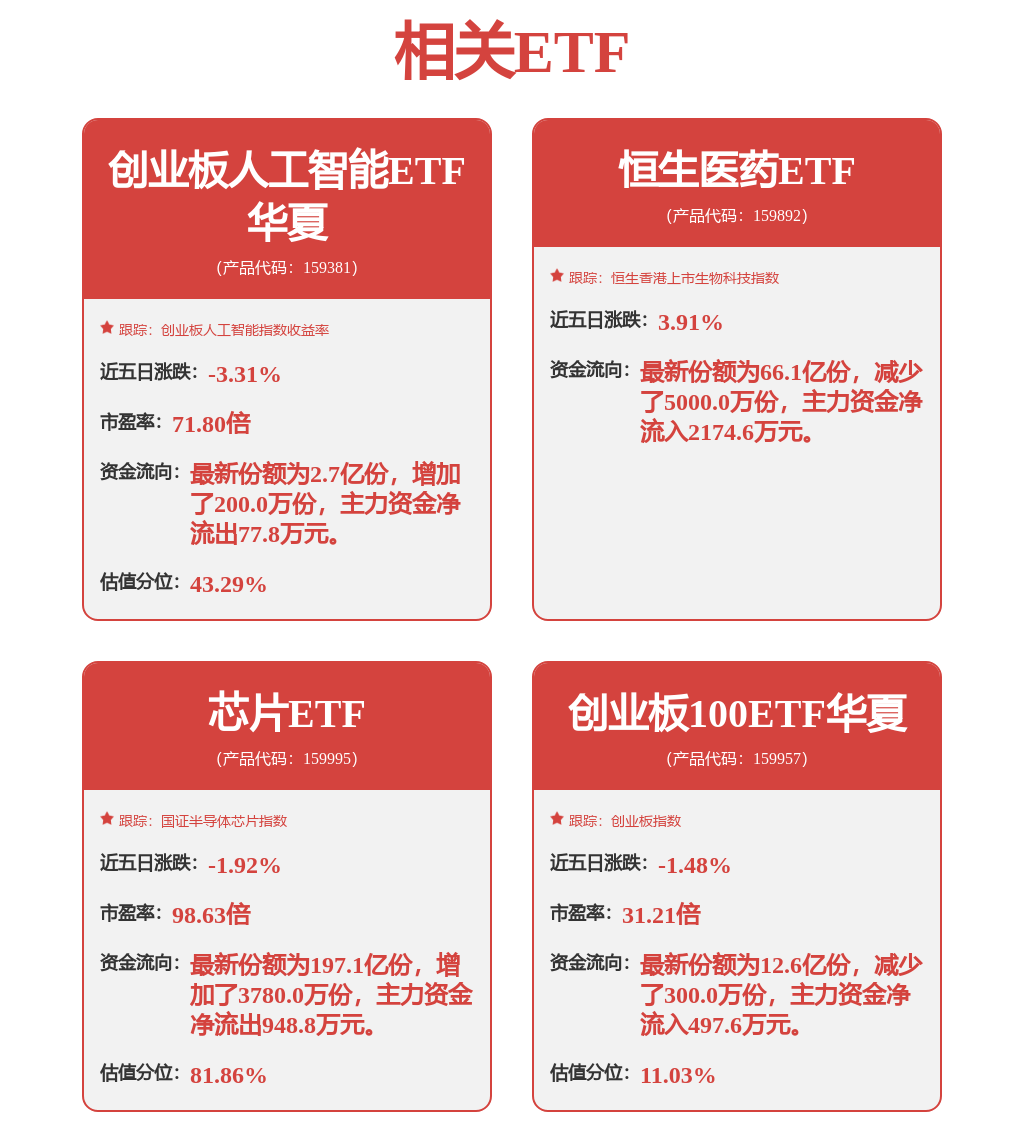
AI概念回调,创业板人工智能ETF华夏(159381)近5个交易日获资金净流入704万元
2 1 Shi Ji Jing Ji Bao Dao· 2025-05-21 03:49
Group 1 - The A-share market saw all three major indices rise collectively, with active performances in sectors such as power batteries, lithium battery anodes, and coal mining, while AI-related concepts experienced a pullback [1] - The ChiNext AI ETF (159381) experienced a slight decline of 0.68%, but its constituent stocks like Tianfu Communication, Advanced Digital Technology, and Runhe Software rose against the trend [1] - The ChiNext AI ETF (159381) has seen a net inflow of 7.04 million yuan over the past five trading days, with a total increase in circulation scale of 22.68 million yuan over the past month [1] Group 2 - Recent quarterly reports from domestic cloud service providers indicate that the demand for computing power may be deferred to the second quarter due to the ongoing iteration needs of large models [2] - The demand for domestic computing chips is expected to experience explosive growth [2]




大盘到底啥时候涨呢?
Hu Xiu· 2025-05-20 06:29
Core Viewpoint - The recent phase agreement in US-China trade negotiations has led to mixed market reactions, with A-shares experiencing a pullback while the Nasdaq has shown an upward trend, particularly in technology stocks [1][2][3]. Market Reactions - A-shares indices showed a volatile downward trend from May 12 to May 19, with the Shanghai Composite Index remaining flat, while the Shenzhen Component and ChiNext Index saw slight declines. Northbound capital exhibited a net outflow during this period [2]. - In contrast, the Nasdaq experienced a significant upward trend, with an overall increase of over 7.18% during the same timeframe, and a single-day increase of 4.35% on May 12, driven by strong performances from tech giants like Tesla, Amazon, and Nvidia, which saw gains of over 5% to 8% [3]. Investor Sentiment - Investors expressed confusion regarding the lack of upward movement in the A-share market, with some attributing this to profit-taking by domestic institutions and concerns over ongoing negotiations before the 90-day pause ends [4]. - The market has shifted focus towards small-cap stocks, particularly following new regulations from the China Securities Regulatory Commission that support mergers and acquisitions [4][5]. AI Sector Performance - Despite the overall market hesitation, the ChiNext AI Index recorded a cumulative increase of 17.50% from April 8 to May 19, indicating strong confidence in the AI sector [6]. - The US's recent adjustments to AI chip export rules, particularly targeting China, have intensified competition in the AI industry, suggesting a continued focus on the AI supply chain [7][8][10]. Domestic AI Industry Developments - Chinese companies are accelerating the self-sufficiency of the AI supply chain, with notable advancements in chip performance and application development. For instance, the Cambrian SiYuan 590 chip achieved 82% of the inference performance of Nvidia's A100 at one-third of the cost [10]. - Companies like Huawei and Jingjia Micro have made significant strides in AI applications and hardware, with substantial growth in orders and user coverage in various sectors [11][12]. Investment Opportunities - The AI sector's price-to-earnings ratio (PE-TTM) stands at 86, higher than the market average, but with a projected compound annual growth rate (CAGR) of 55% over the next three years, the PEG ratio of 1.56 remains attractive compared to semiconductors and new energy sectors [14]. - The launch of the ChiNext AI ETF (code: 159363) provides investors with a convenient way to gain exposure to leading companies in the AI industry, covering the entire supply chain from hardware to application [15][17].
推荐三条投资主线240218
Ge Long Hui· 2025-05-19 01:20
【中信证券通信】推荐三条投资主线240218 一、【旭创+天孚等】AI巨头竞逐火热,光模块龙头有望补涨! 1、1月底到2月份,AI模型和应用端的突破加速,推动英伟达、Coherent等核心龙头年初以来涨幅接近 40%~50%,旭创、天孚涨幅只有10%~20%。 2、云巨头capex趋势向好,微软、谷歌均认可AI对核心业务增长的明显拉动,各家均表示2024年资本支 出将保持较好的增长,24-25年的增长清晰度加强。 3、短短假期,AI巨头竞逐火热:假期,GeminiUltra开放、Gemini 1.5火速推出,OpenAI取消了GPT-4 Turbo的所有每日限制、视频生成模型Sora重磅发布,巨头的火热竞逐,算力与网络升级仍是最确定的 高景气方向。 4、光模块核心龙头有望补涨:在AI模型和应用端竞逐、云厂商Capex向好的推动下,2024年1.6T加速部 署、800G新客户都是潜在的超预期机会,旭创+天孚等有望迎来估值回升和补涨行情,坚定推荐! 二、【中国铁塔+运营商】优质央企持续兑现。 三、关注优质细分龙头的超跌机会:设备商+物联网龙头等。前期市场波动,导致部分优质龙头存在明 显错杀,从价值回归的角度,推荐 ...



美国商务部升级对华芯片管制,AI芯片国产替代预计将加速?
SINOLINK SECURITIES· 2025-05-18 14:08
通信周观点: 1)美国商务部 5 月 13 日升级对华芯片管制,撤销《AI 扩散规则》并出台三项新规:全球禁用华为昇腾芯片、限制美 芯片用于中国 AI 训练、强化供应链审查。此外黄仁勋受访时表示英伟达将重新推出面向中国市场的芯片,但不会再 推出 Hopper 系列产品,预计将采用 GDDR7 显存替代 HBM 高带宽内存,以满足美国出口限制要求。我们认为从性能看, 国产芯片性能或将大超英伟达改版后芯片性能,利好国产算力芯片。2)因英伟达 AI 芯片出货量不及预期(GB200 出 货不及预期,且 H20 受到管制,NVIDIA 计提约 55 亿美元的与 H20 相关的费用损失),而国内芯片供应增长需要时间, 阿里、腾讯等互联网厂商 1Q25 资本支出略低于市场预期。我们认为短期看,互联网厂商全年资本开支可能略有下滑, 但这也将加速 AI 芯片的国产替代进程。长期看伴随国产 AI 芯片的起量,AI 仍将驱动业务增长。3)英伟达 5 月 14 日 宣布在上海设立 AI 芯片研发中心,并与沙特签署 18000 台 GB300 服务器订单。此举凸显其全球布局战略,将推动高 速光模块及液冷技术需求。海外算力基建需求激增, ...




花旗--中国光模块市场分析
傅里叶的猫· 2025-05-18 10:53
Core Viewpoint - Citi believes that 2026 will be the year when 800G optical modules dominate the market, with a projected sales volume of 37 million units, representing an 85% year-on-year growth driven primarily by demand from overseas cloud service providers [1][3]. Group 1: Market Demand and Supply Dynamics - The demand for 800G optical modules is expected to be robust, with over 90% of this demand coming from overseas cloud service providers (CSPs) [3]. - The deployment speed of 1.6T Ethernet switches may slow down, leading to a downward revision of demand forecasts for 1.6T modules [3]. - The market share distribution will be influenced by production capacity and delivery capabilities, with a preference for second-tier suppliers among overseas customers [3]. Group 2: Company Performance and Predictions - Citi's rating hierarchy for companies in the sector is as follows: Eoptolink > Innolight > T&S > TFC, with a particular focus on Eoptolink due to its strong performance in 800G/1.6T products and capacity [4]. - Eoptolink is expected to benefit significantly from the strong demand for 800G, with projections indicating that 75% of its sales will come from this segment by 2026 [15]. - Innolight is also anticipated to capture a substantial share of the 800G demand due to its superior supply capabilities and ongoing silicon photonics migration [17][18]. Group 3: Financial Forecasts and Market Trends - The 2025-2027 shipment forecasts for 400G, 800G, and 1.6T modules have been adjusted, reflecting an increase in 800G shipments and a decrease in 1.6T due to industry demand delays [17]. - The overall market valuation is expected to recover, with industry price-to-earnings ratios projected to rise from 8-10 times to 15-20 times by 2025, driven by cloud infrastructure upgrades and higher optical module integration rates [9]. - The anticipated strong demand for 800G and the potential delay in 1.6T migration may pose risks for CPO (Co-Packaged Optics) deployment, which could be pushed to 2027 [9]. Group 4: Competitive Landscape - The competitive landscape is shifting, with more second-tier suppliers entering the supply chain due to insufficient supply from first-tier suppliers [13]. - Companies like Suzhou Taicheng Light are facing challenges due to lower-than-expected InfiniBand penetration and weak GB200 rack numbers, which may impact their 1.6T demand [20][21]. - The ongoing silicon photonics migration is expected to provide cost advantages for companies like Innolight and Eoptolink, allowing them to maintain higher profit margins compared to competitors who rely on external design sources [18].

【中际旭创(300308.SZ)】24年和25年Q1业绩高增,国内市场和1.6T产品将加速增长——跟踪报告之四(刘凯/朱宇澍)
光大证券研究· 2025-05-16 13:55
Core Viewpoint - The company has reported significant revenue and profit growth for 2024 and Q1 2025, driven by the high demand in the AI industry and advancements in optical module technology [2][3]. Group 1: Financial Performance - In 2024, the company achieved a revenue of 23.862 billion yuan, a year-on-year increase of 122.64%, and a net profit attributable to shareholders of 5.171 billion yuan, up 137.93% [2]. - For Q1 2025, the company reported a revenue of 6.674 billion yuan, reflecting a year-on-year growth of 37.82%, and a net profit of 1.583 billion yuan, which is a 56.83% increase compared to the previous year [2]. Group 2: Market Trends and Developments - The company benefits from the sustained high demand in the AI sector, with significant deployments of 800G optical modules by major AI clients in 2024 [3]. - The maturity of Ethernet technology and hardware has led to large-scale deployments of 400G by CSP clients in the latter half of 2024, contributing to record shipment volumes for both 400G and 800G products [3]. - The company is enhancing its overseas production capacity, which has resulted in substantial growth in overseas shipments of 800G modules, while domestic demand for AI-related products is also increasing [3][4]. Group 3: Domestic Market Opportunities - In the second half of 2024, leading domestic internet companies are increasing their capital expenditures on computing infrastructure, particularly for 400G and 800G optical modules [4]. - The company has established a dedicated subsidiary to focus on domestic market development, aiming to capture the rapidly growing demand for optical modules [4]. - The company expects to gain a competitive advantage in 2025 with increased orders and revenue from domestic clients [4]. Group 4: Future Product Outlook - Although the shipment of the 1.6T product in Q1 2025 was below expectations, it is anticipated to ramp up in the second and third quarters, with significant demand expected in 2026 [5]. - The demand for 1.6T products is projected to increase substantially in 2026, driven by both AI clients and CSP clients upgrading their Ethernet technology [5]. - As a leading supplier of 1.6T optical modules, the company is well-positioned to benefit from this anticipated growth [5].

光模块CPO概念盘中活跃,“易中天”冲高,云计算50ETF(516630)震荡上行
Mei Ri Jing Ji Xin Wen· 2025-05-16 05:19
Group 1 - Major indices such as Sci-Tech 200, CSI 2000, and Sci-Tech 100 led the gains in A-shares on May 16, with sectors like automotive, machinery, and communications showing significant increases [1] - The cloud computing 50 ETF (516630) experienced fluctuations but turned positive in the afternoon, with top-performing stocks including Zhongji Xuchuang, Tianxia Xiu, Xinyisheng, Tuowei Information, and Yunsai Zhili [1] - According to Zhongyuan Securities, China's optical module export value is expected to grow by 4.3% year-on-year in Q1 2025, driven by the increasing demand for 400G and 800G products [1] Group 2 - Cignal AI forecasts that the data center optical device market will grow by over 60% in 2025, with a significant transition to 1.6T optical modules and 800ZR coherent modules expected in the second half of 2025 [1] - The demand for optical device products is anticipated to grow steadily due to the optimistic capital expenditure outlook for leading cloud vendors in 2025, driven by AI development and the construction of large data centers [1] - The cloud computing 50 ETF (516630) has a high AI computing power content, covering sectors such as optical modules, computing leasing (IDC), data storage, servers, and liquid cooling [2]
2025Q1通信板块基金持仓分析:重仓占比有所下滑,持续关注算力相关板块
Great Wall Securities· 2025-05-15 12:29
Investment Rating - The report maintains an "Outperform" rating for the communication sector [1] Core Insights - The heavy stock position in the communication sector has declined, with a weighted market value of 838.59 billion yuan, down 24.27% quarter-on-quarter, representing 2.77% of total fund holdings [3][9] - The AI wave continues to evolve, creating investment opportunities across the entire computing power-related industry chain, driven by high demand for computing power and the expansion of 5G application scenarios [3][20] Summary by Sections Communication Sector Heavy Stock Position - As of Q1 2025, the communication sector's heavy stock position has decreased to 2.77%, ranking 13th among industries, down 0.97 percentage points from the previous quarter [3][8] - The total market value of heavy stocks in the communication sector is 838.59 billion yuan, reflecting a quarter-on-quarter decline of 24.27% [9] Subsector Analysis - The operator and IDC sectors have seen a continuous increase in market value share, while other sectors have experienced varying degrees of decline. As of Q1 2025, the operator sector's heavy stock market value share is 0.48%, up 0.01 percentage points; the IDC sector's share is 0.11%, up 0.05 percentage points [3][16] - The heavy stock market value share for the equipment sector is 0.17%, down 0.09 percentage points; for the optical module sector, it is 0.39%, down 0.36 percentage points [3][16] AI and Computing Power - The ongoing AI wave is expected to drive the development of infrastructure, IDC, and supporting facilities, with significant growth in demand for optical modules, IDC, and servers due to the rapid advancement of AI and the maturation of 5G applications [3][20] - The report highlights the potential for sustained performance improvement in related companies due to the rich and maturing application scenarios in AI, industrial internet, vehicle/internet of things, and AR/VR [3][20] Top Heavy Stocks in Communication Sector - The top ten heavy stocks in the communication sector as of Q1 2025 include China Mobile, NewEase, and Zhongji Xuchuang, with total market values of 136.93 billion yuan, 120.33 billion yuan, and 103.64 billion yuan, respectively [14][15] IDC Sector Performance - The IDC sector's total market value of heavy stocks is approximately 74.79 billion yuan, reflecting a quarter-on-quarter increase of 91.46% [37]



《中美联合声明》落地48小时:“抢运潮”会出现吗?
经济观察报· 2025-05-14 10:45
Core Viewpoint - The recent U.S.-China trade agreement has significantly reduced tariffs, leading to a rapid recovery in the foreign trade sector, particularly in electronics and logistics, creating a 90-day "window period" for businesses to capitalize on the improved trade environment [2][4][5]. Group 1: Market Response - Following the announcement of the trade agreement, many companies, especially in the electronics sector, have seen a surge in inquiries and orders from U.S. clients who previously delayed shipments due to tariffs [2][5]. - The Shenzhen Huaqiangbei electronics market has experienced a revival, with prices for certain electronic components dropping significantly, indicating a return to normalcy in trading activities [4]. - The logistics sector anticipates a "rush" in shipping as businesses aim to maximize the 90-day window, although some companies are still assessing the situation before making large-scale shipping decisions [6][9]. Group 2: Industry Variations - Different industries are responding variably to the trade agreement; for instance, companies in the consumer electronics sector are cautious due to longer production and inventory cycles, while others with existing overseas stock are better positioned to respond quickly [9][10]. - Some sectors, like the optical module industry, report minimal impact from the tariff changes, as they were already exempt from previous tariffs, indicating that the effects of the trade agreement are not uniform across all industries [11]. - U.S. industry associations have welcomed the trade agreement but emphasize the need for long-term stability in trade policies, highlighting ongoing concerns about remaining tariffs and their impact on consumer prices [12].