
农业

Search documents
9月22日复盘:主力早就跑路,存量资金轮动难持续,下周反而更安全?
Sou Hu Cai Jing· 2025-09-22 11:32
Market Sentiment - The market is experiencing a contraction, with major players having exited, leaving weaker participants struggling to recover losses [1] - Today's trading volume is lower than last Friday, indicating a cautious sentiment ahead of the holiday [1][4] Sector Performance - Technology stocks are rising, but other sectors such as liquor, agriculture, pharmaceuticals, banking, and insurance are declining, suggesting a shift in capital from consumer and dividend stocks to technology [1][6] - The main focus for investment should be on technology sectors, particularly robotics and semiconductors, rather than consumer or dividend stocks [6] Trading Dynamics - Buy-side strength is at 1990+, with limited selling pressure at 360+, indicating a manageable outflow of funds [4] - The majority of fund outflows occurred on Thursday and Friday, suggesting that any further selling pressure before the holiday may be minimal [4] Stock Trends - A total of 70 stocks hit the daily limit up, with 57 being genuine limit ups, indicating some bullish activity in the market [5] - There are 1434 stocks that have declined for three consecutive days, which is considered normal, while 208 stocks have declined for five days, indicating a lack of strong support [10] Investment Strategy - Investors are advised to focus on technology stocks as the main line of investment, while avoiding sectors that are experiencing consistent declines [6][10] - It is suggested that maintaining a well-structured portfolio before the holiday is a prudent strategy, as significant market movements are not expected until after the holiday [1][4]


乌前外长爆料!加入欧盟必须要牺牲乌克兰农民?真相扎心代价太大
Sou Hu Cai Jing· 2025-09-22 10:20
Core Viewpoint - The article discusses the difficult position of Ukrainian farmers in the context of Ukraine's aspirations to join the European Union, highlighting the sacrifices they may have to make for this goal [1][10]. Group 1: Impact of EU Policies - The EU initially opened its markets to Ukrainian agricultural products in 2022, leading to a significant increase in imports, which caused unrest among European farmers [3][11]. - Ukrainian sugar exports surged from 40,000 tons to 500,000 tons in just two years, illustrating the dramatic impact of this policy shift [3]. Group 2: Ukrainian Farmers' Sacrifices - Ukrainian farmers are being asked to compromise their agricultural interests to appease European farmers, raising concerns about their livelihoods and the future of Ukraine's agricultural sector [5][10]. - The reliance on France and Germany for influence within the EU diminishes Ukraine's voice in negotiations, positioning it as a minor player in the EU landscape [7][11]. Group 3: Broader Implications - The article suggests that the sacrifices of Ukrainian farmers may not guarantee EU membership, as the EU's policy adjustments are primarily driven by the interests of its own farmers [8][10]. - The situation raises questions about national sovereignty and the dignity of a country that cannot protect its own agricultural sector [10][11]. Group 4: Conclusion - The potential accession to the EU, if contingent on the sacrifices of farmers, may not be a true aspiration but rather a form of constraint, undermining Ukraine's agricultural strengths [12].
湖南全链条赋能高校毕业生就业创业
Zhong Guo Xin Wen Wang· 2025-09-22 08:11
Core Points - The "Zhihui Xiaoxiang Talent Gathering Hunan" initiative aims to empower college graduates in employment and entrepreneurship through a series of specialized actions [1][3] - The initiative includes seven special actions such as "Xiang Talent Retention" and "Excellent Talent Attraction" recruitment events, starting from the launch event in Changsha and expanding to major cities like Shanghai, Beijing, and Wuhan [3] - Hunan has established a mechanism to aggregate job positions from major projects, identifying over 54,000 new job opportunities [3] - A total of 116,100 job positions are provided by private enterprises, covering key industries such as engineering machinery, rail transit equipment, modern agriculture, and cultural tourism [3][4] - Hunan has set up a dedicated investment fund for college students, supporting 2,880 entrepreneurial projects with a total investment of 9.23 million yuan [4] - The province has created a public service platform for entrepreneurship, offering comprehensive support services for college students [4][5] - A "Smart Employment Experience Zone" has been established to provide AI resume diagnostics and mock interviews for graduates [5] - Hunan aims to create a "15-minute employment and training circle" to provide personalized guidance and follow-up services for unemployed graduates [5] Group 1 - The initiative "Zhihui Xiaoxiang Talent Gathering Hunan" focuses on enhancing employment and entrepreneurship for college graduates [1][3] - The recruitment events will take place in multiple major cities to attract young talent to Hunan [3] - Over 54,000 new job opportunities have been identified through major projects in Hunan [3] Group 2 - Private enterprises are offering 116,100 job positions across various key and emerging industries [3][4] - Hunan has invested in a fund specifically for college student entrepreneurship, supporting nearly 3,000 projects [4] - A public service platform has been created to assist college students in their entrepreneurial endeavors [4][5] Group 3 - The "Smart Employment Experience Zone" provides innovative services like AI resume diagnostics for graduates [5] - Hunan is developing a "15-minute employment and training circle" to support unemployed graduates with personalized services [5]


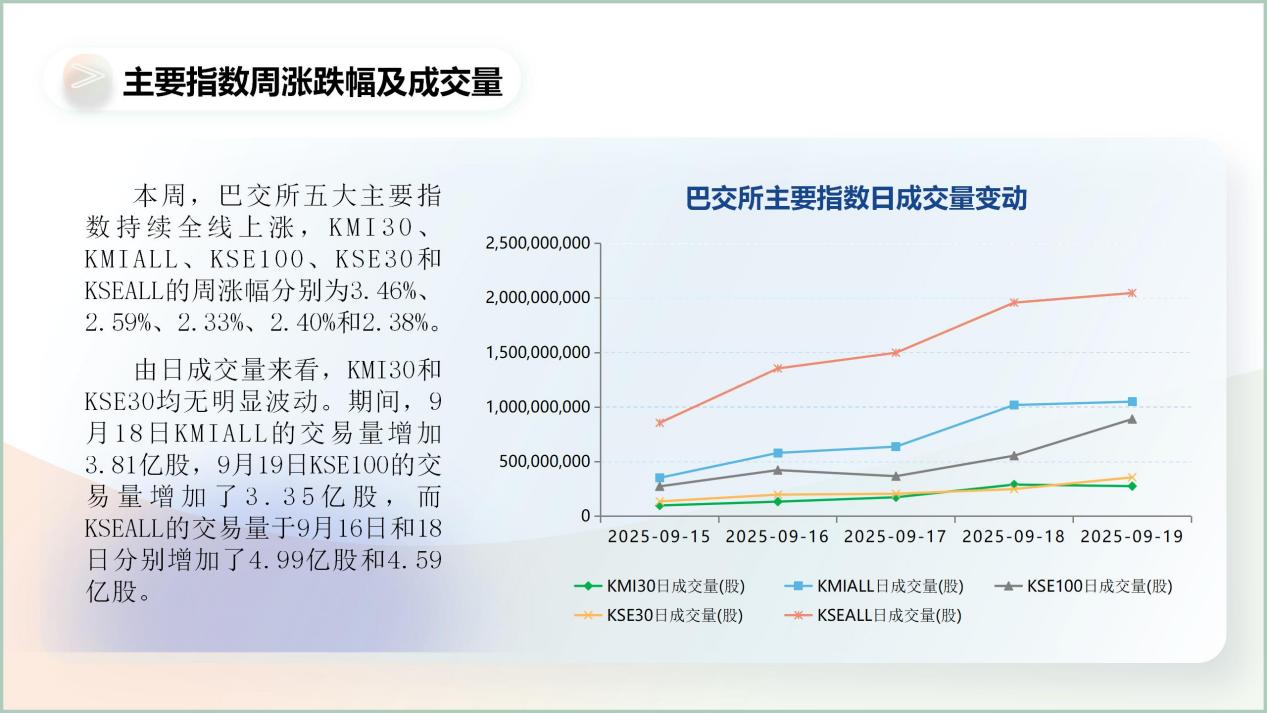
中经资料:巴基斯坦证券市场一周回顾(2025.09.15-2025.09.19)
Zhong Guo Jing Ji Wang· 2025-09-22 07:57
Core Insights - The State Bank of Pakistan (SBP) has maintained the policy interest rate at 11% for the third consecutive time since June 2025, citing a downward trend in inflation and slight macroeconomic deterioration due to recent floods [8] - The SBP has revised the GDP growth forecast for FY 2025-2026 down to approximately 3.25%, a decrease of nearly one percentage point due to the adverse effects of ongoing floods on the agricultural sector [9] - The government has accumulated an average monthly debt of over 817.375 billion PKR in the first 16 months of its term, with total debt rising to 77.888 trillion PKR, primarily driven by domestic debt growth [9] - The current account deficit for August 2025 was reported at $245 million, showing a decrease from the previous month's revised deficit of $379 million, indicating a dependency on strong remittances and stable exports [10] - A five-year maritime action plan has been agreed upon between China and Pakistan to operate the China-Guadar-Africa shipping corridor, positioning Gwadar as a "green port" and enhancing infrastructure connections [10] - The Asian Development Bank (ADB) has highlighted that Pakistan lags behind other regional countries in digital trade opportunities, estimating Pakistan's digital trade for 2024 at $7.93 billion, significantly lower than its ASEAN counterparts [10] - The Prime Minister of Pakistan emphasized the importance of converting signed agreements from the China-Pakistan B2B meetings into binding contracts to ensure smooth Chinese investments under the China-Pakistan Economic Corridor 2.0 plan [11]
武汉在京举办投资促进推介会
Chang Jiang Ri Bao· 2025-09-22 00:57
Core Insights - The event "Chucai Gathering Han, Baizhen Entering Beijing" was held in Beijing, focusing on investment promotion and innovation development [1] - The event emphasized a three-dimensional approach combining investment attraction, talent recruitment, and agricultural product promotion [1] - Over 300 representatives from various sectors, including government, academia, and businesses from the Beijing-Tianjin-Hebei region, attended the event [1] Investment Promotion - The event featured the establishment of the "Beijing-Tianjin-Hebei Chushang Liaison Station" to enhance investment collaboration [1] - Officials from the Wuhan Talent Work Bureau, Investment Promotion Bureau, and Agricultural Rural Bureau presented policies and opportunities for talent and investment in Wuhan [1] Agricultural Development - The "Jiangcheng Baizhen" agricultural brand was highlighted, showcasing unique agricultural products and the strengths of Wuhan's agricultural development [1] - An exhibition area was set up to display agricultural products and local cuisine, allowing attendees to experience Wuhan's agricultural capabilities and culinary culture [1] Technological Innovation - The event included a humanoid robot exhibition and showcased the achievements of Wuhan entrepreneurs and young scholars in technology innovation and talent cultivation [1] - The collaboration between Wuhan and the Beijing-Tianjin-Hebei region in technology and talent development was emphasized [1]
始祖鸟外网道歉被指甩锅中国团队;山姆上架太二酸菜鱼预制菜;已有多个品牌删除全智贤相关内容;李斌:不用担心蔚来不赚钱丨邦早报
创业邦· 2025-09-22 00:09
Group 1: Arc'teryx Controversy - Arc'teryx issued an apology regarding a controversial fireworks display, stating they are in direct communication with the local artist and their Chinese team to resolve the issue and will change their working methods to prevent future occurrences [1] - The apology has been criticized for appearing to distance the brand from its Chinese team, with discrepancies noted between the English and domestic versions of the statement [1] Group 2: Berkshire Hathaway's Investment in BYD - Berkshire Hathaway has completely divested its stake in BYD, marking the end of a 17-year investment that began in 2008 with a $230 million purchase of 225 million shares, representing 9.89% of the company [4] - During the holding period, BYD's stock price increased approximately 3890%, significantly benefiting Berkshire Hathaway [4] - As of June 2024, Berkshire's stake in BYD was reduced to below 5% after selling nearly 76% of its shares since August 2022 [4] Group 3: NIO's ES8 Pricing Strategy - NIO's CEO Li Bin announced the new ES8 pricing starting at 408,600 yuan, with a battery rental option beginning at 298,800 yuan, emphasizing that the pricing reflects reasonable margins and is not driven by price wars [5][6] - Li noted that advancements in technology and management efficiency have contributed to reduced costs, allowing for a more competitive pricing strategy [6] Group 4: Pre-packaged Food Market Developments - Sam's Club has introduced pre-packaged dishes from the Jiumaojiu Group, including items priced at 119.9 yuan for the Tai Er sour fish dish, indicating a potential new revenue growth area for the company [6] - Jiumaojiu's financial performance showed a decline in revenue across its core brands, with total revenue of 2.753 billion yuan and a net profit of 61 million yuan in the first half of 2025 [6] Group 5: Regulatory Developments in Pre-packaged Food - The State Council's Food Safety Office is actively promoting the establishment of national standards for pre-packaged food and advocating for clear labeling in the restaurant sector to protect consumer rights [18]

48:47票,美国投票结果揭晓,特朗普收噩耗,需付351亿巨款?
Sou Hu Cai Jing· 2025-09-21 22:33
Core Insights - The political battle surrounding the Federal Reserve's board nomination has highlighted the limitations of Trump's influence over monetary policy, as evidenced by the narrow 48-47 vote and the resulting modest interest rate cut of 25 basis points instead of the anticipated 50 basis points [3][10][24] - The U.S. economy is facing significant challenges, including a staggering $2 trillion budget deficit and a concerning employment situation, with non-farm payrolls adding only 22,000 jobs in August and an unemployment rate rising to 4.3%, the highest in nearly four years [4][7] - The agricultural sector is under severe strain, with a $35.1 billion shortfall stemming from trade war-related subsidies, and a report indicating that farmers are struggling with unsold soybean inventories of 1.02 billion bushels [8][20][22] Economic Context - The U.S. government's total expenditure for the year is projected at $7 trillion, while revenues are only $5 trillion, leading to a 40% overspend that necessitates borrowing [4] - The inflation rate has risen to 2.9% in August, the highest level since January, indicating a potential economic stagnation combined with rising prices [7][10] Agricultural Sector Challenges - The agricultural crisis, particularly in the soybean market, poses a significant threat to Trump's voter base, as farmers are facing diminishing profits and unsold stock due to trade disruptions [8][20] - The U.S. Department of Agriculture forecasts that soybean inventories will continue to rise, with prices expected to drop to $10.25 per bushel, complicating the subsidy situation for the Trump administration [20] International Relations and Trade Policy - Trump's trade policies have drawn criticism from international allies, with Australia highlighting the disruptive impact of U.S. agricultural subsidies on global markets [22] - The European Union has expressed skepticism about Trump's strategies, viewing them as potentially harmful to their economic interests while increasing dependency on U.S. products [12] Market Reactions - Following the Federal Reserve's decision, market reactions included a rise in the dollar index and U.S. Treasury yields, while gold prices surged past $3,700, indicating a lack of confidence in the Fed's signals [24]
转债建议在中低价寻找科技扩散方向
Soochow Securities· 2025-09-21 06:01
Report Industry Investment Rating No relevant content provided. Core Viewpoints of the Report - Overseas, the Fed's interest rate cut was confirmed this week, with the yield curve steepening rapidly. The long - end has high volatility and strong gaming attributes, while the short - end has relatively strong supply and demand. The long - end is expected to fluctuate between 4 - 4.5%, and the short - end is likely to decline and hard to rise. Gold is still favored [2][40]. - In the equity market, AI computing power showed a tendency to spread to other technology sectors. The market is still considered a "slow bull" and short - term is more structural. In the convertible bond market, high valuations are a psychological obstacle. It is recommended to invest in the mid - low - price range for technology diffusion, more left - side cycle directions, or alpha - focused gaming points [2][41]. - The top ten high - rating, mid - low - price convertible bonds with the greatest potential for parity premium rate repair next week are Hope Convertible Bond, Jinneng Convertible Bond, Liqun Convertible Bond, Liuyao Convertible Bond, Industrial Convertible Bond, Energy - saving Convertible Bond, Jiayue Convertible Bond, Energy - chemical Convertible Bond, Qingnong Convertible Bond, and Jiangong Convertible Bond [2][41]. Summary by Directory 1. Week - on - Week Market Review 1.1 Equity Market: Overall Decline with Most Industries Falling - This week (September 15 - 19), the equity market was significantly differentiated and overall declined. The Shanghai Composite Index fell 1.30%, the Shenzhen Component Index rose 1.14%, the ChiNext Index rose 2.34%, and the CSI 300 fell 0.44%. The average daily trading volume of the two markets increased by about 196.154 billion yuan to 2.494834 trillion yuan, a week - on - week increase of 8.53% [7][9]. - Among the 31 Shenwan primary industries, 12 industries rose, with 5 industries rising more than 2%. Coal, power equipment, electronics, automobiles, and machinery had the highest increases [14]. 1.2 Convertible Bond Market: Overall Decline with Most Industries Falling - The CSI Convertible Bond Index fell 1.55%. Among the 29 Shenwan primary industries, 3 industries rose, with 1 industry rising more than 2%. Communication, national defense and military industry, and automobiles had the highest increases [15]. - The average daily trading volume of the convertible bond market was 9.0635 billion yuan, a significant increase of 364.4 million yuan, a week - on - week change of 4.19%. The top ten convertible bonds in terms of trading volume were Jingxing Convertible Bond, Jing 23 Convertible Bond, etc. [15]. - About 18.29% of individual convertible bonds rose, with 6.48% rising between 0 - 1% and 9.26% rising more than 2% [15]. - The overall market conversion premium rate increased. The average daily conversion premium rate this week was 37.17%, up 1.07 pcts from last week. There were different changes in different price and parity intervals [23]. 1.3 Comparison of Stock and Bond Market Sentiments - This week, the weighted average and median weekly returns of convertible bonds and underlying stocks were negative, and the convertible bonds had a larger weekly decline. The trading volume of both markets increased significantly, with the convertible bond trading volume having a larger increase but a lower percentile level [37]. - About 18.88% of convertible bonds rose, and about 31.65% of underlying stocks rose. About 43.85% of convertible bonds had a higher return than the underlying stocks. Overall, the trading sentiment in the underlying stock market was better this week [37]. 2. Outlook and Investment Strategy - Overseas, the Fed's interest rate cut was confirmed. The long - end has high volatility and strong gaming attributes, while the short - end has relatively strong supply and demand. The long - end is expected to fluctuate between 4 - 4.5%, and the short - end is likely to decline and hard to rise. Gold is still favored [2][40]. - In the equity market, AI computing power showed a tendency to spread to other technology sectors. The market is still considered a "slow bull" and short - term is more structural. In the convertible bond market, high valuations are a psychological obstacle. It is recommended to invest in the mid - low - price range for technology diffusion, more left - side cycle directions, or alpha - focused gaming points [2][41]. - The top ten high - rating, mid - low - price convertible bonds with the greatest potential for parity premium rate repair next week are Hope Convertible Bond, Jinneng Convertible Bond, Liqun Convertible Bond, Liuyao Convertible Bond, Industrial Convertible Bond, Energy - saving Convertible Bond, Jiayue Convertible Bond, Energy - chemical Convertible Bond, Qingnong Convertible Bond, and Jiangong Convertible Bond [2][41].
【环球财经】巴西寻求扩大与阿拉伯国家贸易
Xin Hua Cai Jing· 2025-09-21 02:50
Core Points - The Brazilian government aims to strengthen trade relations with Arab countries in agriculture and livestock, increasing the variety of export products [1] - Brazil's Agriculture and Livestock Minister Carlos Favaro highlighted the desire to import more key materials, primarily fertilizers, from Arab nations while also being open to purchasing other goods of interest from them [1] - Brazil is a leading exporter of halal products globally and is one of the largest exporters of halal food [1] Export Focus - The main agricultural products exported by Brazil to Arab countries include poultry, beef, sugar, corn, and honey [1] - Brazil has facilitated exports of live fertilized eggs to Saudi Arabia, Brazilian berries to Egypt, and coffee and orange juice to the UAE [1] Strategic Goals - Favaro's statements align with Brazil's strategy to diversify markets and reduce dependence on certain trade partners [1] - Brazil is actively working to "open markets, expand business relationships, and create records," with a focus on importing fertilizers and expanding the types of export products [1]
2019-2025年8月下旬棉花(皮棉,白棉三级)市场价格变动统计分析
Chan Ye Xin Xi Wang· 2025-09-21 02:20
Core Insights - The report by Zhiyan Consulting outlines the competitive landscape and future prospects of the cotton industry in China from 2025 to 2031 [1] Price Trends - As of late August 2025, the market price for cotton (lint cotton, grade three) is projected to be 14,756.3 yuan per ton, reflecting a year-on-year increase of 1.79% and a month-on-month increase of 0.97% [1] - The highest recorded price in the past five years for the same period was in August 2021, reaching 18,109.7 yuan per ton [1] Historical Data - A statistical chart detailing the price fluctuations of cotton (lint cotton, grade three) from 2019 to late August 2025 is referenced, indicating significant trends in pricing over the years [1]
