大型科技

Search documents
瑞银:美股9月多回调,但今年投资者无需恐惧!重申配置黄金
智通财经网· 2025-09-05 11:54
Core Viewpoint - UBS highlights that the S&P 500 index has entered a traditionally weak month of September after a strong rally, suggesting investors consider gradually increasing equity exposure during market pullbacks [1] Group 1: Market Performance and Predictions - The S&P 500 index has risen nearly 30% since its April 2025 low and recently surpassed the 6500-point mark, experiencing a slight pullback [1] - Historically, September has been the worst-performing month for the S&P 500, with an average return of approximately -2% over the past decade, and six out of the last ten Septembers have seen declines [1] - UBS forecasts the S&P 500 index to reach 6800 points by the end of June 2026, indicating an upside potential of about 5% [1][2] Group 2: Earnings Growth - 98% of S&P 500 companies have reported Q2 earnings, with 81% exceeding expectations, and the guidance for Q3 remains optimistic [2] - UBS predicts that the earnings per share (EPS) for S&P 500 constituents will reach $270 in 2025 (an 8% year-over-year increase) and $290 in 2026 (a 7.5% increase) [2] - Despite a forward P/E ratio of approximately 22, which is at the upper limit of historical ranges, strong earnings growth supports this valuation level [2] Group 3: Federal Reserve Interest Rate Cuts - Recent inflation data shows easing price pressures, particularly in energy and commodity sectors, while labor market demand is slowing, leading to a more dovish stance from the Federal Reserve [3] - UBS anticipates the Federal Reserve will cut rates by a total of 100 basis points over the next four meetings, which is expected to support the stock market [3] - Historically, rate-cutting cycles by the Fed have been associated with positive stock market returns when the economy continues to grow [3] Group 4: Long-term AI Trends - Major tech companies reported strong Q2 earnings, with many exceeding revenue and EPS expectations, and guidance remains robust [4] - UBS has raised its global AI capital expenditure forecasts to $375 billion and $500 billion for the next two years [4] - The expected EPS growth rate for the global tech sector is projected to be 15% in 2025 and 12.5% in 2026 [4] Group 5: Future Market Returns - Historically, the S&P 500 has shown positive average returns in October and November following a weak September, with average returns of 1.2% and 4%, respectively [5] - Since 1960, the S&P 500 has averaged a 12% return in the year following a new all-time high, with an average return of 38% over the next three years [5] - UBS recommends that underweight investors consider gradually increasing their equity exposure, particularly in sectors such as technology, healthcare, utilities, and financials, in addition to AI [5] Group 6: Regional Market Insights - In Europe, UBS favors high-dividend Swiss stocks, quality European stocks, and European industrial stocks, along with six major investment themes [6] - In Asia, the preference is for Chinese tech stocks, as well as markets in Singapore and India, with Brazil also seen as having investment opportunities [7] Group 7: Gold Market Outlook - Gold reached a record high of $3508 per ounce on September 2, with a year-to-date increase of over 30% [8] - The rise in gold prices is attributed to expectations of the Fed restarting rate cuts, with a nearly 90% probability of a rate cut in September [8] - UBS forecasts global gold demand to grow by 3% to 4760 tons in 2025, the highest level since 2011, and suggests maintaining gold allocation at a low single-digit percentage for investors [9]
巴克莱:美股不便宜,但科技股不贵
Hua Er Jie Jian Wen· 2025-09-03 07:57
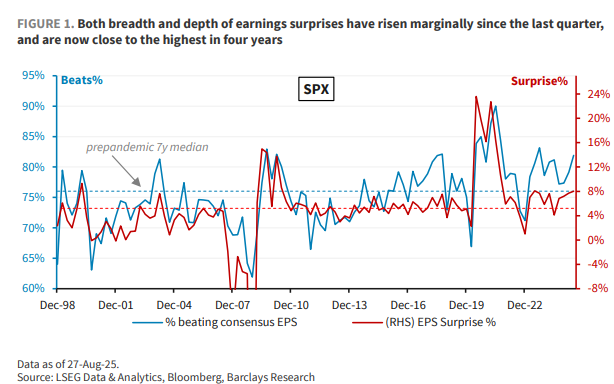
Core Insights - Despite the high valuation of the S&P 500 at 22-22.5 times earnings, it is not considered overvalued, particularly in the technology sector, which still has room for growth [1][5] - The second quarter earnings season showed strong performance, with S&P 500 earnings per share (EPS) growing by 10.6% and sales increasing by 6.1%, although this growth is heavily concentrated in a few sectors, mainly large tech and financials [3][4] Valuation Analysis - Large tech stocks are trading at approximately 29 times forward earnings, which is still below the expected level at the end of 2024 and lower than their historical premium over the S&P 500 [2][5] - In contrast, industrial stocks are considered overvalued, trading at 25 times earnings, driven by aerospace and defense and electrical equipment sectors [5] Earnings Performance - The second quarter earnings season exceeded expectations, with the breadth and depth of earnings surprises being the highest in four years [3] - Large tech stocks saw EPS growth of 27.6%, while other tech stocks grew by 19.7%, significantly above their long-term average of 8.7% [4] Sector Performance - The communication services sector showed remarkable growth of 24.8%, while consumer, materials, and utility sectors lagged behind, with earnings growth falling short of their long-term growth rates [4] - The financial and communication services sectors demonstrated the most significant improvement in profit margins, being the only two sectors to achieve positive operating leverage [4] Market Sentiment and Concerns - Concerns regarding tariffs have eased, with discussions about tariffs among executives decreasing from 90% to 76% in earnings calls, indicating a shift towards a more positive outlook on inventory levels [10] - Approximately 55% of executives discussed artificial intelligence (AI) topics in earnings calls, reflecting a growing trend, with a focus on efficiency improvements rather than cost [10]

港股收评:三大指数齐跌 科技股、基建股低迷 半导体股大肆走高
Ge Long Hui· 2025-08-28 08:26
Group 1 - The Hong Kong stock market indices collectively declined, marking a three-day losing streak, with the Hang Seng Index falling by 0.81% and closing below the 25,000-point mark [1] - The net selling of Hong Kong stocks by southbound funds exceeded 20 billion HKD [1] - Major technology stocks performed poorly, with Meituan experiencing the largest drop of 12.55%, followed by JD.com down 5%, Alibaba down 4.69%, and Baidu down over 1% [1] Group 2 - Infrastructure-related stocks such as heavy machinery, high-speed rail, steel, and building materials saw significant declines, while popular sectors like stablecoin concepts, automotive stocks, innovative pharmaceuticals, and new consumption concepts also fell [1] - Conversely, semiconductor stocks surged due to optimism regarding domestic chip replacement, with InnoCare Technologies rising over 15% and SMIC increasing nearly 11%, reaching a new high since its listing [1] - Other active sectors included robotics, brain-computer interface concepts, insurance, oil, and military stocks [1]
港股收评:恒科指大涨2.7%,半导体股飙涨,华虹半导体涨17%,中芯国际涨10%,小米集团涨2.34%,阿里巴巴涨2%,小鹏汽车涨13%,蔚来涨10%
Sou Hu Cai Jing· 2025-08-22 08:32
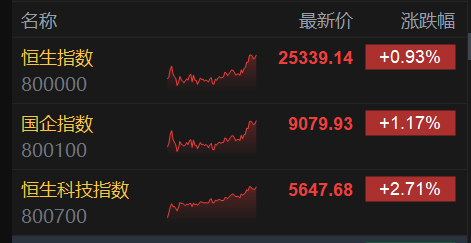
Market Overview - The three major indices continued to rise in the afternoon, with the Hang Seng Index leading with a significant increase of 2.71%, while the Hang Seng China Enterprises Index and the Hang Seng Index rose by 0.93% and 1.17% respectively, with the latter reclaiming the 9000-point mark [2] Stock Performance - Notable stock performances included: - IGG (01347) surged by 17.85% to a price of 56.000 - Jingmen Semiconductor (02878) increased by 10.64% to 0.520 - SMIC (00981) rose by 10.06% to 56.900 - Beike Micro (02149) climbed by 9.15% to 66.800 - Other significant gainers included English Base Technology (02577) up 7.09%, Shanghai Fuzhi (01385) up 6.36%, and Hard Egg Innovation (00400) up 5.26% [3] Sector Movements - Major technology stocks collectively rallied in the afternoon, with Kuaishou rising over 4%, Xiaomi up 2.34%, Alibaba increasing by 2%, and Tencent and Meituan both gaining over 1% [4] - Semiconductor stocks were particularly strong, with Huahong Semiconductor soaring nearly 18%, SMIC up 10%, Jingmen Semiconductor over 10%, and Beike Micro over 9% [4] - Other sectors such as military, robotics, automotive, stablecoin, restaurant, and paper industries also saw upward movements [4] Declines in Specific Sectors - Conversely, airline stocks faced a downturn, dropping over 5% despite a slight decrease in passenger load factor, indicating a marginal improvement in airline revenue levels [4] - Other sectors that performed poorly included copper, brain-computer interface, coal, photovoltaic, and gaming stocks, which mostly exhibited low performance [4]

港股收评:三大指数齐跌 科技股、内银股走弱承压 南下资金净买入358.76亿港元创新高
Ge Long Hui· 2025-08-15 08:33
Market Performance - The Hong Kong stock market indices collectively closed lower, with the Hang Seng Index and the Hang Seng China Enterprises Index down by 0.98%, and the Hang Seng Tech Index down by 0.59% [1] - Despite the overall market decline, southbound funds recorded a significant net purchase of Hong Kong stocks amounting to HKD 35.876 billion, setting a new record for single-day net inflows [1] Sector Performance - Chinese brokerage stocks, often seen as market leaders, experienced substantial gains, with CITIC Securities rising nearly 11%, and China Galaxy and Zhongzhou Securities increasing over 9% [1] - Internet healthcare stocks showed strong performance, with Dingdang Health surging to 36% and JD Health rising by 11.67% post-earnings [1] - Semiconductor stocks, Apple-related stocks, aviation stocks, photovoltaic stocks, domestic property stocks, and military industry stocks mostly exhibited upward trends [1] Underperforming Stocks - Major technology stocks generally underperformed, dragging the market down, with JD.com, NetEase, and Alibaba each falling over 3%, Meituan down over 2%, Baidu down by 1%, and Xiaomi down by 0.66%, while Tencent managed to stay slightly positive [1] - The banking sector faced collective declines, with major banks like Industrial and Commercial Bank of China down by 3%, and Agricultural Bank of China and China Construction Bank each dropping over 2% [1] - Other sectors such as coal, shipping, gaming, and dairy also experienced declines [1]
港股午评:三大指数均跌超1% 内银股下挫 中资券商股拉升 互联网医疗股大涨
Ge Long Hui· 2025-08-15 04:06
Market Performance - The Hong Kong stock market experienced a decline, with all three major indices dropping over 1%, specifically the Hang Seng Index down 1.19%, losing over 300 points, while the Hang Seng China Enterprises Index and the Hang Seng Tech Index fell by 1.26% and 1.08% respectively [1] Sector Performance - Major technology stocks, which serve as market indicators, were generally weak, with JD.com down nearly 4%, Meituan down over 3%, Alibaba down 2.6%, and other tech stocks like Kuaishou, NetEase, Xiaomi, and Baidu also declining over 1%. However, Tencent saw a consecutive rise post-earnings [1] - The banking sector was negatively impacted, with major banks such as Industrial and Commercial Bank of China, Agricultural Bank of China, and China Merchants Bank all dropping over 2% [1] - Insurance stocks, which performed strongly previously, saw some pullback, with AIA Group down nearly 3% [1] - Various sectors including robotics, automotive, gambling, coal, dairy, sports goods, and dining all experienced declines [1] Notable Performers - Chinese brokerage stocks saw significant gains, with Zhongzhou Securities leading with a nearly 14% increase, and other firms like China International Capital Corporation and China Merchants Securities rising over 5% [1] - Internet healthcare stocks surged, with Dingdang Health rising over 26% [1] - Other sectors such as aviation, Apple-related stocks, domestic real estate, and non-ferrous metals showed resilience and were active despite the overall market downturn [1]
K形复苏与木桶短板:美国中部企业正在塌陷?
伍治坚证据主义· 2025-08-14 02:06
Core Viewpoint - The article discusses the "K-shaped economy" in the U.S., where some sectors thrive while others struggle, particularly highlighting the challenges faced by mid-sized companies compared to large tech firms benefiting from AI advancements [2][4]. Group 1: Economic Disparities - Since 2019, mid-sized companies in the U.S. have seen their EBITDA decline by 20% to 25%, with about one-third of these companies experiencing a significant loss in profitability and bargaining power [2][4]. - The GCAI index indicates that in the first two months of Q2 2025, private mid-market companies in the U.S. experienced a 5% increase in profits and a 2% increase in revenue, suggesting resilience among certain firms, especially those providing efficiency-enhancing software [3][8]. Group 2: Sector Performance - The article identifies a clear divide in sector performance: technology, healthcare, and branded consumer goods continue to grow, while industries like manufacturing, traditional retail, and regional services are in decline [4][5]. - High interest rates, tariff uncertainties, technological innovations, and rising capital costs are contributing factors to the economic challenges faced by mid-sized companies [4][5]. Group 3: Challenges for Mid-Sized Companies - Digitalization and AI have increased industry concentration, with large tech firms leveraging data and algorithms to create competitive advantages, leaving mid-sized manufacturers and service providers struggling with automation costs and cash flow issues [5][6]. - Trade wars and tariff policies have destabilized supply chains, making it difficult for many small and mid-sized enterprises to adjust quickly, thereby squeezing their profit margins [6][7]. - A decline in banks' risk appetite has led to stricter loan conditions in a high-interest environment, further narrowing financing options for mid-sized companies [7]. Group 4: Investment Insights - The case of Andrew Milgram's investment in taxi medallions illustrates the potential for value in distressed assets, emphasizing the importance of understanding regulations and market dynamics [3][8]. - The resilience shown by some mid-sized companies adapting to high-cost environments through digital tools and niche market focus indicates that the K-shaped economy is not predetermined but influenced by policy and business strategies [8][9]. Group 5: Policy Implications - The article suggests that if the government stabilizes tariffs and tax policies, reduces regulatory uncertainties, and encourages technology and capital to flow towards mid-sized enterprises, the K-shaped curve could flatten [8][9]. - The health of the mid-sized economy is crucial for overall employment, consumption, and social stability, as a collective failure of these companies could negatively impact the broader economy [8][9].

“著名反指”美银调查:机构对经济和AI更乐观,对中国更乐观,加密货币和黄金持仓很低
美股IPO· 2025-08-11 11:39
Core Viewpoint - The August Bank of America Fund Manager Survey (FMS) indicates a significant improvement in investor sentiment, reaching a six-month high, driven by optimism regarding AI's impact on productivity and expectations of a "soft landing" for the global economy [1][3][7] Group 1: Investor Sentiment and Economic Outlook - 68% of respondents expect a "soft landing" for the global economy, with only 5% anticipating a "hard landing," the lowest since January [9] - The net overweight ratio for equities has risen for the fourth consecutive month, reaching 14%, the highest in six months [4] - Optimism regarding future interest rate cuts has reached its highest point since December 2024 [11] Group 2: AI and Productivity - 55% of fund managers believe AI has already begun to enhance productivity, a significant increase from 42% in July [5][16] - Despite the optimism, there is a divide regarding AI stocks, with 52% believing they are not in a bubble, while 41% think otherwise [18] Group 3: Emerging Markets and China - There is a notable shift in asset allocation towards emerging markets, with the net overweight ratio for emerging market stocks rising from 22% to 37%, the highest since February 2023 [21] - A net 11% of respondents expect the Chinese economy to strengthen, the highest level since March 2025 [23] Group 4: Cryptocurrency and Gold - Interest in cryptocurrencies remains low, with only 9% of respondents holding them, and an average allocation of just 3.2% among holders [27] - Gold also sees limited interest, with 48% of investors holding it, but an overall average allocation of only 2.2% [30]

港股收评:三大指数齐跌!“反内卷”板块多数走低,生物医药股逆市上涨
Ge Long Hui· 2025-07-16 08:40
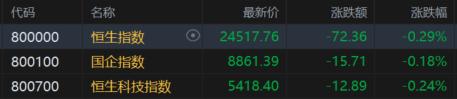
Market Overview - The Hong Kong stock market opened high but closed lower, with the Hang Seng Index down by 0.29%, the Hang Seng China Enterprises Index down by 0.18%, and the Hang Seng Tech Index down by 0.24% [1][2] - All three indices reached new highs since April during the trading session [1] Sector Performance - Major technology stocks mostly declined, with Meituan down 1.66%, Netease down 1%, and Xiaomi, JD.com, and Tencent also falling, while Baidu and Alibaba saw gains [2] - Large financial stocks, including banks, insurance, and brokerage firms, performed poorly, and sectors related to "anti-involution" saw significant declines, particularly in construction materials, cement, and steel [2] - Conversely, education stocks surged due to a national initiative for large-scale vocational skills training, and cryptocurrency-related stocks rebounded in the afternoon [2][11] - Biopharmaceutical stocks continued their upward trend, and semiconductor stocks rose as Nvidia announced a resumption of chip sales to China [2] Notable Stock Movements - Kintone International saw a drop of over 7%, while NIO, Meituan, and BYD Electronics fell over 1%. Conversely, Tongcheng Travel rose over 3%, and Tencent Music and Kuaishou increased by over 2% [4][5] - Real estate stocks declined, with Midea Real Estate down over 5% and several other major developers falling by over 3% [6] - Coal stocks experienced significant drops, with Anyu Asia and Mongolia Energy down over 6% [7] Tourism and Education Stocks - Tourism-related stocks were active, with Tongcheng Travel rising over 5% and other travel companies following suit [8] - The government announced a large-scale vocational skills training initiative, leading to a collective rise in education stocks, including China Oriental Education and Zhonghui Group, both up over 3% [10] Cryptocurrency Stocks - Cryptocurrency-related stocks saw significant gains, with Blue Ocean Interactive up over 25% and Boya Interactive up over 9% [11][12] Individual Stock Highlights - Weiyali resumed trading and saw a dramatic increase of 918.4% at one point, closing with a gain of 288.34% [13] - China San San Media rose over 72%, with a month-to-date increase of 378%, following plans to apply for a stablecoin license [17] Capital Flows - Southbound funds recorded a net inflow of 1.603 billion HKD, with the Shanghai-Hong Kong Stock Connect seeing a net buy of 2.009 billion HKD [21] Market Outlook - Huatai Securities indicated that market volatility may increase, with the importance of sector rotation rising. They suggested focusing on sectors with higher profitability and safety margins in the short term, such as food and beverage, personal care, and finance [23]