
投资管理业

Search documents
霍华德·马克斯:在不确定的世界,把赔率握在自己手里|大师经典系列
聪明投资者· 2025-10-23 07:04
Core Viewpoint - The article discusses the cyclical nature of investment opportunities and risks, emphasizing the importance of understanding current market conditions rather than making predictions about the future. It highlights Howard Marks' investment philosophy, which focuses on recognizing market extremes and adjusting strategies accordingly [1][84]. Group 1: Market Conditions and Investment Philosophy - Howard Marks identifies signs of overheating and speculation in tech and telecom stocks, drawing parallels to past market bubbles [1][2]. - He emphasizes the uncertainty of the future and the importance of understanding present circumstances, stating that while predicting the future is difficult, analyzing current events is manageable [3][14]. - The article illustrates the cyclical nature of markets, where periods of optimism can lead to overvaluation, followed by corrections [60][81]. Group 2: Historical Context and Personal Journey - Marks' upbringing during the Great Depression instilled a cautious mindset, influencing his investment philosophy of risk management and diversification [7][8]. - His academic journey led him to the Wharton School, where he shifted from accounting to finance, finding greater interest in the latter [12][13]. - The "Nifty Fifty" phenomenon serves as a cautionary tale, where even the best companies can experience significant declines, reinforcing the need for prudent investment strategies [22][23]. Group 3: Distress Investing and Market Opportunities - Marks transitioned to high-yield bonds and distressed securities, recognizing the potential for profit in undervalued assets during market downturns [27][28]. - The establishment of Oak Tree Capital marked a significant shift in focus towards distressed investing, emphasizing risk control and consistent returns [54][56]. - The article highlights the importance of positioning in the market, where investing during periods of fear can yield substantial returns [44][45]. Group 4: Recent Market Trends and Future Outlook - The article discusses the evolution of investment strategies from 2008 to 2025, noting the shift from liquidity-driven markets to a focus on cash flow and capital costs [81][82]. - Marks stresses the importance of recognizing current market positions and adjusting strategies accordingly, rather than attempting to predict future outcomes [90]. - The cyclical nature of investment opportunities suggests that understanding market conditions can significantly improve investment odds [84][90].


矽电股份公布半年报 上半年净利减少62.29%
Xin Lang Cai Jing· 2025-08-29 11:24
Group 1 - The core viewpoint of the article highlights the financial performance of Silicon Power Co., which reported a significant decline in both revenue and net profit for the first half of the year [1] - The company's half-year operating revenue was 181,603,703.69 yuan, representing a year-on-year decrease of 36.88% [1] - The net profit attributable to shareholders of the listed company was 21,356,119.70 yuan, showing a year-on-year decline of 62.29% [1] Group 2 - The announcement indicates that among the top ten circulating shareholders, the National Social Security Fund's 114 portfolio is a new institutional investor [1] - Other new circulating shareholders include various investment funds and individual investors, such as the Industrial and Commercial Bank of China and Shenzhen Qianhai Fangwei Investment Management Co., Ltd. [1]
美联储独立性再遭侵蚀,黄金“避风港地位”加固
Sou Hu Cai Jing· 2025-08-27 15:08
Core Viewpoint - The independence of the Federal Reserve is under threat following Trump's dismissal of board member Lisa Cook, leading to potential pressure on U.S. Treasury bonds and the dollar, while increasing the attractiveness of gold as a safe-haven asset [1][4]. Market Volatility - Trump's ongoing conflict with the Federal Reserve continues, highlighted by his announcement to fire Lisa Cook, which he claims is due to alleged past mortgage fraud [2]. - Cook disputes the legality of her dismissal, stating that Trump lacks the authority to remove her without just cause, as per U.S. law [2]. - Following the announcement, the dollar weakened but later recovered, while U.S. Treasury yields mostly declined, with the 2-year yield down 4.26 basis points to 3.672% and the 10-year yield down 0.78 basis points to 4.261% [2]. Stock Market Resilience - The U.S. stock market showed relative resilience, with major indices rising, partly due to expectations of potential interest rate cuts by the Federal Reserve [3]. - Analysts suggest that the market's muted response to the political turmoil may indicate investor fatigue or uncertainty regarding the legality of Trump's actions [3]. - The potential appointment of Trump's nominee Stephen Miran could further shift the balance of power within the Federal Reserve [3]. Gold's Appeal - The attack on the Federal Reserve's independence is seen as a direct threat to its credibility, which could diminish the attractiveness of U.S. assets [4]. - Gold prices surged to a two-week high, closing at $3,393.62 per ounce, reflecting increased demand as a hedge against inflation and political uncertainty [4]. - Analysts predict that if the Federal Reserve loses its independence, gold will become the preferred safe haven for investors, with central banks expected to purchase around 1,000 tons of gold this year [5]. Investment Strategies - In times of financial risk, tangible assets like gold and real estate are expected to become safe havens, especially if the Federal Reserve's independence is compromised [5]. - The loss of the Federal Reserve's independence could pose long-term risks to U.S. bonds and the dollar, prompting investors to consider international investments in stable, low-inflation countries as a hedge against rising U.S. inflation [5].
美联储降息预期引爆套息交易 新兴市场货币获国际资本大举加仓
智通财经网· 2025-08-11 00:14
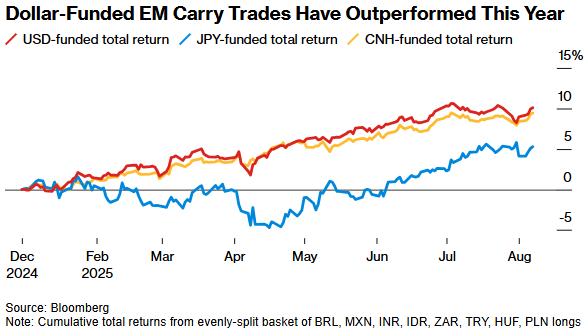
Group 1 - The core viewpoint of the articles highlights a renewed interest in carry trades among emerging market investors due to a weakening US dollar and declining volatility, creating an ideal environment for such strategies [1][3][4] - Fund managers from various institutions, including Neuberger Berman and Aberdeen Group, are increasing their positions in currencies from Brazil, South Africa, and Egypt, driven by high yields [1][4] - Emerging market currencies have shown resilience, with 18 out of 23 major currencies appreciating against the US dollar this year, and local bond indices returning over 12% [3] Group 2 - The preference for emerging markets is reflected in the volatility indicators, with the expected volatility difference between emerging market currencies and G10 currencies at a 12-year high, suggesting a more stable market environment for developing economies [3] - Some emerging market central banks are maintaining hawkish stances due to inflation and tariff concerns, further enhancing the attractiveness of carry trades [3] - The average carry rate for Asian currencies is negative, while Latin American currencies show a positive carry rate of 3.7%, indicating a more favorable environment for carry trades in Latin America [7] Group 3 - The Bloomberg cumulative forex carry trade index for eight emerging market currencies has returned over 10% this year, with investors locking in profits amid concerns over US economic policies [7] - Institutions like Morgan Stanley and BNP Paribas note that the decline in global market volatility has negatively impacted low-yield Asian currencies, while high-yield Latin American currencies benefit from increased risk appetite [7] - Neuberger Berman's outlook suggests that as long as there is confidence that the US dollar will not experience a significant rebound, carry trades remain highly attractive [7]
非农“暴雷”一周后,美股和企业债给出回应:大涨!
Hua Er Jie Jian Wen· 2025-08-09 02:00
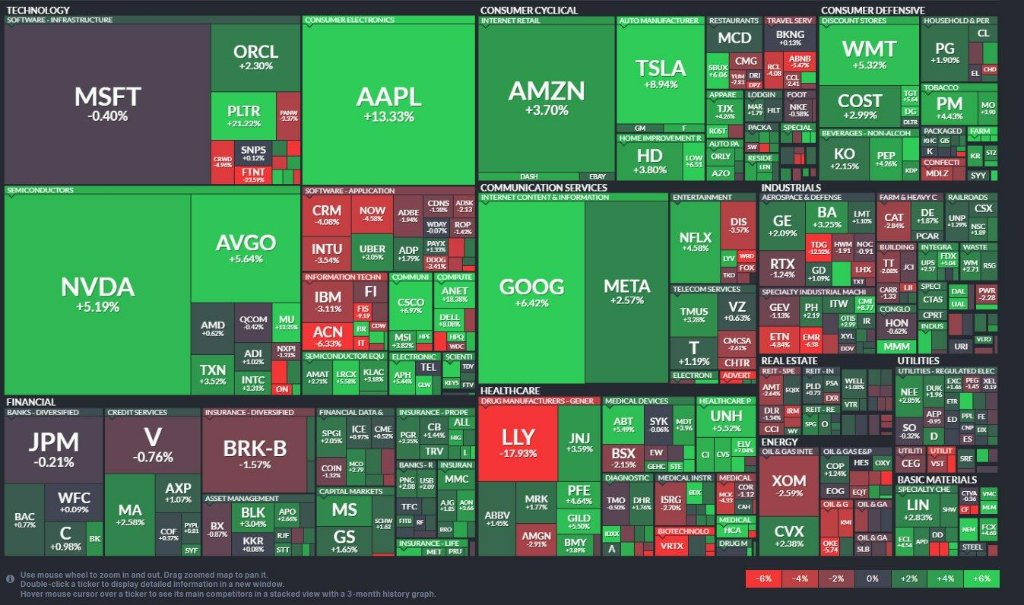
Group 1 - The core sentiment in the market has shifted towards risk-on, with high-risk assets rebounding significantly despite previous economic concerns highlighted by a poor employment report [1][3] - The Nasdaq 100 index recorded its largest weekly gain in over a month, while high-yield corporate bond spreads narrowed for five consecutive days, indicating a recovery in investor sentiment [1][7] - Strong corporate earnings and renewed enthusiasm for artificial intelligence are driving this risk-on sentiment, with the S&P 500 expected to see a 10% growth in earnings for the second quarter, significantly higher than prior forecasts [8] Group 2 - Despite the stock market's rally, the U.S. Treasury market remains cautious, with the 10-year Treasury yield still below levels seen before the employment report, reflecting ongoing economic concerns [3][4] - The divergence between the optimistic stock and corporate bond markets and the cautious Treasury market is becoming a focal point of interest on Wall Street [3][10] - Analysts suggest that the high valuations in the stock market, with a price-to-earnings ratio close to 23, indicate elevated risk levels, reminiscent of the tech bubble era [8][6] Group 3 - The current economic indicators, such as rising unemployment claims and increased consumer inflation expectations, contribute to the uncertainty surrounding the economic outlook [9][10] - There is a belief among some analysts that the bond market's signals should be trusted over the seemingly optimistic high-yield corporate bond indicators, especially in the later stages of the economic expansion cycle [10]
鲍威尔“放鹰”打压9月降息预期 美债、新兴市场货币下跌
Zhi Tong Cai Jing· 2025-07-31 02:39
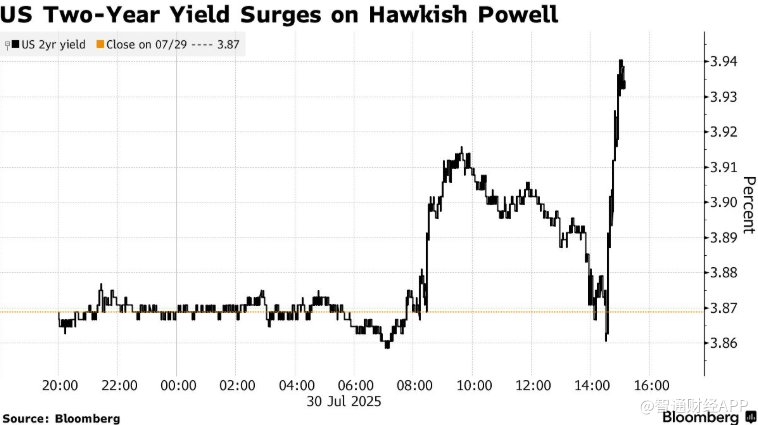
Core Viewpoint - Federal Reserve Chairman Jerome Powell downplayed expectations for a rate cut in September, leading to declines in U.S. Treasury prices and emerging market currencies [1][2][9] Group 1: Federal Reserve and Interest Rates - Powell emphasized the need for patience given the strong U.S. labor market and inflation above target levels [1] - The likelihood of a rate cut in September is now only 40%, while October's probability has risen to 80% [1] - Powell's hawkish comments led to a 7 basis point increase in the two-year U.S. Treasury yield, and the Bloomberg Dollar Spot Index reached a two-month high [2][3] Group 2: Market Reactions - Investors reacted negatively to Powell's statements, with a sell-off in U.S. Treasuries intensifying as he noted the labor market is "in balance" [2][6] - Emerging market currencies fell, with the MSCI Emerging Markets Currency Index down 0.1%, marking its fourth consecutive decline [9][12] - The market anticipates that a delay in rate cuts could strengthen the dollar and weaken emerging market currencies [9][12] Group 3: Economic Indicators - Recent data showed that private sector employment in July exceeded economists' expectations, contributing to a perception of a strong economy [6] - Preliminary data indicated that the U.S. GDP grew at an annualized rate of 3% in the second quarter, surpassing market expectations [6] - The U.S. Treasury announced it would maintain its debt auction size but increase the frequency of repurchase operations to enhance liquidity for long-term bonds [7]
关税通胀首现!分析人士:美联储政策路径或迅速改变
智通财经网· 2025-07-17 22:30
Group 1 - The recent U.S. economic data indicates that tariff policies are beginning to show signs of inflation in prices, marking the first time such signals have been captured in official data [1] - The Consumer Price Index (CPI) for June showed an annual increase from 2.4% in May to 2.7% in June, leading to a brief sell-off in the bond market [1][2] - The Producer Price Index (PPI) for June reported zero growth, stabilizing the market after the CPI report [1][2] Group 2 - Core consumer prices, excluding automobiles, rose by 0.6% month-over-month in June, the largest monthly increase since 2022, with notable increases in home goods and appliances [2] - PIMCO suggests that the CPI data may support the Federal Reserve's cautious stance, indicating room for potential rate cuts in September and beyond [2] - The PCE price index is expected to reach 2.8% in June and potentially 3% in July, which could diminish the likelihood of a rate cut in September [3] Group 3 - Current bond market sentiment views the inflation caused by tariffs as a "temporary adjustment" that will be absorbed in a few months, with prices expected to stabilize near the Fed's target [3] - The 10-year U.S. Treasury yield is currently around 4.45%, which is considered attractive for investors [3][4] - Despite recent tariff-related news, the U.S. Treasury market has remained stable, with the 10-year yield fluctuating within a narrow range of 15 basis points [3]
美股一线|特朗普“对等关税”山雨欲来,美股三大指数全线重挫
2 1 Shi Ji Jing Ji Bao Dao· 2025-03-31 00:43
21世纪经济报道记者吴斌 上海报道 关税影响还有待进一步传导,目前的形势已经不容乐观。3月28日,美国经济分析局公布的数据显示, 美联储最青睐的通胀数据意外走强。2月PCE价格指数环比上升0.3%,同比上升2.5%,与预期一致。但 剔除能源和食品价格后,核心PCE价格指数环比增长0.4%,较前值加速了0.1个百分点,创2024年1月以 来最高;同比增速从2.7%加速至2.8%,为2024年12月以来最高,均比预期高出0.1个百分点。 随着美国总统特朗普"对等关税"山雨欲来,美国经济警报频现,美股三大指数全线重挫。上周五标普 500指数跌1.97%,纳斯达克综合指数跌2.7%,道琼斯工业平均指数跌1.69%。从一周表现来看,标普 500指数跌1.53%,纳指跌2.59%,道指跌0.96%。 自2月中旬创下历史新高以来,标普500指数整体承压,已经较2月19日的历史最高收盘点位下跌了约 9%,纳指更是较去年12月16日的历史最高收盘点位下跌了约14%。 本周特朗普"对等关税"或给市场带来巨大冲击。嘉盛集团资深分析师Jerry Chen对记者表示,关键时间 仍将是4月2日,届时特朗普将宣布"对等关税"。美国政府似乎 ...