
文化体育和娱乐业

Search documents
今年10月中国企业信用指数为161.56 信用水平基本平稳
Jing Ji Guan Cha Wang· 2025-12-01 08:15
Core Insights - The core viewpoint of the article is that China's enterprise credit index for October stands at 161.56, indicating a stable credit level among enterprises [1] Industry Summary - The top five industries ranked by credit index are: 1. Financial industry 2. Electricity, heat, gas, and water production and supply 3. Water conservancy, environment, and public facilities management 4. Scientific research and technical services 5. Construction industry [1] - Half of the industries reported a month-on-month increase in their credit index [1] - The cultural, sports, and entertainment industry experienced the highest growth rate in credit index among all sectors [1] - The real estate industry has shown a continuous month-on-month increase in its credit index for three consecutive months [1]
黑龙江省:前三季度地区生产总值同比增长4.8%,文旅市场消费活力持续释放
Zheng Quan Shi Bao Wang· 2025-10-29 06:25
Economic Overview - Heilongjiang Province's GDP for the first three quarters reached 11,489.0 billion yuan, with a year-on-year growth of 4.8% [1] - The primary industry added value was 1,186.0 billion yuan, growing by 4.3%; the secondary industry added value was 3,014.2 billion yuan, increasing by 3.8%; the tertiary industry added value was 7,288.8 billion yuan, rising by 5.2% [1] Agricultural Sector - The total output value of agriculture, forestry, animal husbandry, and fishery in Heilongjiang Province was 2,275.3 billion yuan, with a year-on-year increase of 4.4% [3] - Vegetable and edible fungus production reached 7.549 million tons, growing by 5.1%; fruit production was 1.704 million tons, increasing by 4.6% [3] - Livestock production saw 18.397 million pigs and 228.091 million live poultry, with growth rates of 4.9% and 7.1%, respectively [3] - Aquaculture produced 710,000 tons of aquatic products, marking a 10.7% increase [3] Industrial Sector - The added value of large-scale industrial enterprises grew by 4.8%, an increase of 7.5 percentage points compared to the previous year [4] - Mining industry added value increased by 5.5%, manufacturing by 4.4%, and electricity, heat, gas, and water production and supply by 3.3% [4] - Key industries such as equipment manufacturing saw a 15.8% increase in added value, with electrical machinery and equipment manufacturing growing by 43.0% [4] Service Sector - The added value of the service industry grew by 5.2%, an increase of 1.1 percentage points year-on-year [5] - The tourism sector welcomed 206.711 million visitors, a growth of 11.2%, with tourism spending reaching 276.99 billion yuan, up by 19.5% [5] - The revenue from cultural, sports, and entertainment industries increased by 6.2%, with sports and entertainment sectors growing by 12.9% and 10.2%, respectively [5] Consumer Market - The total retail sales of consumer goods reached 4,024.6 billion yuan, with a year-on-year growth of 4.5% [6] - Retail sales of communication equipment and home appliances grew significantly by 60.8% and 56.8%, respectively [6] - Online retail sales increased by 16.0%, with physical goods online retail growing by 11.3% [6] Investment Trends - Fixed asset investment decreased by 7.6%, with first industry investment down by 24.0% and third industry investment down by 9.7% [7] - Industrial investment grew by 0.7%, with manufacturing investment increasing by 14.7% [7] - Private investment rose by 12.5%, accounting for 30.6% of total investment, an increase of 5.0 percentage points [7] Income and Price Trends - Per capita disposable income reached 22,810 yuan, growing by 5.0% [7] - The Consumer Price Index (CPI) fell by 0.3% in September, with six categories of goods and services increasing in price [8]

前三季度全省经济运行总体平稳
Liao Ning Ri Bao· 2025-10-24 01:19
Economic Overview - The province's GDP for the first three quarters reached 24,283.9 billion yuan, with a year-on-year growth of 4.3% at constant prices [1] - The primary industry added value was 1,611.5 billion yuan, growing by 4.3%; the secondary industry added value was 8,367.7 billion yuan, growing by 2.1%; and the tertiary industry added value was 14,304.7 billion yuan, growing by 5.4% [1] Industry Performance - The industrial added value for large-scale enterprises increased by 2.2% year-on-year, with high-tech manufacturing growing by 6.1% [1][2] - Among 40 major industrial categories, 24 saw a year-on-year increase in added value, resulting in a growth rate of 60.0% [2] - Notable product growth included transformers, civilian steel ships, synthetic ammonia, and new energy vehicles, all showing double-digit growth [2] Service Sector - The service sector's added value grew by 5.4% year-on-year, with wholesale and retail, and accommodation and catering sectors increasing by 6.0% and 5.4%, respectively [2] - The transportation and postal sectors also showed growth, with cargo turnover increasing by 4.3% and postal business volume growing by 20.9% [2] Consumer Trends - Social retail sales totaled 7,866.0 billion yuan, with a year-on-year growth of 4.1% [3] - Urban retail sales reached 6,835.5 billion yuan, growing by 4.2%, while rural retail sales were 1,030.4 billion yuan, growing by 3.3% [3] - Significant growth in retail sales was observed in home appliances (51.0%), furniture (49.2%), and communication equipment (33.2%) [3] Investment Insights - First industry investment grew by 12.1%, while second industry investment increased by 1.6%, with manufacturing investment rising by 12.0% and high-tech manufacturing investment by 11.7% [3] Fiscal Performance - General public budget revenue reached 2,309.1 billion yuan, growing by 0.7%, while expenditure increased by 3.0% to 4,960.3 billion yuan [4] - Per capita disposable income for residents was 31,441 yuan, with urban residents at 37,493 yuan (4.5% growth) and rural residents at 18,691 yuan (5.1% growth) [4] Price Trends - Consumer prices remained stable, while industrial producer prices declined [5]
前三季度全省经济运行呈现良好态势 平稳向好 趋新向优 韧性增强
He Nan Ri Bao· 2025-10-21 23:33
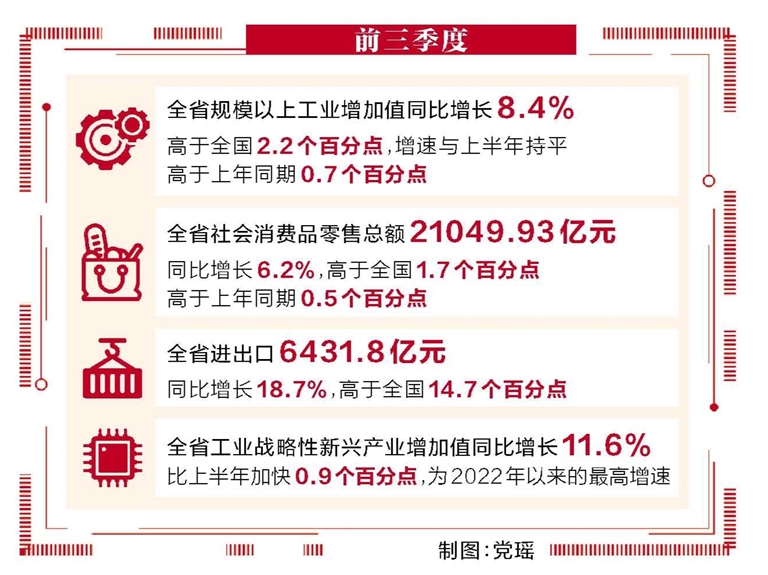
Economic Overview - The province's GDP reached 48,867.57 billion yuan in the first three quarters, with a year-on-year growth of 5.6%, surpassing the national average by 0.4 percentage points [2] - The primary industry added value was 4,007.37 billion yuan, growing by 3.1% year-on-year; the secondary industry added value was 18,659.76 billion yuan, with a growth of 5.7%, exceeding the national growth by 0.8 percentage points; the tertiary industry added value was 26,200.44 billion yuan, growing by 5.9%, higher than the national average by 0.5 percentage points [2] Agricultural Production - The total output value of agriculture, forestry, animal husbandry, and fishery increased by 3.6% year-on-year, with significant growth in major economic crops [3] - Vegetable and edible fungus production reached 61.34 million tons, growing by 2.8% year-on-year; traditional Chinese medicine production was 435,200 tons, with a growth of 4.0% [3] Industrial Growth - The industrial added value for large-scale enterprises grew by 8.4% year-on-year, exceeding the national average by 2.2 percentage points [3] - The automotive and parts industry saw a growth of 20.0%, while the equipment manufacturing industry grew by 14.3%, significantly contributing to the overall industrial growth [3] Service Sector Performance - The revenue of large-scale service enterprises increased by 8.0% year-on-year, surpassing the national average by 0.3 percentage points [3] - Cultural, sports, and entertainment industries experienced a revenue growth of 22.3%, with the micro-short drama industry growing by 107.8% [3] Investment and Consumption - Fixed asset investment grew by 4.5% year-on-year, exceeding the national average by 5.0 percentage points [4] - Social retail sales totaled 21,049.93 billion yuan, with a year-on-year growth of 6.2%, higher than the national average by 1.7 percentage points [4] Foreign Trade - The province's import and export volume reached 643.18 billion yuan, growing by 18.7% year-on-year, surpassing the national average by 14.7 percentage points [4] - Exports of "new three samples" products reached 20.42 billion yuan, with a remarkable growth of 162.4%, including electric vehicle exports of 18.73 billion yuan, growing by 262.1% [4] Emerging Industries - High-tech manufacturing added value grew by 13.9% year-on-year, with strategic emerging industries growing by 11.6%, marking the highest growth since 2022 [5] - Online retail sales increased by 17.0% year-on-year, significantly outpacing the national average [5]
大连:1—8月份,全市规上工业增加值同比增长12.8%
Zheng Quan Shi Bao Wang· 2025-09-24 07:15
Economic Overview - Dalian's economy showed stable performance in the first eight months of the year, with industrial production improving and consumer momentum continuing to release [1] - The city's industrial added value for enterprises above designated size increased by 12.8% year-on-year, maintaining the same growth rate as the previous month [1] Industrial Performance - The added value of high-tech manufacturing increased by 15.9% year-on-year, continuing a double-digit growth trend [1] - State-owned enterprises saw a significant increase in added value by 21.9%, while joint-stock enterprises grew by 16.7%, foreign and Hong Kong, Macao, and Taiwan-invested enterprises by 4.2%, and private enterprises by 2.3% [2] - Mining industry added value surged by 61.5%, while manufacturing grew by 13.3% and the production and supply of electricity, heat, gas, and water increased by 6.8% [2] - Key industries such as petrochemical increased by 7.1%, equipment manufacturing by 17.8%, with notable growth in the railway and shipbuilding industry at 62.0% and the automotive industry at 27.7% [2] - Pharmaceutical manufacturing saw a remarkable increase of 42.9%, with raw material drug manufacturing skyrocketing by 536.3% [2] Service Sector - The service sector in Dalian remained stable, with most industries experiencing growth [3] - The total turnover of road, water, and air transport increased by 1.8%, 4.1%, and 2.5% respectively [3] - Retail sales for large-scale units reached 579.9 billion yuan, marking an 8.2% year-on-year increase, with significant growth in categories such as building materials (990.7%) and home appliances (285.9%) [3] Consumer Prices and Electricity Consumption - Consumer prices in Dalian continued to operate at low levels, with food and beverage prices decreasing by 1.6% [4] - Total electricity consumption in the city reached 33.79 billion kWh, a year-on-year increase of 2.7%, with industrial electricity consumption at 20.49 billion kWh, growing by 1.6% [4]
信阳市公布8月份全市经济运行情况 主要经济指标保持稳增
Sou Hu Cai Jing· 2025-09-22 10:32
Economic Overview - The economic operation of Xinyang City remains stable and resilient, with major economic indicators showing steady growth and improved development quality [1][5] - The city has implemented a "1+2+4+N" target task system focusing on stabilizing employment, enterprises, markets, and expectations [1] Industrial Performance - In August, the industrial production in Xinyang City saw a year-on-year increase of 8.2%, matching the provincial growth rate [1] - Among 33 industrial sectors, 23 reported growth, with a growth coverage of 69.7% [1] - The manufacturing sector showed strong support, with a 10.0% year-on-year increase in manufacturing value added, contributing 8.0 percentage points to the overall industrial growth [1] - Key industries such as biomedicine, equipment manufacturing, green food, and green home products experienced significant growth, with increases of 18.6%, 13.2%, 13.2%, and 8.8% respectively [1] Fixed Asset Investment - From January to August, fixed asset investment in Xinyang City grew by 5.8%, surpassing the provincial growth rate by 1.1 percentage points [2] - Industrial investment saw a substantial increase of 34.9%, significantly higher than the provincial rate of 14.4% [2] - Major project investments contributed positively, with investments in projects worth over 100 million yuan increasing by 11.0%, driving overall investment growth by 7.3 percentage points [2] Consumer Market - The retail market in Xinyang City maintained growth, with total retail sales of consumer goods reaching 9.61 billion yuan in August, a year-on-year increase of 4.7% [3] - Over 60% of retail categories saw growth, with 13 out of 21 categories in the above-limit units reporting year-on-year increases [3] - Basic living consumption remained stable, with significant growth in food and clothing retail sales [3] Emerging Industries - The high-tech industry in Xinyang City showed promising growth, with a year-on-year increase of 7.2% in high-tech industrial value added [4] - Investment in high-tech manufacturing increased by 31.0%, significantly outpacing the overall investment growth rate [4] - The modern service sector also demonstrated vitality, with substantial revenue growth in cultural, sports, and entertainment industries [4] Challenges and Future Outlook - Despite the overall positive economic performance, challenges remain for enterprises, particularly in key industries [5] - The city aims to continue focusing on the "1+2+4+N" target system to navigate current challenges and enhance economic momentum [5]
进一步激发民间投资活力
Jing Ji Ri Bao· 2025-09-18 21:59
Group 1 - The core viewpoint is that China's private investment is undergoing a structural transformation towards high-quality development, with more private capital flowing into new productive forces, emerging services, and new infrastructure [1][3] - From January to August, private fixed asset investment decreased by 2.3% year-on-year, with the decline rate expanding compared to the previous seven months, indicating pressure on overall data [1][2] - Despite the overall decline, the structure of private investment shows positive changes, reflecting strong resilience and playing a crucial role in stabilizing growth, adjusting structure, and ensuring employment [1][2] Group 2 - The decline in private investment growth is primarily influenced by a 16.7% drop in real estate development investment, which reduced the overall private investment growth rate by 4.5 percentage points [2] - Excluding real estate development, private project investment grew by 3% year-on-year, indicating strong investment willingness and capability in the real economy [2] - Manufacturing sector performance is notable, with private investment in manufacturing growing by 4.2%, and over half of the 31 manufacturing categories achieving double-digit growth, particularly in the automotive manufacturing sector with a 22.6% increase [2] Group 3 - Private capital's participation in major infrastructure construction is expanding, with private investment in infrastructure growing by 7.5% year-on-year [2] - The service sector is also a hotspot for investment, with private investment in accommodation and catering growing by 17%, and cultural, sports, and entertainment sectors increasing by 7% [2] - These trends reflect the confidence of private capital in economic development and the continuous optimization of the investment environment [2] Group 4 - Despite challenges faced by some private enterprises, the long-term positive fundamentals of the economy remain unchanged, providing broad space for private investment [3] - Private enterprises are actively engaging in emerging industries such as green industries, artificial intelligence, and embodied robotics, showcasing strong innovative vitality [3] - Future trends in private investment include a shift towards high-quality development fields, diversification of investment models, and increased collaboration among investment entities [3][4] Group 5 - To further stimulate private investment, coordinated efforts are needed across multiple dimensions, ensuring that private capital can invest effectively and exit smoothly [4] - The State Council's recent meeting emphasized addressing key issues for enterprises, implementing practical measures to expand access, unblock bottlenecks, and strengthen guarantees [4] - The National Development and Reform Commission is working on policies to promote private investment development and establish mechanisms for private enterprises to participate in major national projects [4]
民间投资迎政策利好 国常会部署若干措施促发展
Zhong Guo Jing Ying Bao· 2025-09-16 15:11
Core Viewpoint - The article highlights the recent policy measures aimed at boosting private investment in China, indicating a positive trend in private sector participation in fixed asset investment, particularly in infrastructure and emerging industries [1][2]. Group 1: Investment Growth - From January to August this year, national fixed asset investment (excluding rural households) grew by 0.5% year-on-year, while private project investment increased by 3%, outpacing overall investment growth [1]. - Private investment in infrastructure surged by 7.5%, exceeding the overall infrastructure investment growth by 5.5 percentage points [2]. Group 2: Policy Measures - The State Council's recent meeting outlined practical measures to stimulate private investment, focusing on addressing key concerns of enterprises, expanding market access, and enhancing support mechanisms [1][2]. - The government aims to create a fair competitive environment by removing hidden barriers to private investment and providing better financing support [2][3]. Group 3: Sector-Specific Opportunities - Private capital is encouraged to invest in new productive forces, emerging service industries, and new infrastructure, with significant growth observed in sectors like electricity, gas, and water supply, which saw a 23.5% increase in private investment [2]. - In the service sector, private investment in accommodation and catering, as well as cultural and sports industries, grew by 17% and 7% respectively during the same period [2]. Group 4: Long-term Mechanisms - The establishment of a long-term mechanism for private enterprises to participate in major national projects is progressing, particularly in sectors like railways, energy, and water conservancy [2][3]. - The National Development and Reform Commission is working on policies to enhance private investment in significant projects, including setting minimum participation ratios for private investments in major infrastructure projects [3].
民间投资为何持续下滑?国家统计局答一财
Di Yi Cai Jing· 2025-09-15 03:43
Group 1 - Private investment growth has faced pressure, with a continuous decline for three months and a year-on-year decrease of 2.3% from January to August [1][3] - Fixed asset investment (excluding rural households) increased by 0.5% year-on-year during the same period, indicating a broader economic context [1][3] - The decline in private investment is significantly influenced by the real estate sector, which saw a 16.7% drop in private investment, pulling down overall private investment growth by 4.5 percentage points [3] Group 2 - Excluding real estate development, private project investment showed a year-on-year increase of 3%, outpacing overall investment growth [3] - Manufacturing sector private investment grew by 4.2%, accounting for 40.6% of total private investment, with 16 out of 31 manufacturing industries experiencing double-digit growth [3][4] - Notable growth in private investment was observed in the automotive manufacturing and transportation equipment sectors, with increases of 22.6% and 16.2% respectively [3] Group 3 - Private enterprises are key players in innovation and have increased investment in emerging industries, contributing to a positive shift in the industry [4] - High-tech industries, particularly information services and professional technical services, saw private investment growth of 26.7% and 17.6% respectively from January to August [4] - Infrastructure private investment rose by 7.5%, surpassing the overall infrastructure investment growth rate by 5.5 percentage points, with significant contributions from the electricity, gas, and water supply sectors [4] Group 4 - The ongoing high-quality development in China is expected to create more space for private investment, particularly in green industries like new energy vehicles and solar power [5] - Private enterprises demonstrate resilience and adaptability, responding effectively to market demands and external challenges [5] - Strong policy support, including the implementation of the Private Economy Promotion Law, is enhancing the environment for private investment and encouraging stable growth [5]

2025年1—7月份固定资产投资规模继续扩大
Zhong Guo Chan Ye Jing Ji Xin Xi Wang· 2025-08-25 07:15
Group 1 - National fixed asset investment (excluding rural households) reached 288,229 billion yuan from January to July, with a year-on-year growth of 1.6% [1] - Equipment purchase investment showed significant growth, increasing by 15.2% year-on-year, which is 13.6 percentage points higher than the overall investment growth rate, contributing 2.2 percentage points to total investment growth [2] - Manufacturing investment grew rapidly, with a year-on-year increase of 6.2%, 4.6 percentage points higher than the overall investment growth, contributing 1.5 percentage points to total investment growth [3] Group 2 - Infrastructure investment increased by 3.2% year-on-year, contributing 43.0% to total investment growth, which is an increase of 6.0 percentage points compared to the first half of the year [4] - Green energy investment surged by 21.5% year-on-year, contributing 1.4 percentage points to total investment growth, with solar, wind, nuclear, and hydropower investments collectively growing by 21.9% [5] - High-tech service industry investment rose by 6.2% year-on-year, with a share of 5.1% in total service industry investment, an increase of 0.4 percentage points from the same period last year [6] Group 3 - Project investment (excluding real estate development) grew by 5.3% year-on-year, 3.7 percentage points higher than the overall investment growth rate, with private project investment (excluding real estate) increasing by 3.9% [7] - The focus for the next phase includes implementing government investment tools effectively, promoting high-quality "two重" construction, and accelerating the development of high-end, intelligent, and green manufacturing [7]