
电力等

Search documents
上交所:调整上证50、上证180、上证380等指数样本 12月12日收市后生效
智通财经网· 2025-11-28 11:07
Core Points - The Shanghai Stock Exchange and China Securities Index Co., Ltd. have decided to adjust the sample stocks of several indices, including the SSE 50, SSE 180, SSE 380, and Sci-Tech 50, effective after the market closes on December 12, 2025 [1] Group 1: Index Adjustments - The SSE 50 index will replace 4 stocks, while the SSE 180 index will replace 7 stocks, and the SSE 380 index will replace 38 stocks [1] - The Sci-Tech 50 index will replace 2 stocks [1] Group 2: Stocks Added to Indices - Stocks added to the SSE 50 index include SAIC Motor Corporation (600104.SH), Northern Rare Earth (600111.SH), and Huadian New Energy (600930.SH) [1] - Stocks added to the SSE 180 index include Guotou Capital (600061), Zhongtian Technology (600522), and Huadian New Energy (600930) [3] - Stocks added to the SSE 380 index include Guotou Capital (600061), Furuida (600223), and Huadian New Energy (600930) [4] Group 3: Stocks Removed from Indices - Stocks removed from the SSE 50 index include Poly Developments (600048.SH), China Mobile (600941.SH), and Aluminum Corporation of China (601600.SH) [1] - Stocks removed from the SSE 180 index include COSCO Shipping Energy Transportation (600026), Nanshan Aluminum (600219), and Sailun Tire (601058) [3] - Stocks removed from the SSE 380 index include Nanshan Aluminum (600219), Jiangshan Shares (600389), and China Oilfield Services (601808) [4]







广州三喜临门!
2 1 Shi Ji Jing Ji Bao Dao· 2025-11-24 03:23
Group 1 - Guangzhou has achieved significant recognition in the global scientific community, ranking sixth in the "2024 Nature Index - Research Cities" and accounting for 65.6% of the Guangdong Province Science and Technology Awards [1][2] - The number of technology enterprises in Guangzhou has reached 13,500, a sevenfold increase since 2015, highlighting the city's role as a leader in technological and industrial innovation [2][4] - The recent election of five scientists from Guangzhou as academicians of the Chinese Academy of Sciences and the Chinese Academy of Engineering underscores the integration of scientific research and industrial needs [2][4] Group 2 - The establishment of "Academician Workstations" in Guangzhou has facilitated deep collaboration between top scientists and local enterprises, enhancing the innovation capabilities of leading companies [4][5] - Guangzhou has developed a tiered talent cultivation system, focusing on nurturing young talents into leading innovators, with significant support for those with potential as strategic scientists [6][7] - The city emphasizes a "career retention" philosophy, fostering an environment where talents can thrive through deep integration of industry, academia, and research [8][10] Group 3 - Guangzhou is actively attracting high-level global talent, providing targeted services such as entrepreneurial subsidies and housing support during events like the "2024 Overseas Talent Exchange Conference" [11][13] - The number of foreign talents working in Guangzhou has increased by 40.3% since the end of 2019, indicating a growing appeal for international professionals [13] - The integration of technological innovation and industrial development in Guangzhou is creating a robust ecosystem, reflecting the city's dynamic growth in new productive forces [13]

前10月全省经济运行总体平稳
Liao Ning Ri Bao· 2025-11-20 01:08
Economic Overview - The province's economy showed overall stability in the first ten months of the year, with industrial growth, declining fixed asset investment, expanding market sales, and rapid export growth [1] Industrial Performance - The added value of industrial enterprises above a designated size increased by 1.5% year-on-year, with high-tech manufacturing growing by 3.9% [1] - By sector, mining increased by 7.8%, manufacturing by 0.7%, and electricity, heat, gas, and water production and supply by 0.1% [2] - State-owned enterprises saw a 2.2% increase in added value, while foreign and Hong Kong, Macao, and Taiwan-invested enterprises experienced a decline of 5.9% [2] - Among 40 industrial categories, 23 reported year-on-year growth, resulting in a growth rate of 57.5% [2] - Notable growth sectors included chemical fiber manufacturing (growth of 7.7 times), transportation equipment manufacturing (growth of 47.1%), and gas production and supply (growth of 21.6%) [2] Investment Trends - Fixed asset investment decreased overall, but manufacturing investment rose by 6.2%, with high-tech manufacturing investment increasing by 10.8% [2] - Investment in the primary industry grew by 5.1% year-on-year [2] Market Sales - The total retail sales of consumer goods reached 877.98 billion yuan, reflecting a year-on-year growth of 3.5% [3] - Sales of essential goods remained stable, with food and oil retail sales increasing by 13.4% and daily necessities by 11.8% [3] - Upgraded consumer goods saw significant sales growth, including wearable smart devices (growth of 15.5 times) and energy-efficient home appliances (growth of 1.3 times) [3] Trade Performance - The province's total import and export value reached 338.37 billion yuan, marking a 9.6% increase [3] - Agricultural product exports totaled 27.67 billion yuan, with a year-on-year growth of 9.9% [3] - Machinery and electrical products exports were 170.59 billion yuan, growing by 8.5%, with notable increases in ship and automotive parts exports [3] Price Trends - Consumer prices remained stable overall, while industrial producer prices experienced a decline [4]
市场监管总局:截至9月底我国国际标准转化率整体已达86%
Zhong Guo Xin Wen Wang· 2025-10-31 03:56
Core Viewpoint - The State Administration for Market Regulation announced that by the end of September 2025, China's international standard conversion rate is expected to reach 86%, achieving the goals set in the National Standardization Development Outline and supporting the country's green and low-carbon development [1][2]. Group 1: National Standard System Construction - The National Standardization Development Outline has led to the establishment of China's first carbon peak and carbon neutrality standard system, providing top-level guidance for revising green and low-carbon standards across various sectors [1]. - In 2022, 49 national standards for greenhouse gas emission accounting were released, covering major carbon-intensive industries such as steel, non-ferrous metals, and electricity, addressing the challenges of accurate carbon accounting [1]. - 13 national standards for product carbon footprints have been published for widely traded products like plastics and furniture, providing technical support for China's product carbon footprint management system [1]. Group 2: International Standard Conversion - The implementation of the "Precise Standard Adoption" and "Efficient Conversion" approach has shortened the international standard conversion time by nearly six months since June 1 of this year [2]. - A total of 410 international standards have been converted and adopted in areas such as carbon emissions, carbon accounting, and carbon capture [2]. - The overall international standard conversion rate is projected to reach 86% by September 2025, aligning with the goals of the National Standardization Development Outline [2]. Group 3: International Standardization Participation - China is actively participating in international standardization efforts, utilizing bilateral cooperation mechanisms to promote mutual recognition of carbon information disclosure and carbon emission monitoring standards [2]. - Chinese experts have led 228 working groups and proposed 442 international standard proposals during the 14th Five-Year Plan period, contributing to the achievement of the United Nations Sustainable Development Goals [2]. - Collaboration with countries involved in the Belt and Road Initiative and BRICS nations is being strengthened to advance international standards in green and low-carbon fields such as new energy vehicles and circular economy [2].
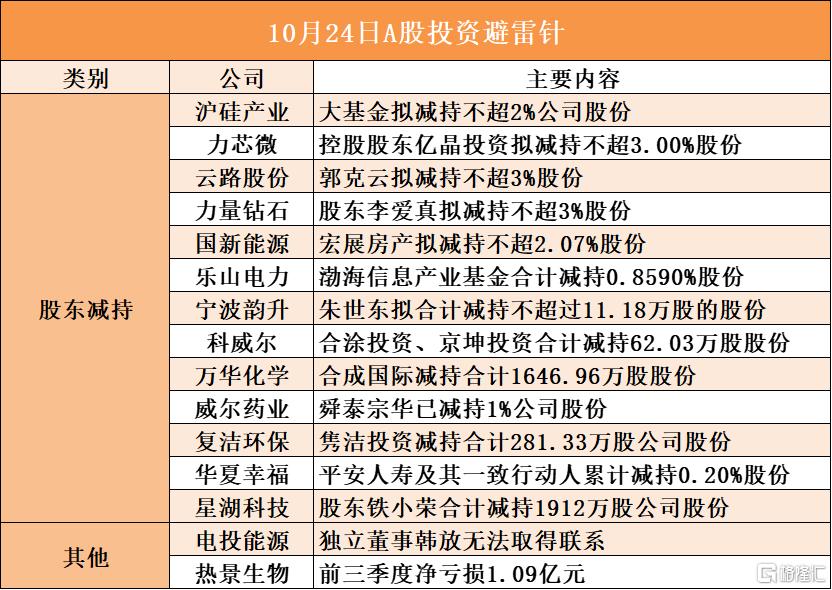
10月24日A股投资避雷针︱沪硅产业:股东大基金拟减持不超2%公司股份;电投能源:独立董事韩放无法取得联系
Ge Long Hui· 2025-10-23 21:09
Company Reductions - The major shareholder of Hu Silicon Industry plans to reduce its stake by no more than 2% [1] - The controlling shareholder of Lichip Micro intends to reduce its stake by no more than 3% [1] - Guo Keyun from Yunlu Co. plans to reduce his stake by no more than 3% [1] - Shareholder Li Aizhen from Power Diamond intends to reduce his stake by no more than 3% [1] - Hongzhan Real Estate plans to reduce its stake in Guo New Energy by no more than 2.07% [1] - Bohai Information Industry Fund has collectively reduced its stake in Leshan Electric Power by 0.8590% [1] Shareholder Reductions - Zhu Shidong plans to reduce his stake in Ningbo Yunsheng by no more than 111,800 shares [1] - He Tu Investment and Jing Kun Investment collectively plan to reduce their stake in Kewell by 620,300 shares [1] - Synth International has reduced its stake in Wanhua Chemical by a total of 16,469,600 shares [1] - Shuntai Zonghua has reduced its stake in Weier Pharmaceutical by 1% [1] - Junjie Investment has reduced its stake in Fuke Environmental Protection by a total of 2,813,300 shares [1] - Ping An Life and its concerted parties have cumulatively reduced their stake in Huaxia Happiness by 0.20% [1] - Shareholder Tie Xiaorong has reduced his stake in Xinghuo Technology by a total of 19,120,000 shares [1] Other Information - Independent director Han Fang of Jiatou Energy has been unreachable [1] - Rejing Bio reported a net loss of 109 million yuan in the first three quarters [1]


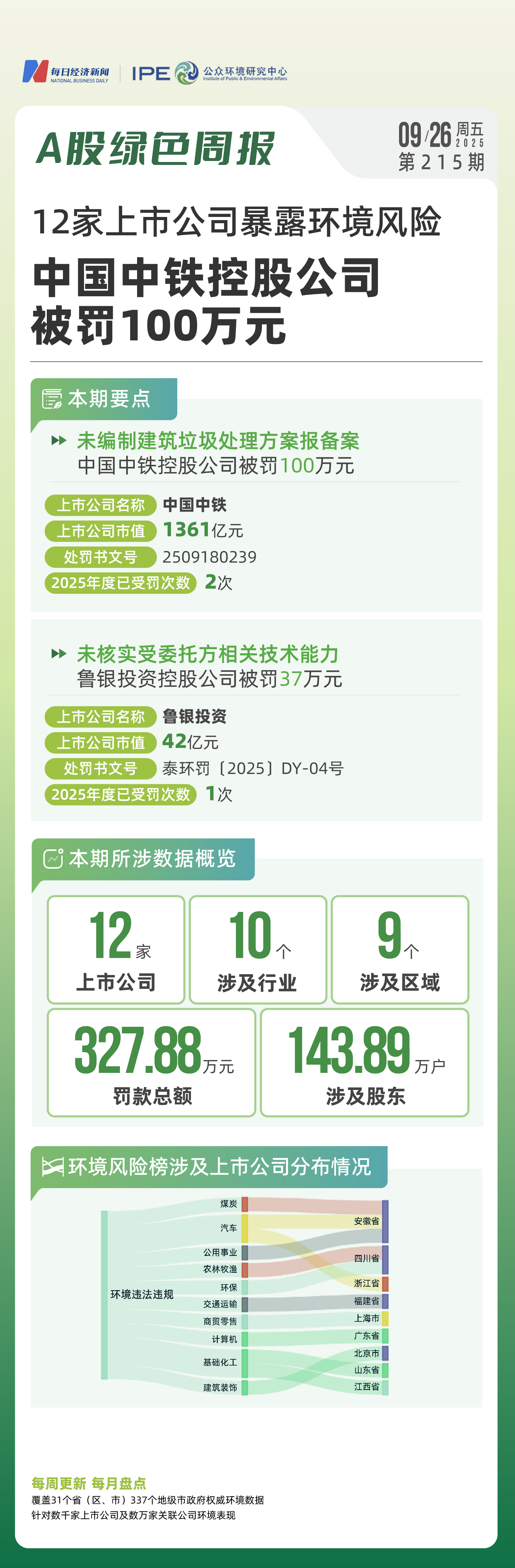
A股绿色周报|12家上市公司暴露环境风险 中国中铁控股公司被罚100万元
Mei Ri Jing Ji Xin Wen· 2025-09-26 09:38
Core Points - The article discusses the increasing environmental risks faced by listed companies in China, highlighting recent penalties imposed on several firms for violations of environmental regulations [10][11][13]. Group 1: Environmental Violations and Penalties - Twelve listed companies were identified as having environmental risks, with nine of them being state-controlled enterprises [11][13]. - China Railway (SH601390) was fined 1 million yuan for failing to prepare a construction waste disposal plan [10]. - Longhua Power (SZ000066) was fined 127,000 yuan for issues related to hazardous waste storage that did not meet national standards [15]. - Luyin Investment (SH600784) was penalized 370,000 yuan for selling slag without verifying the technical capabilities of the receiving parties [16]. - Waneng Power (SZ000543) faced a fine of 262,000 yuan for not verifying the qualifications of parties involved in the disposal of industrial waste [17]. Group 2: Regulatory Framework and Public Awareness - The article emphasizes the importance of environmental information transparency in corporate governance, driven by increasing investor focus on ESG (Environmental, Social, and Governance) factors [17][18]. - The regulatory framework for environmental information disclosure has improved, with laws ensuring public access to environmental data [18][19]. - The public's right to access environmental information and participate in environmental protection efforts is reinforced by various legal provisions [19].


两融余额持续新高,市场风险偏好有所提升,A50ETF(159601)一键布局核心资产
Mei Ri Jing Ji Xin Wen· 2025-09-26 05:04
Group 1 - The A-share market opened lower on September 26, with the ChiNext Index down 0.42%, the Shenzhen Component Index down 0.38%, and the Shanghai Composite Index down 0.35% [1] - The MSCI China A50 Connect Index, which represents core leading assets, fell approximately 0.8% during the session, with leading stocks such as China Merchants Shekou, BYD, and China National Nuclear Power leading the decline [1] - The margin trading balance has been steadily increasing since last September, surpassing 2 trillion yuan on August 5 this year and remaining above this threshold for 37 consecutive trading days, with the balance exceeding 2.4 trillion yuan for the last three days [1] Group 2 - According to a report by Founder Securities, the continuous new highs in margin trading balance reflect an increase in market risk appetite, indicating a relatively loose liquidity environment in the A-share market [1] - Although the absolute scale of the margin trading balance has exceeded that of 2015, its proportion relative to the circulating market value and trading volume remains at historical mid-levels since 2016 [1] - The A50 ETF (159601) closely tracks the MSCI China A50 Connect Index, providing a packaged investment in 50 leading interconnected assets, making it a preferred choice for domestic and foreign funds [1]
行业轮动ETF策略周报-20250922
金融街证券· 2025-09-22 09:21
Core Insights - The report emphasizes a strategy based on industry rotation and thematic ETFs, recommending sectors such as agriculture, film and cinema, and aerospace equipment for the upcoming week [2][3]. - The strategy has shown a cumulative net return of approximately -0.21% for the period from September 15 to September 19, 2025, with an excess return of about 0.16% compared to the CSI 300 ETF [3][11]. - Since October 14, 2024, the strategy has achieved a cumulative return of approximately 24.91%, outperforming the CSI 300 ETF by about 6.36% [3]. Strategy Update - For the week of September 22, 2025, the model recommends increasing positions in the following ETFs: Grain ETF, Film ETF, Industrial Mother Machine ETF, and Oil & Gas ETF, while continuing to hold Aerospace ETF and Green Electricity ETF [2][10]. - The report includes specific ETFs and their respective weights, indicating a focus on sectors like agriculture (46.77% in Grain ETF) and film (45.35% in Film ETF) [10]. Performance Tracking - The report details the performance of various ETFs over the past week, highlighting that the average return of the ETF portfolio was -0.37%, while the CSI 300 ETF had a return of -0.21% [11]. - The report also notes that certain ETFs, such as the Green Electricity ETF and Aerospace ETF, continue to be held despite recent performance fluctuations [11].
美国投资者关注中国市场,上证180ETF指数基金(530280)自带杠铃策略涨近0.5%
Xin Lang Cai Jing· 2025-09-12 02:26
Group 1 - Morgan Stanley's latest report indicates that U.S. investors' interest in the Chinese market has reached its highest level since 2021, maintaining high levels of interest in both index investments and thematic opportunities [1] - Despite short-term market fluctuations, institutions believe that the long-term trend of a slow bull market remains unchanged, with dividend and technology assets expected to yield excess returns over time [1] - The Shanghai Stock Exchange 180 Index is highlighted as a good option for equity market allocation, featuring a barbell strategy of 90% dividend and 10% technology assets, which allows for both stability and growth potential [1] Group 2 - The Shanghai Stock Exchange 180 Index tracks 180 large-cap, liquid securities from the Shanghai market, reflecting the overall performance of core listed companies [2] - As of August 29, 2025, the top ten weighted stocks in the Shanghai 180 Index account for 26.25% of the index, including major companies like Kweichow Moutai and Ping An Insurance [2] - The Shanghai 180 ETF Index Fund closely follows the Shanghai 180 Index and offers various connection options for investors [2]
9.1犀牛财经晚报:上半年A股上市公司近八成盈利 品牌黄金饰品每克金价超千元
Xi Niu Cai Jing· 2025-09-01 10:39
Group 1: A-Share Market Performance - In the first half of the year, A-share listed companies reported a total net profit attributable to shareholders of 2.99 trillion yuan, a year-on-year increase of 2.45%, with nearly 77% of stocks achieving profitability [1] - The agriculture, forestry, animal husbandry, fishery, steel, building materials, computer, and non-ferrous metals sectors showed significant performance growth, while the real estate sector experienced notable losses [1] - Wancheng Group achieved the highest growth rate in net profit, with a staggering 504 times increase, followed by New Special Electric and Southern Precision Engineering [1] Group 2: Public Fund Investment - Public funds have participated in 55 A-share companies' private placements this year, with a total allocation amounting to 17.35 billion yuan and a floating profit of 8.35 billion yuan, resulting in an overall floating profit ratio of 48.14% [1] - 23 public funds achieved floating profits, accounting for 92% of the participants, with notable funds including Nuode Fund, Caitong Fund, and Yifangda Fund, reporting floating profit ratios of 43.99%, 45.95%, and 70.33% respectively [1] Group 3: Insurance Sector - The disclosure of dividend realization rates for life insurance companies for 2024 is nearing completion, with AIA Life reporting the highest rate at 143% [1] - Over 70 insurance companies have disclosed around 3,000 dividend insurance products since the second quarter, highlighting the trend towards dividend insurance amidst a low-interest-rate environment [1] Group 4: New Energy Investment - In the first half of 2025, China's investment in the new energy sector reached approximately 1.4 trillion yuan, a year-on-year decrease of 32.2%, yet it remains a vibrant investment direction, particularly in next-generation battery technology and smart grid [2] - Wind and solar power investments accounted for 560.4 billion yuan, representing 40.8% of the sector's total, but showed a significant year-on-year decline of 44.4%, indicating market saturation [2] Group 5: Semiconductor Industry - The overall capacity utilization rate of the wafer foundry industry is expected to improve in the third quarter, driven by seasonal demand for new products in smartphones, laptops, and servers [3] - The revenue of the top ten global wafer foundry companies is projected to exceed 41.7 billion USD, marking a record high with a quarter-on-quarter increase of 14.6% [3] Group 6: AI and Technology - The usage of enterprise-level large models in China has surged, with an average daily call volume exceeding 10 trillion tokens in the first half of 2025, reflecting a 363% increase compared to the end of 2024 [4] - Alibaba Tongyi holds the largest market share at 17.7%, indicating strong preference among enterprises for its large model [4] Group 7: Automotive Industry - SAIC Group reported a total vehicle sales of 363,400 units in August, representing a year-on-year growth of 41.04%, with new energy vehicle sales reaching 129,800 units, up 49.89% [10] Group 8: Contract Wins and Projects - Samsung Medical's subsidiary signed a contract worth 58.8 million USD for a smart meter project in Egypt, indicating strong international business expansion [11] - Xianghe Industrial signed several contracts totaling 400 million yuan for railway component sales, showcasing growth in infrastructure projects [12] - Weisheng Information won four projects in August with a total bid amount of 85.54 million yuan, reflecting ongoing demand in the energy sector [13]