可选消费

Search documents
港股市场持续活跃,港股消费ETF(513230)、恒生科技指数ETF(513180)持续攀升
Mei Ri Jing Ji Xin Wen· 2025-07-08 06:15
Core Viewpoint - The Hong Kong stock market shows resilience with the Hang Seng Index up 0.78%, driven by strong performance in technology and consumer sectors, despite rising global macro risks and trade tensions [1] Market Performance - As of July 8, the Hang Seng Index increased by 0.78%, the Hang Seng Technology Index rose by 1.29%, and the Hang Seng China Enterprises Index gained 0.84% [1] - Popular ETFs such as the Hang Seng Technology Index ETF (513180) and the Hong Kong Consumer ETF (513230) saw increases of nearly 2% and 1.5%, respectively [1] Economic Outlook - Global macro risks are rising, influenced by trade tensions, particularly threats from Trump regarding tariffs on Japan, and ongoing geopolitical risks in the Middle East [1] - The U.S. job market remains strong, leading to a cooling of interest rate cut expectations from the Federal Reserve [1] - China's economic sentiment showed an overall recovery in June, indicating potential for growth [1] Investment Recommendations - The technology sector is highlighted as having significant investment opportunities due to strong policy support, leading profit growth, and relatively low historical valuations [1] - The consumer sector is expected to see improved performance driven by domestic consumption policies, with a focus on the pharmaceutical and discretionary consumption industries [1] - High dividend stocks are recommended for stable returns amidst domestic and international uncertainties [1] Focus Areas - Hong Kong Consumer ETF (513230) is noted for packaging e-commerce and new consumption, covering areas that are relatively scarce compared to A-shares [1] - Hang Seng Technology Index ETF (513180) includes core AI assets and leading technology firms that are also less represented in A-shares [1]

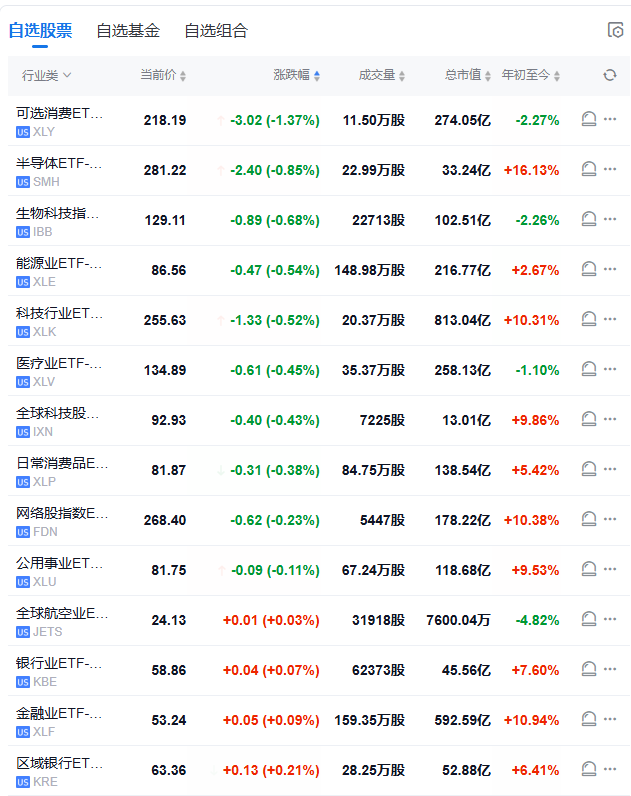
美股盘初,主要行业ETF多数下跌,可选消费ETF跌超1%,半导体ETF跌近1%,生物科技指数ETF跌0.7%。
news flash· 2025-07-07 13:37
Market Overview - Major industry ETFs in the US stock market mostly declined, with the Consumer Discretionary ETF dropping over 1%, the Semiconductor ETF falling nearly 1%, and the Biotechnology Index ETF decreasing by 0.7% [1] ETF Performance - Consumer Discretionary ETF (US XLY) current price: $218.19, down by $3.02 (-1.37%), with a trading volume of 115,000 shares and a total market value of $27.405 billion, year-to-date performance down by 2.27% [2] - Semiconductor ETF (US SMH) current price: $281.22, down by $2.40 (-0.85%), with a trading volume of 229,900 shares and a total market value of $3.324 billion, year-to-date performance up by 16.13% [2] - Biotechnology Index ETF (US IBB) current price: $129.11, down by $0.89 (-0.68%), with a trading volume of 22,713 shares and a total market value of $10.251 billion, year-to-date performance down by 2.26% [2] - Energy ETF (US XLE) current price: $86.56, down by $0.47 (-0.54%), with a trading volume of 1.4898 million shares and a total market value of $21.677 billion, year-to-date performance up by 2.67% [2] - Technology Sector ETF (US XLK) current price: $255.63, down by $1.33 (-0.52%), with a trading volume of 203,700 shares and a total market value of $81.304 billion, year-to-date performance up by 10.31% [2] - Healthcare ETF (US XLV) current price: $134.89, down by $0.61 (-0.45%), with a trading volume of 353,700 shares and a total market value of $25.813 billion, year-to-date performance down by 1.10% [2] - Global Technology ETF (US IXN) current price: $92.93, down by $0.40 (-0.43%), with a trading volume of 7,225 shares and a total market value of $1.301 billion, year-to-date performance up by 9.86% [2] - Consumer Staples ETF (US XLP) current price: $81.87, down by $0.31 (-0.38%), with a trading volume of 847,500 shares and a total market value of $13.854 billion, year-to-date performance up by 5.42% [2] - Internet ETF (US FDN) current price: $268.40, down by $0.62 (-0.23%), with a trading volume of 5,447 shares and a total market value of $178.22 billion, year-to-date performance up by 10.38% [2] - Utilities ETF (US XLU) current price: $81.75, down by $0.09 (-0.11%), with a trading volume of 672,400 shares and a total market value of $11.868 billion, year-to-date performance up by 9.53% [2] - Global Airlines ETF (US JETS) current price: $24.13, up by $0.01 (+0.03%), with a trading volume of 31,918 shares and a total market value of $76.0004 million, year-to-date performance down by 4.82% [2] - Banking ETF (US KBE) current price: $58.86, up by $0.04 (+0.07%), with a trading volume of 62,373 shares and a total market value of $4.556 billion, year-to-date performance up by 7.60% [2] - Financials ETF (US XLF) current price: $53.24, up by $0.05 (+0.09%), with a trading volume of 1.5935 million shares and a total market value of $59.259 billion, year-to-date performance up by 10.94% [2] - Regional Banks ETF (US KRE) current price: $63.36, up by $0.13 (+0.21%), with a trading volume of 282,500 shares and a total market value of $5.288 billion, year-to-date performance up by 6.41% [2]
交银国际:南向资金近月主力配置集中医疗和金融板块 反映对高息防御价值重视
智通财经网· 2025-07-07 02:00
Group 1 - The Hong Kong stock market has shown strong performance in the first half of the year, with the Hang Seng Index and Hang Seng Tech Index recording semi-annual returns of 20% and 18.7% respectively, ranking among the top global indices [1] - The rebound in the Hong Kong stock market is primarily driven by a decrease in risk premium, while contributions from risk-free interest rates and fundamental earnings improvement are relatively limited [1] - Current favorable conditions for the Hong Kong stock market include a reduction in external environmental disturbances, a shift in Trump's policy focus from tariffs to tax cuts, and a supportive liquidity environment for capital allocation [1] Group 2 - The technology sector is highlighted as having significant investment value, with foreign capital showing sustained confidence through increased allocations to the information technology sector [2] - The adjustment in the technology sector's valuation narrative has led to a moderate level of crowding, indicating potential for upward elasticity and positioning it as a key driver for the next market rally [2] - There is a notable rotation of southbound capital across various sectors, with recent focus shifting towards healthcare and financial sectors, reflecting market interest in high-growth sectors and defensive value in high-dividend stocks [2] Group 3 - The short-selling landscape shows high levels of short interest in cyclical and consumer sectors, while the technology sector is experiencing a convergence of long and short positions [3] - The consumer sector is witnessing a clear divergence, with essential consumption remaining stable while discretionary consumption has seen increased short-selling activity [3] - The concentration of short-selling in the information technology sector is decreasing, supported by continued foreign investment and appropriate allocation from southbound capital [3]
港股板块轮动加速,行情是否延续?
Yin He Zheng Quan· 2025-07-06 12:47
Group 1 - The Hong Kong stock market experienced a decline, with the Hang Seng Index falling by 1.52% to 23916.06 points, losing the 24000-point mark [4][16] - Among the sectors, healthcare, materials, and industrial sectors showed the highest gains, increasing by 5.49%, 3.24%, and 2.72% respectively, while information technology, consumer discretionary, and financial sectors faced declines of 1.82%, 1.36%, and 0.28% [7][27] - The average daily trading volume on the Hong Kong Stock Exchange was HKD 2455.12 billion, a decrease of HKD 33.71 billion from the previous week [16][27] Group 2 - As of July 4, the price-to-earnings (PE) and price-to-book (PB) ratios for the Hang Seng Index were 10.65 times and 1.12 times, respectively, both down by 1.28% from the previous week, placing them at the 73% and 75% percentile levels since 2019 [18][21] - The risk premium for the Hang Seng Index was calculated at 5.04%, which is -1.84 standard deviations from the 3-year rolling mean, indicating a low-risk appetite in the market [21][24] - The report suggests that the technology sector remains a high investment opportunity due to strong policy support and growth potential, while the consumer sector is expected to improve performance driven by domestic consumption policies [40][41]
港股板块轮动加速,行情是否延续?
Yin He Zheng Quan· 2025-07-06 07:09
Group 1 - The Hong Kong stock market experienced a decline, with the Hang Seng Index falling by 1.52% to 23916.06 points, losing the 24000-point mark [4][16] - Among the sectors, healthcare, materials, and industrial sectors saw the highest gains, with increases of 5.49%, 3.24%, and 2.72% respectively, while information technology, consumer discretionary, and financial sectors faced declines [7][27] - The average daily trading volume on the Hong Kong Stock Exchange was HKD 2455.12 billion, a decrease of HKD 33.71 billion from the previous week [16][27] Group 2 - As of July 4, the PE and PB ratios for the Hang Seng Index were 10.65 times and 1.12 times, respectively, both down by 1.28% from the previous week, placing them at the 73% and 75% percentile levels since 2019 [18][24] - The risk premium for the Hang Seng Index was calculated at 5.04%, which is -1.84 standard deviations from the 3-year rolling mean, indicating a low-risk appetite in the market [21][24] - The report suggests that the technology sector remains a high investment opportunity due to strong policy support and growth potential, while the consumer sector is expected to improve performance driven by domestic consumption policies [40][41] Group 3 - The report highlights that the A-share market performed better than the Hong Kong market, with the AH share premium index rising to 130.88, at the 46% percentile level since 2014 [27][40] - The healthcare sector is expected to benefit from new policies supporting innovative drug development, which may enhance the performance of related stocks [11][40] - The report emphasizes the importance of high-dividend stocks in providing stable returns amid global uncertainties, particularly in the energy and financial sectors [40][41]
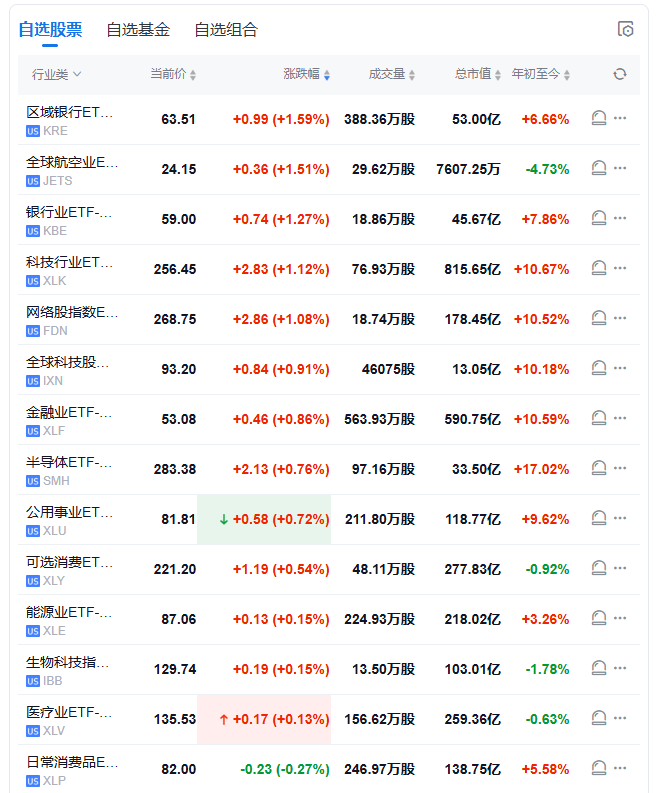
美股盘初,主要行业ETF普涨,区域银行业ETF涨1.59%,全球航空业ETF涨1.51%,银行业ETF涨1.27%。
news flash· 2025-07-03 14:06
Group 1 - Major industry ETFs in the US stock market experienced an overall increase, with regional bank ETFs rising by 1.59%, global airline ETFs by 1.51%, and bank ETFs by 1.27% [1][2] Group 2 - Regional bank ETF (KRE) is currently priced at $63.51, with a gain of $0.99 (+1.59%) and a total market value of $5.3 billion, reflecting a year-to-date increase of 6.66% [2] - Global airline ETF (JETS) is priced at $24.15, up by $0.36 (+1.51%), with a market value of $760.725 million, showing a year-to-date decline of 4.73% [2] - Bank ETF (KBE) is trading at $59.00, gaining $0.74 (+1.27%), with a market capitalization of $4.567 billion and a year-to-date increase of 7.86% [2]
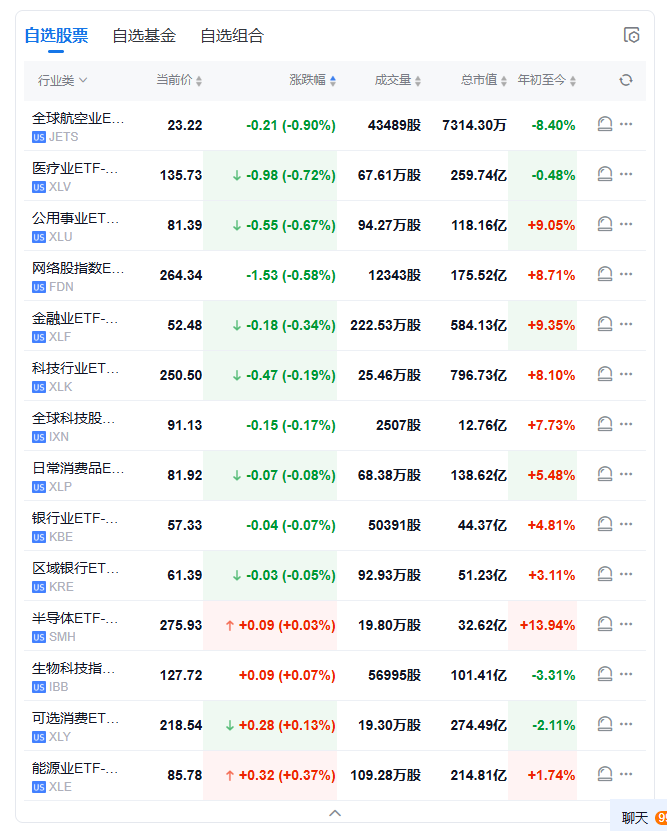
美股盘初,主要行业ETF多数下跌,全球航空业ETF跌0.9%,医疗业ETF跌0.72%,公用事业ETF跌0.67%。
news flash· 2025-07-02 13:40
Market Overview - Major industry ETFs in the US experienced a decline, with the global airline industry ETF down by 0.9%, the healthcare ETF down by 0.72%, and the utilities ETF down by 0.67% [1] Industry Performance - The global airline industry ETF is priced at $23.22, reflecting a decrease of $0.21 or 0.90% with a trading volume of 43,489 shares and a total market value of $73.14 million, showing an 8.40% decline year-to-date [2] - The healthcare ETF is priced at $135.73, down by $0.98 or 0.72%, with a trading volume of 676,100 shares and a total market value of $259.74 billion, indicating a year-to-date decrease of 0.48% [2] - The utilities ETF is priced at $81.39, down by $0.55 or 0.67%, with a trading volume of 942,700 shares and a total market value of $11.81 billion, reflecting a year-to-date increase of 9.05% [2] - The financial sector ETF is priced at $52.48, down by $0.18 or 0.34%, with a trading volume of 2.23 million shares and a total market value of $584.13 billion, showing a year-to-date increase of 9.35% [2] - The technology sector ETF is priced at $250.50, down by $0.47 or 0.19%, with a trading volume of 254,600 shares and a total market value of $796.73 billion, indicating a year-to-date increase of 8.10% [2] - The energy sector ETF is priced at $85.78, up by $0.32 or 0.37%, with a trading volume of 1.09 million shares and a total market value of $21.48 billion, reflecting a year-to-date increase of 1.74% [2]
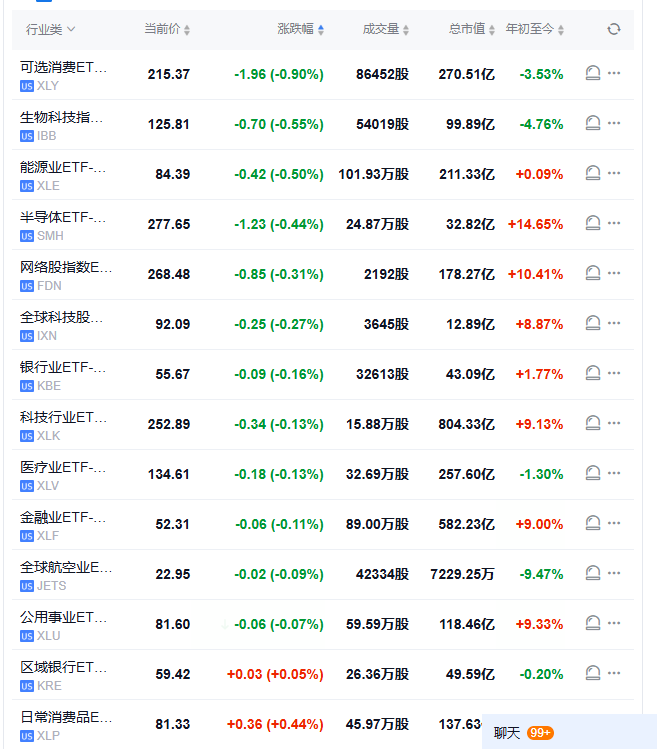
美股盘初:主要行业ETF多数普跌,可选消费ETF跌约1%,生物科技指数ETF跌0.55%,能源业ETF跌0.5%。
news flash· 2025-07-01 13:36
Market Overview - Major industry ETFs mostly declined, with the Consumer Discretionary ETF down approximately 1%, the Biotechnology Index ETF down 0.55%, and the Energy ETF down 0.5% [1] Industry Performance - Consumer Discretionary ETF (US XLY) current price: $215.37, down $1.96 (-0.90%), with a trading volume of 86,452 shares and a total market value of $27.051 billion, down 3.53% year-to-date [2] - Biotechnology Index ETF (US IBB) current price: $125.81, down $0.70 (-0.55%), with a trading volume of 54,019 shares and a total market value of $9.989 billion, down 4.76% year-to-date [2] - Energy ETF (US XLE) current price: $84.39, down $0.42 (-0.50%), with a trading volume of 1.0193 million shares and a total market value of $21.133 billion, up 0.09% year-to-date [2] - Semiconductor ETF (US SMH) current price: $277.65, down $1.23 (-0.44%), with a trading volume of 248,700 shares and a total market value of $3.282 billion, up 14.65% year-to-date [2] - Internet Index ETF (US FDN) current price: $268.48, down $0.85 (-0.31%), with a trading volume of 2,192 shares and a total market value of $17.827 billion, up 10.41% year-to-date [2] - Global Technology ETF (US IXN) current price: $92.09, down $0.25 (-0.27%), with a trading volume of 3,645 shares and a total market value of $1.289 billion, up 8.87% year-to-date [2] - Banking ETF (US KBE) current price: $55.67, down $0.09 (-0.16%), with a trading volume of 32,613 shares and a total market value of $4.309 billion, up 1.77% year-to-date [2] - Technology Sector ETF (US XLK) current price: $252.89, down $0.34 (-0.13%), with a trading volume of 158,800 shares and a total market value of $804.33 billion, up 9.13% year-to-date [2] - Healthcare ETF (US XLV) current price: $134.61, down $0.18 (-0.13%), with a trading volume of 326,900 shares and a total market value of $25.760 billion, down 1.30% year-to-date [2] - Financials ETF (US XLF) current price: $52.31, down $0.06 (-0.11%), with a trading volume of 890,000 shares and a total market value of $58.223 billion, up 9.00% year-to-date [2] - Global Airlines ETF (US JETS) current price: $22.95, down $0.02 (-0.09%), with a trading volume of 42,334 shares and a total market value of $72.293 million, down 9.47% year-to-date [2] - Utilities ETF (US XLU) current price: $81.60, down $0.06 (-0.07%), with a trading volume of 595,900 shares and a total market value of $11.846 billion, up 9.33% year-to-date [2] - Regional Banks ETF (US KRE) current price: $59.42, up $0.03 (+0.05%), with a trading volume of 263,600 shares and a total market value of $4.959 billion, down 0.20% year-to-date [2] - Consumer Staples ETF (US XLP) current price: $81.33, up $0.36 (+0.44%), with a trading volume of 459,700 shares and a total market value of $137.63 million [2]
东南亚消费行业5月跟踪报告:多数地区商品价格走低
Haitong Securities International· 2025-07-01 07:39
Investment Rating - The report does not explicitly provide an investment rating for the Southeast Asia Staples and Discretionary sectors, but it highlights various performance metrics and trends across different countries in the region. Core Insights - Commodity prices have generally fallen across most regions, contributing to a decrease in inflation rates in several Southeast Asian countries [2][9] - Economic growth in Southeast Asia is expected to maintain a moderate pace in the second half of 2025, with overall growth rates projected between 4% and 5% [3] - Consumer confidence varies significantly across the region, with Indonesia experiencing a notable decline in consumer sentiment [20] Economic Overview - In May 2025, Thailand's CPI decreased by 0.57%, marking two consecutive months of deflation, primarily driven by lower food and energy prices [2][23] - Malaysia's inflation rate fell to 1.2%, the lowest in 51 months, while Vietnam's CPI increased by 3.24%, indicating moderate inflation [2][9] - The overall economic activity in Indonesia showed signs of slowing, with GDP growth in 1Q25 at 4.87%, the lowest since 3Q21 [15] Consumer Sector Performance - In May 2025, Indonesia's essential and discretionary consumption sectors saw increases of 6.55% and 6.17%, respectively, outperforming the index [4] - The consumer confidence index in Indonesia dropped to 117.50, the lowest since September 2022, reflecting concerns about job availability and economic conditions [20] - Singapore's food and beverage sales reached SGD 9.5 billion in May 2025, marking a year-on-year growth of 1.9% [34] Market Trends - The report indicates that most consumer sectors in May 2025 experienced valuation increases, with Indonesia's essential and discretionary consumption PE historical percentiles at 5% and 17%, respectively [4] - The stock market performance in May showed mixed results, with Indonesia's essential consumption sector outperforming the index, while Thailand's discretionary consumption sector lagged [4][14] - Vietnam's essential and discretionary consumption sectors underperformed the index, with growth rates of 2.64% and 3.72%, respectively [4] Inflation and Pricing Trends - In May 2025, Indonesia's CPI rose by 1.60% year-on-year, with core inflation dropping to 2.40%, providing room for monetary policy adjustments [18] - Thailand's consumer price index showed a significant decline, while Singapore's core inflation remained low at 0.6% [31][23] - Vietnam's CPI increased by 3.24% in May, driven by rising costs in housing, utilities, and food services [39]
2025年上半年中资企业IPO排行榜
Wind万得· 2025-06-30 22:33
Core Viewpoint - In the first half of 2025, the number of IPOs by Chinese enterprises decreased slightly compared to the second half of 2024, but the fundraising amount approached 140 billion RMB, showing significant growth. The Hong Kong stock market has become the main financing channel for Chinese enterprises' IPOs [1]. Group 1: Overall IPO Performance - In the first half of 2025, Chinese enterprises completed a total of 129 IPOs globally, an increase of 34 compared to the same period in 2024 [2]. - The total fundraising amount for Chinese enterprises' global IPOs reached approximately 139.89 billion RMB, a year-on-year increase of 143.30% [4]. - The distribution of IPOs by market shows that A-shares had 48 listings, Hong Kong had 41, and overseas markets had 40 [7]. Group 2: Market-Specific IPO Details - In the A-share market, the fundraising amount was 38.00 billion RMB, up 25.53% year-on-year [10]. - The Hong Kong market saw a total fundraising of 95.68 billion RMB, a staggering increase of 738.75% compared to 2024 [10]. - The overseas market raised 6.21 billion RMB, which represents a decline of 60.64% year-on-year [10]. Group 3: Industry-Specific Fundraising - In terms of industry, the industrial sector raised 55.84 billion RMB, while the consumer discretionary sector raised 27.02 billion RMB [12]. - The top two companies by fundraising in the first half of 2025 were both listed on the Hong Kong Stock Exchange: Ningde Times raised 37.70 billion RMB and Hengrui Medicine raised 10.45 billion RMB [15]. Group 4: A-Share Market Insights - In the A-share market, 48 companies went public, with 27 in Q1 and 21 in Q2 [19]. - The fundraising amount in the A-share market was 38.00 billion RMB, with a decline of 25.87% in Q1 but a significant increase of 170.98% in Q2 [21]. - The majority of A-share IPOs came from the industrial sector, while the consumer discretionary sector had the highest fundraising amount of 13.14 billion RMB [28]. Group 5: Hong Kong Market Insights - In the Hong Kong market, 41 Chinese enterprises went public, with 16 in Q1 and 25 in Q2 [32]. - The total fundraising in the Hong Kong market was 95.68 billion RMB, with Q1 raising 16.80 billion RMB and Q2 raising 78.85 billion RMB [34]. - The industrial sector dominated the fundraising in Hong Kong, totaling 46.74 billion RMB [37]. Group 6: Overseas Market Insights - In the overseas market, all IPOs were completed in the US, with 1 company listed on the American Stock Exchange and 39 on NASDAQ [48]. - The total fundraising amount for overseas IPOs was 6.21 billion RMB, a significant decrease compared to the previous year [50]. - The consumer discretionary sector had the highest number of companies listed overseas, totaling 11, with a fundraising amount of 3.54 billion RMB [52].