
油脂加工

Search documents
市场观望情绪浓厚,油脂震荡调整
Hua Tai Qi Huo· 2025-08-22 05:24
Report Summary 1. Industry Investment Rating - The report gives a neutral rating for the strategy [4] 2. Core View - The market is in a wait - and - see mood, and the prices of the three major oils are fluctuating. Palm oil was previously supported by biodiesel expectations and consumption, but the price has reached a bottleneck due to the inverted price difference between soybean oil and palm oil and the optimistic outlook for soybean oil supply [1][3] 3. Summary by Related Content Futures and Spot Prices - Futures: The closing price of palm oil 2601 contract was 9500.00 yuan/ton, down 54 yuan (-0.57%); soybean oil 2601 contract was 8394.00 yuan/ton, down 20.00 yuan (-0.24%); and rapeseed oil 2601 contract was 9791.00 yuan/ton, down 37.00 yuan (-0.38%) [1] - Spot: In Guangdong, the palm oil spot price was 9500.00 yuan/ton, up 60.00 yuan (+0.64%); in Tianjin, the first - grade soybean oil spot price was 8480.00 yuan/ton, up 20.00 yuan/ton (+0.24%); in Jiangsu, the fourth - grade rapeseed oil spot price was 9910.00 yuan/ton, down 50.00 yuan (-0.50%) [1] Market Information - Malaysia: As of April 2025, over 30,000 small - scale palm oil growers in Sabah have obtained MSPO certification, covering over 191,000 hectares, with a certification rate of 97.62%. In Sabah, about 97% of oil palm areas and over 92% in Sarawak are MSPO - certified. From August 1 - 20, 2025, Malaysia's palm oil yield per unit decreased by 2.12% month - on - month, oil extraction rate increased by 0.46% month - on - month, and production increased by 0.3% month - on - month [2] - Argentina: The C&F price of Argentine soybean oil (September shipment) was 1151 dollars/ton, down 12 dollars/ton; for November shipment, it was 1148 dollars/ton, down 5 dollars/ton [2] - Canada: The C&F price of Canadian rapeseed oil (September shipment) was 1045 dollars/ton, unchanged; for November shipment, it was 1025 dollars/ton, unchanged [2] - US and Brazil: The C&F price of US Gulf soybeans (September shipment) was 463 dollars/ton, up 1 dollar/ton; US West soybeans (September shipment) was 457 dollars/ton, up 1 dollar/ton; Brazilian soybeans (October shipment) was 488 dollars/ton, down 2 dollars/ton. The import soybean premium for the Mexican Gulf (September shipment) was 217 cents/bushel, up 2 cents/bushel; US West Coast (September shipment) was 191 cents/bushel, up 2 cents/bushel; Brazilian ports (October shipment) was 295 cents/bushel, down 8 cents/bushel [2] - Indonesia: As of the end of June, Indonesia's palm oil inventory decreased by 13% month - on - month to 2.53 million tons. In June, its palm oil exports reached 3.61 million tons, a sharp increase of 35.4% month - on - month [2]
中粮油脂王朝晖:预计今年四季度之前国内菜籽油供给充足
Qi Huo Ri Bao· 2025-08-20 23:12
Group 1 - The 2025 China (Zhengzhou) International Futures Forum was held on August 20, co-hosted by Zhengzhou Commodity Exchange and Chicago Mercantile Exchange Group [1] - Wang Zhaohui, Deputy General Manager of COFCO Oils, discussed the risks and response strategies in the domestic canola oil and peanut oil markets during the agricultural products forum [1] Group 2 - In the canola oil market, it is projected that China will have an additional supply of 19.6 million tons of rapeseed for the 2025/2026 season, with a production of 17.1 million tons and imports of 2.5 million tons [1] - Domestic rapeseed oil supply is expected to be sufficient before the fourth quarter of this year, influenced by production and import fluctuations [1] Group 3 - For the peanut oil market, the National Grain and Oil Center indicates that peanut production will increase by 400,000 tons in the 2024/2025 season, with edible consumption and crushing demand rising by 100,000 tons and 300,000 tons respectively compared to the previous year [1] - Due to reduced imports, the ending inventory for that season is expected to drop to a low level [1] - Current peanut crops are in a critical growth stage, necessitating attention to growth conditions, harvest weather, yield per unit area, and import situations [1]
大越期货油脂早报-20250820
Da Yue Qi Huo· 2025-08-20 01:31
Report Industry Investment Rating - Not provided Core Views - The prices of oils and fats are expected to fluctuate and consolidate. The domestic fundamentals are loose, and the domestic supply of oils and fats is stable. The USDA's South American production forecast for the 24/25 season is high, the Malaysian palm oil inventory is neutral, demand has improved, Indonesia's B40 policy promotes domestic consumption, and the US biodiesel policy for soybean oil supports increased biodiesel consumption. The domestic tariff on Canadian rapeseed has led to a rise in the rapeseed sector, and the domestic fundamentals of oils and fats are neutral with stable import inventories. Sino-US and Sino-Canadian relations have an impact on the market at the macro level. [3][5][6] - The main logic currently revolves around the relatively loose global fundamentals of oils and fats. The main risk factor is El Niño weather. [7] Summary by Related Catalogs Daily Views - Soybean Oil - The main long positions in soybean oil have increased, indicating a bullish signal. [3] - The MPOB report shows that in May, Malaysian palm oil production decreased by 9.8% month-on-month to 1.62 million tons, exports decreased by 14.74% month-on-month to 1.49 million tons, and the end-of-month inventory decreased by 2.6% month-on-month to 1.83 million tons. The report is neutral, with the production decline falling short of expectations. Currently, the shipping survey agency shows that the export data of Malaysian palm oil this month has increased by 4% month-on-month, and palm oil supply will increase in the subsequent production season, presenting a neutral situation. [3][4] - The spot price of soybean oil is 8,580, with a basis of 54, indicating that the spot price is higher than the futures price, a bullish signal. [4] - On July 4, the commercial inventory of soybean oil was 880,000 tons, up 20,000 tons from the previous period and 11.7% higher year-on-year, a bearish signal. [4] - The futures price is above the 20-day moving average, and the 20-day moving average is upward, a bullish signal. [4] - Soybean oil Y2601 is expected to fluctuate in the range of 8,200 - 8,600. [3] Daily Views - Palm Oil - The main short positions in palm oil have decreased, indicating a bearish signal. [5] - Similar to the soybean oil situation, the MPOB report on Malaysian palm oil is neutral, and palm oil supply will increase in the subsequent production season. [5] - The spot price of palm oil is 9,650, with a basis of 10, indicating a neutral situation. [5] - On July 4, the port inventory of palm oil was 380,000 tons, down 10,000 tons from the previous period and 34.1% lower year-on-year, a bullish signal. [5] - The futures price is above the 20-day moving average, and the 20-day moving average is upward, a bullish signal. [5] - Palm oil P2601 is expected to fluctuate in the range of 9,300 - 9,700. [5] Daily Views - Rapeseed Oil - The main short positions in rapeseed oil have increased, indicating a bearish signal. [6] - The MPOB report on Malaysian palm oil is the same as above, and palm oil supply will increase in the subsequent production season. [6] - The spot price of rapeseed oil is 9,900, with a basis of 50, indicating that the spot price is higher than the futures price, a bullish signal. [6] - On July 4, the commercial inventory of rapeseed oil was 650,000 tons, up 20,000 tons from the previous period and 3.2% higher year-on-year, a bearish signal. [6] - The futures price is above the 20-day moving average, and the 20-day moving average is upward, a bullish signal. [6] - Rapeseed oil OI2601 is expected to fluctuate in the range of 9,600 - 10,000. [6] Recent利多利空Analysis - Bullish factors include the US soybean stock-to-use ratio remaining around 4%, indicating tight supply, and the palm oil production reduction season. [7] - Bearish factors include the historically high prices of oils and fats, the continuous accumulation of domestic oils and fats inventories, the weak macroeconomy, and the high expected production of related oils and fats. [7]
油脂:供需边际收紧,价格重心上移
Chang Jiang Qi Huo· 2025-08-19 11:03
Report Industry Investment Rating No relevant content provided. Core Viewpoints - In the short term, the increase in domestic palm oil and rapeseed oil purchases and the call to postpone B50 limit the upside space for oils. However, in the long term, the supply - demand of the three major oils is expected to tighten, laying the foundation for the rise of oil prices. The price performance in the fourth quarter is expected to be stronger than that in the third quarter [2][60]. - For trading strategies, in the short term, the support levels for the 01 contracts of soybean, palm, and rapeseed oils are 8400 - 8500, 9300 - 9400, and 9700 respectively. A strategy of buying on dips is recommended, and chasing highs should be done with caution. Attention can be paid to the reverse spread of rapeseed oil 11 - 01 [3][61]. Summary by Directory Palm Oil - **Short - term Outlook**: Although palm oil is in the seasonal production - increasing period, with the August inventory rising to 2.13 million tons but lower than market expectations, and the high - frequency data showing a decrease in production and an increase in exports in August, palm oil is expected to strengthen again after a small correction [6]. - **Malaysian Palm Oil**: The MPOB July report shows that Malaysia's palm oil has strong supply and demand, but high domestic consumption leads to a lower - than - expected inventory increase. In August, export data improved, with a 16.5 - 21.3% increase in exports from August 1 - 15 compared to the previous month, and production growth slowed down, which is beneficial for price increases. However, seasonal inventory accumulation from September to October may disrupt prices [6]. - **Indonesian Palm Oil**: The GAPKI May report shows a decrease in production and an increase in exports, with the inventory decreasing to 2.916 million tons. From June to July, production continued to decline, possibly due to the crackdown on illegal plantations. Domestic consumption and export demand are expected to remain strong, and the supply - demand is expected to maintain a long - term tight balance, driving up international palm oil prices. The main uncertainties come from lagging data and the risk of B50 postponement [8]. - **Domestic Palm Oil**: In the short term, the supply is relatively abundant, with the inventory reaching 617,300 tons as of August 15. Recently, the import profit has improved, and traders are increasing purchases from August to November. In the long term, although the supply pressure from the origin is not large, the price may be affected by Malaysian seasonal inventory accumulation, Indian procurement demand fluctuations, and Indonesian biodiesel policies [13][17]. Soybean Oil - **Short - term Outlook**: The USDA August report was unexpectedly bullish, and the high - level of domestic soybean and soybean oil inventories, along with concerns about future soybean supply, lead to a short - term strong - side oscillation for soybean oil [18]. - **US Soybean Production**: The USDA August report increased the 25/26 US soybean yield but decreased the planting area by 2.5 million acres. The new - crop supply - demand has tightened, and there is a possibility of further tightening. If the yield drops to 52.5 bushels, the ending inventory will decline to a very low level of 200 million bushels [19]. - **US Soybean Demand**: In the biodiesel sector, the increase in demand for US soybean oil in biodiesel is likely, but the increase may be lower than expected. In the export sector, as of August 18, there was no news of China's resumption of US soybean purchases, which may suppress US soybean prices [20]. - **South American Soybeans**: China continues to purchase a large amount of Brazilian soybeans. If China does not buy US soybeans, the cost of Brazilian soybeans will increase, and Argentina's soybean meal may be imported in large quantities in the fourth quarter [23]. - **Domestic Situation**: From May to August, a large amount of South American soybeans entered China, leading to high inventories of domestic soybeans and soybean oil. In the short term, the supply is sufficient, but after October, if US soybeans cannot be imported, the supply will tighten, which is beneficial for soybean oil destocking [23]. Rapeseed Oil - **Price Fluctuation**: The price of rapeseed oil has fluctuated significantly due to the preliminary anti - dumping review of Canadian rapeseed. After the initial sharp rise, it declined due to the risk warning from the Zhengzhou Commodity Exchange and news of alternative imports [38]. - **Domestic Supply - Demand**: After August 14, the import of Canadian rapeseed will decrease significantly. Although there are plans to increase imports from other countries, they cannot fully make up for the supply shortage. The supply - demand of domestic rapeseed and rapeseed oil is expected to tighten, which is beneficial for price increases. However, policy adjustments and alternative imports may disrupt prices [40]. - **Impact on Canada**: China is the largest buyer of Canadian rapeseed. After the anti - dumping review, the export demand of Canadian rapeseed will face a significant decline, and the supply - demand will shift from slightly loose to significantly loose or even severely surplus, suppressing the price of Canadian rapeseed [50]. - **International Trade**: After the anti - dumping decision, China's dependence on Canadian rapeseed products will decrease, while its dependence on Australian rapeseed and rapeseed oil from other countries will increase. Canada will increase its dependence on the US, UAE, and the EU [54].
印尼打击非法种植园,棕榈油震荡偏强
Hua Tai Qi Huo· 2025-08-19 05:15
Report Industry Investment Rating - The investment strategy for the industry is neutral [4] Core View of the Report - Indonesia's crackdown on illegal plantations has led to a volatile and upward - trending palm oil market. The price of palm oil is affected by Indonesia's policy of confiscating illegal plantations, and the market is also influenced by factors such as the inventory and production of various oils [1][3] Summary by Related Catalogs Futures and Spot Prices - Futures: The closing price of the palm oil 2601 contract was 9,584.00 yuan/ton, a +1.31% change; the soybean oil 2601 contract was 8,516.00 yuan/ton, a -0.21% change; the rapeseed oil 2601 contract was 9,826.00 yuan/ton, a +0.71% change [1] - Spot: In Guangdong, the palm oil spot price was 9,510.00 yuan/ton, a +2.04% change; in Tianjin, the first - grade soybean oil spot price was 8,630.00 yuan/ton, a +0.12% change; in Jiangsu, the fourth - grade rapeseed oil spot price was 9,960.00 yuan/ton, a +0.91% change [1] Market Information Aggregation - As of August 18, the national imported soybean port inventory was 6.75865 million tons, a decrease of 82,400 tons from the previous week [2] - From August 1 - 15, 2025, Malaysia's palm oil yield per unit decreased by 1.78% month - on - month, the oil extraction rate increased by 0.51% month - on - month, and production increased by 0.88% month - on - month [2] - As of August 15, 2025, the rapeseed inventory of major coastal oil mills was 115,000 tons, a decrease of 23,800 tons from the previous week; the rapeseed oil inventory was 104,500 tons, a decrease of 5,500 tons from the previous week; the unexecuted contracts were 82,000 tons, a decrease of 4,000 tons from the previous week [2] - The C&F prices of Argentine soybean oil (September and November shipments) decreased, while the C&F prices of Canadian rapeseed oil (September and November shipments) increased. The C&F prices of Canadian rapeseed (October and December shipments) decreased, and the C&F prices of US and Brazilian soybeans increased [2] - The import soybean premium quotes also increased [2] Policy Impact - Indonesian President Prabowo launched a large - scale natural resource rectification campaign, confiscating 3.1 million hectares of illegal palm plantations, equivalent to 20% of the country's official total plantation area, and another 5 million hectares are under government review, causing palm oil to strengthen [3]
印度需求点燃出口热潮,棕榈油冲高后惊现回落,后市能否继续追高?
Jin Shi Shu Ju· 2025-08-18 10:09
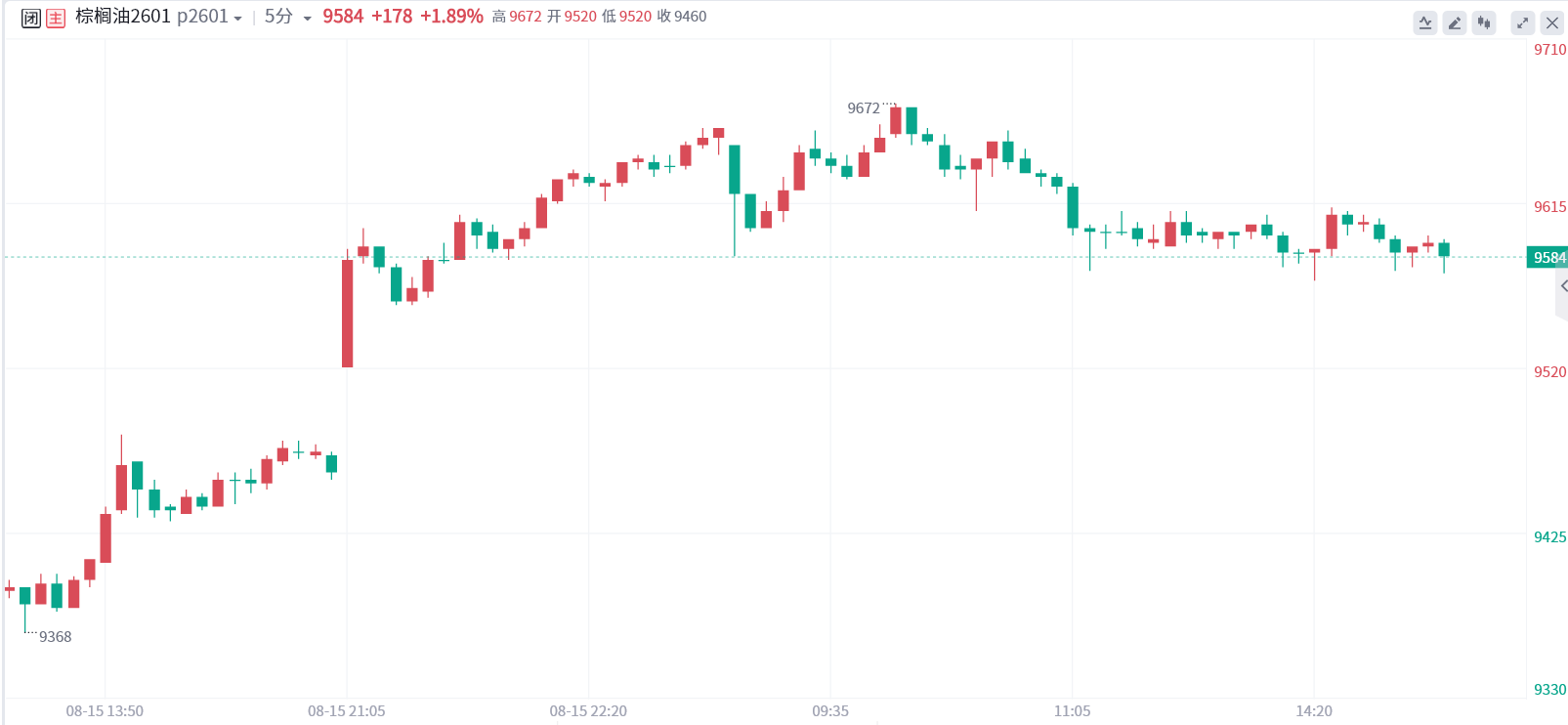
Core Viewpoint - The recent surge in palm oil prices is primarily driven by supply concerns from Indonesia due to government actions against illegal plantations, alongside positive export data from Malaysia fueled by demand for the Indian festival Diwali [3][4][5]. Group 1: Market Dynamics - On August 18, Dalian Commodity Exchange palm oil futures initially rose nearly 3% before closing with a gain of 1.89%, reaching a seven-month high of 9672 yuan/ton [1]. - Indonesia's military has seized 3.1 million hectares of illegal palm plantations, representing 20% of the country's official plantation area, leading to expectations of reduced palm oil production [3]. - The Indonesian government's crackdown may result in lower yields, impacting future palm oil production growth, with projections indicating that the increase in production may not meet consumption growth by 2025 [3]. Group 2: Export and Production Insights - Malaysia's palm oil exports from August 1-15 are estimated at 537,183 tons, a 34.5% increase from the same period last month, driven by demand for the Diwali festival [4]. - Data from SPPOMA indicates a slight decrease in palm oil yield but an increase in extraction rates, suggesting a mixed production outlook for Malaysia [4]. - The overall domestic supply and demand for palm oil in China remains relaxed, with limited procurement for September, indicating a broader market stability [3]. Group 3: Future Outlook - The Indonesian government's intensified actions against illegal plantations could significantly affect future supply, with an additional 3.7 million hectares under scrutiny [4]. - Domestic oil prices are expected to follow international trends, with potential for a phase of adjustment after recent price increases, suggesting a cautious approach to trading strategies [4][5]. - Analysts recommend maintaining low long positions while being cautious about chasing higher prices due to potential market fluctuations [5].

油脂周报:棕榈油供需偏紧,叙事延续-20250816
Wu Kuang Qi Huo· 2025-08-16 14:47
1. Report Industry Investment Rating No relevant content provided. 2. Core Viewpoints of the Report - This week, the three major oils and fats overall closed higher. The bullish factors such as the expected tight supply - demand of palm oil and China's imposition of temporary margins on Canadian rapeseed stimulated the market. However, the actual weak consumption and rumors of Australian rapeseed purchases led to profit - taking. The high - frequency data showed that the exports of Malaysian palm oil from August 1st to 15th increased by 16.5% - 21.3% month - on - month. The strong pattern of oils and fats is difficult to change in the short term [11]. - The USDA 8 - month report maintained that the industrial demand for soybean oil in the US in the 2025/2026 season will increase by about 1.5 million tons. India may have started the restocking process, which will support the subsequent export demand for palm oil [11]. - In the domestic market, the trading volume of soybean oil was good this week, while that of palm oil was weak. The total domestic inventory of oils and fats is about 300,000 tons higher than last year, with sufficient supply. In the next two months, the soybean crushing volume will show a slight downward trend, the export willingness of palm oil will increase after the production rises, and the rapeseed oil inventory will show a slow destocking trend [11]. - Fundamentally, factors such as the unexpected US biodiesel policy draft, the limited growth potential of Southeast Asian palm oil production, the low inventory of vegetable oils in India and Southeast Asian producing areas, and the expectation of Indonesia's B50 policy support the price center of oils and fats. Palm oil prices are expected to be strong in the range from July to September and may rise in the fourth quarter due to the B50 policy. However, the current valuation is relatively high, and the upside space is restricted by factors such as the annual - level expected increase in oil production, the relatively high near - term production of palm oil in producing areas, the undetermined RVO rules, and the adjustment of demand by major importing countries [11][12][13]. 3. Summary According to the Table of Contents 3.1. Weekly Assessment and Strategy Recommendation - **Market Overview**: The three major oils and fats closed higher this week. The bullish factors included the expected tight supply - demand of palm oil and China's measures against Canadian rapeseed. The high - frequency data of Malaysian palm oil exports in August was good. The supply - demand of Southeast Asian palm oil was basically balanced, and the observable oil inventory was at a relatively low level in the same period over the years. The price of domestic rapeseed oil was also pushed up by the tension in China - Canada trade relations [11]. - **International Oils and Fats**: The USDA 8 - month report maintained that the US will increase the industrial demand for soybean oil by about 1.5 million tons in the 2025/2026 season. It is expected that Canada's rapeseed production will increase by 100,000 tons to 19.25 million tons in the 2025/2026 season. India may start the restocking process [11]. - **Domestic Oils and Fats**: This week, the trading volume of soybean oil was good, while that of palm oil was weak. The total domestic inventory of oils and fats is about 300,000 tons higher than last year. In the next two months, the soybean crushing volume will decline slightly, the export willingness of palm oil will increase, and the rapeseed oil inventory will show a slow destocking trend [11]. - **Viewpoint Summary**: Fundamentally, multiple factors support the price center of oils and fats. Palm oil prices are expected to be strong in the range from July to September and may rise in the fourth quarter. However, the current high valuation restricts the upside space [11][12][13]. - **Trading Strategy Suggestion**: For the unilateral strategy, the market is expected to fluctuate strongly. No relevant content is provided for the arbitrage strategy [13]. 3.2. Futures and Spot Market - The report presents multiple charts related to the basis of palm oil, soybean oil, and rapeseed oil futures contracts, including the basis of Malaysian palm oil FOB - Malaysian palm oil 2510, the seasonal basis of Malaysian palm oil 10, and the basis of 09 contracts of palm oil, soybean oil, and rapeseed oil [18][20][23][26] 3.3. Supply Side - **Palm Oil Production and Export**: The report shows the monthly production and export volume charts of Malaysian palm oil and the monthly production and export volume charts of Indonesian palm oil + palm kernel oil, as well as the weekly arrival volume and port inventory charts of soybeans, and the monthly import volume charts of rapeseed and rapeseed oil [29][31][32][33] - **Palm Production Area Weather**: The report provides charts of weighted precipitation in Indonesian and Malaysian palm production areas, as well as charts related to the NINO 3.4 index and the impact of La Nina on global climate [34][36] 3.4. Profit and Inventory - **Overall Inventory**: The report presents the charts of the total domestic inventory of the three major oils and fats and the inventory of Indian imported vegetable oils [42] - **Inventory of Different Oils**: It shows the import profit, commercial inventory of palm oil, the spot crushing profit of imported soybeans in Guangdong, the inventory of major soybean oil mills, the average spot crushing profit of rapeseed in coastal areas, the commercial inventory of rapeseed oil in East China, and the inventory of palm oil in Malaysian and Indonesian producing areas [44][46][48][49] 3.5. Cost Side - **Palm Oil Cost**: The report presents the charts of the reference price of Malaysian palm fresh fruit bunches and the import cost price of Malaysian palm oil [53] - **Rapeseed and Rapeseed Oil Cost**: It shows the CNF import price of rapeseed oil and the import cost price of Chinese imported rapeseed [56] 3.6. Demand Side - **Oils and Fats Transaction**: The report presents the charts of the cumulative transaction volume of palm oil and soybean oil in the crop year [59] - **Biodiesel Profit**: It shows the charts of the POGO spread (Malaysian palm oil - Singapore low - sulfur diesel) and the BOHO spread (soybean oil - heating oil) [61]
菜籽进口结构或改变,菜油冲高回落
Hua Tai Qi Huo· 2025-08-15 06:50
Group 1: Report Industry Investment Rating - The investment rating for the industry is neutral [4] Group 2: Core View of the Report - Due to the trade friction between China and Canada regarding rapeseed, the import cost of Canadian rapeseed has significantly increased. Some traders are seeking to import rapeseed from Australia, but the market expects the impact to be limited, causing the price of oils to rise and then fall [3] Group 3: Market Analysis Summary Futures Market - Yesterday, the closing price of the palm oil 2601 contract was 9,368.00 yuan/ton, a decrease of 56 yuan or 0.59% [1] - The closing price of the soybean oil 2601 contract was 8,520.00 yuan/ton, a decrease of 56.00 yuan or 0.65% [1] - The closing price of the rapeseed oil 2601 contract was 9,840.00 yuan/ton, a decrease of 224.00 yuan or 2.23% [1] Spot Market - In the Guangdong region, the spot price of palm oil was 9,310.00 yuan/ton, a decrease of 160.00 yuan or 1.69%, with a spot basis of P01 + -58.00, a decrease of 104.00 yuan [1] - In the Tianjin region, the spot price of first - grade soybean oil was 8,630.00 yuan/ton, a decrease of 50.00 yuan/ton or 0.58%, with a spot basis of Y01 + 110.00, an increase of 6.00 yuan [1] - In the Jiangsu region, the spot price of fourth - grade rapeseed oil was 9,950.00 yuan/ton, a decrease of 220.00 yuan or 2.16%, with a spot basis of OI01 + 110.00, an increase of 4.00 yuan [1] Group 4: Recent Market Information Summary Import Prices - The C&F price of US Gulf soybeans (September shipment) was 460 US dollars/ton, an increase of 3 US dollars/ton from the previous trading day [2] - The C&F price of US West soybeans (September shipment) was 454 US dollars/ton, an increase of 3 US dollars/ton from the previous trading day [2] - The C&F price of Brazilian soybeans (October shipment) was 497 US dollars/ton, a decrease of 1 US dollar/ton from the previous trading day [2] - The C&F price of Canadian rapeseed (October shipment) was 549 US dollars/ton, an increase of 7 US dollars/ton from the previous trading day [2] - The C&F price of Canadian rapeseed (December shipment) was 539 US dollars/ton, an increase of 7 US dollars/ton from the previous trading day [2] - The C&F price of Argentine soybean oil (September shipment) was 1,146 US dollars/ton, unchanged from the previous trading day [2] - The C&F price of Argentine soybean oil (November shipment) was 1,140 US dollars/ton, an increase of 2 US dollars/ton from the previous trading day [2] - The C&F price of Canadian rapeseed oil (September shipment) was 1,035 US dollars/ton, unchanged from the previous trading day [2] - The C&F price of Canadian rapeseed oil (November shipment) was 1,015 US dollars/ton, unchanged from the previous trading day [2] Import Premiums - The import premium of Mexican Gulf soybeans (September shipment) was 210 cents/bushel, a decrease of 4 cents/bushel from the previous trading day [2] - The import premium of US West Coast soybeans (September shipment) was 184 cents/bushel, a decrease of 4 cents/bushel from the previous trading day [2] - The import premium of Brazilian ports (October shipment) was 313 cents/bushel, a decrease of 12 cents/bushel from the previous trading day [2] Brazilian Soybean Forecast - It is estimated that the soybean production in Brazil in the 2024/25 season will reach 169.657 million tons, an increase of 21.9207 million tons or 14.8% year - on - year, and an increase of 169,100 tons or 0.1% month - on - month [2] - The sown area of soybeans in Brazil in the 2024/25 season is expected to reach 47.6372 million hectares, an increase of 1.4826 million hectares or 3.2% year - on - year, and an increase of 22,300 hectares month - on - month [2] - The soybean yield per unit area in Brazil in the 2024/25 season is expected to be 3.56 tons/hectare, an increase of 360.5 kg/hectare or 11.3% year - on - year, and an increase of 1.9 kg/hectare or 0.1% month - on - month [2]
7月MPOB报告释放利多 8月棕榈油价格或延续涨势
Xin Hua Cai Jing· 2025-08-14 08:04
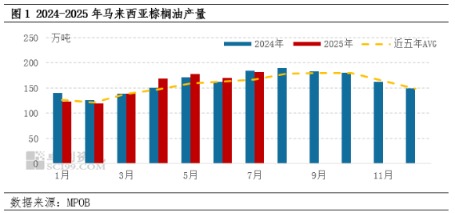
Core Viewpoint - The July report from the Malaysian Palm Oil Board (MPOB) indicates that the increase in palm oil supply outpaced demand, aligning with the trend of inventory accumulation, but the actual inventory was significantly lower than market expectations, leading to a bullish sentiment in the market [1][2][8] Supply and Demand Summary - In July, Malaysia's palm oil production reached 1.8124 million tons, a month-on-month increase of 7.09% [2] - Exports rose to 1.3091 million tons, up 3.82% month-on-month, while imports decreased to 61,000 tons, down 12.82% [2] - By the end of July, palm oil inventory increased to 2.1133 million tons, a month-on-month rise of 4.02% [2][8] - The actual production was lower than the market forecast of 1.83 million tons, providing price support [4] Market Dynamics - The increase in exports in July contributed positively to palm oil prices, although overall exports remain at a low level compared to the past five years [6] - Demand from the Indian market was a significant factor in boosting palm oil exports, despite a slight decrease in import volume to 850,000 tons [6] - The report indicated that the inventory increase was lower than expected due to higher-than-anticipated domestic consumption, which heightened market bullish sentiment [8] Price Outlook - Multiple positive factors are expected to drive palm oil prices higher in August, including the MPOB report, increased soybean oil export demand, and supportive policies in Indonesia [9] - The palm oil market is anticipated to maintain a dual increase in supply and demand, with seasonal production cycles continuing [9] - The domestic market may see improved demand due to upcoming festivals and the back-to-school season, despite some constraints from price differentials with soybean oil [9] - The expected price range for domestic palm oil in August is projected to be between 9,200 and 9,650 yuan per ton [9]
油脂基本面数据:棕榈油:产地供需两旺,低多为主,豆油:美豆偏强,豆油高位震荡
Guo Tai Jun An Qi Huo· 2025-08-14 02:28
Report Summary Investment Rating No investment rating for the industry is provided in the report. Core Views - For palm oil, the supply and demand in the producing areas are both strong, and the strategy is to go long at low prices [1]. - For soybean oil, the U.S. soybeans are strong, and soybean oil will fluctuate at a high level [1]. Detailed Summaries from Different Sections 1. Fundamental Tracking - **Futures Data**: - Palm oil主力: Closing price (day session) was 9,424 yuan/ton with a 0.66% increase, (night session) 9,486 yuan/ton with a 0.66% increase; trading volume was 384,052 lots, a decrease of 58,978 lots, and open interest was 226,780 lots, a decrease of 43,883 lots [1]. - Soybean oil主力: Closing price (day session) was 8,592 yuan/ton with a 1.23% increase, (night session) 8,554 yuan/ton with a -0.44% change; trading volume was 183,673 lots, an increase of 43,470 lots, and open interest was 261,043 lots, a decrease of 45,207 lots [1]. - Rapeseed oil主力: Closing price (day session) was 10,069 yuan/ton with a 2.72% increase, (night session) 9,976 yuan/ton with a -0.92% change; trading volume was 298,318 lots, an increase of 27,033 lots, and open interest was 90,567 lots, a decrease of 26,912 lots [1]. - Malaysian palm oil主力: Closing price was 4,435 ringgit/ton with a 0.80% increase, (night session) 4,436 ringgit/ton with a 0.02% increase [1]. - CBOT soybean oil主力: Closing price was 53.40 cents/pound with a 0.49% increase [1]. - **Spot Data**: - 24 - degree palm oil in Guangdong: Spot price was 9,380 yuan/ton, a price increase of 120 yuan/ton [1]. - First - grade soybean oil in Guangdong: Spot price was 8,820 yuan/ton, a price increase of 170 yuan/ton [1]. - Fourth - grade imported rapeseed oil in Guangxi: Spot price was 10,190 yuan/ton, a price increase of 500 yuan/ton [1]. - Malaysian palm oil FOB price: 1,090 dollars/ton, a price increase of 10 dollars/ton [1]. - **Basis Data**: - Palm oil (Guangdong) basis was - 44 yuan/ton [1]. - Soybean oil (Guangdong) basis was 228 yuan/ton [1]. - Rapeseed oil (Guangxi) basis was 121 yuan/ton [1]. - **Spread Data**: - Rapeseed - palm oil futures主力 spread was 574 yuan/ton, compared to 448 yuan/ton two days ago [1]. - Soybean - palm oil futures主力 spread was - 914 yuan/ton, compared to - 886 yuan/ton two days ago [1]. - Palm oil 9 - 1 spread was - 66 yuan/ton, compared to - 34 yuan/ton two days ago [1]. - Soybean oil 9 - 1 spread was 16 yuan/ton, compared to 12 yuan/ton two days ago [1]. - Rapeseed oil 9 - 1 spread was 5 yuan/ton, compared to - 8 yuan/ton two days ago [1]. 2. Macro and Industry News - Malaysia has raised its reference price for crude palm oil in September, and the export tax has been increased to 10%. The September reference price is 4053.43 ringgit/ton (962.12 dollars/ton), compared to 3864.12 ringgit/ton in August with a 9% export tax [2][3]. - Indonesia has saved at least 3.68 billion dollars in foreign exchange this year by using palm - oil - based biodiesel. The palm oil blending ratio in its biodiesel is 40% (B40 biofuel), and the policy took effect at the beginning of this year. As of June, about 6.8 million kiloliters of B40 biodiesel had been distributed, achieving half of the 2025 target of 13.5 million kiloliters [3]. - As of the week ending August 6, Argentine farmers sold 868,100 tons of 2024/25 soybeans, bringing the cumulative sales to 28.8286 million tons. The local oil mills purchased 679,500 tons, and the export industry purchased 188,600 tons. They also sold 52,700 tons of 2025/26 soybeans, with cumulative sales reaching 593,100 tons. The total soybean sales for all years in that week were 961,800 tons, and the cumulative sales reached 70.2008 million tons. The cumulative export sales registration of 2024/25 soybeans was 8.092 million tons, and that of 2025/26 soybeans was 0 tons [4]. - Ukraine's 2025 rapeseed production is expected to drop to 2.7 - 2.8 million tons, down from 3.7 million tons in 2024. The extreme drought in southern and central - eastern Ukraine has cut the sunflower seed production forecast to no more than 14 million tons, compared to the previous forecast of 16 million tons [4]. 3. Trend Intensity - The trend intensity of palm oil is 0, and that of soybean oil is also 0. The trend intensity ranges from - 2 to 2, with - 2 being the most bearish and 2 being the most bullish [5].