
电动汽车

Search documents
国元香港晨报-20260129
Guoyuan Securities2· 2026-01-29 02:27
券 2026 年 1 月 29 日星期四 【实时热点】 【美国债市】 资料来源:BLOOMBERG、AASTOCKS、WIND、格隆汇、国元证券经纪(香港)整理 请务必阅读免责条款 1 证 【新股资讯】 研 究 报 告 美联储如期按兵不动,沃勒加入支持降息阵营 加拿大央行维持 2.25%利率不变 印度将立即大幅削减欧洲汽车关税至 30%至 35% 深圳五部门:全面优化 2026-2028 年消费环境 全国人口家庭发展工作会议:持续优化生育支持政策和激励 措施 央企 2025"成绩单":资产超 95 万亿、利润 2.5 万亿 国家能源局:2025 年底全国发电装机达 38.9 亿千瓦,同比 增长 16.1% 多家房企称已不被要求上报三道红线 特斯拉 Q4 盈利超预期,停产 ModelS/X 产线转造人形机器 人 SpaceX 拟 6 月 IPO,估值 1.5 万亿美元 2 年期美债收益率持平报 3.596% 5 年期美债收益率涨 25.37 个基点报 3.823% 10 年期美债收益率跌 0.2 个基点报 4.239% | 序号 | 招股日 | 代码 | 简称 | | --- | --- | --- | --- ...
大众最畅销纯电车召回,涉事供应商为韩国电池三巨头之一
Di Yi Cai Jing· 2026-01-29 02:17
近日,美国国家公路交通安全管理局(NHTSA)公布的一份文件显示,大众汽车将在美国分两次召回 共计44551辆大众ID.4电动汽车,原因均涉及高压电池系统的潜在安全隐患。 大众汽车集团(美国)公司向NHTSA提交的第一份报告表示,大众将召回670辆2023~2024年款ID.4, 原因是其高压电池电芯模块在特定生产期间内可能存在电极错位的制造缺陷,在某些情况下可能导致电 池起火。 因此,大众建议,受影响车主将充电上限设置为80%,避免使用直流快充,并在充电后将车辆停放在室 外。大众给出最终的解决方案是为受影响车辆免费更换存在隐患的电池模块。 同日,大众还提交了另一份召回ID.4的报告,这是一次更大规模的召回,涉及43881辆2023~2025年款未 安装"自放电检测"软件的ID.4。文件指出,在极少数情况下高压电池模块可能发生热扩散,存在导致车 辆起火的风险,但"尚未能确定所有事件的清晰根本原因"。大众将为车主进行电池健康检查、安装更新 软件,并在必要时更换电池模块。 这两次召回事件都涉及同一家供应商SK电池美国公司,涉及部件高压电芯模块。根据召回报告,上述 召回汽车的电芯模块由该公司供应。根据文件中披露的事 ...
马斯克称特斯拉需自建芯片厂
Jin Rong Jie· 2026-01-29 01:03
马斯克表示,特斯拉公司需要建造并运营一座名为"TeraFab"的工厂来生产 半导体。这项庞大的工程将 耗资数十亿美元,标志着该公司业务范围的进一步扩张,不再局限于核心的电动汽车业务。"为了消除 未来三四年内可能出现的产能瓶颈,我们必须建造一座特斯拉TeraFab,"马斯克表示,"一座规模庞大 的工厂,涵盖逻辑、存储器和封装等多个环节,而且将在美国本土生产。"马斯克表示,包括台积电、 三星和美光科技在内的现有供应商无法满足特斯拉的芯片供应需求。 ...

特斯拉Q4利润大降61%,马斯克用“科技宏图”撑起信仰:20亿美元押注xAI,太空算力与机器人掀起赛博狂欢
Sou Hu Cai Jing· 2026-01-29 01:01
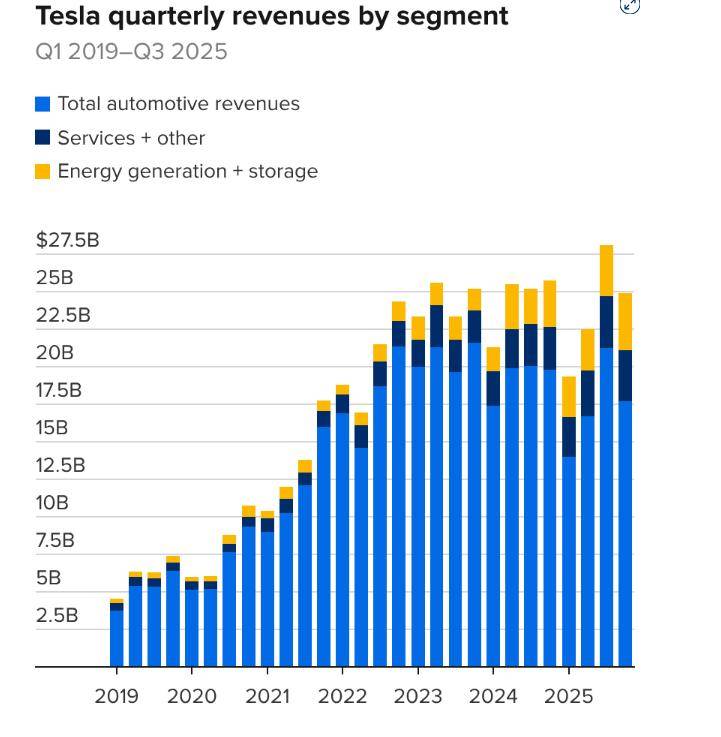
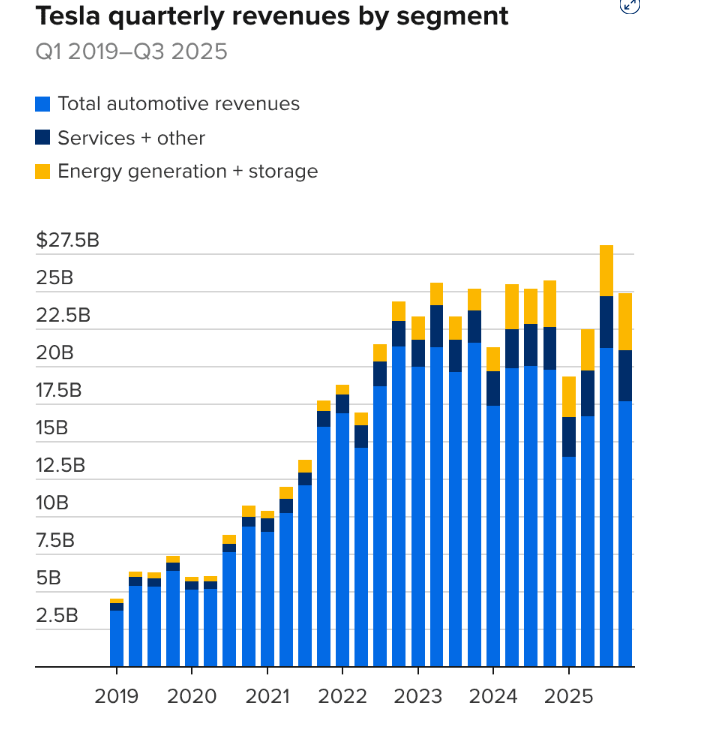
Core Viewpoint - Tesla reported better-than-expected Q4 earnings, with record energy deployment, but faced a 3% decline in annual revenue for the first time in its history, alongside a significant 61% drop in Q4 net profit [1][5][10]. Financial Performance - Tesla's total revenue for Q4 was approximately $24.9 billion, slightly above Wall Street's expectation of $24.79 billion, despite a year-over-year decline of about 3% [2][5]. - The automotive business, which is Tesla's core revenue source, saw a significant year-over-year decline of 11%, dropping from approximately $19.8 billion to $17.7 billion [5]. - Adjusted earnings per share for Q4 were about $0.50, exceeding analysts' expectations of $0.45 [2]. Market Response - Despite the disappointing annual revenue and Q4 profit, Tesla's stock price rose in after-hours trading, reflecting investor confidence in CEO Elon Musk's vision for a "Tesla super technology empire" [1][2]. - The stock has seen a significant increase of 50% since the second half of 2025, indicating strong market sentiment despite ongoing performance challenges [1]. Strategic Investments - Tesla announced a $2 billion investment in xAI, a competitor to OpenAI, aiming to enhance its capabilities in AI applications [1][15]. - The investment aligns with Tesla's broader strategy to integrate AI into its products and services, as outlined in its Master Plan Part IV [16]. Future Growth Initiatives - Tesla is focusing on advancements in AI, autonomous driving, Robotaxi services, and the Optimus humanoid robot, which are seen as key drivers for future growth [12][14]. - The company plans to convert its Fremont factory production line to mass-produce the Optimus robot, with a target to start production by the end of 2026 [14]. Competitive Landscape - Tesla faces increasing competition, particularly from BYD in the Chinese market, which has impacted its vehicle sales in recent quarters [2][10]. - The company reported a 16% decline in electric vehicle deliveries for Q4 and an 8.6% drop in annual deliveries [8]. Energy and Storage Business - Tesla's energy generation and storage business reported revenue of approximately $3.84 billion, reflecting a year-over-year growth of 25%, which partially offsets the decline in automotive revenue [12][14]. - The company emphasized the importance of its energy business as a "hard support" against the downturn in automotive sales [5]. SpaceX and Broader Ecosystem - Tesla's long-term growth narrative is closely tied to SpaceX, with investors viewing Tesla stock as a proxy for exposure to SpaceX's potential IPO and its ambitious projects [2][18]. - SpaceX's plans for solar energy production and AI capabilities are expected to synergize with Tesla's goals, enhancing the overall valuation narrative for both companies [19][21].


特斯拉(TSLA.US)Q4利润大降61% 马斯克用“科技宏图”撑起信仰:20亿美元押注xAI 太空算力与机器人掀起赛博狂欢
智通财经网· 2026-01-29 00:36
Core Insights - Tesla reported better-than-expected Q4 earnings, with record energy deployment, but faced a 3% decline in annual revenue for the first time in its history, and a significant 61% drop in Q4 net profit [1][5][12] - Despite the disappointing financials, CEO Elon Musk's optimistic outlook on AI, autonomous driving, and robotics has led to a post-earnings stock price increase of over 4% [2][13] - The company's automotive revenue fell by 11% year-over-year, while energy and storage revenue grew by 25%, indicating a shift in focus [5][15] Financial Performance - Q4 total revenue was approximately $24.9 billion, slightly above Wall Street's expectation of $24.79 billion, but down 3% year-over-year [2][5] - Adjusted earnings per share for Q4 were about $0.50, exceeding the expected $0.45 [2] - Tesla's gross margin for Q4 was approximately 20.1%, higher than the anticipated 17.1%, but net profit under GAAP standards saw a 61% year-over-year decline due to a 39% increase in operating expenses [5][12] Business Segments - The automotive segment, which has historically been the largest revenue contributor, saw a significant decline, dropping from approximately $19.8 billion to $17.7 billion year-over-year [5][12] - Energy generation and storage revenue reached about $3.84 billion, growing 25% year-over-year, which helped mitigate the decline in automotive revenue [15][18] - Tesla plans to invest $20 billion in xAI, a competitor to OpenAI, to enhance its AI capabilities [16][17] Strategic Initiatives - Tesla is transitioning its production lines to focus on the upcoming Optimus humanoid robot and plans to scale production significantly by 2026 [15][18] - The company is also expanding its Robotaxi service, with plans to roll out in several major U.S. cities [14][15] - Tesla's collaboration with SpaceX is expected to bolster its long-term growth narrative, as both companies are intertwined in Musk's broader vision for technology and infrastructure [19][20] Market Dynamics - Tesla faces increasing competition, particularly from BYD in the Chinese market, which has impacted its vehicle sales [2][9] - The decline in vehicle deliveries by 16% in Q4 and 8.6% for the year highlights ongoing challenges in the automotive sector [9][11] - Investors are increasingly viewing Tesla not just as an automotive company but as part of a larger ecosystem that includes SpaceX and AI technologies, which may support its valuation despite current struggles [2][19]
亚马逊再裁1.6万人,网友曝北京裁员50%,整组被「一锅端」;突发!马斯克宣布:ModelS和ModelX项目将终止;理想智驾部门将被重组
雷峰网· 2026-01-29 00:35
要闻提示 NEWS REMIND 1.亚马逊再裁1.6万人,网友曝北京裁员50%,整组被"一锅端" 2.马云最新发声:AI时代不要再犹豫用不用AI,应关注怎么教孩子用好AI 3.理想调整研发架构,智驾部门将被重组!郎咸朋转战机器人 4.阿童木机器人冲击港股IPO,瓜子二手车杨浩涌、深创投、联想为股东 5.裸车19.99万元,曾经一车难求的雷克萨斯ES,也开始打折卖了 6.字节禁止员工利用公司资源做号谋利 7. 马斯克宣布:ModelS和ModelX项目将终止,特斯拉预计4月推出下一代敞篷跑车 8.光刻机巨头ASML,裁员1700人! 今日头条 HEADLINE NEWS 突发!亚马逊裁员16000人,网友曝北京裁员50%,整组被"一锅端" 1月28日消息,科技巨头亚马逊周三宣布启动近3个月内的第二轮大规模裁员,这次将影响1.6万名白领员工。亚马逊表示,将为大多数美国员工提供90天的 内部职位寻找机会。同时,对于无法在亚马逊找到新职位或选择不寻找新职位的员工,亚马逊将提供过渡支持,包括遣散费、职业介绍服务、医疗保险福利 等。亚马逊也表示,一直在努力通过精简层级、增强责任担当和消除官僚主义来强化组织架构。虽然许多 ...


马云最新发声:谈AI和教育;软银拟向OpenAI追加投资300亿美元;英伟达员工晒年会最牛年终奖:黄仁勋亲笔签名皮衣丨邦早报
Sou Hu Cai Jing· 2026-01-29 00:25
点击输入图片描述(最多30字) 点击输入图片描述(最多30字) 【鸣鸣很忙上市大涨88%】中国最大的休闲食品饮料连锁零售商——湖南鸣鸣很忙商业连锁股份有限公司在港交所主板挂 牌上市,开盘大涨88.08%,截至收盘,涨幅回落至69.06%,报400港元/股,总市值达862.04亿港元。鸣鸣很忙此次全球发 售1410.1万股H股,公开发售阶段认购倍数超过1500倍,8家基石投资者合计认购15亿港元,包括腾讯、淡马锡与贝莱德 等。公司预计净筹资30亿港元以上,发行市值约500亿港元。鸣鸣很忙旗下拥有零食很忙、赵一鸣零食两大品牌,最新数据 显示,截至2025年11月30日,鸣鸣很忙门店数达21041家。(更多内容,点击查看《两位85后卖零食,开店两万家,身价均 超200亿港元,鸣鸣很忙刚刚IPO》)(中国基金报) 点击输入图片描述(最多30字) 【英伟达员工晒年会最牛年终奖:黄仁勋亲笔签名皮衣】近日,英伟达CEO黄仁勋陆续到访上海、北京、深圳,分别参加 了三地分公司举办的新年活动。1月27日,有网友在社交媒体晒出一件黄仁勋亲笔签名的皮衣。该网友表示,自己本来想签 在胸前,结果黄仁勋直接把他翻个身按住并称"Don't ...





马云最新发声:谈AI和教育;软银拟向OpenAI追加投资300亿美元;英伟达员工晒年会最牛年终奖:黄仁勋亲笔签名皮衣丨邦早报
创业邦· 2026-01-29 00:08
Group 1 - Jack Ma emphasizes the importance of teaching children how to effectively use AI rather than debating its necessity, highlighting curiosity, imagination, and creativity as key skills for the AI era [2] - The Ma Yun Rural Teacher Program, initiated by the Jack Ma Foundation in 2015, aims to enhance rural education quality through funding and professional training, selecting 100 teachers annually for support [2] Group 2 - Hunan Mingming Henbang, China's largest snack and beverage retail chain, saw its stock surge by 88.08% upon listing on the Hong Kong Stock Exchange, closing with a market cap of HKD 86.204 billion [4] - The company issued 14.101 million H shares, with a subscription rate exceeding 1500 times, and anticipates net proceeds of over HKD 3 billion from the offering [4] Group 3 - Tesla plans to cease production of Model S and Model X vehicles to transition towards a fully autonomous future, utilizing the "Optimus" robot factory for production [8] - Elon Musk stated that this change is part of Tesla's overall shift towards automation, although support for existing Model S and Model X vehicles will continue [8] Group 4 - SoftBank is reportedly negotiating to invest up to $30 billion in OpenAI, which is seeking to raise up to $100 billion in new funding, potentially valuing the company at $830 billion [10] - OpenAI's largest shareholder, SoftBank, previously invested $22.5 billion in December, increasing its stake to approximately 11% [10] Group 5 - Meta reported Q4 revenue of $59.89 billion, a 24% year-over-year increase, with advertising revenue also rising by 24% to $58.14 billion [11] - The company expects Q1 sales to range between $53.5 billion and $56.5 billion, with a post-earnings stock increase of over 4% [11] Group 6 - Ideal Auto is restructuring its R&D framework, splitting the autonomous driving team into three main groups, with a focus on software and hardware integration [10] - The restructuring aims to enhance the efficiency of the development process and align with the company's strategic goals [10] Group 7 - Amazon announced a reduction of nearly 16,000 jobs as part of an organizational restructuring while continuing to invest in strategic areas [17] - The company aims to balance workforce adjustments with ongoing recruitment in critical functions [17] Group 8 - Longting Technology completed a new round of financing totaling 500 million yuan, with investors including national and local AI industry funds [18] - The funds will be used to accelerate product development and enhance the company's market position [18]


美国电动汽车品牌特斯拉在欧洲销量大幅下滑
Huan Qiu Wang Zi Xun· 2026-01-28 18:25
0:00 欧洲汽车制造商协会27日公布的统计数据显示,2025年全年,特斯拉在欧洲的新车注册量为238656辆, 同比下降26.9%。在欧盟范围内,2025年特斯拉新车注册量同比下降37.9%,市场份额从2024年的2.3% 降至1.4%。 自2025年以来,因美国总统特朗普寻求得到格陵兰岛并在关税上对欧盟反复加码威胁,跨 大西洋关系持续承压。由于特朗普与特斯拉公司首席执行官马斯克关系密切,特斯拉电动汽车过去一年 在欧洲市场受到很多消费者抵制,销量表现也持续走弱。 来源:央视财经 ...
2025年纯电动汽车注册量增长近25% 英国加速普及电动汽车
Ren Min Ri Bao· 2026-01-28 08:00
责任编辑:王奕博 英国政府还将投入2亿英镑用于全国的充电桩铺设。据统计,英国约有8.7万个充电点。新增投资将用于 修建数千个新充电桩,并强化已有的街道充电设施,特别是为那些没有私人停车位的消费者提供便利, 降低他们的充电成本。去年7月,英国还启动了一项价值6300万英镑的投资方案,重点支持无车位的家 庭进行居家充电、推动英国国民健康服务体系车队电动化、部署商用车辆充电设施。 英国交通大臣亚历山大表示,补贴电动汽车销售是对国家未来的投资,可带动高质量制造业岗位增加。 在政策推动下,英国的电动汽车销售量持续提升。但也有部分民众对政府电动汽车补贴政策的反应谨 慎,认为充电基础设施不足和"里程焦虑"等问题持续存在,消费者对电动汽车的认知和信任度不足,对 电池寿命和维修成本等存在顾虑,都会影响未来决策。 根据英国汽车制造商和贸易商协会近期公布的数据,2025年英国纯电动汽车注册量超47.3万辆,同比增 长近25%,约占新车注册总量的23%。英国交通部表示将通过延长电动汽车补贴发放时间、助力公共充 电桩建设等措施加速推动普及电动汽车。 2025年7月,英国政府启动了总额为6.5亿英镑的电动汽车补贴。同年12月,政府宣布追 ...