
科技行业

Search documents
Asia-Pacific markets set to open mixed after Wall Street's tech-fueled recovery
CNBC· 2025-12-02 23:44
Group 1 - Asia-Pacific markets opened higher, influenced by a tech-fueled recovery in Wall Street and a rally in cryptocurrency [1] - Bitcoin surged over 7% to exceed $90,000, trading at 91,462 after a previous sharp sell-off [1] - Japan's Nikkei 225 index increased by 0.74%, while the broader Topix index remained flat [1] Group 2 - South Korea's Kospi index rose by 0.29%, and the small-cap Kosdaq increased by 0.10% [2] - South Korea is set to release revised third-quarter GDP numbers later in the day [2] - South Korean President Lee Jae Myung is expected to address the nation regarding the anniversary of a failed martial law declaration [2] Group 3 - Hong Kong markets were anticipated to open lower, with Hang Seng index futures at 25,965, down from the last close of 26,095.05 [3]


管理层平台年化收益69% 23家投资者或面临亏损
Nan Fang Du Shi Bao· 2025-12-02 23:21
Core Viewpoint - The acquisition of Sichuan Yichong Technology Co., Ltd. by Crystal Clear Mingyuan involves a transaction price of 3.282 billion yuan, with a significant premium of 260.08%, raising concerns about fairness and investor protection [3][6][8] Group 1: Transaction Details - The acquisition price of 3.282 billion yuan is significantly lower than the estimated valuation of 4.58 billion yuan at the end of 2023, indicating a serious valuation discrepancy [5][10] - The transaction employs innovative terms such as "differentiated pricing" and "business split betting," aimed at addressing the diverse needs of investors [3][7] - The valuation of Yichong Technology has increased from approximately 100 million yuan to nearly 4.58 billion yuan over seven years, reflecting high investor interest [5][6] Group 2: Pricing Strategy - The differentiated pricing strategy offers varying buyout prices for different investors, with the highest price reaching 20.95 yuan per registered capital and the lowest at 12.03 yuan, a difference of 74.14% [7][11] - Financial investors are guaranteed a cash price that is at least equal to their investment cost, but the actual returns vary significantly among investors [7][9] - The average estimated price per share is 15.04 yuan per registered capital, with some investors facing substantial losses [7][9] Group 3: Concerns and Questions - The Shanghai Stock Exchange has raised questions regarding the fairness and rationale behind the differentiated pricing, particularly in relation to investor returns [8][12] - There are concerns about potential conflicts of interest and whether the pricing strategy disproportionately favors larger institutional investors over smaller ones [13][14] - The management's rationale for higher pricing for certain platforms, despite already high returns, raises questions about possible preferential treatment [12][13]


港股收盘(12.02) | 恒指收涨0.24% 汽车股走势分化 博彩股、手机产业链表现活跃
智通财经网· 2025-12-02 08:40
Market Overview - Hong Kong stocks opened higher but closed lower, with the Hang Seng Index rising 0.24% to 26,095.05 points and a total turnover of 178.25 billion HKD [1] - The Hang Seng Tech Index fell 0.37% to 5,624.04 points, while the Hang Seng China Enterprises Index increased by 0.11% to 9,182.65 points [1] Blue Chip Performance - Galaxy Entertainment (00027) led blue-chip stocks, rising 2.81% to 40.98 HKD, contributing 3.88 points to the Hang Seng Index [2] - Other notable blue-chip performers included Hengan International (01044) up 2.69% and Budweiser APAC (01876) up 2.35% [2] - WuXi AppTec (02359) fell 3.13%, negatively impacting the index by 2.2 points [2] Sector Highlights - Macau's November gaming revenue reached 21.09 billion MOP, a 14.4% year-on-year increase, exceeding market expectations [4] - The mobile phone supply chain remained active, with notable gains in companies like AAC Technologies (02018) and BYD Electronics (00285) [4][5] - The automotive sector showed mixed results, with BYD (01211) up 2.19% while Xpeng Motors (09868) fell 5.52% [5][6] Notable Stock Movements - Conant Optical (02276) surged 10.58% to 54.85 HKD following the launch of AI glasses in collaboration with Alibaba [8] - Giga Biotech (02367) rose 8.53% after announcing a share buyback plan [9] - GAC Group (02238) increased by 7.32% due to positive management announcements regarding new battery technology and partnerships [10] - Longpan Technology (02465) saw a 4.1% increase amid industry price adjustments in lithium iron phosphate [11] - 3SBio (01530) faced pressure, dropping 4.61% after announcing a share placement to raise capital [12]

Bitcoin Falls as Prospect of Rate Rise in Japan Spooks Investors
WSJ· 2025-12-01 09:46
Core Viewpoint - BOJ Governor Kazuo Ueda's comments have heightened risk aversion in the market, particularly amid concerns regarding the overvaluation of technology stocks and other high-risk assets [1] Group 1 - Ueda's remarks contribute to a broader sentiment of caution among investors [1] - The current market environment is characterized by worries about the inflated valuations of tech stocks [1] - There is an increasing focus on the risks associated with investing in risky assets [1]

瑞银证券:料2026年A股盈利增速有望升至8%
Zhi Tong Cai Jing· 2025-12-01 08:23
Group 1 - UBS Securities analyst Meng Lei predicts that the overall A-share profit growth rate will increase from 6% this year to 8% by 2026 [1] - The current equity risk premium in the A-share market is still higher than the historical average, while other emerging markets are significantly below their long-term averages [1] - Factors such as macro policy support, accelerated A-share profit growth, declining risk-free interest rates, and continuous inflow of long-term capital will contribute to further valuation increases in the A-share market [1] Group 2 - Recent short-term factors have caused a pullback in the A-share market, but these concerns do not alter the medium-term trend of valuation improvement [1] - The global strategy team at UBS believes that global tech stocks are likely to rise further next year, with recent trading proportions of large tech stocks returning to below this year's average levels [1] - Investment themes to watch in 2026 include technological self-reliance, consumer spending driven by corporate profit acceleration, and the ongoing "anti-involution" trend [1] Group 3 - In terms of style allocation, the "growth" style is expected to outperform the "value" style due to positive mid-term market outlook [2] - The "cyclical" style is anticipated to outperform the "defensive" style as the ongoing "anti-involution" trend narrows PPI declines and accelerates industrial profits [2] - Tactical preferences favor industries benefiting from China's innovation, ample market liquidity, and narrowing PPI declines [2]
科技革命与财富周期︱重阳来信2025年12月
重阳投资· 2025-12-01 07:32
Core Viewpoint - Warren Buffett's recent investment in Alphabet (Google's parent company) marks a significant shift in his investment strategy, indicating that technology is an unavoidable theme in today's investment landscape [2]. Group 1: Investment Trends - Berkshire Hathaway's third-quarter report revealed a new position in Alphabet valued at approximately $4.34 billion, making it the company's tenth-largest holding [2]. - Historically, Buffett has avoided technology stocks, with Apple being an exception due to its consumer-oriented nature. The decision to invest in a pure tech stock like Alphabet raises questions about the underlying investment logic [2]. Group 2: Technology and Economic Cycles - Peter Oppenheimer's book "Wealth and Cycles" discusses the intertwined relationship between technology revolutions and capital cycles, emphasizing that technology plays a decisive role in wealth creation and destruction [3]. - Oppenheimer predicts that the impact of technology on the economy and financial markets will continue to grow due to positive network effects and more efficient use of technology [4]. Group 3: Historical Context of Technology Dominance - The history of the technology sector illustrates a "winner-takes-all" phenomenon, where dominant companies capture significant market shares, as seen with Standard Oil, Bell Telephone, and Microsoft [5]. - Despite the dominance of certain companies, over 90% of Fortune 500 companies since 1955 have been replaced, highlighting the risks of complacency in innovation [7]. Group 4: Future of Technology Companies - Oppenheimer identifies three reasons why leading technology companies may maintain their dominance longer than past leaders: the deflationary nature of the tech industry, its importance to national security, and substantial R&D investments [7]. - The investment landscape is complex due to the interplay of technology cycles and capital cycles, which Oppenheimer categorizes into four stages: strong performance driven by new technology, excessive enthusiasm leading to high valuations, bubble bursts, and eventual consolidation around leading firms [8][9]. Group 5: Investment Strategies - Investors often overestimate the potential returns of all companies associated with a new technology, leading to inflated valuations and subsequent bubbles. Historical data shows that 73% of major innovations from 1825 to 2000 resulted in asset bubbles [9]. - The aftermath of a bubble often leads to a market correction where only the most valuable technologies survive, as seen in the internet bubble where companies like Amazon and Google emerged as winners [10].

美联储“救市”成转折点,11月的最后一周,各类资产“强劲反弹”
3 6 Ke· 2025-12-01 01:49
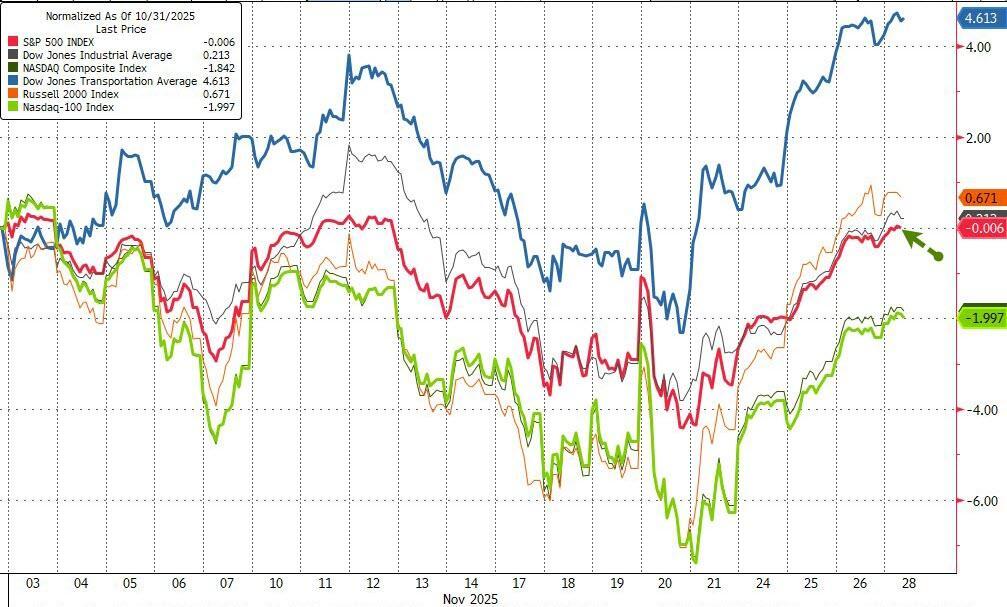
在经历了月初的动荡后,金融市场于11月的最后一周上演了一场万物反弹的行情。 本周,随着美联储12月降息预期的升温,美股、美债、大宗商品乃至加密货币等几乎所有类别的资产均协同上涨,一扫此前对AI泡沫和经济增长的忧虑。 行情逆转的关键节点出现在上周五,华尔街见闻提及,纽约联储主席威廉姆斯放鸽,市场押注12月降息概率因此从约30%突破至50%。随后"鲍威尔盟 友"连续发声支持降息,市场对美联储12月降息预期大幅升至80%。 (美股基准股指11月走势,标普500指数从月中大幅下跌中反弹,最终基本收平) (绿线美联储12月降息概率 VS 蓝线明年1月概率) 周五芝商所因数据中心故障一度暂停交易,也未能阻挡这股上涨势头。本周具体表现来看: 美国标普500指数本周大涨3.7%,创下六个月来最佳单周表现,同时也是自2008年雷曼危机以来最好的"感恩节周"表现。 (标普500指数自2008年以来感恩节期间表现最好的一周) 美国国债价格上涨,10年期国债收益率一度跌破4%的关键心理关口。 比特币也从11月的低点反弹超过7%,回升至9万美元上方,市场风险偏好显著回暖。 彭博商品指数周内上涨超过2%,现货白银和伦铜均突破历史高位。 ...
中国股票策略:年底获利了结拖累 A 股情绪小幅回落-China Equity Strategy-A-Share Sentiment Edged Down on Year-End Profit-Taking
2025-12-01 00:49
Summary of Key Points from the Conference Call Industry Overview - **Industry**: A-Shares in China - **Market Sentiment**: A-share sentiment has softened due to year-end profit-taking and increased volatility in the US market, with a cautiously constructive outlook maintained by the company [1][2][13]. Core Insights and Arguments - **Investor Sentiment**: - The weighted MSASI (Morgan Stanley A-share Sentiment Indicator) decreased by 1% to 50% compared to the previous cut-off date, and the 1MMA (1-Month Moving Average) dropped by 4% to 61% [2]. - Average Daily Turnover (ADT) for A-shares decreased by 6% to RMB 1,801 billion, while ChiNext turnover rose by 2% to RMB 506 billion [2]. - **Net Inflows**: - Southbound trading recorded net inflows of USD 2 billion from November 20 to November 26, with year-to-date net inflows reaching USD 167 billion [3]. - **Government Policy**: - Beijing is considering interest subsidies to lower mortgage costs, which could support listings and stabilize prices. A broad 100bps subsidy could cost approximately RMB 400 billion annually [4]. - The implementation of such policies could lead to a gradual recovery in housing demand and stabilize prices in higher-tier cities [4]. - **Market Volatility**: - Chinese equities have experienced heightened volatility since October, with a potential US market correction posing a significant risk to global risk assets, including Chinese equities [13]. - However, A-shares have shown the lowest correlation with US markets, suggesting potential for relative outperformance [13]. Additional Important Insights - **Foreign Investor Sentiment**: Positive feedback from foreign investors indicates a growing interest in the Chinese equity market, with expectations for continued net inflows in the coming year [14]. - **Catalysts for Improvement**: Key catalysts for a more bullish outlook on China include improved US-China relations and a more aggressive fiscal policy, particularly regarding housing inventory [15][16]. - **Earnings Estimate Revisions**: The breadth of consensus earnings estimate revisions remains negative but has shown slight improvement compared to the previous week [2]. - **Methodology of MSASI**: The MSASI is constructed using 12 individual indicators to capture various dimensions of investor sentiment, normalized to reduce noise and reflect medium-term trends [17][26]. - **Market Dynamics**: The report highlights the importance of monitoring various metrics such as ChiNext turnover, A-share turnover, and margin financing to gauge market sentiment and activity [19][20][21]. This summary encapsulates the key points discussed in the conference call, focusing on the A-share market dynamics, investor sentiment, government policies, and potential catalysts for future market performance.
Stocks drift back toward record highs as the final month of 2025 gets underway: What to watch this week
Yahoo Finance· 2025-11-30 12:27
The final month of the year gets underway on Monday, and investors will be looking for a smoother month to round out the year after choppy November trading saw the Nasdaq Composite (^IXIC) snap a seven-month winning streak while the S&P 500 (^GSPC) moved back to within 1% of a record high. On Friday, markets ended the week by notching a fifth straight session of gains to close out the up-and-down month in a holiday-shortened trading session. And despite snapping its monthly winning streak, the Nasdaq is a ...
美股反弹了,但年底大涨也不用指望?
Hua Er Jie Jian Wen· 2025-11-29 01:25
Core Viewpoint - The U.S. stock market appears to be stabilizing after a recent sell-off, despite disruptions caused by the Chicago Mercantile Exchange outage [1] Group 1: Market Dynamics - Bloomberg macro strategist Simon White indicates that the upward momentum in the U.S. stock market is waning, and the likelihood of a strong year-end rebound is minimal due to significantly reduced buyback activity [2] - The market has shifted from a focus on "momentum" and "trading" factors to a resurgence of the "value" factor, which has taken the lead, while the previously dominant "trading" factor has plummeted to the bottom [3] Group 2: Corporate Buybacks - The corporate buyback trend, a key driver of the current bull market, is rapidly declining. Although November and December are typically strong months for buybacks, the ability of tech giants to continue large-scale buybacks is constrained due to aggressive capital expenditures throughout the year [4] - The "momentum factor" is currently underperforming compared to the S&P 500 index, indicating a potential risk for year-end market performance [5] Group 3: Market Conditions - An analysis of market conditions over the past 25 years shows that the current market is in a "headwind period" characterized by low returns [6] - When the momentum factor outperforms the market, rebounds tend to be healthy and strong. Conversely, when it underperforms, as seen recently, it often corresponds with flat or negative index returns [7] Group 4: Investor Sentiment - Despite the challenges, the overall liquidity in the market remains ample, providing a solid support base for U.S. stocks. However, this does not imply significant upward potential, as weak momentum and limited corporate buyback intentions suggest that expectations for a dramatic year-end rally may be unrealistic [8]