创新药

Search documents
银行理财1月份规模狂掉1万亿?一定要高度重视背后的影响
表舅是养基大户· 2026-02-11 13:35
Core Viewpoint - The significant drop in the scale of bank wealth management products in January indicates a major shift in the industry, suggesting that the previous growth was unsustainable and that a transformation in business models is necessary [1][6]. Group 1: Industry Scale Changes - In January, the scale of 14 leading bank wealth management subsidiaries decreased by over 800 billion, which represents approximately 75% of the total wealth management industry scale, indicating a total industry drop of over 1 trillion [1][3]. - The scale drop of 1 trillion is substantial, especially when compared to a decrease of over 1200 billion in January 2024 and an increase of about 500 billion in January 2025, highlighting a significant shift in investor behavior [3]. Group 2: Business Model Transformation - The release of retained earnings and the end of the "ranking" business model for wealth management companies signal a need for a focus on research capabilities, product line layout, and channel service capabilities [4][7]. - The competition landscape in the wealth management industry is expected to undergo drastic changes, with a shift away from unsustainable business practices towards more robust investment strategies [5][7]. Group 3: Market Implications - The decline in wealth management scale reflects a healthy adjustment in the industry, as it removes inflated growth driven by unsustainable practices [6]. - The end of the previous business model will lead to a decrease in pure debt wealth management yields, which will lower the actual risk-free rate for Chinese residents, potentially increasing the valuation of risk assets [7]. - The transition in wealth management is not just a change for wealth management subsidiaries but requires a comprehensive transformation across management and sales channels [7]. Group 4: Investment Strategy Recommendations - The current low-interest-rate environment necessitates a multi-asset investment approach, emphasizing the importance of asset allocation for both investment advisors and individual investors [7][8]. - The rise of multi-asset wealth management products indicates a shift in investor preferences, with a significant increase in the allocation towards fixed income and public funds [7].


再融资新政落地,布局盯紧资金态度
Sou Hu Cai Jing· 2026-02-11 12:37
Core Insights - The recent refinancing regulations introduced by the Shanghai, Shenzhen, and Beijing stock exchanges aim to facilitate financing for high-quality listed companies, particularly in the tech sector, by improving review speed, flexibility in fund usage, and tolerance for R&D investments [1] - The effectiveness of these policies is contingent upon the actual participation of institutional investors, rather than merely following market trends or concepts [1] Group 1: Institutional Participation - Investors should prioritize examining the "institutional inventory" data to gauge the active participation of institutional funds in trading, rather than being swayed by market concepts [3][5] - A case study revealed that a stock associated with the innovative drug concept had been actively monitored by institutions for over six months, despite its recent volatility, indicating that institutional interest was present before the market hype [3][5] - The "institutional inventory" data serves as a critical indicator of whether institutions are genuinely involved in a stock, which can significantly influence its price movement [5][9] Group 2: Market Dynamics - Stocks that appear stagnant may still have underlying institutional activity, which can lead to sudden price increases when the market eventually recognizes this participation [7][9] - A stock in the liquor sector failed to appreciate in value due to a lack of institutional involvement, despite positive fundamental indicators, highlighting the importance of institutional sentiment in price movements [11] - The overall market behavior is driven by the actions of institutional investors, who possess the financial power to dictate stock trends [11] Group 3: Investment Strategy - Investors are encouraged to adopt a data-driven approach, focusing on objective metrics such as institutional participation rather than emotional reactions to market fluctuations [12] - The formula for sustainable investment capability emphasizes the importance of objective market recognition and structured decision-making processes, minimizing emotional interference [12] - Upgrading investment knowledge involves shifting from subjective speculation to relying on objective data regarding institutional actions, which is essential for long-term success in the market [12]
新诺威股价近期下跌,高管变动与战略合作引关注
Jing Ji Guan Cha Wang· 2026-02-11 10:36
Core Viewpoint - The company Xinnoway (300765.SZ) is currently facing significant stock price volatility due to poor performance forecasts and market sentiment, with a recent stock price of 35.79 yuan reflecting a 2.40% increase on the day but a 12.66% decline over the past 20 days [1]. Group 1: Stock Performance - As of February 10, 2026, Xinnoway's stock price was reported at 35.79 yuan, with a daily increase of 2.40% [1]. - The stock has experienced a cumulative decline of 3.82% over the past 5 days and 12.66% over the past 20 days [1]. - The current price-to-earnings ratio (TTM) is negative at -458.45, indicating the company is in a loss position [1]. Group 2: Institutional Insights - Southwest Securities reported on February 8, 2026, that the A-share innovative drug sector declined by 1.32%, with Xinnoway's weekly drop reaching 12.53%, placing it among the worst performers in the sector [1]. - The overall institutional rating is neutral, with profit forecasts indicating a net profit of 54 million yuan for 2025 (a 0.51% year-on-year increase) and an expected improvement to 73 million yuan in 2026 (a 35.19% year-on-year increase) [1]. - The uncertainty surrounding the innovative drug development process remains a significant risk factor [1]. Group 3: Recent Events - On January 30, 2026, Xinnoway completed a management adjustment, promoting the former board secretary Dai Long (a post-90s executive) to general manager, with Xu Wen taking over as board secretary [2]. - On the same day, the company announced a strategic cooperation with AstraZeneca, involving an upfront payment of 1.2 billion USD, with Giant Bio receiving 35% [2]. - The market reacted cautiously to the appointment of a young executive and the performance decline, resulting in a stock price drop of 15.72% on that day [2].

春节港股或迎独立行情?AI爆发,港股回调到位了吗?
Xin Lang Cai Jing· 2026-02-11 06:21
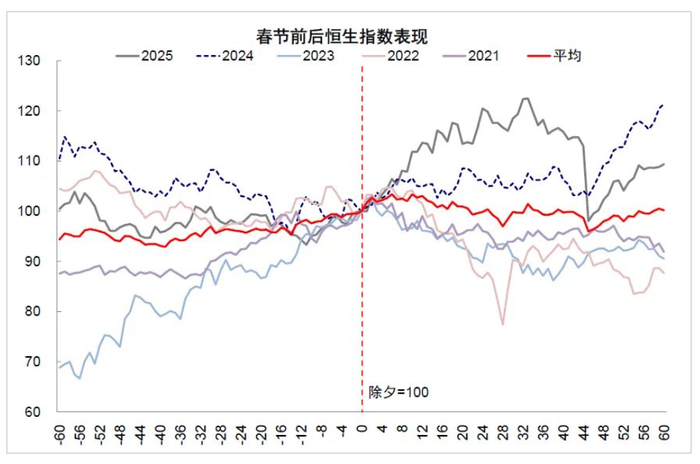
Core Viewpoint - The upcoming Chinese New Year holiday will lead to a 10-day market closure for A-shares, while Hong Kong stocks (H-shares) will continue trading, raising questions about whether H-shares can perform independently during this period. The recent adjustments in H-shares, combined with the surge in AI applications, prompt an analysis of whether the market has reached a correction point [1][3]. Market Trends - Historically, the Hang Seng Index has shown an 82% probability of rising in the three trading days before the Spring Festival, with a 40%-60% chance of increasing after the holiday. The correlation between H-shares and A-shares has strengthened, while the correlation with U.S. stocks has weakened, suggesting a potential for passive upward movement in H-shares [3]. Sector Performance - The Hang Seng Technology Index has seen significant performance metrics, with an average increase of 72.7% from Christmas to the Spring Festival. The average increase for the Hang Seng Index during the same period is 3.8% [4]. Investment Opportunities - The recent pullback in H-shares has made valuations more attractive, with expectations of a rebound. The Hang Seng Technology Index's price-to-earnings (P/E) ratio is currently at 24.5, which is below the historical average, indicating a favorable entry point for investors [7][8]. Innovation and Drug Development - Significant partnerships in the biotech sector, such as the collaboration between Innovent Biologics and Eli Lilly, highlight the potential for innovation in the pharmaceutical industry. This partnership includes a $350 million upfront payment and potential milestone payments totaling up to $8.5 billion [9]. Consumer Sector Dynamics - As the Spring Festival approaches, consumer activity is expected to rise, particularly in sectors like gold retail and hospitality. Government policies aimed at boosting consumption are likely to enhance market sentiment and drive growth in the consumer sector [11]. Dividend Strategies - In a low-interest-rate environment, dividend strategies are becoming increasingly attractive. The dividend yield for H-shares remains higher compared to A-shares, making them a compelling option for investors seeking stable returns [12][13]. Automotive Sector Growth - The automotive sector is poised for growth due to supportive policies and technological advancements in smart driving. The introduction of new policies for electric vehicle purchases is expected to stimulate demand, while advancements in autonomous driving technology present further opportunities [14][15].
港股科技配置价值凸显,港股科技ETF(513020)盘中涨超1.2%
Mei Ri Jing Ji Xin Wen· 2026-02-11 05:35
Core Viewpoint - The peak of overseas liquidity shock has passed, and the earnings expectations for the Hong Kong tech sector have been continuously adjusted downwards since September, but have recently stabilized, indicating that current stock prices reflect a phase of market adjustment [1] Group 1: Market Conditions - The relative valuation of the Hong Kong tech sector has reached historical lows, with a regulatory and development environment significantly better than in previous years, indicating that the sector is significantly undervalued [1] - The industry is progressing smoothly, with various large models being promoted actively by companies like Tencent and Alibaba during the Spring Festival, continuously catalyzing the AI industry [1] Group 2: Investment Opportunities - The Hong Kong Tech ETF (513020) tracks the Hong Kong Stock Connect Technology Index (931573), covering core assets in sectors such as internet, innovative pharmaceuticals, and new energy vehicles, reflecting the diversified characteristics of the tech industry and the overall performance of core tech companies in the Hong Kong market [1] - The Hong Kong Stock Connect Technology Index has outperformed the Hang Seng Tech Index by over 140% since its base date at the end of 2014, with a cumulative return of 224.25% compared to the Hang Seng Tech Index's 83.87%, indicating long-term outperformance against similar indices [1]
华商基金张晓:创新药转向临床数据叙事 将继续驱动国内创新药发展
Xin Lang Ji Jin· 2026-02-11 04:16
医药医疗行业作为兼具防御性与成长性的长期赛道,其发展始终与人口结构、技术创新、政策导向同频 共振。华商医药医疗行业股票基金经理张晓表示,创新药已从BD叙事转为真正的临床数据叙事,大单 品海外临床数据陆续读出,将继续驱动国内创新药发展;CXO板块今年从订单前瞻来看,拐点或已确 立,持续看好整个产业链的业绩和估值修复。 针对她所管理的华商医药医疗行业股票基金,张晓表示,基金配置重心聚焦于创新产业链,包括创新药 与CXO。她认为,创新药方面,行业逻辑已从BD叙事转为真正的临床数据叙事,大单品海外临床数据 陆续读出,将继续驱动国内创新药发展;CXO板块,从订单前瞻来看,拐点或已确立,持续看好整个 产业链的业绩和估值修复。 数据说明:文中基金经理观点及基金策略信息来自基金定期报告,基金经理关注领域仅代表基金经理作 出的判断,可能随市场情况调整,不代表基金的实际投向,具体投资策略和投资标的详见基金法律文件 及基金定期报告。 截至2025年12月31日,张晓具有10.5年证券从业经历(其中6.3年证券研究经历,4.2年证券投资经 历)。张晓历任基金:华商医药医疗行业股票2022.05.19至今、华商恒益稳混合2025.03 ...

平安证券(香港)港股晨报-20260211
Ping An Securities Hongkong· 2026-02-11 03:45
Market Overview - The Hong Kong stock market experienced fluctuations, with the Hang Seng Index closing at 23,831 points, down 145 points or 0.61% [1] - The market turnover decreased to 82.799 billion HKD, with net inflows of 484 million HKD recorded in the Hong Kong Stock Connect [1] - The US stock market showed mixed results, with the Dow Jones rising 0.1% to a new closing high, while the S&P 500 and Nasdaq fell by 0.33% and 0.59% respectively [2] Sector Performance - In the Hong Kong market, local real estate, software, and 5G sectors saw significant declines, while gold stocks performed well [1] - Biotechnology and cultural media sectors were active, with the Hang Seng Index rising 0.58% and the Hang Seng Technology Index increasing by 0.62% [1] - Notable stock performances included a 5.5% increase for CSPC Pharmaceutical Group and a 15.4% rise for China Literature [1] Investment Opportunities - The report emphasizes the importance of "technological self-reliance" and AI applications as key themes for future growth in the Hong Kong market, suggesting that leading companies in these sectors may benefit from long-term development opportunities [3] - The report recommends focusing on sectors supported by policies aimed at expanding domestic consumption, such as sports apparel and non-essential services [3] - It highlights the value of investing in state-owned enterprises with relatively low valuations and high dividends across various industries [3] Company Highlights - ByteDance's subsidiary Doubao launched a New Year campaign, distributing red envelopes and promoting AI applications, which may boost demand for upstream GPU and AI chips [9] - Innovent Biologics announced a strategic partnership with Eli Lilly, with a total transaction value of up to 8.85 billion USD, indicating strong market confidence in China's innovative drug pipeline [9] - The report suggests monitoring leading companies in the domestic semiconductor foundry industry, such as Hua Hong Semiconductor and SMIC, as they are expected to benefit from favorable policies [9]

英大证券晨会纪要-20260211
British Securities· 2026-02-11 02:47
Core Views - The A-share market is showing signs of stabilization and recovery, with a positive outlook for the post-holiday market driven by liquidity improvement and policy expectations [2][3][10] - Key sectors such as cultural media, gaming, and AI applications are performing strongly, while sectors like precious metals and new energy are experiencing adjustments [4][9] Market Overview - On Tuesday, the three major indices in the Shanghai and Shenzhen markets showed mixed results, with cultural media and AI application sectors performing well, while precious metals and new energy sectors faced declines [4][5] - The overall market sentiment is characterized by orderly rotation of hotspots, indicating a positive trend towards stabilization [3][9] Sector Analysis - The cultural media sector has shown significant growth, with a 42.75% increase in the first half of 2023, and is expected to continue to have structural investment value in 2026 due to advancements in AI technology and economic recovery [6][7] - The AI theme remains active, with a focus on applications and hardware, indicating a shift from investment in computing power to practical applications in 2026 [7][8] Future Market Outlook - The market is expected to see increased activity post-holiday, with a focus on liquidity return and policy developments, which could provide new investment opportunities [3][10] - Investors are advised to adopt a cautious approach, focusing on low-cost opportunities in small-cap growth stocks and sectors with clear industrial catalysts [3][10]
早盘直击|今日行情关注
申万宏源证券上海北京西路营业部· 2026-02-11 02:35
Market Overview - The market experienced a narrow range of fluctuations after a rebound, with major indices showing mixed performance and the media sector leading the market for the second consecutive trading day due to seedance catalysts [1] - A-shares are currently in a consolidation phase influenced by external market adjustments, but the lower boundary of the consolidation range has been largely established, indicating a short-term upward trend [1] Key Events Impacting the Market - Two main events have caused market fluctuations: the nomination of the new Federal Reserve Chairman and the impact of AI models on traditional software [1] - The market perceives the nominee, Waller, as a "hawkish" figure, which could affect dollar liquidity; however, this view may be exaggerated as Waller's past ideology suggests a more dovish approach [1] - Internal divisions within the Federal Reserve raise uncertainties about the implementation of Waller's policies, and the necessity of tapering is debatable given the current decline in U.S. inflation [1] - Concerns regarding AI models eroding traditional software are seen as overly pessimistic, as the workflow model still relies on traditional desktop software for AI applications [1] Sector Focus - The technology sector remains the main focus for February, with an emphasis on technology companies showing positive fundamentals [2] - The trend in AI hardware continues to solidify, with a significant increase in the token usage of major AI models, indicating a peak in AI applications expected by 2026 [2] - The domestic and international demand for energy storage is driving growth in new energy materials, with signs of supply shortages and price increases expected to continue through 2026 [2] - The innovative drug and CXO sectors are entering a growth phase after four years of adjustment, with significant growth anticipated for innovative drugs in overseas markets by 2025 and continued upward trends into 2026 [2]

港股速报 | 恒指小幅高开 港股调整到位了吗?
Mei Ri Jing Ji Xin Wen· 2026-02-11 02:21
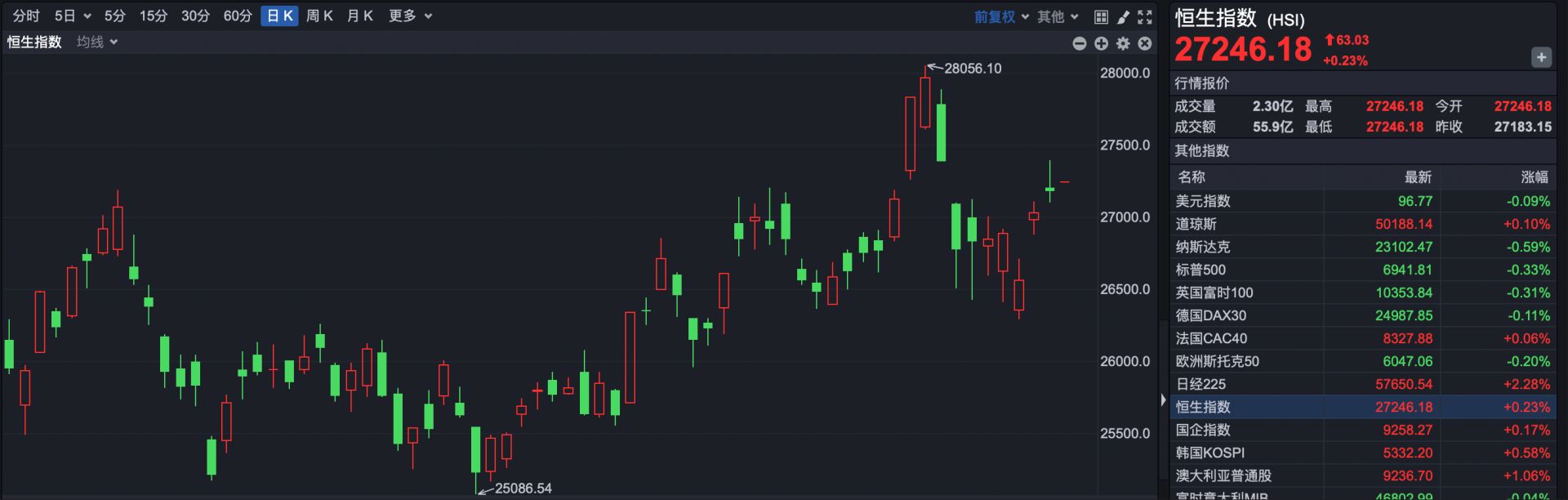
Market Overview - The Hong Kong stock market opened slightly higher on February 11, with the Hang Seng Index at 27,246.18 points, up 63.03 points, a gain of 0.23% [1] - The Hang Seng Tech Index opened at 5,462.70 points, increasing by 11.67 points, a rise of 0.21% [2] Company Focus - The stock of Zhipu AI (HK02513), referred to as the first large model stock, opened over 4% higher and has accumulated a gain of over 60% this week [3] - Zhipu's core competitive advantages include a fully self-developed technology system, leading model performance, an open-source ecosystem, and deep adaptation to domestic computing power. The company has a high proportion of R&D personnel at 74%, with a core team from Tsinghua KEG Laboratory, showcasing strong academic accumulation in natural language processing [5] - The GLM series has rapidly iterated, with GLM-4.7 performing exceptionally well in programming scenarios. The AutoGLM enables AI to autonomously operate smartphones and computer GUIs, marking a new paradigm in agent technology. Multi-modal capabilities cover text-to-image, text-to-video, and visual understanding, with CogView-4 and CogVideoX ranking highly in open-source evaluations. These technological advantages have been translated into practical applications across various sectors, including technology, finance, government, healthcare, and manufacturing [5] Other Company Updates - Shanghai Xiaonanguo (HK03666) saw a decline of over 16% in early trading. The company announced a strategic restructuring, confirming the temporary suspension of operations for 10 of its Shanghai restaurants. It clarified that claims regarding non-refundable deposits and prepaid cards were incorrect, as it is processing refunds for customers [7] - The market showed mixed performance among tech stocks, with Baidu, Kuaishou, and Bilibili rising over 1%, while Tencent fell over 1%. Innovative drug concept stocks were active, with Zai Lab rising over 3%, and automotive stocks also saw some increases, with BYD up over 1% [7] Market Outlook - CICC's latest view indicates that the recent pullback in the Hong Kong stock market is a result of weak fundamentals, concerns over tightening liquidity, and a decline in the attractiveness of Hong Kong's unique market structure. The overall credit cycle is experiencing turbulence, limiting the market index's potential, with the Hang Seng Index expected to range between 28,000 and 29,000 points [8] - In the short term, the market may have overreacted to various factors, including the nomination of Waller as the next Fed chair and concerns over AI bubbles and the collapse of old technology applications. There may be potential for upward correction after a pullback. In the medium term, a 3% to 4% growth in earnings for Hong Kong stocks is anticipated, which could drive the Hang Seng Index higher [8] - CICC suggests that the main investment focus should follow the direction of credit expansion, particularly in AI technology, cyclical sectors, consumption, and dividends, with AI technology and cyclical sectors being the primary focus of current credit expansion [8]