可选消费

Search documents
A股重大调整,今日生效!
第一财经· 2025-06-16 00:22
Core Viewpoint - The periodic adjustment of A-share indices took effect on June 16, 2025, impacting various indices including the Shanghai Stock Exchange 50, 180, 380, and the ChiNext indices, among others [1][3]. Group 1: Index Adjustments - A total of 187 sample stocks were replaced across six major cross-market indices, with the CSI 300 index changing 7 stocks, the CSI 500 changing 50 stocks, and the CSI 1000 changing 100 stocks [3][16]. - The newly added stocks include notable companies such as Softcom Power and AVIC Chengfei [3][20]. Group 2: Sector Representation - The adjustments reflect a shift towards enhancing representation in sectors like information technology, communication services, and industrials, with the CSI 500 index seeing a 1.82% increase in the weight of the information technology sector [16][19]. - The manufacturing sector remains dominant in the Shenzhen Component Index, accounting for 73% of the sample companies, while the ChiNext index emphasizes strategic emerging industries with a weight of 92% [19][20]. Group 3: New Index Launch - The newly launched SSE 580 index focuses on smaller-cap stocks within the Shanghai market, comprising 580 securities that reflect the performance of smaller listed companies [20].


A股的3400点突围战开始了丨智氪
36氪· 2025-06-15 09:41
Core Viewpoint - The article discusses the challenges faced by the Shanghai Composite Index in breaking through the 3400-point barrier, highlighting the current high valuation levels and the lack of supportive policies or improved earnings expectations as key obstacles [4][10]. Valuation Analysis - The static PE ratio of the Wind All A (excluding financials) is currently at 31.51 times, which is at the 49th percentile since 2000, the 54th percentile over the past decade, and the 100th percentile over the last three years, indicating that the market is nearing its high tolerance for valuations [6][10]. - Compared to global equity markets, the valuation of Wind All A (excluding financials) is relatively high, with the Nasdaq at 44 times, S&P 500 (excluding financials) at approximately 30 times, and the Hang Seng Tech Index at 21 times, suggesting that A-shares lack a solid foundation to maintain levels above 3400 points [9][10]. Market Conditions - The article emphasizes that without new incremental policy support or significant improvements in earnings expectations, the market is unlikely to sustain levels above 3400 points. Current trade environment pressures limit the feasibility of large-scale policy stimulus [10]. - The Producer Price Index (PPI) has shown a continuous decline, with a year-on-year drop of 3.3% in May, indicating that A-share earnings are unlikely to improve in the near term [10]. Future Market Outlook - The market is expected to experience volatility, with a higher probability of downward movement. The focus will likely shift towards sectors with more predictable earnings, suggesting a strategy of seeking certainty and avoiding underperforming stocks [10][11]. - In the absence of significant changes in policies or PPI, a notable rise in the Shanghai Composite Index above 3400 points would be seen as a signal to reduce positions rather than increase them [11]. Structural Opportunities - The article outlines different market styles based on historical data since 2015, indicating that stable styles (e.g., utilities, consumer staples) are favored during external risks or tightening policies, while cyclical styles (e.g., materials, industrials) thrive in improving economic conditions [13][14]. - Growth styles (e.g., technology, emerging industries) depend on upward industry trends, policy support, and liquidity, while consumer styles are closely tied to economic recovery and consumer confidence [15][16]. - Currently, the market environment is characterized by weak earnings and low capital inflows, which is unfavorable for cyclical, growth, and consumer styles, but relatively beneficial for stable and financial styles [19]. Investment Recommendations - The article suggests a balanced allocation strategy, focusing on sectors with potential marginal improvements such as petrochemicals, brokerages, non-ferrous metals, military, and electric power, as well as industries aligned with policy and industry trends like AI applications, gaming, communication, and semiconductors [19].
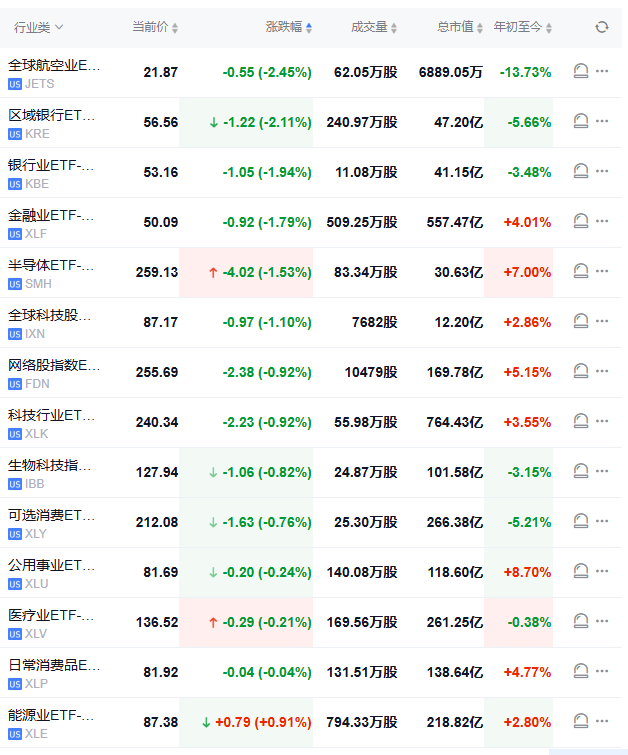
美股盘初,主要行业ETF多数下跌,全球航空业ETF、区域银行业ETF跌超2%,银行业ETF跌近2%。
news flash· 2025-06-13 13:57
Core Viewpoint - Major industry ETFs in the US are mostly down, with global airline and regional banking ETFs dropping over 2%, and banking ETFs nearly down 2% [1] Group 1: Industry Performance - Global airline industry ETF is priced at $21.87, down by $0.55 (-2.45%), with a trading volume of 620,500 shares and a year-to-date decline of 13.73% [2] - Regional banking ETF is priced at $56.56, down by $1.22 (-2.11%), with a trading volume of 2,409,700 shares and a year-to-date decline of 5.66% [2] - Banking ETF is priced at $53.16, down by $1.05 (-1.94%), with a trading volume of 110,800 shares and a year-to-date decline of 3.48% [2] - Financial sector ETF is priced at $50.09, down by $0.92 (-1.79%), with a trading volume of 5,092,500 shares and a year-to-date increase of 4.01% [2] Group 2: Other Sector Performance - Semiconductor ETF is priced at $259.13, down by $4.02 (-1.53%), with a trading volume of 833,400 shares and a year-to-date increase of 7.00% [2] - Global technology stock ETF is priced at $87.17, down by $0.97 (-1.10%), with a trading volume of 7,682 shares and a year-to-date increase of 2.86% [2] - Biotechnology index ETF is priced at $127.94, down by $1.06 (-0.82%), with a trading volume of 248,700 shares and a year-to-date decline of 3.15% [2] - Consumer discretionary ETF is priced at $212.08, down by $1.63 (-0.76%), with a trading volume of 253,000 shares and a year-to-date decline of 5.21% [2] - Energy sector ETF is priced at $87.38, up by $0.79 (+0.91%), with a trading volume of 7,943,300 shares and a year-to-date increase of 2.80% [2]
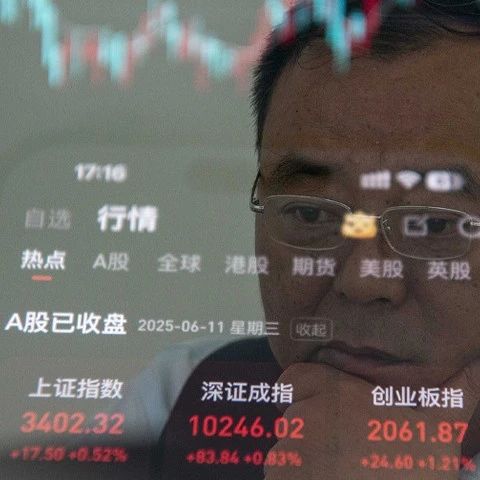
深化资本市场互联互通 打通粤港澳大湾区企业“H+A”上市通道
Zheng Quan Ri Bao· 2025-06-11 17:28
Group 1 - The issuance of the "Opinions" allows companies in the Guangdong-Hong Kong-Macao Greater Bay Area listed on the Hong Kong Stock Exchange to also list on the Shenzhen Stock Exchange, marking a deepening of the interconnection mechanism of China's capital markets from the "trading end" to the "issuance end" [1][2] - This reform is expected to facilitate domestic financing for red-chip companies and the return of Chinese concept stocks, accumulating "Bay Area experience" for institutional innovation [1][2] - The policy aims to address the challenges of cross-border capital flow and institutional differences, enhancing regional synergy and promoting the dual listing mechanism to meet corporate financing needs [2][3] Group 2 - As of June 11, there are 2,636 H-share listed companies, with 1,589 of them registered in the Greater Bay Area, accounting for over 60% of the total and a market capitalization of approximately 20.72 trillion yuan, which is 32.23% of the total H-share market [3] - The characteristics of H-share companies in the Greater Bay Area include industry diversification, a concentration of well-known enterprises, and a strong demand for flexible financing environments due to international business needs [3][4] - Listing on the Shenzhen Stock Exchange is expected to enrich the industry matrix and types of companies in the Shenzhen market, optimizing the valuation system and enhancing the attractiveness of the A-share market to domestic and foreign investors [3][4]
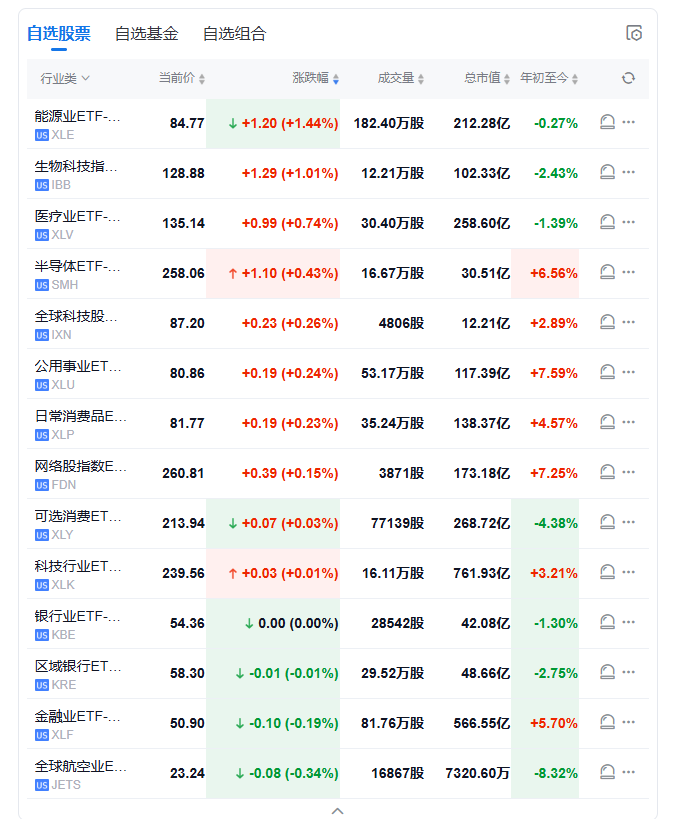
美股盘初,主要行业ETF多数上涨,能源业ETF、生物科技指数ETF涨超1%,医疗业ETF涨近1%。
news flash· 2025-06-10 13:38
Group 1 - Major industry ETFs in the US stock market mostly rose, with Energy ETFs and Biotechnology Index ETFs increasing over 1%, and Healthcare ETFs rising nearly 1% [1] Group 2 - Energy ETF (XLE) current price is $84.77, up by $1.20 (+1.44%), with a trading volume of 1.824 million shares and a total market value of $21.228 billion, showing a year-to-date change of -0.27% [2] - Biotechnology Index ETF (IBB) current price is $128.88, up by $1.29 (+1.01%), with a trading volume of 122,100 shares and a total market value of $10.233 billion, reflecting a year-to-date change of -2.43% [2] - Healthcare ETF (XLV) current price is $135.14, up by $0.99 (+0.74%), with a trading volume of 304,000 shares and a total market value of $25.860 billion, indicating a year-to-date change of -1.39% [2] - Semiconductor ETF (SMH) current price is $258.06, up by $1.10 (+0.43%), with a trading volume of 166,700 shares and a total market value of $3.051 billion, showing a year-to-date change of +6.56% [2] - Global Technology ETF (IXN) current price is $87.20, up by $0.23 (+0.26%), with a trading volume of 4,806 shares and a total market value of $1.221 billion, reflecting a year-to-date change of +2.89% [2] - Utilities ETF (XLU) current price is $80.86, up by $0.19 (+0.24%), with a trading volume of 531,700 shares and a total market value of $11.739 billion, indicating a year-to-date change of +7.59% [2] - Consumer Staples ETF (XLP) current price is $81.77, up by $0.19 (+0.23%), with a trading volume of 352,400 shares and a total market value of $13.837 billion, reflecting a year-to-date change of +4.57% [2] - Internet Index ETF (FDN) current price is $260.81, up by $0.39 (+0.15%), with a trading volume of 3,871 shares and a total market value of $17.318 billion, indicating a year-to-date change of +7.25% [2] - Consumer Discretionary ETF (XLY) current price is $213.94, down by $0.07 (+0.03%), with a trading volume of 77,139 shares and a total market value of $26.872 billion, showing a year-to-date change of -4.38% [2] - Technology Sector ETF (XLK) current price is $239.56, up by $0.03 (+0.01%), with a trading volume of 161,100 shares and a total market value of $76.193 billion, reflecting a year-to-date change of +3.21% [2] - Banking ETF (KBE) current price is $54.36, unchanged (0.00%), with a trading volume of 28,542 shares and a total market value of $4.208 billion, indicating a year-to-date change of -1.30% [2] - Regional Banking ETF (KRE) current price is $58.30, down by $0.01 (-0.01%), with a trading volume of 295,200 shares and a total market value of $4.866 billion, reflecting a year-to-date change of -2.75% [2] - Financials ETF (XLF) current price is $50.90, down by $0.10 (-0.19%), with a trading volume of 817,600 shares and a total market value of $56.655 billion, indicating a year-to-date change of +5.70% [2] - Global Airlines ETF (JETS) current price is $23.24, down by $0.08 (-0.34%), with a trading volume of 16,867 shares and a total market value of $73.206 million, reflecting a year-to-date change of -8.32% [2]
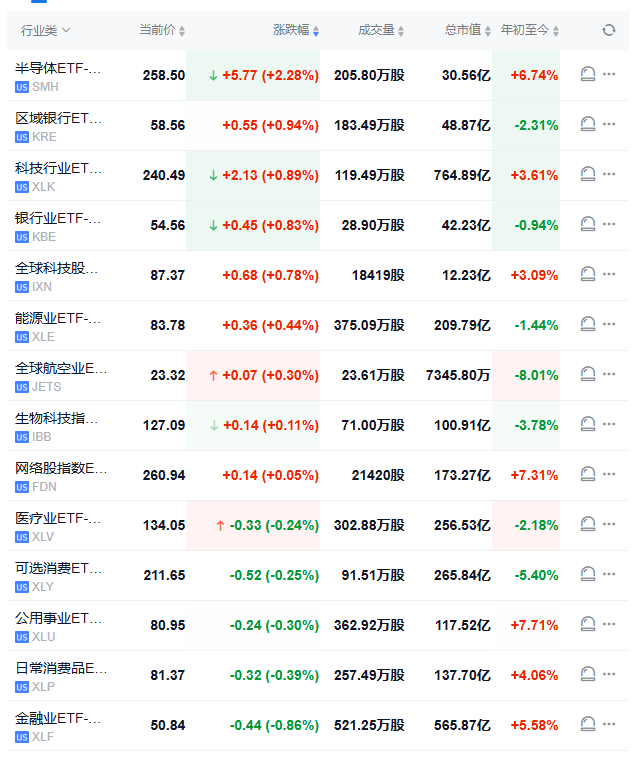
美股盘初,主要行业ETF涨跌不一,半导体ETF涨超2%,区域银行业ETF涨近1%,金融业ETF跌近1%。
news flash· 2025-06-09 14:28
Core Viewpoint - The performance of major industry ETFs in the U.S. stock market is mixed, with semiconductor ETFs showing significant gains while financial sector ETFs are declining [1]. Group 1: Semiconductor Sector - Semiconductor ETF increased by 2.28%, reaching a price of $258.50, with a trading volume of 205.80 million shares and a total market value of $30.56 billion [2]. - Year-to-date performance for the semiconductor ETF is up by 6.74% [2]. Group 2: Regional Banks - Regional bank ETF rose by 0.94%, priced at $58.56, with a trading volume of 183.49 million shares and a total market value of $48.87 billion [2]. - Year-to-date performance for the regional bank ETF is down by 2.31% [2]. Group 3: Financial Sector - Financial sector ETF decreased by 0.86%, priced at $50.84, with a trading volume of 521.25 million shares and a total market value of $565.87 billion [2]. - Year-to-date performance for the financial sector ETF is up by 5.58% [2]. Group 4: Technology Sector - Technology sector ETF increased by 0.89%, priced at $240.49, with a trading volume of 119.49 million shares and a total market value of $764.89 billion [2]. - Year-to-date performance for the technology sector ETF is up by 3.61% [2].
中证苏银理财长三角创新指数下跌0.05%,前十大权重包含沪电股份等
Jin Rong Jie· 2025-06-06 13:10
Core Viewpoint - The China Securities Index for the Yangtze River Delta Innovation Index has shown mixed performance, with a slight decline on the latest trading day, reflecting the overall performance of technology companies in the region [1] Group 1: Index Performance - The China Securities Index for the Yangtze River Delta Innovation Index closed down 0.05% at 1822.5 points, with a trading volume of 31.253 billion yuan [1] - Over the past month, the index has increased by 3.20%, while it has decreased by 5.33% over the past three months and is down 0.93% year-to-date [1] Group 2: Index Composition - The index comprises 100 technology companies from the Yangtze River Delta region, selected based on strong R&D investment, profitability, and growth potential [1] - The top ten holdings in the index include: - Lanke Technology (6.44%) - Hikvision (4.83%) - Guodian NARI (4.75%) - Zhongwei Company (4.45%) - United Imaging (4.23%) - Hushan Electronics (3.63%) - Siyuan Electric (3.47%) - Hengsheng Electronics (3.12%) - Xinhengcheng (2.58%) - Tianfu Communication (2.3%) [1] Group 3: Market Sector Distribution - The market sector distribution of the index holdings is as follows: - Information Technology: 43.30% - Industrial: 28.45% - Healthcare: 16.07% - Communication Services: 6.62% - Consumer Discretionary: 4.08% - Materials: 1.48% [2] Group 4: Sample Adjustment - The sample of the index is adjusted semi-annually, with adjustments occurring on the next trading day after the second Friday of June and December each year [2] - Weight factors are adjusted in accordance with the sample changes, and special circumstances may lead to temporary adjustments [2]

港股新股申购市场概览:“A+H”潮起,港股申购可冀
Shenwan Hongyuan Securities· 2025-06-06 08:12
Group 1: IPO Market Overview - The number of new IPOs in Hong Kong increased by 7 from the previous year, with total fundraising exceeding 710 million HKD in the first five months of 2025[3] - A+H shares accounted for over 70% of the total fundraising in 2025, with 5 A+H IPOs contributing 503 million HKD[45] - The average first-day premium for new listings rose to 10.8% in 2025, compared to 8.6% in 2024, while the first-day break rate decreased to 29%[64] Group 2: Investor Participation and Trends - Public subscription enthusiasm has increased, with 70% of projects triggering a reallocation mechanism in 2025[62] - The average effective subscription multiple for public offerings reached 688 times in 2025, indicating strong demand[62] - The allocation for cornerstone investors has remained above 40% since 2022, while the share for anchor investors has decreased to around 40%[32] Group 3: Valuation and Performance - The average initial valuation for new listings dropped from 27 times in 2024 to 19 times in 2025, marking a significant decline[3] - A+H new shares have generally been issued at a discount compared to their A-share counterparts, although the discount rate has narrowed recently[54] - The average first-day return for A+H shares in 2025 was notably strong, with no instances of breakage among the five listings[66]


中证香港美国上市中美科技指数报5032.17点,前十大权重包含Avago Technologies Ltd等
Jin Rong Jie· 2025-06-05 12:20
Core Points - The China-Hong Kong-US Technology Index has shown a significant increase, with a rise of 4.77% in the last month, 2.89% in the last three months, and 12.01% year-to-date [1] - The index is composed of high liquidity and high market capitalization technology companies listed in Hong Kong and the US, calculated using an equal-weighted method to reflect the overall performance of these companies [1] - The index's top ten holdings include companies such as Innovent Biologics (3.5%), Xiaomi Group-W (3.19%), and BYD Company (3.06%) [1] Market Composition - The index's holdings are distributed across various exchanges, with 41.82% on the Nasdaq Global Select Market, 35.21% on the Hong Kong Stock Exchange, and 21.28% on the New York Stock Exchange [2] - In terms of industry composition, Information Technology accounts for 39.19%, Consumer Discretionary for 20.43%, Healthcare for 15.96%, and Communication Services for 14.29% [2] Index Adjustment Mechanism - The index samples are adjusted semi-annually, with adjustments occurring on the next trading day after the second Friday of June and December [2] - Weight factors are generally fixed until the next scheduled adjustment, with provisions for temporary adjustments in special circumstances [2]
【广发宏观王丹】行业出现哪些边际变化:5月PMI的中观拆解
郭磊宏观茶座· 2025-06-02 10:45
Core Viewpoint - The manufacturing sector showed mild recovery in May, with the manufacturing PMI rising by 0.5 points to 49.5, slightly above the seasonal average. However, this increase is not strong considering the low base from April due to tariff impacts. The absolute value of 49.5 is only better than May 2019 and May 2023 in the past decade [1][7][8]. Manufacturing Sector Analysis - In May, the manufacturing sectors that improved can be categorized into three types: emerging manufacturing (computer communication electronics, electrical machinery), essential consumer agricultural products, and the petrochemical industry chain (petrochemical refining, chemicals, synthetic fibers, and plastics) [2][9]. - The macroeconomic clues behind these improvements include: the cancellation of high tariffs leading to better export orders, the continued effects of domestic "two new" policies, and demand growth from the AI industry. The sectors experiencing significant downturns are mainly in the construction chain and optional consumer goods [2][9]. - The electrical machinery sector is leading in terms of prosperity, with a PMI above 55, benefiting from rapid growth in new energy and new energy vehicles, as well as policy dividends from "two new" initiatives [3][11]. Emerging Industries - Emerging industries such as new generation information technology, new materials, high-end equipment, and energy-saving and environmental protection sectors showed improved prosperity in May. This is attributed to the rebound in external demand and domestic policy support [3][12]. - The biological industry remains the weakest, with a significant decline in export orders continuing from April [3][12]. Construction Sector Insights - The construction industry in May is characterized by "infrastructure improvement and real estate drag." Civil engineering construction saw a continuous improvement for two months, while the real estate chain showed weakness across all stages [4][15]. - The construction activity index decreased by 0.9 points to 51.0 in May, indicating a slowdown in the real estate sector [14][16]. Service Sector Performance - The service sector saw a slight improvement, with the PMI rising by 0.1 points to 50.2. Key drivers include travel-related sectors benefiting from the May Day holiday and a rebound in the water transport industry [6][17]. - The information technology service sector continues to perform well, driven by trends such as "AI+" and online consumption [6][17]. Summary of Key Insights - The "two new" policies are concentrated in sectors benefiting from tariff reductions, such as electrical machinery and computer electronics, which currently show high prosperity [5][6]. - The new generation information technology sector leads in emerging industries, while the service sector's IT services maintain a leading position [5][6]. - External uncertainties continue to impact sectors like textiles, pharmaceuticals, and biotechnology, as indicated by their performance data [5][6]. - The construction sector is experiencing a rise in prosperity due to accelerated issuance of special bonds and project implementations, although upstream material sectors remain under pressure due to real estate slowdowns [5][6].