
黄金珠宝

Search documents
金价一度大跌1000美元!金店被挤爆 有人买入近1斤 有人卖金还房贷 “木头姐”精准“预言”大跌:黄金是泡沫 美元一涨就会破
Mei Ri Jing Ji Xin Wen· 2026-02-02 16:52
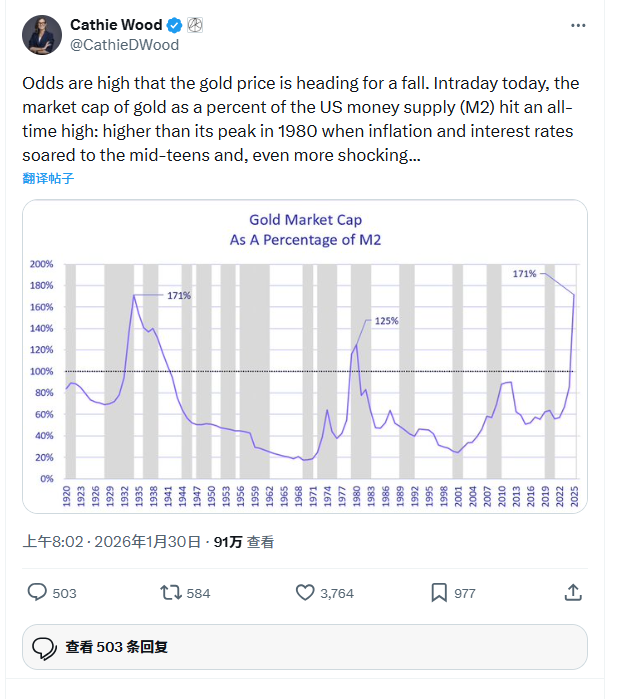
Group 1 - International gold prices experienced a significant drop, with spot gold falling by 10% to $4,402 per ounce, marking a new low since January 8, and a three-day decline exceeding 20% [1] - Spot silver prices also plummeted over 16% to $71.31 per ounce, with a three-day drop reaching 40%, nearly erasing January's gains [1] - The recent decline in precious metals was triggered by the nomination of Kevin Warsh as the next Federal Reserve Chairman, leading to a reassessment of the outlook for the dollar and dollar assets [1][2] Group 2 - Cathie Wood, a prominent fund manager, suggested that gold prices are nearing a peak, indicating a potential bubble, and highlighted the historical correlation between a strong dollar and falling gold prices [2] - Robin Brooks, a senior researcher, warned that the recent gold bubble was primarily driven by retail purchases, similar to previous market bubbles [4] - The surge in gold prices has led to increased consumer activity, with many individuals rushing to sell gold for cash, reflecting a shift in market sentiment [5][6] Group 3 - Major banks, including China Merchants Bank and Postal Savings Bank, have issued risk warnings regarding the volatility in precious metal prices, adjusting margin requirements for gold and silver trading [9][11] - The "Zhaocai Gold" business of China Merchants Bank, which facilitates individual participation in gold trading, has seen adjustments in its operations due to market fluctuations [11] - Analysts predict that gold prices will experience significant volatility in the short term, advising investors to wait for market stabilization before making new investments [13][14]

杰我睿启动兑付!高杠杆下的黄金交易何时收场?
Xin Lang Cai Jing· 2026-02-02 14:18
然而,在这片常年喧嚣的黄金交易市场中,作为商户之一的深圳市杰我睿珠宝有限公司(以下简称"杰 我睿")近日了发生一场浩大的兑付危机,引发市场关注。 "第一财经"报道称,根据投资者自行统计的数据,杰我睿未兑付资金已超过百亿元;另据一份投资者提 供的呈报书,截至1月27日,仅初步实名统计,涉案未结算金额达到2.46亿元。 1月31日,深圳罗湖区工作专班发布情况通报称,在工作专班督促下,杰我睿公司处置资产、筹集资 金,已启动兑付,开通线上签约兑付渠道,并设立线下接洽办理点,同时委托第三方专业机构对公司经 营情况进行审计,并称"初步结果显示,网传金额明显夸大"。 炒股就看金麒麟分析师研报,权威,专业,及时,全面,助您挖掘潜力主题机会! 来源 | 独角金融 作为全国最大的黄金珠宝产业集散地,深圳水贝承载着无数人对"真金白银"的信赖。这里汇聚了全国七 成以上的黄金珠宝交易,工费低廉、品类齐全,既是从业者的淘金沃土,也是普通消费者囤金避险的首 选之地。 天眼查信息显示,杰我睿成立于2014年6月,注册资本1100万元,法定代表人及实际控制人为张志腾, 员工仅有15人。杰我睿主营业务为有色金属及矿石批发,最初是水贝地区的黄金原 ...

悦己消费产业链研究之银发经济:社会结构演进及政策加码支持,银发悦己需求快速扩容
Guoxin Securities· 2026-02-02 13:44
Investment Rating - The report maintains an "Outperform the Market" rating for the industry [2][48]. Core Insights - The silver economy in China is rapidly expanding, with the market size projected to grow from 4.3 trillion yuan in 2019 to 7.1 trillion yuan in 2023, and further to 8.3 trillion yuan in 2024. By 2030, the market is expected to exceed 16.2 trillion yuan, indicating significant growth potential [3][5][42]. - The new generation of elderly consumers, primarily those born in the 1960s and 1970s, exhibit different consumption habits compared to previous generations, focusing more on enjoyment and quality rather than just practicality [19][34]. Summary by Sections Market Size and Growth - The silver economy market size in China reached 4.3 trillion yuan in 2019, growing to 7.1 trillion yuan in 2023, and is expected to reach 8.3 trillion yuan in 2024. By 2030, it is projected to surpass 16.2 trillion yuan, with a compound annual growth rate (CAGR) of approximately 11.5% from 2025 to 2030 [3][5][42]. Consumer Behavior - The new elderly demographic is characterized by higher education levels and disposable income, leading to a shift in consumption from "saving" to "enjoyment." They prioritize health, quality, and emotional experiences in their purchasing decisions [19][25][34]. - Online shopping is becoming increasingly popular among the elderly, with 1.56 billion users aged 60 and above, representing 14.1% of total internet users. This demographic is significantly influenced by peer recommendations and social media [20][24]. Industry Trends - Retailers are adapting to the needs of elderly consumers by creating shopping environments that combine social interaction with purchasing. Companies like Bailian and Chongqing Department Store are developing tailored business models to cater to the preferences of this demographic [3][26][42]. - In the jewelry sector, older consumers remain a key market, with a focus on investment and brand loyalty. Companies like Caibai and Laofengxiang are enhancing their offerings to meet the demands of this consumer group [4][43]. Beauty and Healthcare - The beauty and healthcare market for the elderly is expanding, with a notable increase in the consumption of skincare and medical beauty services. The market for beauty products among consumers aged 50 and above is growing, with significant sales increases reported [34][37]. - The medical beauty sector is also expected to grow, with older consumers increasingly seeking anti-aging treatments and comprehensive care solutions [39][40]. Policy Support - Recent government policies are aimed at promoting the silver economy, emphasizing the importance of addressing the needs of the elderly population and fostering the development of related industries [9][12].
大消费行业周报(1月第4周):《方案》催化服务消费提质扩容
Century Securities· 2026-02-02 10:24
Investment Rating - The report does not explicitly state an investment rating for the industry Core Insights - The service consumption sector is expected to see quality improvements and expansion due to the "Accelerating the Cultivation of New Growth Points for Service Consumption Work Plan" issued by the State Council, which includes twelve specific measures targeting key areas such as transportation, housekeeping, and tourism [3] - The gold and jewelry sector is experiencing significant volatility in gold prices, leading to a mixed development landscape, with high-end consumption scenarios showing promise despite challenges in gold jewelry demand due to rising prices [3] - The report highlights a divergence in performance across the consumer sector, with textiles, social services, and retail showing declines, while food and beverage sectors have seen some gains [3] Market Weekly Review - The consumer sector showed mixed performance in the week of January 26-30, with textiles down by 0.68%, social services down by 3.45%, and food and beverage up by 1.56% [3] - Notable stock performances included Huangtai Liquor (+22.92%) and Samsung New Materials (+23.72%) leading gains, while stocks like Haoxiangni (-20.89%) and Tianyin Electromechanical (-18.66%) faced significant declines [3] Industry News and Key Company Announcements - Shenzhen's market supervision authorities have launched a three-year action plan to optimize the consumption environment, focusing on digital consumption and innovative retail formats [15] - The China Chain Store and Franchise Association reported a moderate recovery in shopping center operations, with increased member consumption but a decline in average transaction values [15] - Anta Sports announced a €1.5 billion acquisition of a stake in Puma, becoming the largest shareholder, which reflects strategic moves in the sportswear market [15] - The World Gold Council reported a record high in gold bar and coin purchases in China for 2025, indicating strong investment demand despite price pressures [15]
北京金店被挤爆,有人现场拿下近1斤金,有人卖金还房贷
21世纪经济报道· 2026-02-02 09:20
记者丨张欣 郭聪聪 编辑丨周炎炎 视频丨柳润瑛 "自上周五以来,来买卖黄金的人突然多了起来,昨天应该是人数最多的一天。" 北京市西城区 菜市口百货(以下简称"菜百") 一位 销售人员向21世纪经济报道透露,近期金 价的大幅波动,吸引了大批市民涌入金店,而人气最旺的当属四楼的投资金条销售区。 作为北京黄金消费的风向标,"菜百"成为本轮黄金热潮的缩影。 2月2日,本报记者实地探访菜百门店,刚踏入大门就被扑面而来的火热氛围包围,各个楼层的 金饰柜台、回购窗口前都挤满了人,咨询声、讨论声交织在一起。 ("菜百"黄金回购处的情景,来源:21世纪经济报道记者张欣拍摄) 一位年逾50的阿姨向21世纪经济报道记者细数手中的黄金饰品,她打算将藏品全部变现, 其 中包括1995年购入的16克左右金项链,彼时买入价仅130元/克 ,还有2018年入手的黄金饰品 及耳环,部分耳环早已送给女儿佩戴。 "近期金价合适,看到北京到处都在排队卖金,我也想趁机变现,给孩子偿还房贷。"阿姨向本 报记者说道。 与此同时,当前国际金价正在上演过山车行情。2月2日下午,国际现货黄金价格一度跌破4450 美元/盎司,创下1月8日以来的新低,较日内高点回 ...


港股异动 | 黄金珠宝股今日走低 国际金价急速下挫 国内首饰金价同步迎来大幅回调
Zhi Tong Cai Jing· 2026-02-02 08:17
(原标题:港股异动 | 黄金珠宝股今日走低 国际金价急速下挫 国内首饰金价同步迎来大幅回调) 智通财经APP获悉,黄金珠宝股今日走低,截至发稿,周生生(00116)跌6.21%,报13.75港元;六福集团 (00590)跌4.92%,报30.56港元;周大福(01929)跌4.58%,报13.74港元;老铺黄金(06181)跌3.86%,报 748港元。 消息面上,2月2日,黄金继续大幅下跌,伦敦现货金距离1月29日高点跌幅一度超过1000美元/盎司。受 国际金价急速下挫传导影响,国内首饰金价同步迎来大幅回调。据央广财经报道,市场监测显示,周生 生的足金饰品价格已调整至1484元/克,与前一交易日的1618元/克相比,每克价格下降了134元。 高盛发布研报称,预期中国珠宝市场今年增长将放缓至4%,相较于去年黄金强劲上升周期推动市场在 低基数下增长约10%。以及行业股价大幅跑赢恒生指数。因此,基于较高基数、需求恢复正常,以及整 体消费力仍不稳定,该行对今年行业持"中性"看法。 ...


港股黄金珠宝股今日走低 周生生跌超6%
Mei Ri Jing Ji Xin Wen· 2026-02-02 08:11
每经AI快讯,港股黄金珠宝股今日(2月2日)走低。截至发稿,周生生(00116.HK)跌6.21%,报13.75港 元;六福集团(00590.HK)跌4.92%,报30.56港元;周大福(01929.HK)跌4.58%,报13.74港元;老铺黄金 (06181.HK)跌3.86%,报748港元。 ...
菜百股份(605599):25年业绩超预期,投资金热度持续高位
NORTHEAST SECURITIES· 2026-02-02 08:07
Investment Rating - The report assigns a "Buy" rating for the company, indicating a strong potential for stock price appreciation in the coming months [10]. Core Insights - The company, Caibai Co., Ltd., is expected to achieve a net profit attributable to shareholders of 1.06-1.23 billion yuan for 2025, representing a year-on-year growth of 47.4%-71.1%, significantly exceeding market expectations [1]. - The core driver of this high growth is the explosive increase in investment gold business, supported by strong consumer demand driven by high gold prices and favorable tax policies for gold transactions [1][2]. - The company has a competitive advantage as a comprehensive member of the Shanghai Gold Exchange, benefiting from tax exemptions on standard gold transactions, which is expected to enhance its market share [1]. Financial Summary - The projected revenue for 2025 is 3.20 billion yuan, reflecting a growth rate of 58.23% compared to the previous year [3]. - The net profit for 2025 is forecasted at 1.16 billion yuan, with a growth rate of 61.17% [3]. - The earnings per share (EPS) is expected to be 1.49 yuan for 2025, with a price-to-earnings (P/E) ratio of 14.44x [3]. Product Structure and Market Position - In addition to the rapidly growing investment gold business, the company’s high-margin jewelry segment is also maintaining growth, with premium brands enhancing overall profitability and brand image [2]. - The company is focusing on the Beijing market, where retail sales in the gold and jewelry sector have shown strong performance despite broader consumer pressures [2]. - The online sales channel has seen significant growth, accounting for over 30% of revenue in the first half of 2025, with an impressive year-on-year increase of 85.77% [2]. Investment Recommendations - The report suggests that the company’s advantages, including being a member of the Shanghai Gold Exchange, a fully direct sales model, and a focus on high-net-worth areas, provide strong profit certainty during the rising gold price cycle [2]. - Future net profit projections for 2025, 2026, and 2027 are 1.16 billion, 1.46 billion, and 1.67 billion yuan, respectively, with corresponding P/E ratios of 14.4, 11.4, and 10.0 [2].
黄金珠宝股今日走低 国际金价急速下挫 国内首饰金价同步迎来大幅回调
Zhi Tong Cai Jing· 2026-02-02 07:56
消息面上,2月2日,黄金继续大幅下跌,伦敦现货金距离1月29日高点跌幅一度超过1000美元/盎司。受 国际金价急速下挫传导影响,国内首饰金价同步迎来大幅回调。据央广财经报道,市场监测显示,周生 生的足金饰品价格已调整至1484元/克,与前一交易日的1618元/克相比,每克价格下降了134元。 黄金珠宝股今日走低,截至发稿,周生生(00116)跌6.21%,报13.75港元;六福集团(00590)跌4.92%,报 30.56港元;周大福(01929)跌4.58%,报13.74港元;老铺黄金(06181)跌3.86%,报748港元。 高盛发布研报称,预期中国珠宝市场今年增长将放缓至4%,相较于去年黄金强劲上升周期推动市场在 低基数下增长约10%。以及行业股价大幅跑赢恒生指数。因此,基于较高基数、需求恢复正常,以及整 体消费力仍不稳定,该行对今年行业持"中性"看法。 ...
四大证券报头版头条内容精华摘要_2026年2月2日_财经新闻
Xin Lang Cai Jing· 2026-02-02 00:37
Group 1 - Multiple LOFs experienced a collective trading halt for one hour, indicating a surge in arbitrage interest among investors [1] - Fenglong Co. announced the resumption of its stock trading after a halt due to abnormal fluctuations, with a remarkable 456.34% increase in stock price over a period of 18 consecutive trading days [2][19] - Several actively managed equity funds saw their scale increase from less than 100 million to over 1.5 billion within a quarter, capitalizing on investment opportunities in hot sectors like energy storage and resources [3][20] Group 2 - In January, equity ETFs faced a net outflow of nearly 800 billion, with 12 broad-based ETFs experiencing outflows exceeding 11 billion each, totaling 939.74 billion [6][23] - Nearly 80% of investors are optimistic about the market in 2026, with significant profits reported in 2025, particularly from sectors like artificial intelligence [7][24] - The domestic market for duty-free shopping in Hainan has shown strong growth, with cumulative shopping amounts reaching 10.05 billion, a year-on-year increase of 25.32% since the new policy implementation [14][30][31] Group 3 - The 3D printing industry is witnessing a resurgence, with a 52.5% year-on-year increase in equipment production in 2025, driven by advancements in technology and market demand [16][33] - The penetration rate of new energy heavy trucks in China surpassed 50% for the first time, with sales reaching 231,100 units in 2025, marking a 182% increase year-on-year [17][34]