
券商

Search documents
ETF盘中资讯|大金融反攻,券商、银行携手发力,顶流券商ETF(512000)摸高2%,银行ETF(512800)吸金超4亿,人气回归?
Sou Hu Cai Jing· 2026-01-26 06:14
Group 1 - The market showed mixed performance on January 26, with major indices fluctuating, while blue-chip stocks rebounded, particularly in the brokerage and banking sectors [1] - Notable stock movements included a surge in Citic Securities, which approached a daily limit, and significant gains in Ningbo Bank, Industrial Securities, and Hangzhou Bank, all exceeding 3% [1] - The top-performing ETFs included the leading brokerage ETF (512000), which saw a price increase of 2% at one point, and the largest banking ETF (512800), which rose over 1%, with a total inflow of 414 million yuan over the past four days [1] Group 2 - The brokerage sector experienced substantial growth in performance due to increased trading volume, with Guotai Junan Securities noting a 3.08 percentage point under-allocation in the non-bank sector [4] - Long-term capital inflows are expected to accelerate, particularly from retail investors, creating investment opportunities in wealth management-focused brokerages [4] - Citic Securities recommended increasing allocations to non-bank financials, suggesting that investors have ample time to adjust their positions without chasing prices during periods of ETF redemptions [4] Group 3 - The first batch of listed banks reported stable recovery in their performance, driven by favorable policies, low interest rates, and significant dividend distributions [4] - The banking sector continues to exhibit dividend characteristics, with long-term capital, particularly from insurance funds, increasing their holdings, thereby enhancing pricing efficiency and valuation reconstruction [4] - The banking ETF (512800) is highlighted as an efficient investment tool, tracking the performance of 42 listed banks, with a fund size exceeding 11.3 billion yuan and an average daily trading volume of over 800 million yuan [5]

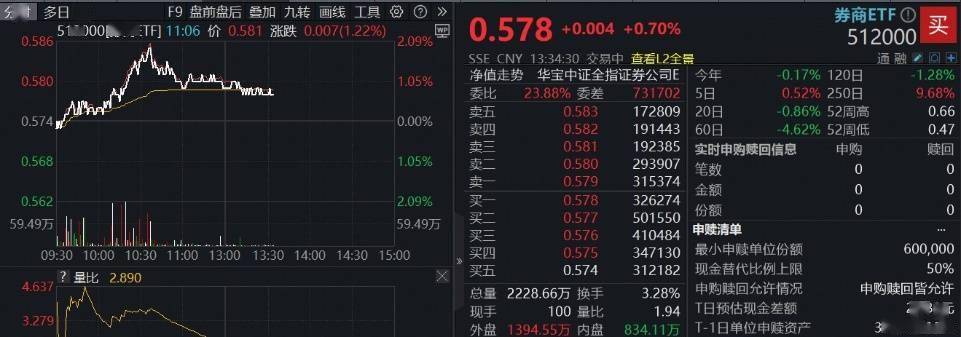
大金融反攻,券商、银行携手发力,顶流券商ETF(512000)摸高2%,银行ETF(512800)吸金超4亿,人气回归?
Xin Lang Cai Jing· 2026-01-26 05:59
Market Overview - The market experienced fluctuations on January 26, with major indices showing mixed results, while large-cap stocks rebounded, particularly in the brokerage and banking sectors [1][7] - Notable stock performances included a surge in Citic Securities, which approached a limit-up, and increases in Ningbo Bank (over 5%), and several other banks and brokerages [1][7] ETF Performance - The top-performing brokerage ETF (512000) reached a peak price increase of 2% during trading, currently up by 0.7%, with a total fund size exceeding 39 billion [1][10] - The largest banking ETF (512800) also saw a price increase of over 1%, currently up by 0.91%, and has attracted a total of 414 million in inflows over the past four days [1][10] Brokerage Sector Insights - The brokerage sector is witnessing significant performance growth due to increased trading volumes, with non-bank financials still underrepresented by 3.08 percentage points [3][9] - Long-term capital inflows are expected to accelerate, particularly from retail investors, creating investment opportunities in wealth management-focused brokerages [3][9] Banking Sector Insights - The first batch of listed banks reported stable recovery in performance, driven by favorable policies, low interest rates, and substantial dividend distributions [3][10] - Long-term capital, particularly from insurance funds, continues to increase holdings in banks, enhancing pricing efficiency and valuation reconstruction [3][10] Investment Tools - The brokerage ETF (512000) serves as an efficient investment tool, tracking the CSI All-Share Securities Companies Index, encompassing 49 listed brokerage stocks [3][10] - The banking ETF (512800) is designed to track the overall performance of the banking sector, including 42 listed banks, and is noted for its large scale and liquidity among A-share banking ETFs [4][10]
午评:沪指震荡微涨 保险、石油等板块拉升 黄金概念活跃
Zheng Quan Shi Bao Wang· 2026-01-26 04:53
Market Overview - The A-share market experienced a narrow fluctuation with over 3,700 stocks in the red, while the Shanghai Composite Index slightly increased by 0.12% and the Shenzhen Component Index and ChiNext Index fell by 0.74% and 0.86% respectively [1] - The total trading volume in the Shanghai and Shenzhen markets reached approximately 2.26 trillion yuan [1] Sector Performance - Sectors such as semiconductors, retail, liquor, and real estate saw declines, while insurance, oil, non-ferrous metals, coal, and brokerage sectors showed gains [1] - Gold and biopharmaceutical concepts were active in the market [1] Short-term Market Outlook - According to Zhongyin Securities, the market is currently in a high-level fluctuation phase with increasing structural differentiation, driven by expectations for domestic demand expansion policies and supply-side policies to curb industry "involution" [1] - There is a caution regarding the impact of short-term regulatory easing on the marginal increase of ETF and leveraged funds on the market [1] - The market may enter a phase of oscillation and speculation before the holiday, with a focus on performance-driven stocks [1] Industry Insights - The non-ferrous metals industry is expected to benefit from dual drivers of industrial trends and financial attributes by 2026 [1] - The anticipated interest rate cuts by the Federal Reserve and risk aversion are expected to enhance the industry's valuation [1] - In the context of Sino-US competition, strategic metals such as rare earths, tungsten, and antimony may see a revaluation of their strategic value [1] - In the short term, the upward slope of the industry may slow down, with a focus on industrial metals and precious metals that have performance support [1]
午评:沪指震荡微涨,保险、石油等板块拉升,黄金概念活跃
Sou Hu Cai Jing· 2026-01-26 04:12
Market Overview - The A-share market experienced a narrow fluctuation with over 3,700 stocks in the red, while the Shanghai Composite Index slightly increased by 0.12% and the Shenzhen Component Index and ChiNext Index decreased by 0.74% and 0.86% respectively [1] - The total trading volume in the Shanghai and Shenzhen markets reached approximately 2.26 trillion yuan [1] Sector Performance - Sectors such as semiconductors, retail, liquor, and real estate saw declines, while insurance, oil, non-ferrous metals, coal, and brokerage sectors showed gains [1] - Gold and biopharmaceutical concepts were notably active in the market [1] Short-term Market Outlook - According to Zhongyin Securities, the market is currently in a high-level fluctuation phase with increasing structural differentiation, driven by expectations for domestic demand expansion policies and supply-side policies aimed at curbing industry "involution" [1] - There is an anticipation of a phase of oscillation and speculation in the market before the holiday, with a focus on performance-driven stocks [1] Industry Insights - The non-ferrous metals industry is expected to benefit from dual drivers of industrial trends and financial attributes by 2026, with expectations of a Federal Reserve interest rate cut and risk aversion boosting industry valuations [1] - In the context of Sino-US competition, strategic metals such as rare earths, tungsten, and antimony may see a revaluation of their strategic value [1] - In the short term, the upward slope of the industry may slow down, with a focus on industrial metals and precious metals that have performance support [1]
A股午评 | 三大指数走势分化 大金融板块护盘 热门股集体跳水
智通财经网· 2026-01-26 03:46
Core Viewpoint - The A-share market shows a mixed performance with small-cap stocks underperforming, indicating a shift towards defensive strategies amid rising geopolitical risks and a declining US dollar index [1] Market Performance - As of the midday close, the Shanghai Composite Index rose by 0.12%, while the Shenzhen Component and ChiNext Index fell by 0.74% and 0.86%, respectively [1] - Over 3,800 stocks in the market were in the red, reflecting a significant retreat in speculative trading [1] Sector Highlights Precious Metals - The precious metals sector continues to surge, with stocks like Yuguang Gold Lead and Hunan Gold hitting the daily limit [2] - Spot gold prices have surpassed $5,000 per ounce for the first time, and silver futures have seen a 17% increase [2] Oil and Gas - The oil and gas sector is experiencing strong performance, with China National Offshore Oil Corporation (CNOOC) rising over 6% to reach a historical high [3] - The surge in natural gas prices in the US, driven by winter storms, has contributed to this sector's strength [3] Alcoholic Beverages - The liquor sector is facing declines, with Yanghe Brewery dropping over 8% to its lowest level since November 2017 [4] - Yanghe's profit forecast indicates a potential decline of 62.18% to 68.30% year-on-year for 2025, signaling a challenging environment for the industry [4] Institutional Insights CITIC Securities - CITIC Securities suggests that market confidence is gradually recovering, recommending to increase allocations in non-bank financials and certain domestic demand or high-growth sectors [6] - The focus is on sectors that can recover from low valuations, particularly in the consumer chain leading up to the Two Sessions [6] CITIC Jiantou - CITIC Jiantou emphasizes a dual focus on "technology + resource products," highlighting sectors like AI, semiconductors, and new energy as key areas of growth [5] - The firm notes that the economic environment remains weak but liquidity is ample, favoring investment in sectors with strong performance expectations [5] Dongfang Securities - Dongfang Securities observes that market panic is dissipating, with a structural rally driven by policy catalysts and industry trends [7] - Areas such as commercial aerospace, AI computing, and storage chips are identified as having dual support from policy and industry dynamics, suggesting long-term tracking value [7]

国泰海通:保险券商均获增配,看好居民资金入市下的非银机会
Zhi Tong Cai Jing· 2026-01-26 01:55
Group 1 - The brokerage sector has been upgraded, with public fund holdings (excluding passive index funds) increasing from 0.85% to 1.08%, still under-allocated by 2.30 percentage points [1][2] - The insurance sector's allocation ratio rose significantly from 1.03% to 2.13%, under-allocated by 0.33%, with the insurance index increasing by 23.42% in Q4 [1][3] - The overall non-bank sector holdings have increased but remain under-allocated by 3.08 percentage points, with expectations of improved profitability and low valuations attracting resident funds [1][4] Group 2 - The increase in the brokerage sector's allocation is driven by a 0.97% rise in the Wind All A Index and a high trading volume of 2.45 trillion yuan in Q4, despite a 3% quarter-on-quarter decline [2] - Individual stocks such as CITIC Securities and Huatai Securities saw their market value ratios increase, indicating a shift towards equity asset allocation by residents [2] - The insurance sector is expected to benefit from continued capital inflows and a focus on undervalued assets, with specific recommendations for China Life, Ping An, and China Pacific Insurance [3] Group 3 - The multi-financial and fintech sectors saw a decrease in public fund holdings from 0.204% to 0.145%, with specific stocks like Lakala and Yuexiu Financial Holdings receiving increased allocations [3] - The investment outlook includes opportunities in financial technology and brokerage due to increased resident capital inflows, valuation recovery in the insurance sector, and expansion of digital RMB scenarios [4] - The company remains optimistic about the growth of third-party payment companies and the broadening exit channels for equity investment institutions due to an increase in IPOs [4]

华泰证券“换帅”:55岁王会清当选董事长,周易续任CEO;今年以来新成立基金达76只,合计募集资金规模超700亿元 | 券商基金早参
Mei Ri Jing Ji Xin Wen· 2026-01-26 01:39
Group 1 - Huatai Securities has elected Wang Huaiqing as the new chairman and Zhou Yi continues as CEO, marking a smooth transition in the core management team [1] - Wang Huaiqing, aged 55, has extensive experience in finance and state-owned asset management, which is expected to enhance the company's strategic layout and governance structure [1] - The leadership changes are anticipated to boost investor confidence and solidify Huatai's leading position among top brokerages, contributing positively to market sentiment [1] Group 2 - Huatai Securities Asset Management has completed its executive adjustments, appointing Jiang Xiaoyang as chairman and Zhu Qian as general manager, both of whom are seasoned professionals within the company [2] - The new leadership is expected to ensure strategic continuity and team stability, positively impacting the development of Huatai's asset management business [2] - The smooth transition in management is likely to enhance operational efficiency in the securities sector, driving high-quality industry development [2] Group 3 - Since the beginning of 2026, 76 new funds have been established, raising a total of 71.939 billion yuan, with an average fund size of 9.47 billion yuan [3] - The market has seen a significant increase in fund issuance, with 12 blockbuster funds raising a total of 39.033 billion yuan, accounting for 54.3% of the total fundraising [3] - The strong performance of newly established funds indicates increased investor confidence in the equity market, which may lead to enhanced activity and positive support for overall market sentiment [3]

A股分析师前瞻:“慢牛”趋势有望延续,业绩与题材共舞
Xuan Gu Bao· 2026-01-25 13:17
Group 1 - The overall sentiment among sell-side strategies remains optimistic for the upcoming market, with a consensus on the interplay between performance and themes [1] - The market structure has shown changes, with increased inflows into real estate chains, resource products, and price increase chains, indicating a rise in medium to low-risk preference for incremental capital [1] - Key focus areas for the spring market include commercial aerospace and AI applications, as well as price increase chains with significant profit elasticity expectations [1] Group 2 - From a medium to long-term perspective, the current market is still in the mid-stage of a "slow bull" trend, with ample room for growth compared to previous bull markets [2] - The Shanghai Composite Index currently has a risk premium of 5.27%, which is higher than the 2.5% level seen in previous bull markets, indicating potential for further market expansion [2] - The total market capitalization of A-shares relative to M2 and the free float market capitalization to household deposits are at historical midpoints, suggesting sufficient opportunities in the market [2] Group 3 - The liquidity environment is expected to remain favorable before the Spring Festival, with a potential for the market to continue to strengthen [2] - The focus for strategies may shift towards sectors with positive first-quarter earnings expectations, particularly in the overseas computing power industry chain [1][2] - High elasticity sectors continue to attract incremental capital, supported by a stable RMB exchange rate and a relatively loose overall liquidity environment [1][2] Group 4 - The market is expected to gradually shift towards performance recovery, with a focus on sectors that show high growth potential and sustainability [4] - Key sectors to watch include batteries, certain chemicals, and industries benefiting from price increase logic, such as non-ferrous metals and storage chips [4] - If the main sectors show weak performance growth, sectors with recovery potential may outperform in the short term [4]
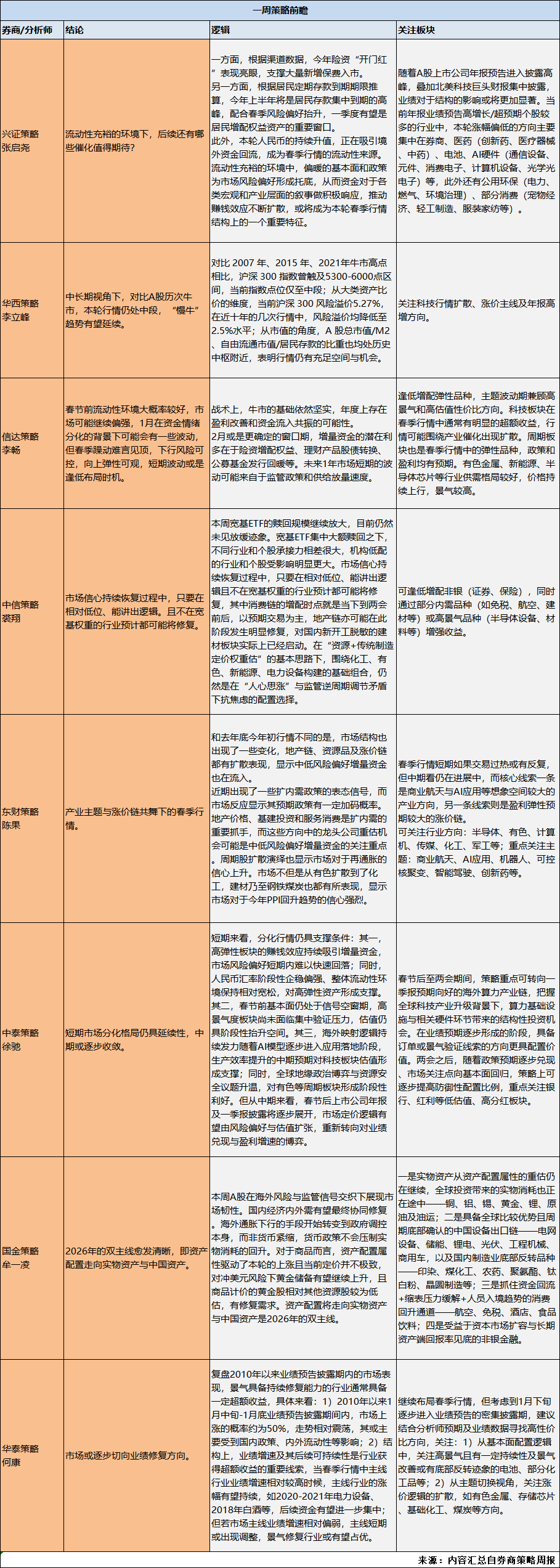
兴业证券:后续还有哪些催化值得期待?
智通财经网· 2026-01-25 11:55
Core Viewpoint - The report from Industrial Securities emphasizes that the recent cooling in the market affects the rhythm and structure rather than the overall trend, with the core logic supporting the upward spring market remaining unchanged. The current spring market is still in progress, and although the market rhythm has slowed, the upward trend continues, with the profit effect expanding to a broader range [1]. Group 1: Liquidity and Catalysts - A liquidity-rich environment is the core driving force supporting the upward trend of the spring market, stemming from the strong performance of insurance funds and the influx of foreign capital due to the appreciation of the RMB [1][2]. - Insurance funds have shown impressive performance in the "opening red" period, with individual insurance premium growth rates exceeding 30% for leading companies, and some companies' individual insurance premiums surpassing 10 billion [1]. - The first half of this year is expected to see a peak in the maturity of residents' fixed deposits, creating an important window for residents to increase their allocation to equity assets [2]. - The continuous appreciation of the RMB is attracting foreign capital back to the market, with a record high of $99.9 billion in bank foreign exchange settlement surplus in December 2025, including a $11.5 billion surplus in securities investment [2]. Group 2: Market Structure and Performance - The current market is characterized by a warm macro environment and supportive policies, which are enhancing market risk appetite and driving the profit effect to expand across various sectors [3]. - The upcoming week will feature a concentrated window for industry catalysts, particularly with the earnings reports from North American tech giants, which may influence the domestic market [4]. - The earnings preview period is approaching its peak, with a disclosure rate expected to reach around 55%, which will significantly impact market structure [4][7]. Group 3: Earnings Forecasts and Sector Focus - As of January 23, 2025, 889 A-share listed companies have released earnings forecasts, with 304 companies expecting net profit growth exceeding 50%, primarily in sectors such as computing, chemicals, new energy, pharmaceuticals, and computer technology [5][6]. - The sectors with high growth or exceeding expectations in earnings forecasts include storage, new energy (battery storage, grid equipment), chemicals, and innovative pharmaceuticals [6][7]. - The report highlights that industries with low price increases during the current market rally include AI hardware, new energy, and various cyclical sectors [8]. Group 4: Future Market Outlook - February is anticipated to be a core window for bullish market activity, with a typical pattern of market volatility driven by liquidity and risk appetite, particularly in small-cap and growth sectors [9]. - The report suggests that themes such as AI applications, commercial space, and energy narratives should be revisited as they may gain renewed attention in February [9].

金融行业周报(2026、01、25):业绩比较基准新规正式落地,坚定保险中长期向好逻辑-20260125
Western Securities· 2026-01-25 10:30
Investment Rating - The report maintains a positive long-term outlook for the insurance sector, indicating a strong continuity in market performance despite recent fluctuations [2][12][16]. Core Insights - The financial sector experienced a mixed performance this week, with the non-bank financial index down by 1.45%, underperforming the CSI 300 index by 0.83 percentage points. The insurance sector saw a decline of 4.02%, while the brokerage sector decreased by 0.61% [1][10]. - The insurance sector's performance is driven by two main factors: policy support leading to economic recovery and liquidity easing combined with a strong stock market. The report suggests a shift from liquidity-driven growth to a focus on macro policy support and economic recovery expectations [2][13][16]. - The brokerage sector is expected to benefit from new regulations that enhance investment management quality, with a recommendation to focus on larger, undervalued firms and those involved in mergers and acquisitions [3][18]. - The banking sector is facing a slight decline, but there are signs of recovery in profitability for leading banks, with recommendations to focus on banks with high dividend yields and those expected to benefit from market conditions [19][21]. Summary by Sections Insurance Sector - The insurance sector's recent decline is attributed to short-term market sentiment and liquidity changes, but the long-term outlook remains positive due to strong support from both the liability and asset sides [2][12][16]. - Key recommendations include focusing on companies like China Pacific Insurance, China Ping An, China Life (H), and China Taiping, with a specific recommendation for New China Life [4][16]. Brokerage Sector - The brokerage sector's performance is slightly better than the overall market, with a focus on the new guidelines from the regulatory body that aim to improve fund management quality [3][17]. - Recommended firms include Guotai Junan, Huatai Securities, and others, particularly those with strong merger and acquisition prospects [4][18]. Banking Sector - The banking sector has shown a decline but is expected to stabilize, with recommendations to focus on banks with high earnings elasticity and strong dividend yields [19][21]. - Specific banks to watch include Hangzhou Bank, Ningbo Bank, and others, with a focus on those that have previously been undervalued [4][21].



