券商

Search documents
中国金融业-2026年展望:逐步回归正循环
2026-01-20 03:19
Summary of the Conference Call on China's Financial Industry Outlook for 2026 Industry Overview - The report focuses on the **Chinese financial industry** and its outlook for 2026, predicting a gradual return to a positive cycle after hitting a low in 2025 [1][8]. Key Points and Arguments 1. **Economic Recovery**: - The Chinese financial industry is expected to enter a positive cycle characterized by a gradual recovery in new loans and financial asset yields, stable credit costs, and active capital markets [1][8]. - Nominal GDP growth is projected to stabilize and improve compared to 2025, providing a favorable environment for financial stocks [1][8]. 2. **Policy Support**: - Policy support is shifting from credit to fiscal measures, which will help reduce long-term credit risks [1][8]. - The reduction in policy intervention regarding loan growth and pricing is anticipated, leading to a more favorable lending environment [1][8]. 3. **Financial Asset Yields**: - Financial asset yields are expected to gradually recover in the second half of 2026, driven by a slowdown in loan supply and a renewed focus on risk pricing [2][10]. - The banking sector's net interest margin is expected to bottom out in the first half of 2026 and rebound later due to delayed deposit repricing [12][13]. 4. **Insurance Sector Growth**: - The insurance sector is expected to benefit from improved investment spreads and strong growth in premium income, with double-digit growth anticipated [2][14]. - Ping An is highlighted as a preferred stock due to its advantages in structural growth and product innovation [2][17]. 5. **Banking Sector Performance**: - Ningbo Bank is noted for its strong revenue and profit growth, while Minsheng Bank shows potential for recovery [2][18]. - Overall, bank profits are expected to recover, supported by stable credit costs and improved fee income from active capital markets [2][14]. 6. **Credit Risk Management**: - The report indicates that credit risks in retail, small and micro enterprises, and industrial loans are being effectively managed, with new risk accumulation slowing significantly [15][16]. - The banking system is expected to continue digesting high-risk financial assets, with non-performing loans projected to decrease [15][16]. 7. **Market Opportunities**: - The report identifies several investment opportunities in the financial sector, particularly in insurance, banking, and brokerage firms [17][19]. - The anticipated recovery in A-share and Hong Kong stock markets, along with increased IPO activity, is expected to benefit brokers and exchanges [19][20]. Other Important Considerations - **Risks**: - A significant decline in loan or financial asset yields could adversely affect credit availability and the financial system's ability to absorb risks [23]. - The report emphasizes the importance of maintaining reasonable loan rates to support market-driven capacity clearing in the industrial sector [23]. - **Catalysts for Growth**: - Key catalysts for the banking sector include stable or slightly lower loan market rates and strong performance in 2025, which could support credit demand [21][22]. - **Investment Recommendations**: - The report provides a list of top investment ideas, including specific banks and insurance companies, highlighting their competitive advantages and growth potential [20]. This summary encapsulates the key insights and projections for the Chinese financial industry as discussed in the conference call, providing a comprehensive overview of expected trends, opportunities, and risks for 2026.
非银行业周报(2026年第二期)中信发布25年业绩快报,看好券商业绩增长
AVIC Securities· 2026-01-20 00:30
Investment Rating - The industry investment rating is "Overweight," indicating that the growth level of the industry is expected to exceed that of the CSI 300 index over the next six months [3][37]. Core Insights - The report highlights that the securities sector experienced a decline of 2.21% during the week, underperforming the CSI 300 index by 1.64 percentage points. The current price-to-book (PB) ratio for the brokerage sector is 1.38 times [1][2]. - CITIC Securities reported a net profit of 30.051 billion yuan for 2025, marking a year-on-year growth of 38.46%, and its operating revenue reached 74.83 billion yuan, up 28.75% year-on-year. This performance is attributed to the overall upward trend in the domestic capital market and increased investor confidence [2][35]. - The report emphasizes that the growth drivers for the industry in 2025 will be diverse, with traditional businesses showing resilience and investment banking benefiting from a recovery in the equity financing market [2][6]. Summary by Sections Securities Weekly Data Tracking - The brokerage sector's performance is closely monitored, with traditional businesses like brokerage and proprietary trading showing high elasticity in growth due to increased market activity [2][9]. Insurance Weekly Data Tracking - The insurance sector saw a decline of 3.59%, underperforming the CSI 300 index by 3.02 percentage points. China Life Insurance reported over 62.24 million claims in 2025, with a total claim amount exceeding 100.4 billion yuan, reflecting a 10% year-on-year increase [7][8]. - The overall insurance industry achieved a premium income of 576.29 billion yuan in November 2025, with a year-on-year growth of 7.56% [25][8]. Industry Dynamics - The report notes that regulatory encouragement for industry consolidation is present, with mergers and acquisitions seen as effective means for brokerages to achieve external growth. This consolidation is expected to enhance industry competitiveness and resource allocation [3][6][30].






慢牛背景下,券商板块行情会缺席吗?
Mei Ri Jing Ji Xin Wen· 2026-01-20 00:26
Group 1 - The core viewpoint of the report from CITIC Securities is that the recent short-term adjustment in the securities sector does not indicate the end of the market trend, as the sector is currently supported by strong fundamentals at a low valuation level [1] - The report identifies two potential upward paths for the securities sector under a slow bull market: one is based on the stabilization of trading volume leading to valuation increases, and the other is driven by unexpected financial policy catalysts that could break through valuation ceilings [1] - Both scenarios suggest that the brokerage market will not be absent, and a window for left-side positioning is gradually approaching [1] Group 2 - Huatai Securities indicates that the expectation for the U.S. uranium replenishment cycle is strengthening, which further reinforces the logic of the uranium mining sector from the demand side [2] - The report highlights that due to rigid supply-side bottlenecks, uranium prices are expected to remain in an upward channel [2] - The recommendation continues to favor domestic uranium suppliers in the U.S. and trading partners, as they are likely to benefit first from the tight supply expectations [2] Group 3 - CITIC Securities emphasizes the upcoming release of Tesla's Optimus Gen3 in the first quarter, which is expected to maintain market anticipation for the robotics sector [3] - The report notes that Tesla's supply chain is gradually entering a verification phase, focusing on quality segments to capture certainty and core changes [3]

杨德龙:2026年我国资本市场投资机会明显增多|立方大家谈
Sou Hu Cai Jing· 2026-01-19 12:29
Economic Growth - The overall economy achieved stable growth, with GDP growth projected at 5% for the year, reflecting a recovery and improvement trend [1] - Quarterly GDP growth rates for 2025 are forecasted at 5.4%, 5.2%, 4.8%, and 4.5% respectively [1] - China's trade surplus reached a historic high of over $1.1 trillion, showcasing the competitiveness of Chinese export products [1] Domestic Demand - The main issue in domestic demand is the imbalance of strong supply versus weak demand, with stable prices indicating insufficient demand [1] - Policies to stabilize consumption include promoting trade-in programs and subsidies for certain products, which have positively impacted sales [1] - Retail sales growth remains relatively low, indicating the need for further policies to enhance residents' income and unlock greater consumption potential [1] Income Disparity - Rural residents experienced a real income growth rate of 6%, significantly higher than the 4.2% growth for urban residents, indicating structural improvement [2] - The decline in labor demand in some urban factories has led to a return of laborers to rural areas, contributing to faster income growth in rural regions [2] Investment Opportunities - The new energy sector is witnessing a differentiated market, with some areas showing profit improvements while others face significant losses, emphasizing the need for value investment [3] - The stock market is currently in a phase of adjustment, with expectations for stronger performance around the Spring Festival [4] - The technology sector is expected to remain a dominant feature, with emerging industries such as robotics, semiconductor chips, and biomedicine identified as beneficiaries of economic transformation [3][4]
科技企业需求瞩目,深圳甲级写字楼净吸纳量创四年新高
Nan Fang Du Shi Bao· 2026-01-19 11:38
Group 1: Market Overview - The Shenzhen Grade A office market is expected to see a significant supply of 1.182 million square meters in 2025, marking the first time in three years that supply reaches the million-level [1] - The total stock of Grade A office space in Shenzhen is projected to expand by 9.4% year-on-year, reaching 12.843 million square meters by the end of 2025 [1] - The net absorption for Grade A offices in Shenzhen is forecasted to reach 664,000 square meters in 2025, the highest since 2021, and 16.9% above the five-year average [1] Group 2: Demand Drivers - The demand from technology companies for upgrades and expansions is particularly notable, contributing to significant transactions and driving net absorption growth [1] - Financial institutions, e-commerce, retail, and logistics sectors are also actively engaging in leasing activities, further supporting market demand [1] - The upcoming APEC meeting in 2026 is expected to boost demand from technology and high-end manufacturing sectors, enhancing market expectations [2] Group 3: Rental Market Trends - The rental market is experiencing downward pressure, with the rental index for Grade A offices in Shenzhen declining by 1.9% quarter-on-quarter and 10.6% year-on-year, averaging RMB 132.6 per square meter per month [2] - Landlords are offering rental discounts to secure tenants due to stricter budget controls from companies [2] Group 4: Future Outlook - The supply of Grade A office space in Shenzhen is anticipated to remain substantial in 2026, potentially exceeding one million square meters again, with total stock expected to approach 14 million square meters, reflecting an 8.0% year-on-year increase [2] - The APEC meeting is expected to enhance Shenzhen's international profile and provide opportunities for higher levels of openness, directly benefiting the development of technology and high-tech manufacturing enterprises [2]
AI应用,继续调整
中国基金报· 2026-01-19 11:06
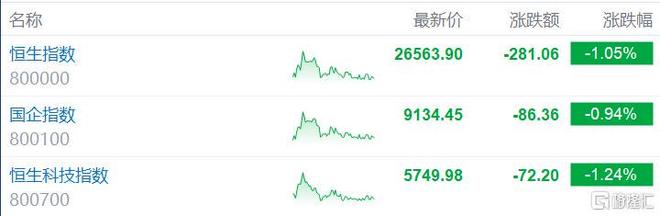
Market Overview - The Hong Kong stock market experienced a decline, primarily driven by weak performances in the financial and technology sectors. The Hang Seng Index fell by 1.05% to close at 26,563.90 points, while the Hang Seng Technology Index dropped by 1.24% to 5,749.98 points, and the Hang Seng China Enterprises Index decreased by 0.94% to 9,134.45 points [4][5]. Sector Performance - Major technology stocks showed collective weakness, with Alibaba down by 3.49% and a trading volume of approximately HKD 11.7 billion. Other notable declines included Meituan, JD.com, and Tencent, each falling over 1% [7][8]. - AI application stocks continued their downward trend, with companies like YaoShibang, Ping An Good Doctor, and Alibaba Health experiencing declines of 5.44%, 4.41%, and 3.53% respectively. MINIMAX-WP, Huizhong Technology, and Zhipu saw drops exceeding 10% [10][12]. Biotech Sector - The Hang Seng Biotech Index fell by 3.06%, with key constituents such as Kelun-Biotech, InnoCare Pharma, and BeiGene also closing lower. Despite this, the CRO industry is reportedly improving, with a positive outlook for 2026 due to increased demand for innovative drugs and a recovering financing environment [14][15]. Safe-Haven Assets - The gold sector showed resilience, with international gold prices reaching historical highs, pushing up the prices of Hong Kong-listed gold companies like Datang Gold and Mengjin Garden, which rose by 8.77% and 5.38% respectively [17][18]. Company News - New World Department Store China saw a significant stock price increase of 29.51%, closing at HKD 0.395 per share. This surge followed recent announcements of management changes within the company [20][21].


又有私募自购!
中国基金报· 2026-01-19 09:27
Core Viewpoint - Multiple private equity firms in China have initiated self-purchase actions, indicating confidence in the market and their own products [2][4][6]. Group 1: Self-Purchase Actions - Jiu Yang Run Quan Capital announced that its chairman and fund manager, Hu Jun Cheng, personally subscribed to new fund shares worth RMB 10 million [2][5]. - Yuan Fang Fund declared a self-purchase of no less than RMB 4 million for its Yuan Fang Han Ze Growth No. 1 private equity fund [2][5]. - Self-purchase actions by private equity firms are seen as a way to align the interests of managers and investors, alleviating investor concerns and enhancing product competitiveness [6]. Group 2: Market Confidence - The A-share confidence index for hedge fund managers recorded 124.94 in January 2026, a slight increase of 0.48% from December 2025, indicating improved confidence in the market [8]. - The average position of subjective long-bull strategy private equity funds was 78% as of December 2025, with 93.8% of funds maintaining positions above 50%, reflecting stable market engagement [8]. - Analysts expect a continuation of the spring market rally due to increased market activity and improved liquidity [8]. Group 3: Investment Focus - Resource and technology sectors are highlighted as key investment areas for many private equity firms, with a focus on scarce resources and high-quality companies expanding globally [10]. - Investment strategies include maintaining high positions in cyclical industries, benefiting from AI advancements, and focusing on monopolistic industries with high dividend rates [10].

港股收评:恒指跌超1%,科技、金融股齐受挫,航空板块逆势活跃
Ge Long Hui· 2026-01-19 08:59
Market Overview - The Hong Kong stock market indices showed weakness on January 19, with the Hang Seng Index down by 1.05%, the Hang Seng China Enterprises Index down by 0.94%, and the Hang Seng Tech Index down by 1.24, influenced by tariffs and geopolitical risks [1] Technology Sector - Major technology stocks, which serve as market indicators, performed poorly, with Alibaba down by 3.49%, and other notable declines including Meituan, JD.com, and Tencent, each falling over 1% [3][5] - AI application concept stocks continued to decline, particularly in the AI healthcare sector, with significant drops in stocks like Baidu and iFlytek [6][7] Healthcare Sector - AI healthcare concept stocks saw substantial declines, with Baidu down over 8%, and iFlytek and other related stocks also experiencing drops exceeding 5% [7] - Biopharmaceutical stocks collectively fell, with notable declines in stocks like Kelun-B and WuXi Biologics, each dropping over 4% [8] Education Sector - Education stocks faced declines, with Dadi Education down over 9% and several others like Australia Chengfeng Higher Education and Excellence Education Group dropping over 3% [9] Copper and Mining Sector - Copper stocks experienced a pullback, with Jin Xun Resources down by 6.81% and Jiangxi Copper falling over 3% [11] Financial Sector - Chinese brokerage and insurance stocks showed weak performance, with Shenwan Hongyuan down over 3% and several others like China Galaxy and China Pacific Insurance also declining [12] Consumer Sector - The aviation industry showed a strong recovery trend, with China Eastern Airlines rising over 9%, supported by positive forecasts for passenger transport during the upcoming Spring Festival [16][17] Energy Sector - Electric power equipment stocks rose, with Dongfang Electric up over 6% and Harbin Electric up over 5%, driven by significant investment plans from the State Grid Corporation [18] - Oil stocks also saw gains, with China Petroleum and Chemical Corporation up over 3% [22] Precious Metals - Gold and precious metals performed actively, with gold prices reaching historical highs due to geopolitical tensions and increased demand for safe-haven assets [21][22] Investment Outlook - Analysts suggest that the technology sector remains a long-term investment focus, with potential for upward movement due to multiple favorable factors including price increases in the supply chain and accelerated AI applications [25]


收评:明天是时间窗,可适当关注券商的态度
Sou Hu Cai Jing· 2026-01-19 08:05
Group 1 - The market showed a low opening and a small upward movement, closing below 4115, indicating a lack of strong bullish sentiment [2] - The index formed a 15-minute bottom divergence after touching the 10-day line, which is unusual as it lacked rebound desire [2] - The market is currently in a short-term bearish phase, with the need to break above 4170 to potentially end this short-term adjustment [2][3] Group 2 - The critical support and resistance levels for the market are identified, with resistance at 4127, 4140, and 4154, and support at 4090, 4083, and 4071 [4] - The long-term trend indicates that maintaining above the 60-day line is necessary to sustain a bull market, while staying above the 250-day line is essential to avoid reverting to a bear market [4]

港股午评:恒指跌0.99%,科指跌1.15%,科技股及大金融股走低,AI应用概念股回调,航空股走高
Jin Rong Jie· 2026-01-19 04:13
Market Overview - The Hong Kong stock market experienced a "V"-shaped movement, with the Hang Seng Index down by 0.99% to 26,578 points, the Hang Seng Tech Index down by 1.15% to 5,755.35 points, and the National Enterprises Index down by 0.85% to 9,142.45 points [1] - Major airline stocks saw significant gains, with China Eastern Airlines up over 9% and China Southern Airlines up 6.5% [1] - Large tech stocks generally declined, with Alibaba down 3.31%, Tencent down 1.13%, and JD.com down 1.23% [1] - Biopharmaceutical stocks also fell, with WuXi Biologics down over 5% [1] - Broker stocks decreased, with Shenwan Hongyuan down over 3% [1] Company News - China Shenhua (01088.HK) expects coal sales to be 431 million tons in 2025, a decrease of 6.4% year-on-year [2] - New China Life Insurance (01336.HK) anticipates cumulative original insurance premium income of 195.899 billion yuan in 2025, a 15% increase year-on-year [3] - Yongjia Group (03322.HK) projects a revenue growth rate of approximately 16% for its high-end fashion retail business in Q4 2025 [4] - Ronshine China (03301.HK) expects total contract sales of about 3.777 billion yuan in 2025, a decrease of 50.96% year-on-year [5] - Tianhong International Group (02678.HK) forecasts a net profit increase of about 60% for the 2025 fiscal year due to a recovery in domestic and international market orders [5] - Quzhi Group (00917.HK) anticipates turning a profit in 2025, with net profit between 270 million to 330 million yuan, compared to a loss of 1.663 billion yuan in the previous year [5] - October Rice Field (09676.HK) expects adjusted net profit of approximately 550 million to 590 million yuan in 2025, a year-on-year increase of about 57.6% to 69.1% [5] - China Boton (03318.HK) issued a profit warning, expecting goodwill impairment losses of no less than 750 million yuan for its tobacco flavoring business in 2025 [5] Institutional Insights - Huatai Securities notes that the core factors driving the market rebound in Q1 remain unchanged, including overall loose financial conditions and improved profit expectations [9] - Tianfeng Securities believes that the Hong Kong market has the basis for a rebound but remains cautious due to high overseas interest rates [9] - Guojin Securities expects the valuation advantages of the Hong Kong market to become more pronounced as the domestic economy recovers and overseas monetary policies turn accommodative [10] - Industrial Securities recommends focusing on leading companies in the AI sector and suggests opportunities in dividend assets and new consumption areas [10]