新能源车

Search documents
港股科技ETF(513020)涨超1.3%,近20日净流入超3.4亿元,“蚂蚁阿福”爆款引市场关注
Mei Ri Jing Ji Xin Wen· 2025-12-19 02:31
Group 1 - Ant Group's AI health application "Ant Aifu" saw a significant increase in downloads, reaching the third position on the Apple App Store on December 16, with over 15 million monthly active users and more than 5 million health inquiries answered daily [1] - Dongwu Securities believes that the competition among major companies in model and entry points is far from over, suggesting that vertical agents focused on specific industries or scenarios are more likely to establish business models and industry barriers compared to general agents [1] - Huachuang Securities highlights the positive outlook for low-position asset recovery following the central economic work conference and the Hong Kong Monetary Authority's interest rate cut, alongside advancements in AI technology, such as OpenAI's release of GPT-5.2 and its strategic partnership with Disney [1] Group 2 - The Hong Kong Stock Connect Technology Index has outperformed the Hang Seng Technology Index in sectors like new energy vehicles and innovative pharmaceuticals, with a cumulative return of 256.46% from the end of 2014 to October 2025, significantly exceeding the Hang Seng Technology Index's return of 96.94% [2] - The Hong Kong Stock Connect Technology ETF (513020) tracks the Hong Kong Stock Connect Technology Index (931573), reflecting the diversified characteristics of the technology industry and the overall performance of core technology companies in the Hong Kong market [1][2]
A股高开,优迅股份上市首日涨超360%
Di Yi Cai Jing Zi Xun· 2025-12-19 01:53
新股优迅股份上市首日涨超360%。 2025.12.19 本文字数:555,阅读时长大约1分钟 作者 |一财阿驴 09:30可控核聚变大幅高开,王子新材涨停,常辅股份高开超10%,爱科赛博、哈焊华通、雪人集团等 涨幅靠前。消息面上,特朗普媒体科技集团大涨超40%。据报道,特朗普媒体科技集团同意以全股票交 易方式与核聚变能源企业TAE科技公司合并,交易总价值超60亿美元。 09:25 A股开盘丨三大指数集体高开 沪指高开0.05%,深成指高开0.48%,创业板指高开0.89%。 | 代码 | 名称 | 两日图 | 现价 | 涨跌 | 涨跌幅 | | --- | --- | --- | --- | --- | --- | | 000001 | 上证指数 | wh | 3878.23 | 1.86 | 0.05% | | 15841-2010 11 399001 | 深证成指 | w | 13116.19 | 62.21 | 0.48% | | 399006 | 创业板指 | M | 3134.80 | 27.74 | 0.89% | 盘面上,算力硬件方向反弹,CPO、存储器指数领涨;核聚变、6G、消费电子概念股活 ...


A股高开,优迅股份上市首日涨超360%
第一财经· 2025-12-19 01:46
Core Viewpoint - The article highlights significant market movements, particularly in the context of the stock market opening and specific company performances, indicating a positive trend in certain sectors like nuclear fusion and technology [3][4]. Market Opening - The A-share market opened with all three major indices rising: Shanghai Composite Index up 0.05%, Shenzhen Component Index up 0.48%, and ChiNext Index up 0.89% [4][5]. - The opening prices for the indices were reported as follows: Shanghai Composite Index at 3878.23, Shenzhen Component Index at 13116.19, and ChiNext Index at 3134.80 [5]. Sector Performance - The computing hardware sector showed a rebound, with CPO and storage indices leading the gains. In contrast, coal, precious metals, and shipping industries experienced declines [6]. - Notable stock movements included a significant rise in companies related to nuclear fusion, 6G technology, and consumer electronics [6]. Noteworthy Stock Movements - New stock Youxin Co. debuted with an impressive increase of over 360% on its first trading day [7]. - Trump Media Technology Group saw a surge of over 40% following news of a merger with TAE Technologies, valued at over $6 billion [3]. Hong Kong Market Opening - The Hong Kong market also opened positively, with the Hang Seng Index up 0.53% and the Hang Seng Tech Index up 0.81%. Key tech stocks like NetEase, Alibaba Health, and Kuaishou showed strong performance [8][9].

欧洲刚宣布稀土喜讯,冯德莱恩转身对中国发难,中国早已留好后手,反制已到位
Sou Hu Cai Jing· 2025-12-18 16:44
Group 1 - The EU has become increasingly reliant on China for rare earth materials, with a dependency rate of 98%, which directly impacts key industries such as renewable energy, military, and aerospace [4] - In September 2025, China exported 2,582 tons of rare earth magnets to the EU, marking a 21% month-on-month increase and reaching a recent high [1] - The EU is planning to impose a 50% tariff on Chinese steel and has initiated 20 anti-dumping investigations, indicating a shift towards protectionist measures against Chinese imports [1] Group 2 - The EU's recent sanctions against 12 Chinese companies, accused of helping Russia evade sanctions, have raised concerns among European businesses about the potential disruption of supply chains [1][9] - China's recent export controls on rare earth materials include a compliance review system, which could impact global supply chains and create a "valve" controlled by China [7] - The EU's Critical Raw Materials Act aims to reduce reliance on single third-country suppliers to below 65% by 2030, but challenges remain due to slow progress in domestic rare earth projects [6] Group 3 - European companies are facing production disruptions due to China's tightened rare earth export controls, with some firms experiencing a 40% drop in imports and a 15% increase in production costs [9] - The political tensions between the EU and China are creating a complex environment for businesses, as companies like those in Bavaria are successfully navigating through established "green channels" for importing rare earth materials [10] - The EU's internal contradictions regarding its approach to China are evident, as it seeks to balance geopolitical alignment with the U.S. while also recognizing the necessity of maintaining stable supply chains from China [6]

今日新闻丨比亚迪第1500万辆新能源车下线!本田工厂或暂时停产!岚图和宁德时代签署十年深化合作协议!广汽埃安昊铂将整合!
电动车公社· 2025-12-18 15:54
Group 1 - BYD has rolled out its 15 millionth new energy vehicle, specifically the Tengshi N8L, at its Jinan factory on December 18 [1] - It took BYD 17 years to reach the first 15 million vehicles, but only 13 months to go from 10 million to 15 million, averaging 385,000 units per month, setting a new industry record. In the first 11 months of this year, BYD's global sales reached 4.182 million units [3] - The achievement of 15 million vehicles not only represents BYD but also reflects the transformation of the Chinese automotive industry from technology follower to global leader. This milestone is seen as a new starting point for future growth [6] Group 2 - Honda plans to suspend or reduce vehicle production in Japan and China from late December to early January due to semiconductor shortages, marking a further spread of supply chain crises to core manufacturing bases [8] - The semiconductor shortage affecting Honda is primarily due to increased fluctuations in global supply chains caused by changes in international import and export policies. Previous experiences from North America suggest that delays in delivery for certain models will occur, but the overall impact on Honda will not be significant [10] Group 3 - Lantu Automotive and CATL have signed a ten-year deepening cooperation agreement to promote continuous breakthroughs in battery technology, including the development of advanced battery technologies for new models [12][15] - The establishment of the GAC Aion and Haobo business unit marks the beginning of a reform in GAC Group's independent brand strategy, integrating the high-end Haobo brand with the mass-market Aion brand for more efficient operations [16] - This restructuring is not merely a merger but aims to reduce costs and increase efficiency through channel integration and resource collaboration, with both brands maintaining their distinct market positions [20]




曹远征:超大规模性是理解中国经济发展的一把钥匙
Di Yi Cai Jing· 2025-12-18 12:31
Group 1 - The core idea presented is that China's super-large scale is fundamental to its economic integrated innovation and resilience [1] - The transformation of green development into a dividend rather than a cost is highlighted, with the example of new energy vehicles demonstrating this shift [1] - The specialized production and supply chain of companies like BYD, where 40% of its components are sourced from enterprises in the Greater Bay Area, exemplifies the benefits of detailed division of labor and scale economies [1] Group 2 - The importance of continuous technological advancement, particularly in mainstream industrial technology, is emphasized as a key factor for economic development [2] - China's new focus on green development in mainstream industrial technology is identified as a reason for global market optimism towards the Chinese economy [2]
小鹏汽车重拳打击“盗电”黑灰产:已报案,坚决维护企业与用户权益
Xin Lang Cai Jing· 2025-12-18 06:39
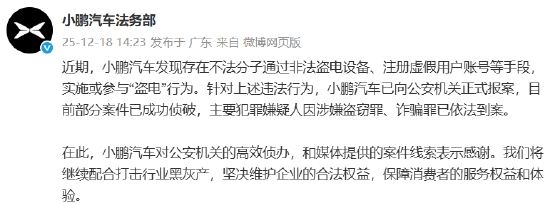
12月18日,小鹏汽车官微发文称,近期,发现存在不法分子通过非法盗电设备、注册虚假用户账号等手 段,实施或参与"盗电"行为。针对上述违法行为,小鹏汽车已向公安机关正式报案,目前部分案件已成 功侦破,主要犯罪嫌疑人因涉嫌盗窃罪、诈骗罪已依法到案。 小鹏汽车表示,将继续配合打击行业黑灰产,坚决维护企业的合法权益,保障消费者的服务权益和体 验。 立案告知书 T 小鹏汽车充电站电被盗刷案一案,我局认为符合刑事案件立案标 准,根据《中华人民共和国刑事诉讼法》第一百一十二条之规定,现 已决定立案侦查,并提供立案告知书。 特此告知。 本告知书已收到。 · 被告知人 采取其他方式告知或者有特殊情况未告知的 、注明情况: , (20) 办案人: - 3 1 1 1 年 月 日 时 y with 一式两份,一份附卷、一份交被告知人。 670小腸汽车油售 破案告知书 广州小鹏智慧充电科技有限公司: 广州小鹏智慧充电科技有限公司被盗窃电费一案,我局认为经过侦 查,现该案嫌疑人已经到案,主要犯罪事实已经固定,案件已侦破。 特此告知。 投诉、举报、监督电话;110 比联交被告知人 笑 件编号:A440112670000202507605 ...
港股科技ETF(513020)近20日净流入超3.7亿元,流动性预期与政策博弈成焦点
Mei Ri Jing Ji Xin Wen· 2025-12-18 03:12
风险提示:提及个股仅用于行业事件分析,不构成任何个股推荐或投资建议。指数等短期涨跌仅供参 考,不代表其未来表现,亦不构成对基金业绩的承诺或保证。观点可能随市场环境变化而调整,不构成 投资建议或承诺。提及基金风险收益特征各不相同,敬请投资者仔细阅读基金法律文件,充分了解产品 要素、风险等级及收益分配原则,选择与自身风险承受能力匹配的产品,谨慎投资。 港股科技ETF(513020)跟踪的是港股通科技指数(931573),覆盖【互联网+创新药+新能源车】等港 股核心资产,集中体现多元化科技产业特征与港股市场核心科技企业的整体表现。 港股通科技指数相比恒生科技指数超配新能源车、创新药等行业,从业绩表现来看,从2014年底基日开 始至2025年10月底,港股通科技指数累计收益256.46%,相对恒生科技指数(96.94%)超额近160%,长 期跑赢恒生科技指数、沪港深互联网指数、恒生互联网科技业指数、恒生医疗保健指数等同类指数。 华创证券指出,中央经济工作会议定调叠加香港金管局跟随美联储降息落地,看好后续低位资产的修复 弹性。AI领域,OpenAI发布GPT-5.2推动模型从问答到交付的价值闭环,迪士尼与OpenAI达 ...
2026年新能源车年度需求展望:规模增长预期温和,结构增量成为核心
Guo Tai Jun An Qi Huo· 2025-12-17 12:25
Report Industry Investment Rating No relevant content provided. Core Viewpoints of the Report - In 2026, the global electric vehicle demand growth rate will tend to be moderate, and the increase in the penetration rate of the structural market will become the core logic. It is estimated that the total global electric vehicle sales will increase by 13% year-on-year to 23.75 million units. China's total sales will increase by 16% year-on-year to 19.12 million units, and domestic demand will increase by 11% to 15.66 million units. In terms of year-on-year increment, China, Western Europe, and emerging Asian regions will contribute 60%, 25%, and 19% respectively, making them the core driving regions, while the American market may have a negative impact [2][81]. - China's electric vehicle market faces the total pressure of the diminishing marginal benefit of the trade-in policy and the increase in purchase tax, and there is a risk of a slowdown in growth. However, the structural market still has bright spots, including the in-depth development of passenger electric vehicles in the sinking market and the electrification of the commercial field. Although the penetration rate of the mid - high - end market has slowed down at around 60%, the penetration rate of the sinking market still has room to catch up, and the penetration rate of the commercial field is expected to increase by 10%. It is estimated that the structural market may have an incremental space of nearly 2.2 million units. However, the sinking market is more cost - sensitive, and the weakening of purchase tax incentives may increase the resistance to the release of sinking consumption power. In addition, the market has a high demand for the continuation of the trade - in policy, but the accumulated over - consumption of replacement demand may reach more than one million units, which may drag down the demand forecast. It is estimated that China's domestic demand is expected to bring an incremental of about 1.6 million units [3][82]. - The incremental overseas market lies in Europe and emerging regions. Europe's new carbon emission cycle is forcing the electrification process forward. Although the cycle target has been temporarily relaxed, the long - term trend remains unchanged. There are both short - term assessment pressure and long - term target driving forces, and many European countries have restarted subsidies to support it. It is estimated that Western Europe is expected to bring an incremental of 600,000 - 700,000 units. At the same time, other emerging Asian regions are still in the subsidy policy cycle, and their electrification progress is catching up with that of mature markets, which is expected to bring an incremental of 400,000 - 500,000 units. On the contrary, the pre - consumption in the US market has been initially realized, and after the policy direction changes, there may be a risk of negative impact [3][82]. Summary According to the Directory 1. 2025 Electric Vehicle Demand Review: China and Europe as the Main Drivers - In the first three quarters of 2025, the global electric vehicle sales increased by 28% year - on - year to 14.63 million units (with an incremental of 3.21 million units year - on - year), and the annual sales in 2025 are expected to increase by 20% year - on - year to more than 20 million units. In terms of market share, China's domestic demand market accounts for 65%, other regions in Asia and Oceania (excluding China) account for 5%, Western Europe accounts for 18%, the Americas account for 10%, Central and Eastern Europe account for 1%, and the Middle East and Africa account for 1% [6]. - In the 3.21 million units of year - on - year incremental, China contributes 64%, other regions in Asia and Oceania (excluding China) contribute 10%, Western Europe contributes 18%, the Americas contribute 5%, Central and Eastern Europe contribute 2%, and the Middle East and Africa contribute 1% [6]. - In terms of penetration rate, the growth rate of China's market penetration rate has slightly slowed down marginally, with the penetration rates from 2022 - 2025 being 26%, 33%, 45%, and 50% respectively; the electrification of other emerging regions in Asia and Oceania has started, and the penetration rate has increased from the historical 4% - 6% to 11% marginally; the European region has been boosted by the new carbon emission cycle, especially in Western Europe, where the penetration rate has increased by 5% to 26% after stagnating at 21% - 22%, and the penetration rate in Central and Eastern Europe has also increased by 3% to 6%; while the growth in the Americas, the Middle East, and Africa is relatively small, with the penetration rate remaining stable and slightly increasing [6]. 2. China: Structural Market Growth, Policy Driving Force Weakening 2.1 Structural Incremental to Make up for the Gap, Electrification Penetration to Increase - The consumption structure of electric vehicles is differentiated, and the penetration rate of the sinking market is expected to catch up. From 2023 - 2025, the penetration rate of the high - end passenger vehicle market (models above 300,000 yuan) has remained stable at a high level, basically running at around 60%, while the sinking market has started in - depth electrification. Automobile enterprises have carried out price cuts, promotions, and new product launches in the domestic market and explored export markets in emerging regions such as Asia, constantly catching up with the penetration rate of high - end electric vehicles. Among them, the penetration rate of the 200,000 - 300,000 yuan market has linearly increased from 38% to 60%, but after reaching 60%, the marginal increase in penetration rate has converged. The penetration rates of the 100,000 - 200,000 yuan and below 180,000 yuan markets have increased from 31% and 28% to 48% respectively. Looking forward, the sinking market will be the core incremental in 2026, and the greatest potential lies in the 100,000 - 200,000 yuan and below 100,000 yuan markets. In the passenger vehicle segment, these two markets account for about 70% in total, and the sales volume is expected to exceed 20 million units in 2025. If it is assumed that the sinking penetration rate is fully made up to 60% in 2026, it is expected to bring an incremental of about 1.7 million units to the domestic demand for electric vehicles [21]. - The electrification of the commercial field has started. Commercial vehicles account for about 13% of automobile demand, mainly including buses and trucks (including tractors), accounting for 15% and 85% of the commercial market respectively. Trucks are further divided into heavy - duty, medium - duty, light - duty, and mini - trucks. If tractors are included in heavy - duty trucks, the four types account for 32%, 5%, 52%, and 11% of the truck market respectively. In 2025, the penetration rate has shown a steep growth trend. The electrification of the commercial field is mainly driven by technological and scenario - based factors. The increase in battery energy density has met the demand for short - and medium - distance urban distribution, and the optimization of cost - effectiveness has made electric vehicles more competitive. Secondly, due to the relatively fixed transportation points compared with passenger vehicles, intelligent technology has solved the customized scenario - based demand, including urban distribution and park transportation. The large - scale replacement of logistics customers is the driving force for the growth of commercial penetration. Therefore, it is expected that the difference in structural penetration rate between the commercial and passenger vehicle fields is expected to be broken. If the penetration rate of commercial vehicles increases by 10% in 2026, it is expected to bring an incremental of about 500,000 units to the demand for electric vehicles [24]. - The average battery capacity per vehicle has started to rise again, and the growth rate of power is expected to exceed that of the terminal. From the perspective of installed capacity to measure the demand for electric vehicles, in the previous transition period from fuel vehicles to electric vehicles, the proportion of PHEV has increased significantly, doubling from less than 20% to more than 40%. The increase in the proportion of low - battery - capacity vehicles and the increase in battery energy density have offset each other's effects, and the average battery capacity per vehicle has basically remained stable from 2021 - 2024. However, in 2025, there has been an important turning point. The growth of the PHEV proportion has stagnated and even declined slightly, which also indicates the transformation of the transition period. In the long term, with the improvement of battery technology, BEV will still be the mainstream direction of electric vehicles. At the same time, since the average battery capacity of BEV/PHEV in commercial vehicles is close to 200/90 KWh, about 3.6/2.8 times that of passenger vehicles respectively, the electrification of the commercial field, combined with the transformation cycle of the technology route, will make the growth rate of electric vehicle demand measured from the perspective of installed capacity more optimistic [31]. 2.2 Policy Driving Force Weakening, Concerns about Demand Remaining - The effectiveness of the trade - in policy has decreased, and attention should be paid to the impact of over - consumption in the long term. In early 2025, the continuation of the trade - in policy filled the vacuum period after the end of the subsidy cycle in 2024, and the policy intensity exceeded market expectations, mainly including three aspects: 1) The subsidy amount remained at the increased level in 2024; 2) The scope of old models eligible for scrap and replacement was expanded; 3) The policy period was longer, covering the whole year. As of the end of October, it can be found that the average daily application volume of subsidies in 2025 reached 34,000, exceeding the average daily application volume in 2024 by 84%. However, marginally, since 54% of the total 300 billion yuan of trade - in funds was allocated in the first half of the year, it provided support for the consumer side. However, the less funds in the second half of the year were mismatched with the seasonality of automobile consumption. In the second half of 2023 and 2024, automobile sales usually accounted for 56% of the annual sales, and for electric vehicles, it even reached 61% - 63%. Therefore, the trade - in policies in various provinces have been decreasing in the second half of the year, and it is expected that the average daily application volume for the whole year will drop to about 31,000 - 32,000, still more than 70% higher than that of last year. Looking forward to 2026, after stimulating the unexpected replacement demand of consumers in 2024 - 2025, it will have a certain over - consumption effect on the long - term demand. In the report "Terminal Demand Logic Switching, Policy Cycle Awaited", the over - consumption effect was evaluated, and it is estimated that the cumulative over - consumption of electric vehicle demand in two years may reach 1.2 - 1.5 million units, which may put pressure on the demand in 2026. Of course, in the stage of economic bottom - building and recovery, the market generally has a high demand for the continuation of the trade - in policy. The continuation of the policy may bring forward the more long - term demand, thereby offsetting the impact on the short - term demand in 2026. Therefore, the continuation intensity of the subsidy policy is still worthy of attention. The Central Economic Work Conference has deployed the economic work for 2026, and the key task mentions "adhering to the domestic demand - led strategy and building a strong domestic market", which involves optimizing the implementation of the "two new" policies, further giving the market expectations for the continuation of the trade - in policy [37]. - The preferential policy for electric vehicle purchase tax has been reduced, and the electrification of the sinking market may not be as expected. According to the purchase tax policy in June 2023, new energy vehicles purchased between 2024 - 2025 are exempt from vehicle purchase tax, but the tax reduction for new energy passenger vehicles should not exceed 30,000 yuan. From 2026 - 2027, new energy vehicles will be subject to a half - reduction in purchase tax, and the tax reduction for each new energy passenger vehicle should not exceed 15,000 yuan. By comparing the previous four policies, the preferential intensity of tax has shown a certain decline, and 2026 may be an important turning point. If this round of preferential policy remains unchanged, the overall demand for electric vehicles in 2026 may face pressure. More importantly, as mentioned above, the core incremental in 2026 lies in the strength of the sinking market, and this part of the market is relatively sensitive to discounts of tens of thousands of yuan. The reduction in the preferential intensity of purchase tax may make the electrification of the sinking market fall short of expectations [41]. 3. Overseas: Different Policy Directions in Europe and the United States, Emerging Regions Catching Up 3.1 Europe's Policy: Both Hard and Soft Measures, Second - Round Electrification Promotion - The European market was under the negative pressure of subsidy withdrawal for three years from 2022 - 2024, and the growth of penetration rate basically stagnated. However, in 2025, the space for subsidy withdrawal narrowed, and the logic switched to a new carbon emission cycle, restarting the electrification cycle. Even in the stage of economic pressure and negative growth of automobile consumption, European electric vehicles still achieved a growth rate of more than 20%, far exceeding market expectations. The growth of the European market does not come from the total volume, but from the policy - driven increase in penetration rate. Among them, Western Europe accounts for more than 90% of the electric vehicle demand in Europe, and the penetration rate increased by 5% to 26% from January to September. The penetration rate in Central and Eastern Europe also increased by 3% to 6% [43]. - The carbon emission target has been marginally relaxed, but the long - term trend remains unchanged. The EU has formulated a series of strict automobile carbon emission regulations in stages, with a five - year cycle. Taking passenger vehicles as an example, the carbon emission target for automobile enterprises from 2020 - 2024 was 115.1 g/km, and the original target starting from 2025 was 93.6 g/km. However, in March 2025, considering the pressure on European automobile enterprises, the European Commission mentioned that the carbon emission assessment pressure in 2025 would be relaxed stage by stage. In May, the European Parliament approved the revised regulation plan for the relaxation of carbon emission requirements, that is, the average carbon emission from 2025 - 2027 only needs to meet the original target. This adjustment is not considered to change the long - term electrification trend, but to ease the short - term pressure on European automobile enterprises. From the deduction of the three - year average target path: due to the phenomenon that some orders were delivered in 2025 after being postponed from 2024, combined with the low base, the growth rate of the European region in 2025 is expected to be more than 26%. On this basis, the consumption of electric vehicles in Europe still needs an annualized growth of 10% from 2026 - 2027 to achieve the target. Therefore, there is still a long - term driving force for electrification [44]. - The short - term target is not the focus, and long - term electrification is the core. In the report "Terminal Demand Logic Switching, Policy Cycle Awaited", the European automobile carbon emission cycle from 2020 - 2024 was reviewed. European automobile enterprises did not just meet the immediate target, but also needed to work hard in advance for the higher target in the next cycle. Although they did not directly meet the target in the first year of the previous cycle, they exceeded the immediate target in the second and third years of the cycle. Facing the long - term target of reducing carbon emissions by half by 2030, European automobile enterprises still need to continue electrification from 2025 - 2029 and may not be short - sighted about the current targets from 2025 - 2027. At the same time, considering the base effect, the growth rate of Europe from 2026 - 2027 is expected to significantly exceed 10%. If the penetration rate reaches 35% in 2026, the growth rate is expected to exceed 18% [45]. - A new round of electrification has started, and Europe has restarted subsidies to support it. Key European countries have introduced subsidy policies: 1) In July, the UK announced a 650 - million - pound electric vehicle subsidy plan, providing a 3,750 - pound subsidy for electric vehicles below 37,000 pounds, and the funds will last until the 2028 - 2029 fiscal year. If it is assumed that the subsidy lasts for 4 years, about 43,000 electric vehicles per year can receive the subsidy; 2) The German government plans to allocate 3 billion euros for electric vehicle subsidies by the end of 2029, mainly targeting low - and middle - income groups. The subsidy will take effect on January 1, 2026. For electric vehicles with a price below 45,000 euros, the subsidy amount can be up to 4,000 euros; 3) In October, Italy launched a new 600 - million - euro subsidy plan, with a maximum subsidy of 11,000
A股,放量上攻!多股尾盘直线涨停!
Xin Lang Cai Jing· 2025-12-17 09:55
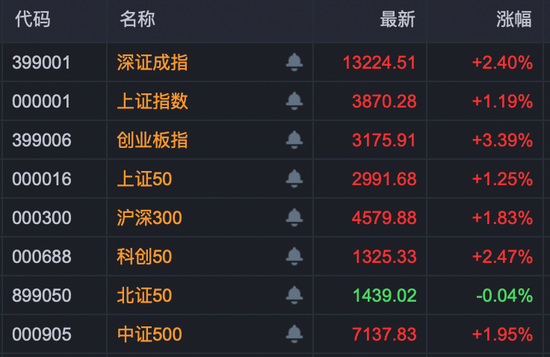
炒股就看金麒麟分析师研报,权威,专业,及时,全面,助您挖掘潜力主题机会! 今日(12月17日)午后,A股放量大幅上攻,创业板指大涨3.39%,创近2个月来最大单日涨幅,深证成 指、科创50也均涨逾2%,上证指数、沪深300、上证50等亦涨超1%,市场成交温和放大至1.83亿元。 万和证券认为,市场将震荡上行,"反内卷"政策有效推动市场竞争持续优化,扩内需、保民生等政策落 地带来供需关系的改善,建议关注消费行业的投资机会。此外,高技术制造业继续位于扩张区间,且明 显高于制造业总体水平,行业支撑作用持续显现,建议关注受益于政策和业绩驱动的集成电路、商业航 天板块。 市场热点方面,大金融午后集体异动拉升成为市场上涨主要动力。券商股在13:30左右开始放量,板块 指数约40分钟就由绿盘转为大涨近3%。华泰证券盘中一度冲击涨停,股价创2015年6月以来10年半新高 (复权,下同),收盘涨幅收窄至6.09%;兴业证券、广发证券等涨幅居前。 同一时段,保险板块指数也放量拉升,一度涨近4%,创历史新高。板块内所有个股上涨,中国太保、 新华保险逼近历史最高点,中国人寿、中国平安创年内新高。 银行板块指数午后也一度涨逾1%,多元 ...