
金融业

Search documents
前三季度浙江GDP同比增长5.7%
Guo Ji Jin Rong Bao· 2025-10-24 06:06
Economic Overview - Zhejiang Province's GDP for the first three quarters reached 68,495 billion yuan, with a year-on-year growth of 5.7% at constant prices [1] - The primary industry added value was 1,735 billion yuan, growing by 3.7%; the secondary industry added value was 26,086 billion yuan, growing by 5.2%; and the tertiary industry added value was 40,674 billion yuan, growing by 6.0% [1] Agricultural Sector - The agricultural, forestry, animal husbandry, and fishery sectors saw a value-added growth of 3.8% [1] - Vegetable production increased by 3.7%, while total meat production (pork, beef, lamb, poultry) decreased by 5.2% to 855,000 tons [1] - Egg production rose by 11.0% to 322,000 tons, and milk production increased by 4.2% to 166,000 tons [1] - Total aquatic product output was 4,258,000 tons, growing by 5.2% [1] Industrial Sector - The industrial added value for large-scale enterprises grew by 7.1%, with private enterprises contributing 76.2% to this growth [2] - Among 37 major industrial categories, 28 saw an increase in added value, with a growth rate of 75.7% [2] - Key manufacturing sectors such as automotive, computer communication electronics, and instruments saw increases of 17.7%, 16.5%, and 13.6% respectively [2] - High-tech manufacturing and digital economy core industries grew by 12.4% and 11.6% respectively [2] Investment Trends - Fixed asset investment decreased by 3.8%, but excluding real estate development, it grew by 7.7% [3] - Manufacturing investment increased by 10.7%, with significant growth in automotive (34.2%) and general equipment (24.9%) [3] - Infrastructure investment rose by 7.9%, accounting for 27.5% of total investment, an increase of 3.0 percentage points year-on-year [3] Consumer Market - Total retail sales of consumer goods reached 28,408 billion yuan, with a year-on-year growth of 5.2% [3] - Retail sales through public networks grew by 23.4%, indicating a strong shift towards online shopping [3] - Significant growth was observed in the sales of home appliances (57.0%) and communication equipment (64.2%) [3] Price Trends - The Consumer Price Index (CPI) decreased by 0.2% year-on-year, with four categories of goods and services experiencing price increases [4] - The Producer Price Index (PPI) for industrial producers fell by 2.0% year-on-year [4] Employment and Income - The urban surveyed unemployment rate averaged 4.7%, with 925,000 new urban jobs created [5] - Per capita disposable income for residents reached 54,653 yuan, a nominal increase of 4.7% [5] - Urban residents' income was 63,079 yuan, while rural residents' income was 36,383 yuan, reflecting a nominal growth of 4.2% and 5.3% respectively [5]
调查:香港绿色金融规模显著扩大 58%恒指成份公司部署AI加快ESG转型
智通财经网· 2025-10-23 06:14
Core Insights - The report by Grant Thornton (Hong Kong) indicates an improvement in ESG reporting among large listed companies in Hong Kong, particularly in climate-related disclosures and green finance, although many companies remain unprepared [1][2][3] ESG Reporting and Compliance - In 2024, 95% of large Hang Seng Index constituent companies disclosed climate-related risks, a 6% increase from 2023 [2] - Only 10% of companies are fully prepared to provide comprehensive disclosures with accurate quantitative data, adhering to recognized frameworks and third-party verification [1][2] - 41% of large companies are inadequately prepared for new ESG disclosure regulations, raising concerns about vague disclosures and insufficient information, especially in risk management and climate goals [1][2] Green Finance Developments - Ten large Hang Seng Index companies reported green financing exceeding HKD 50 billion in 2024, a 20% increase from the previous year, indicating rapid maturation in Hong Kong's sustainable finance sector [3] - 39% of large companies mentioned green finance tools in their ESG reports, a 3% increase year-on-year [3] - 78% of green finance issuance in 2024 exceeded HKD 10 billion, reflecting a growing market momentum and the importance of sustainable capital allocation in high-carbon, capital-intensive industries [4] Technology and Data Management - Over half (58%) of large Hang Seng Index companies reported deploying or planning to deploy AI technology to enhance the accuracy of ESG data collection and reporting [1][5] - 92% of companies emphasized cybersecurity in their ESG reports, a significant 10% increase from 2023 [5] - Only 69% of companies disclosed AI-related training or IT skill enhancement plans, highlighting a significant gap in aligning AI applications with emerging global standards [5][6] Future Outlook and Recommendations - Companies are urged to shift focus from the quantity of ESG reporting to the quality, including investing in robust data systems and independent verification [6] - The upcoming mandatory climate disclosure regulations necessitate that Hong Kong listed companies accelerate their ESG transformation efforts [6]
北京经济前三季度“稳中提质”,三大优势行业引领增长
Xin Jing Bao· 2025-10-22 12:56
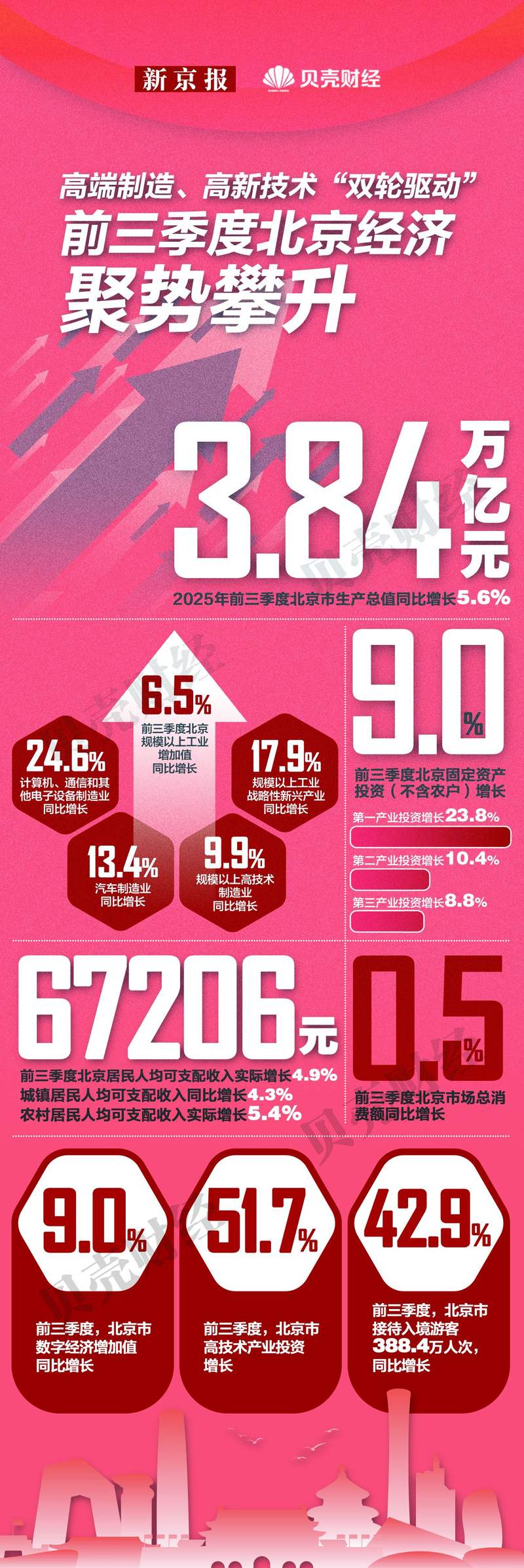
Economic Performance - Beijing's GDP reached 38,415.9 billion yuan in the first three quarters, with a year-on-year growth of 5.6% at constant prices [1] - The information transmission, software and IT services, financial services, and industrial sectors contributed over 80% to the city's economic growth, accounting for 52.5% of the GDP [1] Sector Contributions - The third sector's value added grew by 5.8% year-on-year, with an increase of 0.2 percentage points compared to the first half of the year [1] - The information transmission, software, and IT services sector saw an 11.2% increase in value added, while the financial sector grew by 9.0% [1] - Digital economy value added increased by 9.0%, with core industries growing by 10.7% [1] Industrial Growth - The industrial output value for large-scale enterprises grew by 6.5% year-on-year, with significant growth in computer, communication, and electronic equipment manufacturing (24.6%) and automotive manufacturing (13.4%) [2] - High-tech manufacturing and strategic emerging industries saw value added growth of 9.9% and 17.9%, respectively, with their shares in industrial output increasing [2] Consumer Trends - Service consumption in Beijing grew by 4.8% year-on-year, with significant increases in large events and cultural spending [2] - The number of inbound tourists reached 3.884 million, marking a 42.9% increase year-on-year [2]

重磅会议召开,“十五五”规划怎么看?(上篇)|宏观经济
清华金融评论· 2025-10-22 12:18
Core Viewpoint - The article discusses the transition from the "14th Five-Year Plan" to the "15th Five-Year Plan" in China, emphasizing the need to adapt to significant changes in the external environment and the importance of high-quality development to achieve modernization goals by 2035 [2][24]. Group 1: External Environment Changes - The new round of technological revolution is advancing, with artificial intelligence becoming a core area of competition, leading to increased pressure on China to enhance its independent innovation capabilities [3][27]. - Global supply chains are being restructured, shifting focus from cost and efficiency to security and stability, which presents both opportunities and challenges for China as the largest manufacturing center [3][29]. - The global governance system is undergoing transformation, with emerging multilateral mechanisms playing a significant role in addressing global issues, while traditional mechanisms struggle [3][30]. Group 2: Economic Development Characteristics - Economic growth is converging towards a medium speed, with contributions from labor diminishing due to demographic changes, while quality and efficiency are improving [4][44]. - New industrialization is advancing, with a shift towards digital transformation and intelligent upgrades in traditional industries, leading to the emergence of new manufacturing applications [4][45]. - Urbanization is transitioning from high-speed to medium-speed, focusing on improving the quality of urban life and public services [4][46]. - The green and low-carbon transition is entering a critical phase, with energy consumption growth slowing down and pollution emissions reaching peak levels [4][47]. Group 3: Market Development Strategies - Building a unified national market is essential for unleashing domestic demand potential and promoting high-quality development, requiring the removal of market barriers and the establishment of fair competition [5][10]. - The super-large market size provides significant advantages, including economies of scale, diverse production factors, and enhanced innovation capabilities, which are crucial for maintaining competitiveness [7][8][34]. - The construction of a unified market must address issues such as local protectionism and market segmentation to facilitate smoother resource flow and enhance market advantages [19][21]. Group 4: Challenges in Economic Development - Population decline and aging are accelerating, leading to a decrease in the labor force and impacting consumption demand, which poses a challenge to economic growth [39]. - Technological innovation is not yet aligned with the requirements for high-quality development, with insufficient investment in basic research and a lack of leading talents [40]. - The transition from traditional growth drivers to new ones is challenging, as sectors like real estate face significant adjustments, impacting overall economic performance [41]. - The pressure to shift traditional development methods is increasing, necessitating a focus on consumption-driven growth rather than investment and export-led strategies [42]. Group 5: Future Economic Trends - The "15th Five-Year Plan" period is critical for promoting high-quality development and transforming economic structures, with a focus on enhancing productivity and efficiency [43][49]. - The integration of new technologies and industries will drive economic growth, with strategic emerging industries expected to play a significant role in the future [36][38].

高端制造引领增长 前三季度北京经济运行稳中提质
Bei Jing Shang Bao· 2025-10-22 12:11
Economic Overview - In the first three quarters, Beijing's GDP reached 38,415.9 billion yuan, with a year-on-year growth of 5.6% at constant prices, indicating a stable economic performance [1] - The city's economic growth is characterized by a strong start in Q1 and stable growth in Q2 and Q3, supported by effective economic stabilization policies [1] Investment Trends - Fixed asset investment (excluding rural households) in Beijing grew by 9% year-on-year, with equipment purchase investment increasing by 83.1%, accounting for 29.3% of total fixed asset investment [4] - Infrastructure investment rose by 2.3%, while manufacturing investment increased by 5.4%. However, real estate development investment saw a decline of 13.7% [4] - High-tech industry investment surged by 51.7%, driven by significant growth in sectors such as information transmission, software, and IT services [4][5] Manufacturing Sector - Manufacturing investment grew by 5.4%, contributing 0.5 percentage points to overall investment, with notable increases in automotive manufacturing (45.4%) and general equipment manufacturing (37.9%) [5] - The high-tech manufacturing sector saw a 2.4% increase, making up 81.6% of total manufacturing investment [5] Service Sector Performance - The service sector's value added reached 33,000 billion yuan, growing by 5.8% year-on-year, contributing 5 percentage points to GDP growth [6] - The information transmission, software, and IT services sector achieved a value added of 9,225.5 billion yuan, with a year-on-year growth of 11.2% [6] - High-tech service industry revenue increased by 13.2%, outpacing the average service sector growth of 10.6% [7] High-End Manufacturing Growth - The five major equipment manufacturing industries experienced an 8.2% increase in value added, with the computer and communication equipment manufacturing sector growing by 24.6% [8] - The automotive manufacturing sector's value added increased by 13.4%, with a significant rise in the production of new energy vehicles, which grew by 150% [8] Future Outlook - The city aims to enhance technological innovation and cultivate new productive forces, focusing on six key areas: future information, health, manufacturing, energy, materials, and space [9] - The economic development in Beijing is expected to continue its stable upward trend in the fourth quarter, supported by macroeconomic policies and emerging sectors [10]
爱建集团:为全资子公司爱建进出口公司提供1900万元担保
Mei Ri Jing Ji Xin Wen· 2025-10-22 10:30
Core Viewpoint - Aijian Group has signed loan agreements with Agricultural Bank and Industrial Bank to provide its wholly-owned subsidiary, Aijian Import and Export Company, with a total of RMB 19 million in working capital loans, enhancing its financing capabilities and supporting its business development [1][2]. Group 1: Loan Agreements - Aijian Import and Export Company signed a working capital loan contract with Agricultural Bank for RMB 9 million, with Aijian Group providing a joint liability guarantee [1]. - Aijian Import and Export Company also signed a working capital loan contract with Industrial Bank for RMB 10 million, with Aijian Group providing a joint liability guarantee [1]. Group 2: Financial Position - As of the announcement date, the total external guarantee limit for Aijian Group and its subsidiaries is RMB 9.8 billion, representing 83.23% of the company's latest audited net assets [2]. - The current guarantee balance is approximately RMB 1.868 billion, accounting for 15.86% of the company's latest audited net assets [2]. Group 3: Revenue Composition - For the year 2024, Aijian Group's revenue composition is as follows: financing leasing accounts for 37.71%, financial services for 35.59%, commercial activities for 20.76%, and other businesses for 5.94% [2]. Group 4: Market Capitalization - As of the report, Aijian Group's market capitalization stands at RMB 8.9 billion [3].

前三季度上海地区生产总值同比增长5.5%
Zhong Guo Jing Ji Wang· 2025-10-22 09:07
Core Insights - Shanghai's GDP for the first three quarters reached 40,721.17 billion yuan, with a year-on-year growth of 5.5% at constant prices [1] - The industrial sector showed a growth trend, with the manufacturing sector experiencing rapid growth [1] Economic Performance - The primary industry added value was 64.26 billion yuan, growing by 0.9% [1] - The secondary industry added value was 8,448.67 billion yuan, growing by 3.9% [1] - The tertiary industry added value was 32,208.24 billion yuan, growing by 5.9% [1] Industrial Growth - Industrial added value in Shanghai increased by 5.2% year-on-year [1] - The total industrial output value for large-scale industries grew by 5.7%, with an increase of 0.1 percentage points compared to the first half of the year [1] - Key manufacturing sectors such as railway, shipbuilding, aerospace, and other transportation equipment grew by 15.9% [1] - Electrical machinery and equipment manufacturing grew by 14.3%, while computer, communication, and other electronic equipment manufacturing grew by 12.1% [1] Leading Industries - The three leading manufacturing industries saw an 8.5% increase in output value, outpacing the overall industrial output growth by 2.8 percentage points [1] - The artificial intelligence manufacturing sector grew by 12.8%, integrated circuit manufacturing by 11.3%, and biopharmaceutical manufacturing by 3.6% [1] - Strategic emerging industries in manufacturing saw a total output value growth of 7.3% [1] - The new energy industry grew by 19.6%, next-generation information technology by 10.9%, and high-end equipment by 10.3% [1] Tertiary Sector Performance - The tertiary sector's added value grew by 5.9% year-on-year [2] - The information transmission, software, and IT services sector added value was 5,277.43 billion yuan, growing by 15.5% [2] - The financial sector's added value was 6,965.27 billion yuan, with a growth of 9.8% [2] Investment and Consumption - Fixed asset investment in Shanghai grew by 6.0% year-on-year [2] - Industrial investment surged by 20.3%, significantly outpacing the overall fixed asset investment growth [2] - Urban infrastructure investment increased by 11.7%, while real estate development investment grew by 2.2% [2] - The total retail sales of consumer goods reached 12,302.77 billion yuan, with a year-on-year growth of 4.3% [2] Financial Market Activity - Shanghai's major financial markets saw a transaction volume increase of 12.7% year-on-year [2] - The Shanghai Stock Exchange's securities transaction volume grew by 38.4%, while the Shanghai Futures Exchange and Shanghai Gold Exchange saw increases of 11.5% and 40.2%, respectively [2] - By the end of September, the balance of deposits in domestic and foreign financial institutions reached 23.84 trillion yuan, growing by 8.4% [2] - The loan balance was 12.89 trillion yuan, with a growth of 7.1% [2] Price Stability - The Consumer Price Index (CPI) in Shanghai remained stable, with no year-on-year change, and a slight decrease of 0.1 percentage points compared to the first half of the year [2] - The core CPI, excluding food and energy prices, increased by 0.6% year-on-year [2]
文莱经济二季度萎缩0.3个百分点
Shang Wu Bu Wang Zhan· 2025-10-22 08:37
Core Viewpoint - Brunei's GDP for Q2 2025 shows a slight decline of 0.3% year-on-year, primarily due to a contraction in the non-oil and gas sector despite a growth of 1.5% in the oil and gas industry [1] Economic Performance - Brunei's GDP at constant prices for Q2 2025 is 4.63 billion Brunei dollars, down from 4.65 billion Brunei dollars in the same quarter last year [1] - The oil and gas sector accounts for 49.5% of GDP, while the non-oil sector makes up 50.5% [1] Sector Analysis - The oil and gas industry experienced a growth of 1.5% due to increased production from new and existing oil wells [1] - The non-oil sector contracted by 1.8%, with significant declines in various industries: - Financial services decreased by 15.3% due to lower bank revenues from global interest rate declines [1] - Other manufacturing fell by 24.9%, attributed to the completion of major oil and gas maintenance projects [1] - Wholesale and retail trade declined by 3.7% due to weak consumer demand [1] - Business services, particularly IT programming, also saw a downturn [1] Contribution by Sector - The industrial sector remains dominant, contributing 62.9% to the economy, while the services sector accounts for 35.8% and agriculture, forestry, and fisheries make up 1.4% [1] Expenditure Perspective - Government spending increased by 12%, but net exports, household consumption, and investments all experienced declines [1]
湖北前三季度GDP增长6% 保持大省领先中部领跑态势
Chang Jiang Ri Bao· 2025-10-22 07:06
Economic Overview - Hubei Province achieved a GDP of 44,875.62 billion yuan in the first three quarters, with a year-on-year growth of 6.0% at constant prices [1] - The GDP growth rate accelerated by 0.2 and 0.3 percentage points compared to the previous year and the same period last year, respectively, and is 0.8 percentage points higher than the national average [1] Industry Performance - The primary industry added value was 3,855.36 billion yuan, growing by 3.2%, while the secondary industry increased by 5.9% to 17,072.96 billion yuan, and the tertiary industry grew by 6.5% to 23,947.30 billion yuan [1] - Industrial output for large-scale enterprises increased by 7.7%, with high-tech manufacturing leading the growth at 13.5%, contributing 26.7% to the overall industrial growth [2] - Key products such as lithium batteries, new energy vehicles, and smartphones saw production increases of 42.8%, 24.0%, and 20.0%, respectively [2] Service Sector - The service sector's added value grew by 6.5%, with significant contributions from transportation, warehousing, and postal services (10.1%), wholesale and retail (5.7%), accommodation and catering (4.1%), and finance (5.1%) [2] Investment and Consumption - Fixed asset investment rose by 6.5%, with manufacturing investment showing a notable increase of 12.5% [2] - The total retail sales of consumer goods reached 19,533.95 billion yuan, growing by 5.2%, with rapid sales growth in home appliances and furniture related to the old-for-new policy [2] - The total import and export volume was 6,176.9 billion yuan, marking a growth of 25.3%, with exports increasing by 30.8% [2] Employment and Income - The employment situation remained stable, with 816,100 new urban jobs created [2] - The per capita disposable income for residents was 28,036 yuan, reflecting a year-on-year growth of 5.3%, while the income gap between urban and rural residents continued to narrow [2] Future Outlook - The overall economic performance in the first three quarters indicates steady progress, with a focus on maintaining stability while pursuing growth [3] - The province aims to continue promoting stable growth, risk prevention, and livelihood protection to achieve sustainable and healthy economic development [3]
前三季度北京地区生产总值同比增5.6%
Zhong Guo Xin Wen Wang· 2025-10-22 06:30
Economic Growth - Beijing's GDP for the first three quarters reached 38,415.9 billion RMB, with a year-on-year growth of 5.6% [1] - The primary industry saw a decrease in value added by 1.1%, while the secondary industry grew by 4.0% to 5,055.9 billion RMB, and the tertiary industry increased by 5.8% to 33,282.0 billion RMB [1] Sector Performance - The information transmission, software, and IT services sector achieved a value added of 9,225.5 billion RMB, growing by 11.2%, contributing significantly to the tertiary industry's growth [1] - The financial sector's value added reached 6,700.0 billion RMB, with a growth rate of 9.0%, together with the information sector, accounting for nearly 80% of the tertiary industry's growth [1] - The rental and business services sector grew by 3.9% to 2,114.8 billion RMB, while transportation, warehousing, and postal services increased by 7.9% to 1,056.0 billion RMB [1] Investment and Consumption - Fixed asset investment in Beijing (excluding rural households) grew by 9.0%, with equipment purchase investment surging by 83.1%, now accounting for 29.3% of total fixed asset investment [2] - Total market consumption in Beijing increased by 0.5%, driven by a 4.8% rise in service consumption, while retail sales of consumer goods totaled 9,803.1 billion RMB, declining by 5.1% [2] - The per capita disposable income of Beijing residents reached 67,206 RMB, marking a growth of 4.5%, with a real growth of 4.9% after adjusting for price factors [2]