
医药制造

Search documents
688332,预告业绩暴增
Sou Hu Cai Jing· 2026-01-07 17:42
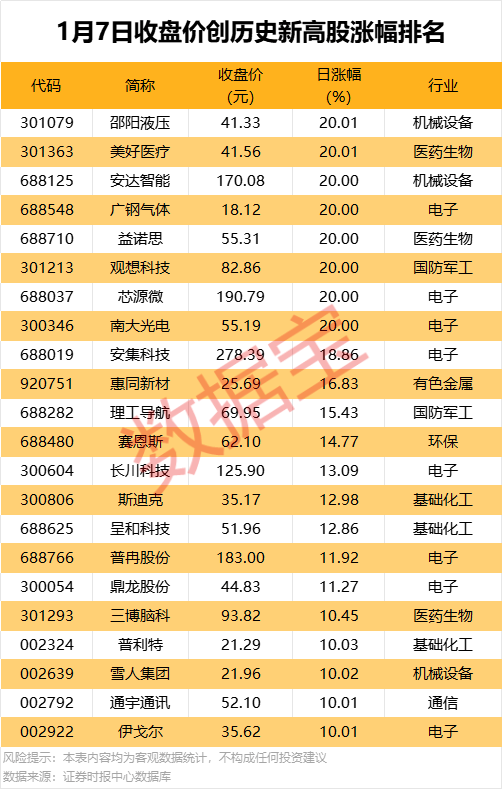
Market Overview - The three major A-share indices experienced a slight increase on January 7, with total trading volume in the Shanghai and Shenzhen markets reaching 2.88 trillion yuan, an increase of over 49 billion yuan compared to the previous day [1] - More than 2,100 stocks closed higher, with notable gains in sectors such as storage chips, state-owned capital holdings, and advanced packaging [1] Historical Highs - A total of 99 stocks reached their historical closing highs, excluding newly listed stocks from the past year. The electronics, machinery equipment, and non-ferrous metals sectors had the highest concentration of stocks hitting new highs, with 27, 13, and 11 stocks respectively [1] - The average increase for stocks that reached historical highs was 7.25%, with stocks like Shaoyang Hydraulic, Meihua Medical, and Nanda Optoelectronics hitting the daily limit [1] Top Gainers - The top gainers among stocks that reached historical highs included: - Shaoyang Hydraulic (41.33 yuan, +20.01%) - Meihua Medical (41.56 yuan, +20.01%) - Andar Intelligent (170.08 yuan, +20.00%) - Nanda Optoelectronics (55.19 yuan, +20.00%) [2] Institutional Activity - In the market, 17 stocks were net bought by institutions, with five stocks seeing net purchases exceeding 1 billion yuan. Notably, Sanbo Brain Science and Shunhao Co. received over 2 billion yuan in net purchases [2] - Conversely, Jin Feng Technology faced the highest net sell-off by institutions, amounting to over 400 million yuan, followed by Meihua Medical and Chip Source Micro with net sells of 371 million yuan and 241 million yuan respectively [3] Northbound Capital Flow - Northbound funds saw net purchases in 14 stocks, with Nanda Optoelectronics, Sanbo Brain Science, and Lei Ke Defense leading with amounts exceeding 1 billion yuan [4] - On the sell side, Jin Feng Technology topped the list with a net sell amount of 92.58 million yuan, followed by Yunhan Chip City and Shunhao Co. with net sells exceeding 40 million yuan [5] Company Announcements - Zhongke Lanyun (688332) projected a net profit increase of 366.51% to 376.51% for 2025, driven by significant growth in the fair value of investments in Moer Thread and Muxi Co. [7] - Su Meida plans to acquire a 16.92% stake in Blue Science High-Tech to achieve control [7] - Baomo Co. is planning a change in control by its actual controller [7] - Puli Te's LCP film products are suitable for use as flexible electrode materials in brain-computer interfaces [7] - Chuanjin Nuo expects a net profit increase of 144.24% to 172.64% for 2025 [7]




多家A股公司,预计盈利翻倍增长
证券时报· 2026-01-07 15:39
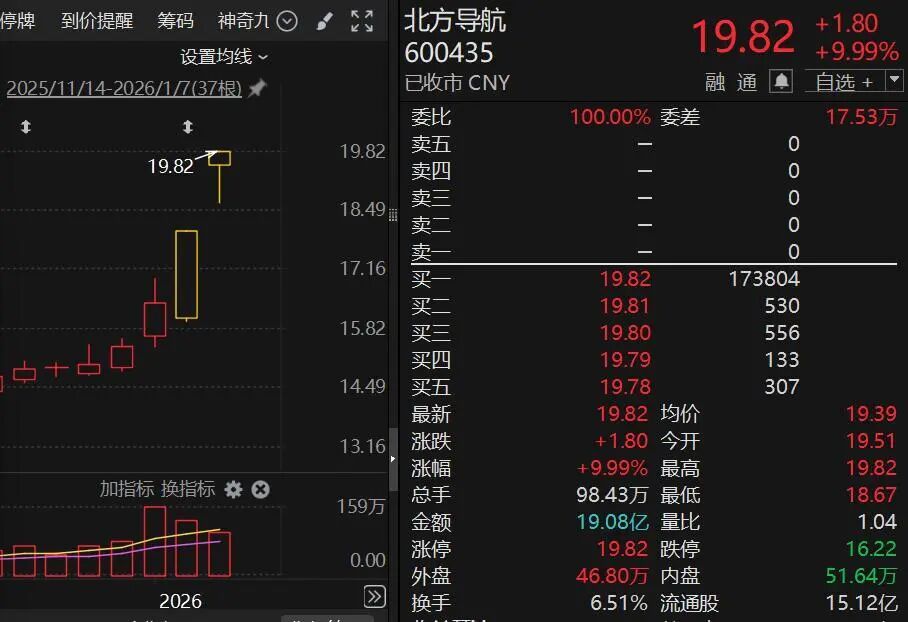
Core Viewpoint - The article highlights the significant profit growth of several A-share listed companies in their 2025 performance forecasts, indicating a positive trend across various industries, including military, pharmaceuticals, and technology [3][4]. Group 1: Company Performance - Northern Navigation expects a net profit of CNY 110 million to CNY 140 million for 2025, representing a year-on-year increase of 86.32% to 137.14% from CNY 59.04 million [5]. - The company reported a non-recurring net profit of CNY 89 million to CNY 119 million, with a year-on-year growth of 121.10% to 195.63% [5]. - Northern Navigation's revenue for the first three quarters of 2025 reached CNY 2.468 billion, with a net profit of CNY 125 million, laying a solid foundation for annual performance growth [5]. Group 2: Industry Trends - Multiple A-share companies have disclosed profit growth forecasts, with Zhongtai Co. leading with a median year-on-year increase of 677.22% [6]. - Other companies like Chuanhua Zhili and Bai'ao Saitu expect median year-on-year increases of 308.82% and 303.57%, respectively [6]. - The performance growth is primarily concentrated in sectors such as machinery, public utilities, and steel, driven by steady industry demand and internal improvements in product structure and operational efficiency [7]. Group 3: Market Reactions - Northern Navigation's stock price has seen significant increases, with a cumulative rise of over 45% since mid-December 2025, reflecting positive market sentiment [5]. - The company issued a clarification regarding its involvement in the commercial aerospace sector, stating it has no related business or orders, despite market speculation [6]. Group 4: Growth Drivers - Different industries exhibit unique growth drivers; for instance, Ding Tai High-Tech benefits from surging demand for servers and data centers, while Zhongcai Technology sees growth from optimized product structures and increased sales of wind turbine blades [7]. - Companies like Whirlpool and Huayou Cobalt have also reported profit growth due to increased orders and advantages from industrial integration [7].


“牛股”迎利好,多家A股公司,预计盈利翻倍增长
Zheng Quan Shi Bao· 2026-01-07 14:18
Core Viewpoint - The A-share listed companies are showing significant profit growth in their 2025 performance forecasts, with notable contributions from sectors such as military, pharmaceuticals, and commercial aerospace [1][3]. Group 1: Company Performance - Northern Navigation expects a net profit of CNY 110 million to CNY 140 million for 2025, representing a year-on-year increase of 86.32% to 137.14% from CNY 59.0374 million [1]. - The non-recurring net profit for Northern Navigation is projected to be CNY 89 million to CNY 119 million, with a year-on-year growth of 121.10% to 195.63% [1]. - Kangchen Pharmaceutical anticipates a net profit of CNY 145 million to CNY 175 million for 2025, a substantial increase of 243% to 315% from CNY 42.22 million [2][3]. - The non-recurring net profit for Kangchen Pharmaceutical is expected to rise by 350% to 447%, reaching CNY 140 million to CNY 170 million [2]. Group 2: Industry Trends - The commercial aerospace sector has been active, with Northern Navigation's stock price increasing over 45% since mid-December 2025 [1]. - Other companies, such as Zhongtai Co., expect a median year-on-year net profit increase of 677.22%, leading among disclosed forecasts [3]. - Industries such as machinery, public utilities, and steel are seeing significant profit growth, driven by steady demand expansion and internal improvements in product structure and operational efficiency [3].
【财闻联播】11000亿元!央行,明日操作!市场监管总局:CCC认证模式将调整
券商中国· 2026-01-07 12:19
★ 宏观动态 ★ 央行:明日开展11000亿元买断式逆回购操作 央行公告,为保持银行体系流动性充裕,2026年1月8日,中国人民银行将以固定数量、利率招标、多重价位中 标方式开展11000亿元买断式逆回购操作,期限为3个月(90天)。 国家外汇局:截至2025年12月末我国外汇储备规模为33579亿美元 国家外汇管理局统计数据显示,截至2025年12月末,我国外汇储备规模为33579亿美元,较11月末上升115亿美 元,升幅为0.34%。 2025年12月,受主要经济体货币政策、宏观经济数据等因素影响,美元指数下跌,全球金 融资产价格涨跌互现。汇率折算和资产价格变化等因素综合作用,当月外汇储备规模上升。我国不断巩固拓展 经济稳中向好势头,经济长期向好的支撑条件和基本趋势没有改变,有利于外汇储备规模保持基本稳定。 工信部:到2028年推动不少于5万家企业实施新型工业网络改造升级 工信部印发《工业互联网和人工智能融合赋能行动方案》。目标到2028年,工业互联网与人工智能融合赋能水 平显著提升。满足人工智能工业应用高通量、低时延、高可靠、低抖动通信需求的新型工业网络规模持续扩 大,在原材料、装备制造、消费品、电子信 ...
医药制造行业2026年度信用风险展望(2025年12月)
Lian He Zi Xin· 2026-01-07 11:29
Investment Rating - The report indicates that the overall credit risk of the pharmaceutical manufacturing industry is controllable, with stable operating performance expected in 2026 [5][6][11]. Core Insights - The pharmaceutical manufacturing industry has shown a slight increase in the number of enterprises, with a deepening degree of differentiation within the industry. Revenue and total profit have remained stable year-on-year due to a stabilizing policy environment [6][11]. - The "14th Five-Year Plan" supports the development of innovative drugs, with the scale of license-out exceeding the total for 2024 in the first three quarters of 2025, indicating a positive outlook for innovative drug development [6][11]. - The industry has maintained net inflows in bond market financing, with overall debt pressure being manageable despite a significant amount of bonds maturing within one year [6][11]. Industry Fundamentals Industry Policy - The pharmaceutical industry is highly sensitive to policy changes, with a "three medical linkage" policy framework encouraging innovation, improving medical services, and optimizing medical insurance payments. The "14th Five-Year Plan" emphasizes the strategic importance of the biomanufacturing industry [7][8]. - Recent policies have focused on cost control in medical insurance, reforming payment methods, and promoting the development of generic drugs and innovative medicines [7][8]. Industry Operating Conditions - As of the end of 2024, the number of pharmaceutical manufacturing enterprises in China reached 9,793, with a slight increase in the number of loss-making enterprises, indicating a growing differentiation within the industry [12][11]. - The basic medical insurance fund's income and expenditure structure has improved, with significant cost control effects observed [11][12]. Financial Performance Growth Metrics - In 2024, the pharmaceutical manufacturing industry reported total revenue of 25,298.5 billion yuan and total profit of 3,420.7 billion yuan, with minor fluctuations expected in 2025 [22][23]. - For the first three quarters of 2025, total revenue was 18,211.4 billion yuan, a decrease of 2.00% year-on-year, while total profit was 2,534.8 billion yuan, down 0.70% [22][23]. Profitability - The gross profit margin for the pharmaceutical manufacturing industry has shown a declining trend, with the sales expense ratio remaining stable and the management expense ratio slightly decreasing [24][25]. - The net cash flow from operating activities has been declining, indicating potential liquidity risks [24][25]. Leverage and Solvency - The leverage level in the pharmaceutical manufacturing industry remains low, with a slight fluctuation observed in recent years. The debt-to-asset ratio has been stable, and the overall solvency indicators are at a high level [30][31]. - As of September 2025, the liquidity ratios have slightly improved, indicating a manageable debt repayment risk [31][32]. Bond Market Performance Issuance Overview - In 2025, the pharmaceutical manufacturing industry experienced a net inflow in bond market financing, with a total of 104 bonds issued amounting to 713.80 billion yuan [39][41]. - The industry has seen a concentration of bond issuers at the AA+ level, with a significant number of private enterprises involved [39][41].
港股收盘 | 恒指收跌0.94% 科网股全天承压 医药、镍业股等走强
Zhi Tong Cai Jing· 2026-01-07 09:03
Market Overview - The Hong Kong stock market experienced a downward trend, with the Hang Seng Index closing down 0.94% at 26,458.95 points and a total turnover of HKD 2,761.34 million [1] - The Hang Seng China Enterprises Index fell by 1.14% to 9,138.75 points, while the Hang Seng Tech Index decreased by 1.49% to 5,738.52 points [1] - Zheshang International noted that the fundamentals of the Hong Kong market remain weak, with a decline in the funding environment, while Goldman Sachs maintains an "overweight" rating on Chinese A-shares and H-shares, citing attractive risk-reward ratios [1] Blue Chip Performance - WuXi Biologics (02269) led blue-chip stocks, rising 5.92% to HKD 36.12, contributing 11.87 points to the Hang Seng Index [2] - Other notable blue-chip performers included Innovent Biologics (01801) up 5.38% and WuXi AppTec (02359) up 4.91%, while Alibaba (09988) fell 3.25%, dragging the index down by 65.17 points [2] Sector Highlights Pharmaceutical Sector - The pharmaceutical sector continued its upward trend, with notable gains from Rongchang Biologics (09995) up 12.93% and Tigermed (03347) up 8.88% [3] - The National Medical Products Administration reported that 76 innovative drugs are expected to be approved by 2025, significantly surpassing the 48 approved in 2024, with a total transaction value exceeding USD 130 billion [4] Nickel Sector - Nickel stocks showed strong performance, with Xinjiang Xinxin Mining (03833) rising 12.28% and Zhongwei New Materials (02579) up 10% [4] - Nickel prices surged over 20% in the past two weeks, driven by supply constraints from Indonesia, which plans to reduce nickel mining quotas by 2026 [4] Paper Sector - Paper stocks saw significant gains, with Nine Dragons Paper (02689) up 8.97% and Lee & Man Paper (02314) up 6.92% [5] - Several paper companies announced price increases, indicating a reduction in production pressure and a more favorable market environment [5] Coal Sector - Coal stocks generally rose, with Shougang Resources (00639) up 5.98% and China Qinfa (00866) up 5.92% [6] - The Dalian Commodity Exchange saw a surge in coal futures, and analysts expect improvements in supply-demand dynamics for the coal industry [6] Optical Communication Sector - Optical communication stocks rebounded, with Yangtze Optical Fibre (06869) rising 6.75% [6] - The sector was buoyed by strong performances in the U.S. market, particularly from Lumentum and Coherent [7] Notable Stocks - Yadea Group (01585) announced a profit increase, leading to a 4.63% rise in its stock price [8] - Jinli Permanent Magnet (300748) was active, rising 3.65% amid news of potential export restrictions on rare earth materials to Japan [9] - Jitu Express (01519) reached a new high, with a 3.39% increase, reporting significant growth in package volume [10] - GF Securities (01776) faced pressure, dropping 4.09% after announcing a share placement and convertible bond issuance to raise funds for international business development [11]

东阳光股价涨5.08%,华夏基金旗下1只基金重仓,持有557.2万股浮盈赚取690.93万元
Xin Lang Cai Jing· 2026-01-07 05:22
Group 1 - The core point of the news is that Dongyangguang's stock price increased by 5.08% to 25.65 CNY per share, with a trading volume of 1.251 billion CNY and a turnover rate of 1.67%, resulting in a total market capitalization of 77.195 billion CNY [1] - Dongyangguang Technology Holdings Co., Ltd. is located in Dongguan, Guangdong Province, and was established on October 24, 1996, with its listing date on September 17, 1993. The company operates in four main business segments: electronic new materials, alloy materials, chemical products, and pharmaceutical manufacturing [1] - The revenue composition of Dongyangguang's main business includes high-end aluminum foil at 40.81%, chemical new materials at 27.63%, electronic components at 25.40%, and other categories at 5.16% [1] Group 2 - From the perspective of fund holdings, one fund under Huaxia Fund has a significant position in Dongyangguang. Huaxia Excellent Growth Mixed A (024928) held 5.572 million shares in the third quarter, accounting for 4.36% of the fund's net value, making it the sixth-largest holding [2] - The estimated floating profit from Huaxia Excellent Growth Mixed A on the current day is approximately 6.9093 million CNY [2] - The fund manager of Huaxia Excellent Growth Mixed A is Zhong Shuai, who has been in the position for 5 years and 165 days, with the fund's total asset size at 13.26 billion CNY and a best return of 185.99% during his tenure [3]

渤海证券研究所晨会纪要(2026.01.07)-20260107
BOHAI SECURITIES· 2026-01-07 02:15
Fixed Income Research - The core viewpoint indicates a divergence in the issuance guidance rates for credit bonds, with medium to high ratings increasing and low ratings decreasing, resulting in an overall change of -6BP to 4BP [2] - In December, the issuance scale of credit bonds decreased month-on-month, with only short-term financing bonds seeing an increase; net financing for credit bonds decreased while company bonds saw an increase [2] - The secondary market saw an increase in transaction volume for credit bonds in December, with yields showing low volatility; the overall credit spread widened, with most varieties at historical low levels [2] - The report suggests that the supply shortage and strong demand for allocation will continue to drive a recovery in credit bonds, with a long-term downward trend in yields expected [2] - The report emphasizes the importance of adjusting strategies in response to market fluctuations and highlights the need to focus on the trends in interest rate bonds while considering the value of individual bonds [2] Financial Engineering Research - The report notes that all major indices rose, with the margin balance continuing to increase, indicating a recovery in valuations and trading opportunities [4] - For the week of December 24-30, all major A-share indices increased, with the CSI 500 showing the largest rise of 2.79% [5] - The margin balance in the two markets reached 25,472.93 billion yuan, an increase of 236.17 billion yuan from the previous week, with the average daily number of investors participating in margin trading rising by 17.70% [5][6] Industry Research - Pharmaceutical and Biological Industry - The report highlights the ongoing trend in the innovative drug industry, with significant developments in regulatory frameworks and a notable increase in the number of approved innovative drugs [12] - In November, the medical care CPI was 101.6, showing a year-on-year increase of 1.6%, while the pharmaceutical manufacturing PPI was 96.1, down 3.9% year-on-year [12] - The report indicates that the innovative drug industry in China is expected to continue its long-term growth trajectory, with a focus on strategic developments in related sectors [12][13] Industry Research - Metals Industry - The report outlines that the steel industry is expected to continue facing weak demand in January 2026, with prices likely to remain low [16] - For copper, the supply is expected to be sufficient, but high prices may suppress downstream demand, leading to a phase of high price fluctuations [16] - The report suggests that the aluminum industry may see improved profitability due to low prices of alumina and strong demand from sectors like new energy vehicles [18] - The report emphasizes the strategic value of rare earth resources and suggests that the industry is poised for future growth, particularly in new energy and robotics sectors [20]
浙江医药股份有限公司关于2025年限制性股票激励计划授予结果的公告
Shang Hai Zheng Quan Bao· 2026-01-06 18:42
Core Viewpoint - Zhejiang Medicine Co., Ltd. has completed the grant registration of its 2025 Restricted Stock Incentive Plan, awarding 10.284 million shares of restricted stock to 865 participants at a price of 7.30 yuan per share [2][4][6]. Grant Details - Grant Date: November 26, 2025 [3] - Total Shares Granted: 10.244 million shares [4] - Number of Participants: 865, including directors, senior management, and key employees [5] - Grant Price: 7.30 yuan per share [6] - Source of Shares: Shares repurchased from the secondary market [7] Changes in Grant Numbers - The actual number of shares granted decreased from 10.284 million to 10.244 million due to 10 participants voluntarily waiving their rights to a total of 40,000 shares [8]. Registration and Lock-up Period - Registration Date for Restricted Shares: January 5, 2026 [10] - Lock-up Period: 12 months and 24 months for different tranches of shares [11] Performance Assessment - The performance assessment for unlocking the restricted shares will be based on company-level and individual-level evaluations over the 2026-2027 accounting years [12][15]. - Company-level assessments will be categorized into three tiers (A, B, C) based on various business segments [13]. Financial Impact - The funds raised from this incentive plan will be used to supplement the company's working capital [7]. - The accounting costs associated with the restricted stock will be recognized over the vesting period, with potential impacts on the company's financial results [18].

新疆百花村医药集团股份有限公司关于终止筹划控制权变更事项暨复牌的公告
Shang Hai Zheng Quan Bao· 2026-01-06 17:49
证券代码:600721 证券简称:百花医药(维权) 公告编号:2026-001 新疆百花村医药集团股份有限公司 关于终止筹划控制权变更事项暨复牌的公告 本公司董事会及全体董事保证本公告内容不存在任何虚假记载、误导性陈述或者重大遗漏,并对其内容 的真实性、准确性和完整性承担法律责任。 重要内容提示: ● 证券停复牌情况:适用 因新疆百花村医药集团股份有限公司(以下简称"百花医药"或"公司")控股股东、实际控制人米在齐先 生、米恩华先生、杨小玲女士终止筹划本次控制权变更事项,本公司的相关证券停复牌情况如下: 登录新浪财经APP 搜索【信披】查看更多考评等级 由于公司控股股东、实际控制人与交易对方未就控制权变更相关重大事项达成一致意见,本着审慎的原 则,决定终止本次控制权变更事项。 公司目前各项经营情况正常,终止筹划控制权变更事项不会对公司经营业绩和财务状况产生重大不利影 响。 三、复牌安排 ■ 一、停牌情况概述 因公司控股股东、实际控制人米在齐先生、米恩华先生、杨小玲女士正在筹划公司股份协议转让事宜, 该事项可能导致公司控制权发生变更。鉴于该事项正在洽谈当中,尚存在不确定性,为保证公平信息披 露,维护投资者利益, ...
