调味品

Search documents
一瓶辣酱的逆袭:老干妈“四不原则”背后的创业逻辑
Sou Hu Cai Jing· 2026-01-18 13:11
货架上那瓶熟悉的红色辣酱,在经历了接班人风波和业绩下滑后,2024年营收重回53.91亿元,距离历 史峰值仅一步之遥。 在贵阳南明老干妈风味食品有限责任公司的一次内部会议上,72岁的陶华碧做出了一个令在场所有人心 疼的决定:销毁约500吨风味出现微小偏差的产品,价值上百万元。当时有员工惋惜地表示"一般消费者 根本尝不出来",但她坚定回应:"产品就是自己的作品,做食品要讲诚信,要对得起良心。" 这个决定成了老干妈命运的转折点。在她回归一线的短短三年间,老干妈从2019年营收低谷迅速反弹。 业绩回升 近期发布的《2025贵州企业100强》榜单显示,老干妈2024年营收达到53.91亿元,几乎追平了2020年 54.03亿元的历史峰值。 回看老干妈的发展历程,这一成绩来之不易。从2021年的42.01亿元到2024年的53.91亿元,老干妈用三 年时间完成了一场"触底反弹"。 这家起源于1996年的贵阳小作坊,凭借一瓶风味豆豉辣椒酱,长期占据着中国辣椒酱市场约20%的份 额,稳居行业第一。即使在海外,老干妈也成为了一种文化符号,产品销往全球160多个国家和地区。 换椒风波 老干妈的这次"触底反弹",源于2014年的 ...



【转|太平洋食饮-26年度策略】底部向阳,寻找结构性亮点
远峰电子· 2026-01-18 11:38
Overall Sector Review - The food and beverage sector significantly underperformed the market, with a year-to-date decline of -0.62%, lagging behind the Shanghai Composite Index by 15.0 percentage points [2] - The sector experienced a deep correction after an initial rebound driven by expectations of consumption recovery and supportive policies, but the actual recovery rate was lower than anticipated, leading to a consensus on weak domestic demand [2] Subsector Performance - The snack sector outperformed with a year-to-date increase of 28.88%, driven by channel expansion and a revenue growth rate of 30.97% in the first three quarters [4] - Soft drinks also showed resilience with a 10.11% stock price increase, benefiting from strong travel demand and low-cost, high-frequency consumption [4] - The restaurant chain sector saw a rebound with gains of approximately 10.34% and 10.29% for pre-processed and baked goods, respectively [4] - The liquor sector, particularly high-end liquor, faced challenges with weaker sales and declining prices, while beer performance was supported but affected by high-end market constraints [4] Investment Insights - The sector is under pressure from deflationary trends and a weak recovery, with consumer confidence remaining low, indicating a shift to a "new normal" of low growth [8] - High-end consumption has shown slight recovery due to stock market wealth effects, but sustainability remains a concern [9] - The food and beverage sector's valuation is at historical lows, with a current PE (TTM) of 21.9X, indicating potential investment opportunities in undervalued segments [12] Fund Holdings - As of Q3 2025, the food and beverage sector's fund holdings decreased to 6.38%, nearing levels seen in 2016, with the liquor segment comprising 5.52% of this [14] - Fund holdings in the liquor sector increased for certain subsectors, including white liquor and seasoning products, while others saw declines [16] Long-term Trends - The liquor industry is undergoing its longest adjustment period since 2003, with significant price corrections and a potential bottoming out of valuations [21] - The white liquor sector has underperformed the market with a year-to-date return of -4.87%, reflecting weak demand and a divergence from broader market trends [24] - The third quarter of 2025 saw a significant decline in revenue and net profit for the white liquor sector, indicating a deep adjustment phase [27] Pricing Dynamics - The white liquor market is experiencing a general decline in prices, particularly in high-end segments, while lower price segments show resilience [29] - The average price of high-end products like Moutai has dropped significantly, while mid-range and lower-range products have maintained stability or slight increases [31] Investment Recommendations - The white liquor sector is advised to focus on inventory reduction and demand recovery, with a preference for leading brands that can maintain pricing power and product stability [32]






食品饮料行业周度市场观察-20260118
Ai Rui Zi Xun· 2026-01-18 05:07
Investment Rating - The report does not explicitly provide an investment rating for the food and beverage industry Core Insights - The food and beverage industry is experiencing significant trends, including the rise of health-conscious products and innovative marketing strategies to attract younger consumers Industry Environment - Multiple condiment companies are accelerating their IPOs to tap into overseas markets amidst rising costs and intense competition, with the industry expected to reach a scale of 498.1 billion yuan by 2024 [2] - The popularity of turmeric drinks has surged among young consumers, driven by health benefits such as anti-inflammatory properties, with sales showing strong growth despite higher prices [2] - The emergence of health-focused tea shops in hospitals is attracting young consumers, integrating traditional Chinese medicine concepts into modern beverage offerings [6] - The upcycled food industry is gaining traction as a sustainable solution to food waste, with a projected global market size of 74.8 billion USD by 2029, driven by innovative technologies [6] - The health beverage market is booming, with consumers increasingly favoring low-sugar and natural products, reflecting a shift in consumer behavior towards healthier options [10] Top Brand News - The brand "Guozi Shule" is expanding its product line into electrolyte water after securing a top position in the no-sugar tea market, indicating a strategy of diversification and targeting younger demographics [16] - "Tai Er" is rebranding to focus on fresh ingredients and new dishes, responding to market changes and performance pressures, while maintaining its traditional offerings [16] - Danone's "Pulse" beverage is expected to reach nearly 7 billion yuan in revenue, highlighting the growth potential in the functional bottled water market [17] - "Haidilao" is diversifying into the seafood market with a new model that emphasizes fresh and affordable options, aiming to capture a growing segment of consumers [17] - The brand "Xiaoguan Tea" has successfully launched a new brewing method that caters to the "lazy economy" trend, simplifying tea preparation while maintaining quality [20]
“老醯”新变记
Xin Lang Cai Jing· 2026-01-18 04:04
Core Insights - The article emphasizes the transformation and upgrading of the Shanxi aged vinegar industry, particularly focusing on the "Qingxu Aged Vinegar" as a representative of regional characteristics and modernization efforts [1][2]. Industry Overview - The Shanxi aged vinegar industry is experiencing significant growth, with a projected production of 880,000 tons by 2025, accounting for 20% of national output and over 80% of provincial output, generating a value of 7.5 billion yuan [2]. - The industry is characterized by a high concentration of brands, with "Qingxu Aged Vinegar" synonymous with "Shanxi Aged Vinegar," reinforcing its reputation as "China's Vinegar Capital" [1]. Technological Advancements - The production process has evolved from manual to mechanized operations, significantly increasing efficiency, with one machine equating to the labor of 30 workers [3]. - Innovations include the development of an intelligent brewing system and a microbial strain library to enhance fermentation processes and product quality [3]. Environmental Sustainability - Companies are adopting green production methods, such as using natural gas and solar energy for steam systems, achieving a 99% utilization rate of steam networks [4]. - Full-process pipeline transportation ensures no grain is wasted, contributing to sustainability [4]. Market Expansion and Diversification - Companies are diversifying their product lines beyond traditional vinegar, entering health food and seasoning markets, with products like functional vinegars targeting health benefits [7]. - The industry is also expanding into e-commerce, with significant sales growth through online platforms, exemplified by a company achieving nearly 1 billion yuan in sales within a year [10]. Consumer Engagement and Branding - Innovative marketing strategies are being employed, such as creating unique products like vinegar ice cream and collaborating with travel agencies to enhance brand visibility [6]. - The focus is shifting from merely selling vinegar to creating experiences and expanding the brand's influence in new markets [6][9]. Government Support - Local government initiatives are providing financial support and infrastructure development to bolster the vinegar industry, including the establishment of a provincial-level key professional town for aged vinegar [10].

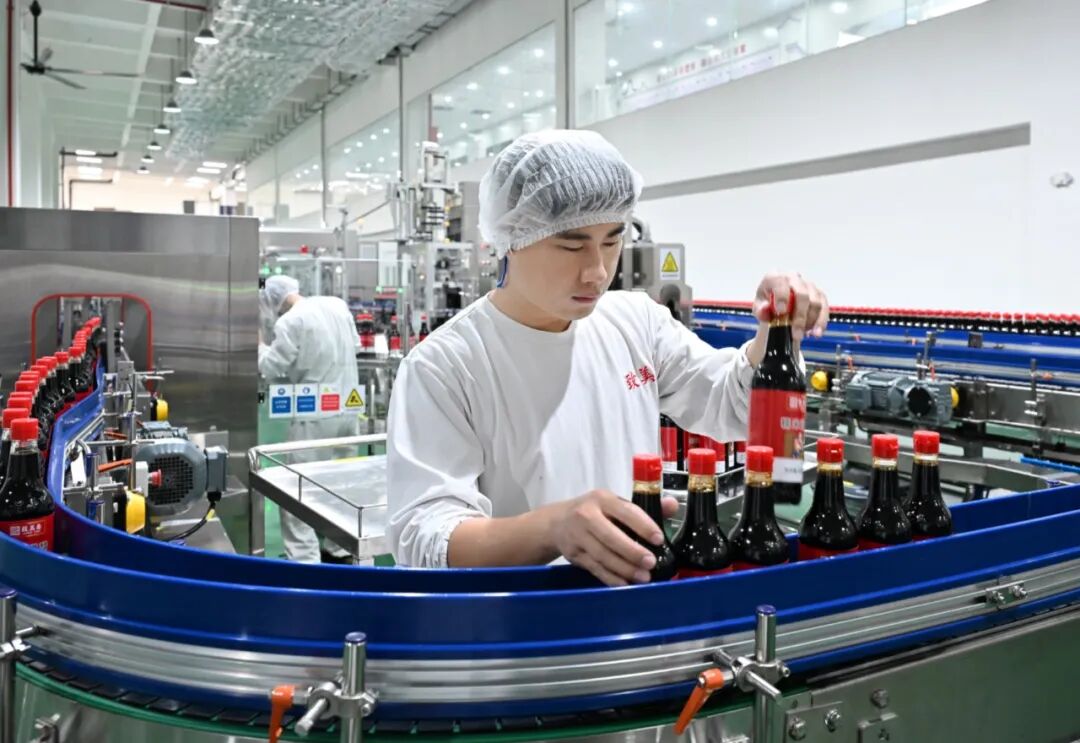
规划产能15万吨!致美斋阳西基地订单猛增
Xin Lang Cai Jing· 2026-01-18 04:04
Core Insights - The company is experiencing a surge in orders as the Spring Festival approaches, with its automated production lines operating at full capacity to meet demand [1][3] - The company has implemented a full-chain quality traceability system, allowing for product tracing within two hours, and has established an emergency response team for quality issues [3] - The company is focusing on high-end product lines, with a significant increase in demand for traditional brewed soy sauce and premium oyster sauce, and a 40% year-on-year increase in orders from e-commerce and new retail channels [3][5] Production Capacity and Investment - The company's production base in Yangxi covers approximately 300 acres with a total planned investment of 2 billion yuan, and the first phase of the project is set to be operational by the end of December 2024 [5] - The company aims to double its revenue by 2026 while continuing to expand into the mid-to-high-end market [5] Technological and Environmental Initiatives - The company is collaborating with a team led by an academician from the Chinese Academy of Engineering to establish a flavor innovation research institute focused on high-quality seafood condiments [5] - The company is upgrading its fermentation process automation and implementing a digital management system from raw materials to finished products [5] - A photovoltaic system has been installed in the factory to enhance energy efficiency, with an annual reduction of 1,500 tons of standard coal [5]
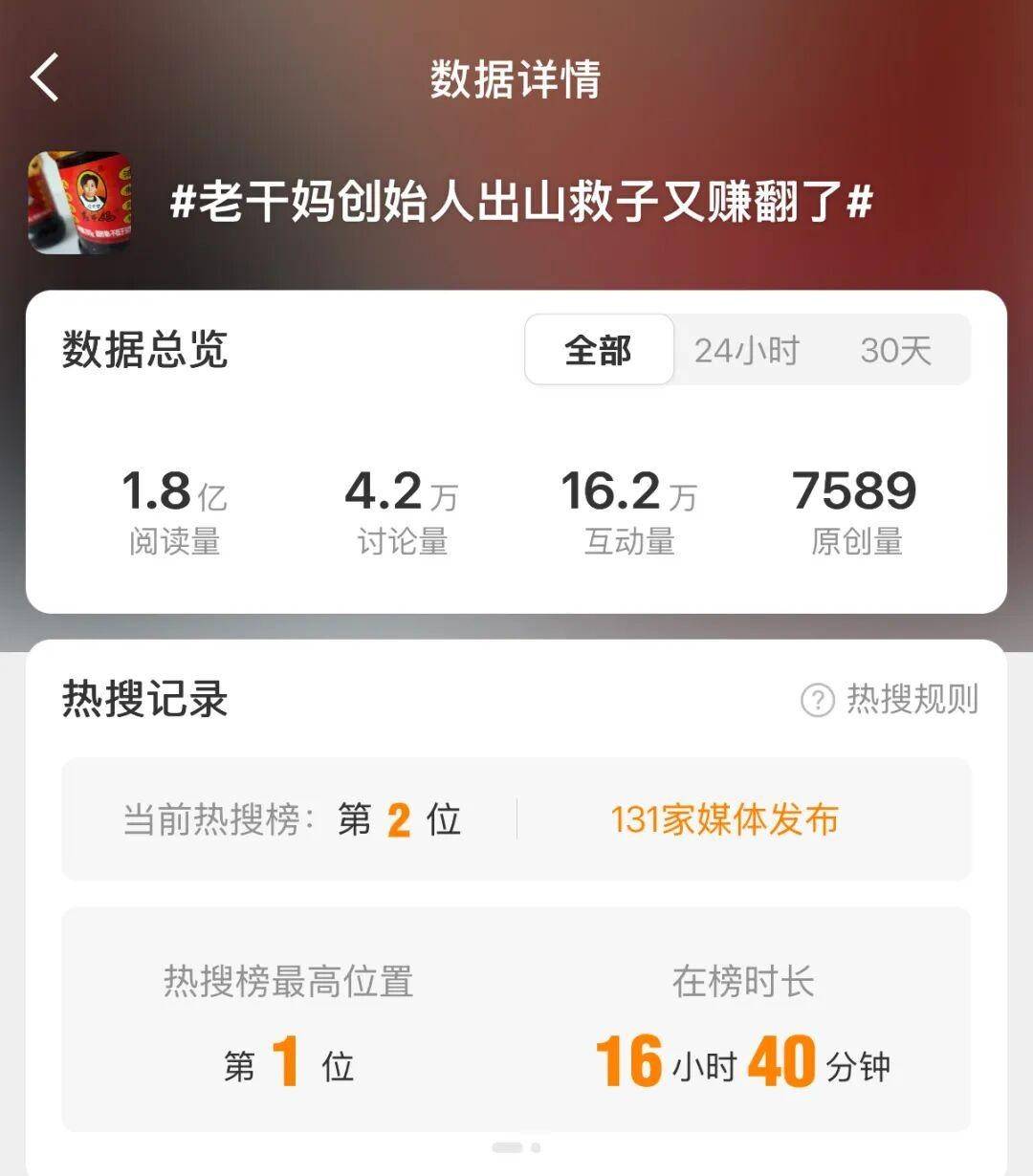
老干妈差点被搞垮?陶碧华出山“救子”,一年狂卖53亿,重回巅峰
Sou Hu Cai Jing· 2026-01-17 22:17
Core Insights - The article highlights the remarkable recovery of Lao Gan Ma, achieving a sales figure of 5.391 billion yuan in 2024, just 12 million yuan short of its historical peak in 2020 [1] - The brand's resurgence is attributed to the founder, Tao Huabi, who employed unconventional strategies to navigate the competitive landscape of the chili sauce market [2] Company Performance - Lao Gan Ma holds approximately 20% market share in the domestic chili sauce market, maintaining its position as the industry leader, with competitors' combined market share barely matching it [3] - The brand's revenue had previously declined from 4.5 billion yuan in 2016 to 4.2 billion yuan in 2021, facing significant challenges from emerging brands [5] Leadership and Management Changes - In 2014, Tao Huabi stepped back from daily operations, handing control to her sons, which led to a series of mismanagement issues that undermined the brand's foundation [5][7] - The new management's cost-cutting measures, including substituting core ingredients with cheaper alternatives, resulted in a loss of product quality and consumer trust [7][9] Recovery Strategies - In 2019, Tao Huabi returned to the forefront, prioritizing product quality by reinstating original core ingredients despite increased costs [12] - The brand's marketing strategy diverged from industry trends, as Tao disbanded the live-streaming team and focused on enhancing offline distribution channels [14][16] - Lao Gan Ma expanded its presence to over 160 countries, achieving a 30% increase in overseas revenue in 2023, with significant growth in export figures in early 2024 [16] Financial Strategy - The company adheres to a conservative financial strategy of not taking loans, not seeking external financing, and not going public, allowing it to focus on quality improvements during downturns [18] Future Challenges - Despite the current success, concerns remain regarding the succession of leadership as Tao Huabi approaches her 80s, with the ability of her sons to uphold her business philosophy and quality standards being crucial for the brand's long-term sustainability [20] Conclusion - Lao Gan Ma's journey serves as a lesson for entrepreneurs, emphasizing the importance of focusing on product quality and maintaining core business principles in a rapidly changing market environment [21]
老干妈,还得靠老妈
凤凰网财经· 2026-01-17 13:00
Core Viewpoint - Lao Gan Ma, once thought to be declining, has achieved a sales revenue of 5.391 billion yuan in 2024, nearing its historical peak, amidst fierce competition and changing consumer preferences [4][36]. Group 1: Company Background - Founded by Tao Huabi, Lao Gan Ma has evolved from a roadside condiment stall to a globally recognized brand, reaching tables in 160 countries and regions over thirty years [5]. - The brand's success is attributed to a commitment to quality, with strict standards for ingredient selection and production processes [12][13]. Group 2: Leadership Transition and Challenges - In 2014, Tao Huabi transferred her last 1% stake to her younger son, Li Miaoxing, while she stepped back from daily operations, leading to a decline in product quality and customer dissatisfaction [15][16]. - The company faced a significant drop in revenue from 45.49 billion yuan to 43.89 billion yuan between 2016 and 2018 due to changes in production practices [16]. - In 2019, Tao Huabi returned to oversee production, reinstating the original quality standards, which resulted in a revenue recovery to over 50 billion yuan [17][36]. Group 3: Market Dynamics - The external market is evolving, with younger consumers favoring healthier, low-fat options, challenging Lao Gan Ma's traditional high-oil products [24]. - New competitors are leveraging innovative distribution channels and online marketing strategies, contrasting with Lao Gan Ma's traditional approach [25][28]. - Despite these challenges, Lao Gan Ma maintains a strong market presence, with a focus on quality and a limited product range, which has created a significant competitive barrier [30][34]. Group 4: Future Considerations - The company's future hinges on its ability to transition from a founder-led model to a sustainable corporate governance structure, as reliance on Tao Huabi's personal authority poses risks [37][40]. - The success of the next generation in upholding the brand's values and adapting to market changes will be crucial for Lao Gan Ma's long-term viability [40][41].

颐海国际(01579):颐海国际跟踪报告:关联方企稳,2B、海外延续较快成长
GUOTAI HAITONG SECURITIES· 2026-01-17 11:20
Investment Rating - The investment rating for the company is "Accumulate" [2][6]. Core Insights - The report highlights the return of the founder of Haidilao, which is expected to stabilize the related party business and continue rapid growth in the third-party business [3]. - The company anticipates that the related party business will recover in the second half of 2025, driven by improvements in Haidilao's operations and pricing adjustments [10]. - The overseas and B2B businesses are projected to drive the third-party business's growth, with overseas revenue expected to reach 266 million RMB in the first half of 2025, reflecting a year-on-year increase of 34.43% [10]. Financial Summary - Total revenue is projected to grow from 6,147.57 million RMB in 2023 to 8,118.23 million RMB by 2027, with a compound annual growth rate (CAGR) of approximately 8.99% [4]. - Net profit is expected to decrease from 852.70 million RMB in 2023 to 739.43 million RMB in 2024, before recovering to 962.06 million RMB by 2027 [4]. - The company’s price-to-earnings (PE) ratio is projected to decrease from 13.04 in 2023 to 14.60 in 2027, indicating a potential increase in valuation [4]. Business Performance - The related party business is expected to stabilize, with a low profit margin of around 13% in the first half of 2025, suggesting limited room for further decline [10]. - The overseas business is anticipated to maintain rapid growth, supported by the ramp-up of production capacity in Thailand and enhanced local supply chain capabilities [10]. - The B2B segment is expected to continue its rapid growth due to brand and cost advantages, as well as the establishment of a professional B2B team [10].
加加食品4年亏损6亿元 “无主”状态亟待破局
Zhong Guo Jing Ying Bao· 2026-01-16 20:15
Core Viewpoint - 加加食品 is currently facing significant operational challenges, including a lack of control and governance, resulting in substantial financial losses and a deteriorating market position [3][6][11]. Financial Performance - From 2021 to 2024, 加加食品 incurred cumulative losses of nearly 600 million yuan, with specific annual losses of 80.16 million yuan in 2021, 79.59 million yuan in 2022, 191 million yuan in 2023, and 243 million yuan in 2024 [5]. - In the first half of 2025, the company reported a net profit of 8.35 million yuan, a year-on-year increase of 128.64%, but still faced a net loss of 26.38 million yuan in the first three quarters [5]. Ownership and Control - As of January 2026, 中国东方 holds 23.42% of 加加食品's total shares, becoming the largest shareholder, while the original controlling family, 杨振's family, has been significantly impacted by personal debt issues [3][5]. - The company is currently in a "no owner" state due to the bankruptcy proceedings of 湖南卓越, which previously held a significant stake [6]. Market Position and Competition - 加加食品, once a leading player in the soy sauce market, has seen its market presence diminish, with major competitors like 海天 and 李锦记 dominating the market [11]. - The soy sauce market is highly concentrated, with the top five companies holding a combined market share of 77.48% [11]. Strategic Recommendations - To regain market confidence and improve operational efficiency, 加加食品 should focus on enhancing its core soy sauce products, particularly through health-oriented innovations like reduced-salt options [12]. - The company is advised to leverage its existing production capabilities and brand recognition while exploring new distribution channels, including online platforms and community markets [12].

股市进入冲刺阶段了?
集思录· 2026-01-16 14:14
Market Overview - The current market is characterized by a structural bull market rather than a comprehensive bull market, with significant disparities among stocks [2][4] - The market capacity has expanded, making it unlikely to see a comprehensive bull market like the one from 2019 to 2021, where the China Securities 500 index had a price-to-book (PB) ratio of less than 2.2 and a price-to-earnings (PE) ratio of around 20 [2] Stock Valuation - Currently, the PB ratio of the China Securities 500 index is approximately 2.6, and the PE ratio is nearing 40, indicating a significant increase in valuations compared to previous years [2] - Core assets, particularly in the food and beverage sector, have seen their valuations drop from over 100 times earnings during the previous bull market to around 30 times for companies like Haitian Flavoring and Food [2] Market Sentiment - There is a sense of caution among investors, with some expressing that even in a bull market, certain stocks may not yield profits and could incur losses [3] - The sentiment reflects a belief that while a comprehensive market crash is unlikely, structural downturns in specific sectors could occur [4] Investment Strategies - Investors are advised to adopt a long-term perspective, particularly during prolonged bear markets, as these periods can provide opportunities to accumulate quality assets at lower prices [11] - The strategy of holding onto stocks acquired at low prices during bear markets can lead to significant returns when the next bull market arrives, as investors can benefit from dividends and capital appreciation without the pressure of high entry costs [11] Future Outlook - Some analysts predict that the market may experience adjustments in the short term but remain optimistic about long-term growth, with potential targets for indices like the CSI 300 reaching above 6200 points before significant sell-offs occur [8] - The overall sentiment suggests that the current market phase is just the beginning, with further upward movements anticipated before any major risks are considered [9]